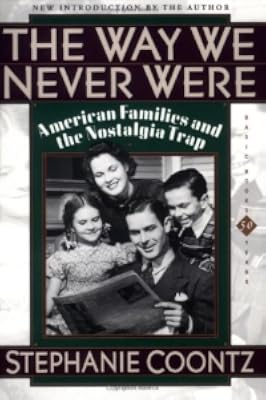
The Way We Never Were: American Families and the Nostalgia Trap
by Stephanie Coontz
On This Page
Description
The definitive edition of the classic, myth-shattering history of the American familyLeave It to Beaver was not a documentary, a man's home has never been his castle, the "male breadwinner marriage" is the least traditional family in history, and rape and sexual assault were far higher in the 1970s than they are today. In The Way We Never Were, acclaimed historian Stephanie Coontz examines two centuries of the American family, sweeping away misconceptions about the past that cloud current show more debates about domestic life. The 1950s do not present a workable model of how to conduct our personal lives today, Coontz argues, and neither does any other era from our cultural past. This revised edition includes a new introduction and epilogue, exploring how the clash between growing gender equality and rising economic inequality is reshaping family life, marriage, and male-female relationships in our modern era.
More relevant than ever, The Way We Never Were is a potent corrective to dangerous nostalgia for an American tradition that never really existed. show less
Tags
Recommendations





Member Recommendations
Othemts A lot of politics and punditry are based on mythology of how America used to be better and how its so bad today. Read "The Way We Never Were" and "The Culture of Fear" to help the scales fall from your eyes and see the truth behind these myths.
20

Member Reviews
This book makes the case that maybe -- just maybe -- Ward and June had the odd argument when The Beaver wasn't looking. (Obviously, I'm oversimplifying, but that's the main idea. It's an extremely well-researched and thought-provoking book.)
Coontz presents the historical facts of American family life and political and economic movements in hopes of demonstrating that the families of the past were not so idyllic and the families of the present are not so dysfunctional as they are often portrayed. She argues that historical mythologizing about family life distracts us from constructively examining how best to serve families and communities. She points out that drug abuse was more widespread a hundred years ago, alcohol consumption was three times higher, and prostitution and serious sexually transmitted infections were more prevalent. The US has had the highest homicide rates in the industrial world for 150 years, and we had sadistic lynch mobs and teen murderers long before show more violent video games or gay people could be blamed. The 1950s was an extremely atypical economic period, with higher job security , more affordable housing, and less income inequality...but these were not due to 1950s family practices but rather the time's economic and political support systems for families. Families have rarely been economically or socially self-sufficient; families have relied upon governmental assistance from the frontier times and beyond. By correcting these sorts of historical distortions, Coontz frees us up to learn the actual lessons of the past: that children can thrive in a wide variety of caregiving arrangements, that racist and sexist assumptions harm our families and children, and that poverty and economic insecurity have a huge impact on personal and family dysfunction. Coontz ends her introduction with this:
I thought the book was well argued and drew upon a good variety of sources. She cites well and often. Truthfully, I want to own this book so I can return to it often. show less
"As long as our view of family change is refracted through the lens of nostalgia for the past, we will not be able to see a way forward. But by learning how complex and multifaceted the experience of family life has been in the past, along with the trade-offs, reversals, and diverse outcomes that have accompanied change, we may be able to develop a greater tolerance for the ambiguities of contemporary family life, rather than longing for a past that was never as idyllic or uncomplicated as we sometimes imagine...Only when we have a realistic idea of how families have and have not worked in the past can we make informed decisions about how to support families in the present and improve our future."
I thought the book was well argued and drew upon a good variety of sources. She cites well and often. Truthfully, I want to own this book so I can return to it often. show less
Finished The Way We Never Were: American Families and the Nostalgia Trap by Stephanie Coontz.
Debates about family values often revolve around the idea of the "normal" nuclear family. Mom, Dad, kids, Dad works, Mom stays home, Mom is fully focused on both her role as wife and role as mother, Grandma and Grandpa are always there to give help and advice, there is a strong work ethic, children are not exposed to sex or other adult concerns, men and women are chaste until marriage, everyone is content. One side claims that if we could just revive this model, all would be well. The other side claims that we can never go back to those days, and we have to work with the "modern" family. What both sides take for granted is that such families show more made up the historical norm.
Coontz sets out to show that the traditional nuclear family is neither particularly nuclear nor particularly traditional. Coontz's scholarly credentials make her well qualified to undertake such a task. She backs her claims with lots of data and does a good job of distinguishing strong claims from weaker claims. My summary will not be nearly so scholarly. =)
The idealized American family never existed at a large scale. The idealized family is a mishmash of historical realities. Our strongest memory of the ideal family comes from the 1950's. The family of this era perhaps came closest to being the ideal family, however, this family structure had some aspects that were not sustainable. For example, it was a historical norm during that period that conflicts between marital ties and kin networks, peer groups, or community ties would always be resolved in favor of marital ties. In fact, such extended networks were viewed with suspicion. As we are seeing now, the loss of community and larger networks has put families in a precarious position because they have much smaller networks to help them when things go wrong. It is my opinion that our current over dependence on the government to do things for us is partially due to the loss of larger kinship and community networks.
One recurring theme in the myths that Coontz disproves is that the idealized family (whether of the 1950's or the 1650's) was independent of outside intervention. As I mentioned already, families have always been dependent on extended networks. However, this dependence shows up in other ways. The most interesting one is that the standard nuclear family is, to some degree, a product of public intervention in private families. In the first part of the 20th century, it was common for public agencies to intervene in families that did not follow the nuclear norm. Of particular concern to these agencies were extended kin networks (because of their association with "un-American" immigrants). Children were often taken away from households that contained adults other than the parents (e.g., aunts and uncles). These agencies strongly believed that families should consist of a mother, a father, and children and that any deviance from that should be strongly discouraged.
I have only scratched the surface of Coontz's arguments (the book is ~290 pages of dense text and ~90 pages of notes). I recommend this book to anyone who has an interest in how family structures in the U.S. have changed over time. Coontz does not advocate an "anything goes" attitude with respect to families, but she clearly believes that our debates about families and family values are not based in facts. This book provides some of the missing facts. show less
Debates about family values often revolve around the idea of the "normal" nuclear family. Mom, Dad, kids, Dad works, Mom stays home, Mom is fully focused on both her role as wife and role as mother, Grandma and Grandpa are always there to give help and advice, there is a strong work ethic, children are not exposed to sex or other adult concerns, men and women are chaste until marriage, everyone is content. One side claims that if we could just revive this model, all would be well. The other side claims that we can never go back to those days, and we have to work with the "modern" family. What both sides take for granted is that such families show more made up the historical norm.
Coontz sets out to show that the traditional nuclear family is neither particularly nuclear nor particularly traditional. Coontz's scholarly credentials make her well qualified to undertake such a task. She backs her claims with lots of data and does a good job of distinguishing strong claims from weaker claims. My summary will not be nearly so scholarly. =)
The idealized American family never existed at a large scale. The idealized family is a mishmash of historical realities. Our strongest memory of the ideal family comes from the 1950's. The family of this era perhaps came closest to being the ideal family, however, this family structure had some aspects that were not sustainable. For example, it was a historical norm during that period that conflicts between marital ties and kin networks, peer groups, or community ties would always be resolved in favor of marital ties. In fact, such extended networks were viewed with suspicion. As we are seeing now, the loss of community and larger networks has put families in a precarious position because they have much smaller networks to help them when things go wrong. It is my opinion that our current over dependence on the government to do things for us is partially due to the loss of larger kinship and community networks.
One recurring theme in the myths that Coontz disproves is that the idealized family (whether of the 1950's or the 1650's) was independent of outside intervention. As I mentioned already, families have always been dependent on extended networks. However, this dependence shows up in other ways. The most interesting one is that the standard nuclear family is, to some degree, a product of public intervention in private families. In the first part of the 20th century, it was common for public agencies to intervene in families that did not follow the nuclear norm. Of particular concern to these agencies were extended kin networks (because of their association with "un-American" immigrants). Children were often taken away from households that contained adults other than the parents (e.g., aunts and uncles). These agencies strongly believed that families should consist of a mother, a father, and children and that any deviance from that should be strongly discouraged.
I have only scratched the surface of Coontz's arguments (the book is ~290 pages of dense text and ~90 pages of notes). I recommend this book to anyone who has an interest in how family structures in the U.S. have changed over time. Coontz does not advocate an "anything goes" attitude with respect to families, but she clearly believes that our debates about families and family values are not based in facts. This book provides some of the missing facts. show less
It's quite mind-blowing that this book was initially published in 1992 as it feels like nothing has really changed in over thirty years. The author has a 2016 prologue and epilogue updates with a few new numbers, but I think there is even more to be said where we are now as you can tell she didn't write the 2016 updates before Trump was first elected. The history here along with the references are incredible, and I want to dig in more when I can get the ebook in my hands as I only listened to the audiobook; it feels as though it should be required reading, and I'm glad to have heard of it as it was referenced recently at least twice in some reading and also perhaps a podcast.
We Americans have long cherished certain images of ourselves, many of which fall under the heading, "This is How Life Should Be Lived." The problem is not that these images don't exist outside the US--many have never really existed for us!
Here's just one example. "Always stand on your own two feet" (ie., the Horatio Alger-like reliance on self alone). The book cites Senator Phil Gramm, co-author of the Gramm-Rudman-Hollings amendment and famous for his opposition to "government handouts": Born to a father living on veterans disability pension, Gramm attended a publicly-funded university on a grant from the War Orphans Act. His graduate work was financed by the National Defense Education Act, and his first job was at a federal land-grant show more institution (Texas A&M University). His later work in slashing federal assistance programs for low-income Americans seems illogical to say the least--and, the book suggests, could only have met with success because of this national reverence for "standing on your own two feet."
Many aspects of our self-image as Americans are wonderful and true: Ours is a unique nation, borne of remarkable minds at a remarkable time in history, bringing admirable ideals into reality. This book suggests that we should keep our eyes open to creeping incursions into our self-image. Patriotic pride, justifiable though it may be, is a double-edged sword. "Know thyself," the Delphic Oracle said. This is as true today as it ever was. show less
Here's just one example. "Always stand on your own two feet" (ie., the Horatio Alger-like reliance on self alone). The book cites Senator Phil Gramm, co-author of the Gramm-Rudman-Hollings amendment and famous for his opposition to "government handouts": Born to a father living on veterans disability pension, Gramm attended a publicly-funded university on a grant from the War Orphans Act. His graduate work was financed by the National Defense Education Act, and his first job was at a federal land-grant show more institution (Texas A&M University). His later work in slashing federal assistance programs for low-income Americans seems illogical to say the least--and, the book suggests, could only have met with success because of this national reverence for "standing on your own two feet."
Many aspects of our self-image as Americans are wonderful and true: Ours is a unique nation, borne of remarkable minds at a remarkable time in history, bringing admirable ideals into reality. This book suggests that we should keep our eyes open to creeping incursions into our self-image. Patriotic pride, justifiable though it may be, is a double-edged sword. "Know thyself," the Delphic Oracle said. This is as true today as it ever was. show less
If there's one thing that's great about this book is that it dismantles the myth that middle class white people "pulled themselves up by their bootstraps" to get where they are now. The GI Bill, highway system, low-interest mortgages and much more government aid helped build the middle class after World War II. Of course there's much more in this book about the mythology of the Golden Age of America's past and that makes it all the better still. A great book and recommended reading for all Americans.
The way we never were is a dense book about family structures throughout American history backed up by substantial sociological, family science, and economic research. The main thesis is that family structures change in response to macroeconomic trends, rather than causing these trends (i.e. a "break down" of family values can't be blamed for increased rates of poverty, rather, increased poverty precipitates families forming different arrangements to adapt to economic pressures). If you read the book, definitely read the 2016 edition because the prologue and epilogue provide updates on economic and sociological trends since the book was first published in the 90s and are in fact, probably the most important parts of the book. Also, show more despite the listed pagination, the book is really only about 400 pages of text, with almost another 200 of notes and bibliography. show less
Members
- Recently Added By
Published Reviews
The golden age of the American family never existed, assets Coontz (The Social Origins of Private Life) in a wonderfully perceptive, myth-debunking report.... Viewing modern domestic problems as symptoms of a much larger socioeconomic crisis, she demonstrates that no single type of household has every protected Americans from social disruption or poverty. An important contribution to the show more current debate on family values. show less
added by Lemeritus
Lists

LT picks: Blue Books
197 works; 44 members

Top Five Books of 2014
1,064 works; 398 members
Author Information

11+ Works 2,672 Members
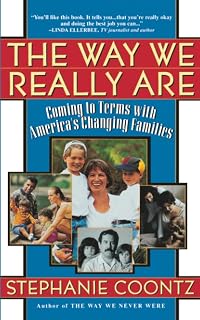
Stephanie Coontz is a social analyst, family historian, writer, and a professor. She teaches at Evergreen State College in Olympia, Washington. Her research interests include the historical accuracy, myths, and facts that surround our present concept of traditional family values. In her book, The Way We Never Were: American Families and the show more Nostalgia Trap, Coontz disputes many of the myths about the decade of the 1950s. Her book, The Way We Really Are: Coming to Terms with America's Changing Families explores new economic and social pressure put on families. Coontz is a frequent commentator on CNN and NBC news programs and has appeared on the Oprah Winfrey Show. She was the keynote speaker at the Thirteenth Annual Maine Women's Studies Conference in 1998. (Bowker Author Biography) show less
Common Knowledge
- Original publication date
- 1992
- Canonical DDC/MDS
- 306.850973
Classifications
- Genres
- Sociology, Nonfiction, General Nonfiction, History, Sexuality and Gender Studies
- DDC/MDS
- 306.850973 — Society, government, & culture Social sciences, sociology & anthropology Social Behavior - Dating, Marriage, Divorce Marriage, partnerships, unions; family Family History, geographic treatment, biography North America United States
- LCC
- HQ535 .C643 — Social sciences The family. Marriage, Women and Sexuality The Family. Marriage. Women The family. Marriage. Home
- BISAC
Statistics
- Members
- 1,127
- Popularity
- 22,517
- Reviews
- 15
- Rating
- (3.84)
- Languages
- English
- Media
- Paper, Audiobook, Ebook
- ISBNs
- 8
- ASINs
- 9