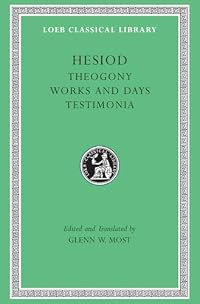
Hesiod: Theogony / Works and Days / Testimonia
by Hesiod
On This Page
Description
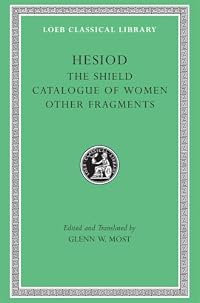
"Hesiod describes himself as a Boeotian shepherd who heard the Muses call upon him to sing about the gods. His exact dates are unknown, but he has often been considered a younger contemporary of Homer. The first volume of this revised Loeb Classical Library edition offers Hesiod's two extant poems and a generous selection of testimonia regarding his life, works, and reception. In Theogony, Hesiod charts the history of the divine world, narrating the origin of the universe and the rise of the show more gods, from first beginnings to the triumph of Zeus, and reporting on the progeny of Zeus and of goddesses in union with mortal men. In Works and Days, Hesiod shifts his attention to humanity, delivering moral precepts and practical advice regarding agriculture, navigation, and many other matters; along the way he gives us the myths of Pandora and of the Golden, Silver, and other Races of Men. The second volume contains The Shield and extant fragments of other poems, including the Catalogue of Women, that were attributed to Hesiod in antiquity. The former provides a Hesiodic counterpoint to the shield of Achilles in the Iliad; the latter presents several legendary episodes organized according to the genealogy of their heroes' mortal mothers. None of these is now thought to be by Hesiod himself, but all have considerable literary and historical interest. Glenn W. Most has thoroughly revised his edition to take account of the textual and interpretive scholarship that has appeared since its initial publication." --Book jacket. show lessTags
Recommendations









Member Reviews
All hale Hesiod, and his timeless advice. Thanks be to the Muses in their wise choice of such a singer of their whims. How else would I have learned about Athena and Hephaestus and how to poor out libations in the proper manner. Who else could give us such sage warnings:
For those who who live near the sea and those far from the swelling sea in the valleys and glens, fertile land: sow naked, and plow naked, and harvest naked, if you want to bring in all of Demeter's works in due season, so that each crop may grow for you in its season.
Or this gem:
In the winter, turn your hired man out of your house and look for a serving-girl without her own child; for a serving girl with a baby under flank is a difficult thing. And get a jagged-tooth show more dog-do not be sparing with its food, lest some day sleeping-man steal your things from you.
Yes, the world would be a miss without Hesiod. I see him as the first rap challenger really. Throwing down against Homer not to mention slamming his lazy good for nothing brother Perses at the poetry slam of Amphidamas' Funeral Games. If only our funerals had poetry slams and chariot races.
Due thanks goes to Loeb for making these available in a time where classical Greek literature is hard to come by, at least the obscure authors. And for finally putting Hesiod in his own two volumes instead of including him in the usual Homeric Apocrypha.
For those of you who are looking for the first layout of the Greek Pantheon, the Theogony is it. Plus, if you want some hilarious advice on how to live the good life and be upstanding you could do no better than the works and days. Hesiod is boss. show less
For those who who live near the sea and those far from the swelling sea in the valleys and glens, fertile land: sow naked, and plow naked, and harvest naked, if you want to bring in all of Demeter's works in due season, so that each crop may grow for you in its season.
Or this gem:
In the winter, turn your hired man out of your house and look for a serving-girl without her own child; for a serving girl with a baby under flank is a difficult thing. And get a jagged-tooth show more dog-do not be sparing with its food, lest some day sleeping-man steal your things from you.
Yes, the world would be a miss without Hesiod. I see him as the first rap challenger really. Throwing down against Homer not to mention slamming his lazy good for nothing brother Perses at the poetry slam of Amphidamas' Funeral Games. If only our funerals had poetry slams and chariot races.
Due thanks goes to Loeb for making these available in a time where classical Greek literature is hard to come by, at least the obscure authors. And for finally putting Hesiod in his own two volumes instead of including him in the usual Homeric Apocrypha.
For those of you who are looking for the first layout of the Greek Pantheon, the Theogony is it. Plus, if you want some hilarious advice on how to live the good life and be upstanding you could do no better than the works and days. Hesiod is boss. show less
i love this book because it says that somebody castrated his father, and aphrodite, goddess of love and beauty was the result. i am enchanted with that notion, relative to aesthetics. it makes freud look, well, PALE.
Ratings
Members
- Recently Added By
Author Information

163+ Works 7,386 Members
The poet Hesiod tells us that his father gave up sea-trading and moved from Ascra to Boeotia, that as he himself tended sheep on Mount Helicon the Muses commanded him to sing of the gods, and that he won a tripod for a funeral song at Chalcis. The poems credited to him with certainty are: the Theogony, an attempt to bring order into the otherwise show more chaotic material of Greek mythology through genealogies and anecdotes about the gods; and The Works and Days, a wise sermon addressed to his brother Perses as a result of a dispute over their dead father's estate. This latter work presents the injustice of the world with mythological examples and memorable images, and concludes with a collection of folk wisdom. Uncertain attributions are the Shield of Heracles and the Catalogue of Women. Hesiod is a didactic and individualistic poet who is often compared and contrasted with Homer, as both are representative of early epic style. "Hesiod is earth-bound and dun colored; indeed part of his purpose is to discredit the brilliance and the ideals of heroism glorified in the homeric tradition. But Hesiod, too, is poetry, though of a different order. . . " (Moses Hadas, N.Y. Times). (Bowker Author Biography) show less
Some Editions
Series
Belongs to Publisher Series
Loeb Classical Library (57N)
Common Knowledge
- Canonical title
- Hesiod: Theogony / Works and Days / Testimonia
Classifications
- Genres
- Fiction and Literature, Poetry
- DDC/MDS
- 881.01 — Literature & rhetoric Classical & modern Greek literatures Classical Greek poetry Different categories of Greek classical poetry Philosophy and Theory
- LCC
- PA4009 .A2 — Language and Literature Greek language and literature. Latin language and literature Greek literature Individual authors
- BISAC
Statistics
- Members
- 213
- Popularity
- 152,606
- Reviews
- 2
- Rating
- (4.06)
- Languages
- English, Greek (Ancient)
- Media
- Paper, Ebook
- ISBNs
- 3