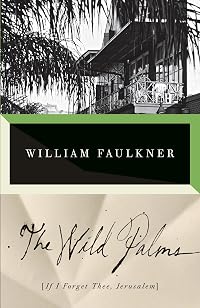
The Wild Palms
by William Faulkner
On This Page
Description
Fiction. Literature. Romance. Historical Fiction. HTML:In this feverishly beautiful novel—originally titled If I Forget Thee, Jerusalem by Faulkner, and now published in the authoritative Library of America text—William Faulkner interweaves two narratives, each wholly absorbing in its own right, each subtly illuminating the other. In New Orleans in 1937, a man and a woman embark on a headlong flight into the wilderness of illicit passion, fleeing her husband and the temptations of show more respectability. In Mississippi ten years earlier, a convict sets forth across a flooded river, risking his own chance at freedom to rescue a pregnant woman. From these separate stories Faulkner composes a symphony of deliverance and damnation, survival and self-sacrifice, a novel in which elemental danger is juxtaposed wiht fatal injuries of the spirit. The Wild Palms is grandly inventive, heart-stopping in its prose, and suffused on every page with the physical presence of the country that Faulkner made his own. show lessTags
Recommendations









Member Reviews
Reads like a darker Thomas Wolfe. Not the paeans to the American universe but a full prose that speaks of the hardness, pain, and melancholia of existence in the American land of the early 20th century. Faulkner is insightful and eloquently descriptive in telling his tales of suffering and endurance. I lost the string of each of the stories a couple of times. His transitions were not clear. The endings to both of his stories were chaotic and harsh. But his prose, insights, and depth of thought were impressive.
5. The Wild Palms (If I Forget Thee, Jerusalem) by William Faulkner
OPD: 1939
format: 290-page paperback
acquired: 2024 (from Faulkner House in New Orleans) read: Jan 29 – Feb 8 time reading: 11:11, 2.3 mpp
rating: 3
genre/style: classic novel theme: Faulkner
locations: Mississippi , New Orleans, Chicago, Wisconsin, and along the Mississippi River
about the author: 1897-1962. American Noble Laureate who was born in New Albany, MS, and lived most of his life in Oxford, MS.
Hmm. Does it work? This novel is actually two separate stories in each in a kind of distinct contrast. Chapters alternate. One is the story of an impoverished and aspiring, if unenthused, doctor, who abandons his internship to run off with a married woman. She leaves her show more children willing, drawing him away. Her story is about attempting to escape societies expectations by trying to leave society altogether. At one point they spend several months in a seasonally abandoned Wisconsin summer cabin. He wavers between wanting to believe in her goals, and also attempt to make things work. The other story is that of a convict who gets lost during the 1927 Mississippi River flood. He ends up floats down the Mississippi Huck-like, but instead of Jim, he's with a pregnant women nearing labor. He has a sort of parallel experience in an isolated cabin, hunting alligators. The men in these stories each pursue their own logic, and with their own principles, and stick to them to their tragic ends.
There are interesting elements here, including a look at abortion when it was illegal. I got caught up in it in places, especially with the accidentally escaped convict. But I'm not sure this novel was really worked through all the way, and maybe it doesn't work. Reviews online indicate Faulkner wrote the extramarital story first, and felt it was lacking, so he added the escape convict's story to provide some balance and contrast. Weird, but it's not a quick and dirty add. The convict's story may even be the better one. Some reviews find plot connections between the two stories, but I'm not sure they have it right. The connection I found is thin.
One thing I liked about the stories is that they are more straightforward and accessible.
Anyway, a book for Faulkner completists only.
2025
https://www.librarything.com/topic/367331#8764311 show less
OPD: 1939
format: 290-page paperback
acquired: 2024 (from Faulkner House in New Orleans) read: Jan 29 – Feb 8 time reading: 11:11, 2.3 mpp
rating: 3
genre/style: classic novel theme: Faulkner
locations: Mississippi , New Orleans, Chicago, Wisconsin, and along the Mississippi River
about the author: 1897-1962. American Noble Laureate who was born in New Albany, MS, and lived most of his life in Oxford, MS.
Hmm. Does it work? This novel is actually two separate stories in each in a kind of distinct contrast. Chapters alternate. One is the story of an impoverished and aspiring, if unenthused, doctor, who abandons his internship to run off with a married woman. She leaves her show more children willing, drawing him away. Her story is about attempting to escape societies expectations by trying to leave society altogether. At one point they spend several months in a seasonally abandoned Wisconsin summer cabin. He wavers between wanting to believe in her goals, and also attempt to make things work. The other story is that of a convict who gets lost during the 1927 Mississippi River flood. He ends up floats down the Mississippi Huck-like, but instead of Jim, he's with a pregnant women nearing labor. He has a sort of parallel experience in an isolated cabin, hunting alligators. The men in these stories each pursue their own logic, and with their own principles, and stick to them to their tragic ends.
There are interesting elements here, including a look at abortion when it was illegal. I got caught up in it in places, especially with the accidentally escaped convict. But I'm not sure this novel was really worked through all the way, and maybe it doesn't work. Reviews online indicate Faulkner wrote the extramarital story first, and felt it was lacking, so he added the escape convict's story to provide some balance and contrast. Weird, but it's not a quick and dirty add. The convict's story may even be the better one. Some reviews find plot connections between the two stories, but I'm not sure they have it right. The connection I found is thin.
One thing I liked about the stories is that they are more straightforward and accessible.
Anyway, a book for Faulkner completists only.
2025
https://www.librarything.com/topic/367331#8764311 show less
My mother asked me what I thought of it, and mentioned that she thought it sounded kind of "steamy" from the GoodReads summary, so this started out as a comment on her comment and then turned into a general commentary/review so I thought it would make more sense to just make my official comment lol.
I thought it was excellent. there's not really a lot of explicit sex in it, so i wouldn't call it steamy so much as "shocking" in the context of the times. there's a mention of using a douche, there's two abortions (not graphic, nothing like Cider House Rules, thank God), but the purpose of the sex is not for its own sake but to contribute to the realism of the book. the whole point is that there are two stories interpolated with each other, show more and they have absolutely NOTHING to do with each other. there's no crossover of characters, or even types of characters, time, place, etc. there are, however, various themes which are common to both. The name of one story is Wild Palms, and the other is Old Man. I remember my professor telling us what the deal was with the title being "If I Forget Thee, Jerusalem", but I don't remember what it was.… In any case, the Wild Palms story is where the sex takes place, and the realism of the relationship portrayed there is infinitely enhanced by the unequivocal, unapologetic, *unromantic* presence of their sexual acts. show less
I thought it was excellent. there's not really a lot of explicit sex in it, so i wouldn't call it steamy so much as "shocking" in the context of the times. there's a mention of using a douche, there's two abortions (not graphic, nothing like Cider House Rules, thank God), but the purpose of the sex is not for its own sake but to contribute to the realism of the book. the whole point is that there are two stories interpolated with each other, show more and they have absolutely NOTHING to do with each other. there's no crossover of characters, or even types of characters, time, place, etc. there are, however, various themes which are common to both. The name of one story is Wild Palms, and the other is Old Man. I remember my professor telling us what the deal was with the title being "If I Forget Thee, Jerusalem", but I don't remember what it was.… In any case, the Wild Palms story is where the sex takes place, and the realism of the relationship portrayed there is infinitely enhanced by the unequivocal, unapologetic, *unromantic* presence of their sexual acts. show less
This is actually two separate novellas (the other story being "The Old Man"), told in alternating chapters. According to the intro, the two novellas were intended by Faulkner to be printed together in this fashion, and they actually complement each other. I couldn't quite see that, but the style is not really distracting. No, what distracts is Faulkner's literary style, tending toward pompous verbosity. Here (in "The Wild Palms"), he even allows his obfuscatory verbage to infect the dialogue. If I were a character in this story, I'd be liable to yell "What on Earth are you talking about?". And it's really too bad, because both stories are pretty compelling. "The Wild Palms" is about a housewife and mother who impulsively leaves her show more husband for a medical intern, and their struggle to keep the demands of the world from pressing into their pure desire for each other. "The Old Man" is about a convict who inadvertently escapes while being called upon to lend aid during a Mississippi flood, and rescues a pregnant woman who becomes his dazed companion as he attempts to navigate floodwaters over several days. Both stories are powerful and well-plotted, but fatally marred by Faulkner's writing. The final sentence of "The Wild Palms", however, is a masterpiece of bleakly spare philosophy, and perfectly encapsulates the story. show less
Faulkner brings together two disparate novellas and creates a distinct whole. The result is more than the sum of its parts. The narratives of "The Old Man" and "The Wild Palms" don't match up exactly, since they aren't directly related.
I would recommend this book to readers interested in Faulkner, since the novel is more commercial and more mainstream in its style.
"Wild Palms" also has the memorable quote: “Between grief and nothing I will take grief." This occurs with the bohemian couple on the run. The quote also appears in Jean-Luc Godard's classic New Wave film "Breathless," also about two bohemians on the run.
"Wild Palms" foreshadows modern American cinema, especially the ones featuring somewhat-interrelated storylines, show more everything fro Steven Soderburgh's "Traffic" to "Babel" and "Crash" (not the David Cronenberg one).
While more accessible to readers, Faulkner is also daring enough to let the reader decide how the two storylines fit together. It isn't explained, not should it be. Sometimes the reader has to make their own decisions and not have everything spelled out for them by The Author. These demands on the reader elevate the novel to something above the standard romantic potboiler. show less
I would recommend this book to readers interested in Faulkner, since the novel is more commercial and more mainstream in its style.
"Wild Palms" also has the memorable quote: “Between grief and nothing I will take grief." This occurs with the bohemian couple on the run. The quote also appears in Jean-Luc Godard's classic New Wave film "Breathless," also about two bohemians on the run.
"Wild Palms" foreshadows modern American cinema, especially the ones featuring somewhat-interrelated storylines, show more everything fro Steven Soderburgh's "Traffic" to "Babel" and "Crash" (not the David Cronenberg one).
While more accessible to readers, Faulkner is also daring enough to let the reader decide how the two storylines fit together. It isn't explained, not should it be. Sometimes the reader has to make their own decisions and not have everything spelled out for them by The Author. These demands on the reader elevate the novel to something above the standard romantic potboiler. show less
Two seemingly unrelated novellas in one book, one about a doctor-turned-bohemian and his adulterous affair with a woman who runs away with him, only to die from a botched abortion, the other about a convict's adventure as he saves a pregnant woman during a horrific flood in Mississippi (he gets ten additional years added to his sentence for his trouble). Well-written, enjoyable, but not a major work. I liked it a great deal.
A couple meet, she is married with children , he is a poor naive medical student. They fall in love and run away.
She is an artist. He wants to keep their love pure, above middle class conventions such as security. This absolute idea leads to stupid behavior and eventually he performs an abortion on her which kills her. This is largely a novel of an idea, hardly a novel, more an argument of ideas. The characters are not developed. The pot is simple and obvious. There is an effort to capture ' consciousness' of a person when a crisis is occurring.
She is an artist. He wants to keep their love pure, above middle class conventions such as security. This absolute idea leads to stupid behavior and eventually he performs an abortion on her which kills her. This is largely a novel of an idea, hardly a novel, more an argument of ideas. The characters are not developed. The pot is simple and obvious. There is an effort to capture ' consciousness' of a person when a crisis is occurring.
Members
- Recently Added By
Lists

1001 Books You Must Read Before You Die
1,448 works; 1,133 members

20th Century Literature
1,161 works; 55 members

Harold Bloom - The Western Canon: D. The Chaotic Age
833 works; 24 members

1930s
262 works; 5 members

Tammen Keltainen kirjasto
81 works; 1 member

Books We'd Want on a Desert Island
203 works; 131 members
Canon de la narrativa universal del s. XX (cicutadry)
499 works; 3 members

The Five Books That Represent Us
391 works; 149 members
Author Information

466+ Works 99,462 Members
Born in an old Mississippi family, William Faulkner made his home in Oxford, seat of the University of Mississippi. After the fifth grade he went to school only off and on-lived, read, and wrote much as he pleased. In 1918, refusing to enlist with the "Yankees," he joined the Canadian Air Force, and was transferred to the British Royal Air Force. show more After the war he studied a little at the University, did house painting, worked as a night superintendent at a power plant, went to New Orleans and became a friend of Sherwood Anderson, then to Europe and back home to Oxford. By this time he had written two novels. The Sound and the Fury followed in 1929. Financial success came with Sanctuary in 1931, which he assisted in filming. Faulkner 's novels are intense in their character portrayals of disintegrating Southern aristocrats, poor whites, and African Americans. A complex stream-of-consciousness rhetoric often involves Faulkner in lengthy sentences of anguished power. Most of his tales are set in the mythical Yoknapatawpha County, Mississippi, and are characterized by the use of many recurring characters from families of different social levels spanning more than a century. His best subjects are the old, dying South and the newer materialistic South. As I Lay Dying (1930), is a grotesquely tragicomic story about a family of poor southern whites. With Absalom, Absalom! (1936); the difficult parts of his famous short novel "The Bear" (published in Go Down, Moses, 1942); and the allegorical A Fable (1954), a non-Yoknapatawpha novel set in France during World War I; Faulkner returned to an innovative and difficult style that most readers have trouble with. Yet, interspersed among such works are collections of easily read stories originally published in popular magazines. There seems to be a growing sentiment among critics that the Snopes trilogy-The Hamlet (1940), The Town (1957), and The Mansion (1959)-for the most part an example of Faulkner's "moderate" style, could well be among his most important works. Faulkner was awarded the 1949 Nobel Prize for literature "for his powerful and artistically independent contribution to the new American novel," but it would appear now that he also deserved to win that honor for his contribution to world literature. When reporting his death, the Boston Globe quoted Faulkner's having once told an interviewer: "Since man is mortal, the only immortality for him is to leave something behind him that is immortal since it will always move. That is the artist's way of scribbling "Kilroy was here" on the wall of the final and irrevocable oblivion through which he must some day pass." In addition to the Nobel Prize, Faulkner received the Howells Medal of the American Academy of Arts and Letters in 1950, and in 1951 he was given the National Book Award for his Collected Stories Collected Stories. For his novel A Fable he received the National Book Award for the second time, as well as the Pulitzer Prize in 1955. The Reivers (1962) was awarded the Pulitzer Prize in 1963. In 1957 and 1958, he was the University of Virginia's first writer-in-residence, and in January 1959 he accepted an appointment as consultant on contemporary literature to the Alderman Library of that university. Although Faulkner was not without honors in his lifetime and has received world recognition since then, it is surprising to learn that, when Malcolm Cowley edited The Portable Faulkner in 1946, he found that almost all of Faulkner's books were out of print. By arranging selections from the works to form a continuous chronicle, Cowley deserves much of the credit for making readers aware of the way in which Faulkner was creating a fictive world on a scale grander than that of any novelist since Balzac. William Faulkner died in Oxford, Mississippi, in 1962. (Bowker Author Biography) show less
Some Editions
Awards and Honors
Notable Lists
Series
Belongs to Publisher Series
Európa Zsebkönyvek (95)
Koliber (37)
Nobelpreisträger Coron-Verlag (weiß) (1949 (USA))
Keltainen kirjasto (46)
Zephyr Books (68)
Mirmanda (214)
A tot vent (226)
Work Relationships
Is contained in
Has as a study
Has as a concordance
Common Knowledge
- Original title
- If I Forget Thee, Jerusalem
- Alternate titles
- The Wild Palms
- Original publication date
- 1939
- Important places
- Mississippi, USA
- Related movies
- Hallmark Hall of Fame: Old Man (1997 | IMDb)
- Original language
- English
- Disambiguation notice
- Original title If I Forget Thee, Jerusalem
ISBN 0451016432 is for the 2-in-1 containing The Wild Palms and The Old Man
Classifications
Statistics
- Members
- 1,498
- Popularity
- 15,512
- Reviews
- 18
- Rating
- (3.81)
- Languages
- 14 — Catalan, Czech, Danish, English, Finnish, French, German, Italian, Lithuanian, Polish, Portuguese, Spanish, Swedish, Turkish
- Media
- Paper, Audiobook, Ebook
- ISBNs
- 61
- ASINs
- 30