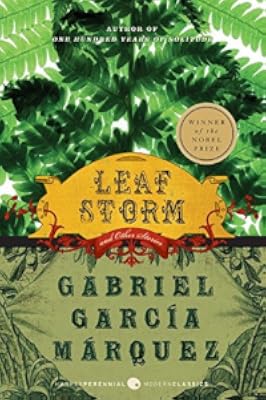
Leaf Storm and Other Stories
by Gabriel Garcia Marquez
On This Page
Description
Presents a collection of seven short stories written between 1957 and 1968 by twentieth-century Colombian-born author Gabriel Garcia Marquez.Tags
Recommendations











Member Reviews
"No medicine cures what happiness cannot."
Set in a fictional Columbian coastal town this novella tells of the arrival and exit of the “leaf storm,” the hordes of outsiders who descended on the region as they followed the banana companies, its prosperity during the 1910’s, and its decadence after 1918. A short period of wealth that ended as quickly as it had begun.
Central to this book is the burial of the most hated man in the village and is told through the eyes of the three generations of one family: the Colonel, his daughter Isabel and his young grandson. The Colonel is motivated by a promise he made to the dead man; Isabel obeys her father's request and goes along reluctantly worried as to how the other villagers will react if show more they are seen attending the funeral; while the child does not fully understand what is going on and whilst he is intrigued by the sight of a dead man would rather be playing with his friends.
The dead man, an outsider of unknown origins, has been found hanged and how he arrived at the village and became to be so disliked is told through a series of flashbacks by the two older characters. Most of the book consists of inner monologues by the respective characters and there is only minimal dialogue throughout. In contrast to his elders the narrative of the young boy is primarily concerned with his fascination towards the dead and thinking of the fun things that he would rather be doing.
I read somewhere that this was the author's first piece of work and it took seven years for him to find a publisher for it. Frankly I'm not surprised. Despite realising that two of the major themes of this book is a feeling of obligation and the effects of a sudden influx of new people can have on a small community I really just couldn't really see where this was going at all and as such wasn't that impressed with it . It is at least thankfully short. show less
Set in a fictional Columbian coastal town this novella tells of the arrival and exit of the “leaf storm,” the hordes of outsiders who descended on the region as they followed the banana companies, its prosperity during the 1910’s, and its decadence after 1918. A short period of wealth that ended as quickly as it had begun.
Central to this book is the burial of the most hated man in the village and is told through the eyes of the three generations of one family: the Colonel, his daughter Isabel and his young grandson. The Colonel is motivated by a promise he made to the dead man; Isabel obeys her father's request and goes along reluctantly worried as to how the other villagers will react if show more they are seen attending the funeral; while the child does not fully understand what is going on and whilst he is intrigued by the sight of a dead man would rather be playing with his friends.
The dead man, an outsider of unknown origins, has been found hanged and how he arrived at the village and became to be so disliked is told through a series of flashbacks by the two older characters. Most of the book consists of inner monologues by the respective characters and there is only minimal dialogue throughout. In contrast to his elders the narrative of the young boy is primarily concerned with his fascination towards the dead and thinking of the fun things that he would rather be doing.
I read somewhere that this was the author's first piece of work and it took seven years for him to find a publisher for it. Frankly I'm not surprised. Despite realising that two of the major themes of this book is a feeling of obligation and the effects of a sudden influx of new people can have on a small community I really just couldn't really see where this was going at all and as such wasn't that impressed with it . It is at least thankfully short. show less
Marquez is most famous for his '100 Years...', a masterpiece of magic realism; but he wrote other stories before the novel, and 'Lead Storm' is an interesting collection that shows the ideas as they first formed. The major story in the collection, the titular piece, at first seemed too slow and disjointed, but it built a remarkable momentum as it moved forwards until, by the second half, I couldn't get enough of it. The other stories reminded me in a strange way of Borges, though I can't put my finger on why exactly.
Ky koleksion i jashtëzakonshëm prozash, që përfaqëson disa nga veprat e hershme të Gabriel García Márquez nga vitet 1950, si dhe tregime të shkruara në vitet 1960 dhe 1970, përfshin njëmbëdhjetë tregime të shkurtra dhe një novelë, Innocent Eréndira, në të cilën një vajzë e re që ëndërron lirinë nuk mund t'i shpëtojë gjyshes së saj të egër dhe lakmitare.
Yaprak Fırtınası bitti. Sınavlar dolayısıyla bir haftadır elimde dolanıp duruyordu anca bitirebildim.
Daha önce iki kitabını okuduğum için Marquez sevdiğim bir yazar. Bu kitabına kadar da beğenmedim bir kitabı olmamıştı. Antigone'u andıran konusundan dolayı bu kitaba dair de büyük umutlarım vardı ama kitap umutlarımı tamamen boşa çıkardı.
Kitap aynı ailenin üç ferdinin gözünden anlatılıyor ve yazar hızlı bir şekilde bu üç karakter arasında gidip geliyor. Kitabın başında bu anlatım tarzını benimsemiştim ama kitabın ortalarından itibaren bu anlatım tarzı can sıkıcı bir hal almaya başlıyor ve kitabın kalitesinin düşmesine neden oluyor. Aynı betimlemeleri tekrar tekrar üç show more karakterin ağzından okumaktan dolayı kitabı okumaktan çok yoruldum. show less
Daha önce iki kitabını okuduğum için Marquez sevdiğim bir yazar. Bu kitabına kadar da beğenmedim bir kitabı olmamıştı. Antigone'u andıran konusundan dolayı bu kitaba dair de büyük umutlarım vardı ama kitap umutlarımı tamamen boşa çıkardı.
Kitap aynı ailenin üç ferdinin gözünden anlatılıyor ve yazar hızlı bir şekilde bu üç karakter arasında gidip geliyor. Kitabın başında bu anlatım tarzını benimsemiştim ama kitabın ortalarından itibaren bu anlatım tarzı can sıkıcı bir hal almaya başlıyor ve kitabın kalitesinin düşmesine neden oluyor. Aynı betimlemeleri tekrar tekrar üç show more karakterin ağzından okumaktan dolayı kitabı okumaktan çok yoruldum. show less
This was my first Gabriel Garcia Marquez book and it didn't take me long to see why he's a Nobel winner. I can see why readers fall in love with his books. He instantly grabs your attention. The first sentence is "I've seen a corpse for the first time." Who wouldn't want to read more after reading that awesome opening line? I'm looking forward to reading more of his work, especially One Hundred Years of Solitude and Love in the Time of Cholera.
A slight novella about the death of a doctor in Macondo. It's not the most engaging of his books, just a short taster.
Members
- Recently Added By
Author Information

Gabriel García Márquez was born in Aracataca, Colombia on March 6, 1927. After studying law and journalism at the National University of Colombia in Bogota, he became a journalist. In 1965, he left journalism, to devote himself to writing. His works included Leaf Storm, No One Writes to the Colonel, The Evil Hour, One Hundred Years of Solitude, show more Love in the Time of Cholera, The Autumn of the Patriarch, Chronicle of a Death Foretold, The General in His Labyrinth, Clandestine in Chile, and the memoir Living to Tell the Tale. He won the Nobel Prize for Literature in 1982. He died on April 17, 2014 at the age of 87. (Bowker Author Biography) show less
Some Editions
Series
Belongs to Publisher Series
Bard (17566)
Work Relationships
Contains
Common Knowledge
- Canonical title
- Leaf Storm and Other Stories
- Original title
- La hojarasca
- Alternate titles*
- Ochiba
- Original publication date
- 1972 (Jonathan Cape) (Jonathan Cape)
- People/Characters
- Aureliano Buendía (Colonel)
- Important places
- Macondo
- Epigraph
- But Polyneices' corpse who died in pain
they say he has proclaimed to the whole town
that none may bury him and none bewail,
but leave him unwept, untombed, a rich sweet sight
for the hungry birds' beholding.
S... (show all)uch orders they say the worthy Creon gives
to you and me -- yes, yes, I say to me --
and that he's coming to proclaim it clear
to those who know it not.
Further: he has the matter so at heart
that anyone who dares attempt the act
will die by public stoning in the town.
Antigone - First words
- I've seen a corpse for the first time.
- Original language
- Spanish
- Disambiguation notice
- Please, do not combine with the stand-alone edition of "La hojarasca".
*Some information comes from Common Knowledge in other languages. Click "Edit" for more information.
Classifications
- Genres
- Fiction and Literature, General Fiction
- DDC/MDS
- 863.64 — Literature & rhetoric Spanish Literature Spanish fiction 20th Century 1945-2000
- LCC
- PQ8180.17 .A73 .A27 — Language and Literature French, Italian, Spanish and Portuguese literatures Spanish literature Provincial, local, colonial, etc. Spanish America
- BISAC
Statistics
- Members
- 1,003
- Popularity
- 26,163
- Reviews
- 6
- Rating
- (3.73)
- Languages
- 7 — Arabic, English, Finnish, Japanese, Farsi/Persian, Spanish, Turkish
- Media
- Paper, Audiobook, Ebook
- ISBNs
- 13
- ASINs
- 14