A Room Made of Leaves
by Kate Grenville
On This Page
Description
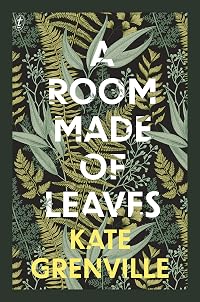
What if Elizabeth Macarthur - wife of the notorious John Macarthur, wool baron in early Sydney - had written a shockingly frank secret memoir? In her introduction Kate Grenville tells, tongue firmly in cheek, of discovering a long-hidden box containing that memoir. What follows is a playful dance of possibilities between the real and the invented. Grenville's Elizabeth Macarthur is a passionate woman managing her complicated life-marriage to a ruthless bully, the impulses of her own heart, show more the search for power in a society that gave her none-with spirit, cunning and sly wit. Her memoir reveals the dark underbelly of the polite world of Jane Austen. It explodes the stereotype of the women of the past - devoted and docile, accepting of their narrow choices. That was their public face-here's what one of them really thought. At the heart of this book is one of the most toxic issues of our times - the seductive appeal of false stories. Beneath the surface of Elizabeth Macarthur's life and the violent colonial world she navigated are secrets and lies with the dangerous power to shape reality. show lessTags
Recommendations

















Member Reviews
Elizabeth Macarthur was the wife of John Macarthur, a notorious early Australian settler. The documentation of her life is scarce. Kate Grenville pieces together what little there is, including a few letters to home, to make Elizabeth a complete person, with thoughts, feelings, a point of view, and a possibly significant role in the success of her husband’s business ventures.
The first question is: how did Elizabeth, who was born into a modest family, come to marry someone that, by all accounts, would not have been considered a good match? As with so many women of her day, Grenville believes the marriage was a matter of economic necessity, and creates a series of circumstances and events that lead to Elizabeth and John marrying and show more traveling to Australia. From the beginning we see Elizabeth refusing to bow to her husband’s will, but doing so in very clever ways. She figures out how to live a fulfilling life despite his controlling manner.
I love historical fiction that brings untold stories to light, and this is an excellent example of the genre. It's no surprise it was shortlisted for the Walter Scott Prize for Historical Fiction. show less
The first question is: how did Elizabeth, who was born into a modest family, come to marry someone that, by all accounts, would not have been considered a good match? As with so many women of her day, Grenville believes the marriage was a matter of economic necessity, and creates a series of circumstances and events that lead to Elizabeth and John marrying and show more traveling to Australia. From the beginning we see Elizabeth refusing to bow to her husband’s will, but doing so in very clever ways. She figures out how to live a fulfilling life despite his controlling manner.
I love historical fiction that brings untold stories to light, and this is an excellent example of the genre. It's no surprise it was shortlisted for the Walter Scott Prize for Historical Fiction. show less
I love a book with short chapters. They propelled me through what feels like a short story, even though some of the chapter names were a bit perfunctory, almost tabloid in style. The very fine balance between Elizabeth's voice and the author, Kate Grenville's voice gradually tips into an almost farcical didacticism, The former becoming unbelievable as the latter dominates - a voice fresh from a workshop on the correct things to write about Indigenous colonial relations.
I wanted this curiously truncated book to succeed because I have several personal connections to the story: my mother was very involved in the restoration of Elizabeth Farm and, I was delighted and surprised to find a close relative, Nicholas Nepean (one of my middle show more names is Nepean) appear, even if it was not a particularly flattering portrayal.
What seems like the mundane discontent of a bad marriage turns almost heroic as Elizabeth gives birth to a sickly child. But there is something quite stultified about Elizabeth as a character (her children have no character). Perhaps it's because (like her marriage) Elizabeth can't escape her author's insistence that she have a 21st Century perspective.
Kate Grenville has missed a wonderful opportunity to examine how the various ways people thought about Aborigines influenced what they saw. This is something Keith Willey examines in his intriguing but little-known book [b:When the Sky Fell Down: The Destruction of the Tribes of the Sydney Region, 1788-1850's|975423|WHEN THE SKY FELL DOWN The Destruction of the Tribes of the Sydney Region 1788-1850s|Keith Willey|https://i.gr-assets.com/images/S/compressed.photo.goodreads.com/books/1394329290l/975423._SY75_.jpg|960320]
Next, I'm thinking I'll read a history of the Aboriginal warrior [b:Pemulwuy, The Rainbow Warrior|6323289|Pemulwuy, The Rainbow Warrior|Eric Willmot|https://i.gr-assets.com/images/S/compressed.photo.goodreads.com/books/1361081906l/6323289._SX50_.jpg|6508759] and from that perspective, I may be able to offer some more insightful comments about Kate Grenville's historical research. show less
I wanted this curiously truncated book to succeed because I have several personal connections to the story: my mother was very involved in the restoration of Elizabeth Farm and, I was delighted and surprised to find a close relative, Nicholas Nepean (one of my middle show more names is Nepean) appear, even if it was not a particularly flattering portrayal.
What seems like the mundane discontent of a bad marriage turns almost heroic as Elizabeth gives birth to a sickly child. But there is something quite stultified about Elizabeth as a character (her children have no character). Perhaps it's because (like her marriage) Elizabeth can't escape her author's insistence that she have a 21st Century perspective.
Kate Grenville has missed a wonderful opportunity to examine how the various ways people thought about Aborigines influenced what they saw. This is something Keith Willey examines in his intriguing but little-known book [b:When the Sky Fell Down: The Destruction of the Tribes of the Sydney Region, 1788-1850's|975423|WHEN THE SKY FELL DOWN The Destruction of the Tribes of the Sydney Region 1788-1850s|Keith Willey|https://i.gr-assets.com/images/S/compressed.photo.goodreads.com/books/1394329290l/975423._SY75_.jpg|960320]
Next, I'm thinking I'll read a history of the Aboriginal warrior [b:Pemulwuy, The Rainbow Warrior|6323289|Pemulwuy, The Rainbow Warrior|Eric Willmot|https://i.gr-assets.com/images/S/compressed.photo.goodreads.com/books/1361081906l/6323289._SX50_.jpg|6508759] and from that perspective, I may be able to offer some more insightful comments about Kate Grenville's historical research. show less
Devon, 1788 and Elizabeth Veale knows her options are limited so she allows herself to be seduced by an officer and accepts the marriage that follows. Her husband is ambitious but egotistical and Elizabeth learns to be compliant even when his debts cause him to accept a posting to the penal colony of New South Wales. Elizabeth finds Australia difficult at first but then she allows herself to open, firstly to passion, then to the natives and finally she finds her vocation in farming.
Written as a purported memoir, this book tells the story of Elizabeth Macarthur, wife of one of the first prominent men in the colony and producer of fine merino wool. The introduction claims that the story is based on a series of papers recently discovered show more but in the author's notes she explains that this is just a literary device. It's a clever one as the reader believes the story to be a slightly exaggerated biography based on primary sources whereas it is actually a fictionalised story based on secondary sources. The story itself is wonderful, a small woman finding herself in the vast new country, racism is addressed as well as feminism, and all is wrapped up in wonderful prose. show less
Written as a purported memoir, this book tells the story of Elizabeth Macarthur, wife of one of the first prominent men in the colony and producer of fine merino wool. The introduction claims that the story is based on a series of papers recently discovered show more but in the author's notes she explains that this is just a literary device. It's a clever one as the reader believes the story to be a slightly exaggerated biography based on primary sources whereas it is actually a fictionalised story based on secondary sources. The story itself is wonderful, a small woman finding herself in the vast new country, racism is addressed as well as feminism, and all is wrapped up in wonderful prose. show less
In "A Room Made of Leaves," the splendid Kate Grenville takes the scanty historical materials covering the settlement of Sydney to build a narrative of Elizabeth Macarthur, settler and early wool entrepreneur in New South Wales. In 1790, Mrs. Macarthur, wife of Captain John Macarthur of the New South Wales Corps, was the first wife of a British soldier to arrive in Sydney. It’s well-established that her husband was at the least a prideful and disputatious man, and made things difficult for himself and all around him, including, of course, his wife.
Every marriage has its own emotional tenor and nuances, and Grenville supplies these for the Macarthurs brilliantly. Balancing what we know of the captain’s character against the show more undeniable achievements of his wife, this author-supplied shading feels inevitable, spot-on. Other unknowable particulars, such as Elizabeth’s marriage prospects or the couple’s courtship, we gladly leave to Grenville’s highly capable imagination. Suffice it to say these treatments are every bit up to Grenville’s mastery, proving once again why she is among the first rank of novelists today.
These particulars are a matter of public record, but as is so often the case, the public record leaves a great deal to be desired—and corrected. I’ll start by citing some of the bare background. Elizabeth Macarthur managed the first and most exemplar wool station in Australia. Her husband made two journeys to England, each of these under either arrest or a cloud of suspicion, and his absences totaled 13 years between 1801 and 1817. During that time, Elizabeth bred and developed the fine wool-producing sheep that eventually led to Australia’s first-in-the-world wool industry that thrives to this day.
"A Room Made of Leaves" has its flights of poetry, however; this is no dry tome. The established fact of Elizabeth’s ability as an amateur astronomer and botanist was celebrated in 1920s newspaper accounts. Grenville reaches a level of poetry in treating her ongoing studies with Lt. Dawes, the first Royal Astronomer of Australia. The author bestows her soaring language on Elizabeth’s quest for knowledge as she braves the novelty of the observatory’s remote location and the difficulties of reaching it (pp. 195-196):
"Each step revealed a new marvel: a view through the bushes of a slice of harbour rough and blue like lapis, a tree with bark of such a smooth pink fleshiness that you could expect it to be warm, an overhang of rock with a fraying underside, soft as cake, that glowed yellow. The wind brought with it the salt of the ocean and the strange spicy astrigency given off by the shrubs and flowers. There was an almost frightening breadth and depth and height to the place, alive with openness and the wild energy of breeze and trees and the crying gulls and the brilliant water. Alone, a speck of human in a place big enough to swallow me, I looked about with eyes that seemed open for the first time. … It was not a long track, but it was a journey into another landscape, another climate, another country.”
Such are the treats we expect and welcome from Kate Grenville. She has produced a fine, nuanced, and fully fictionalized version (which from me is the highest praise possible) of a historical person. In the process she honors one of Australia’s most important and influential pioneers, one who feels the guilt at the treatment of the Aboriginals—and who admits her own complicity in it—but one who bravely raised her children and ran her agricultural holdings in the face of steep odds. With this memorable book, Grenville does her bit to redress the prejudice against women’s accomplishments and gives us a vivid personal retelling of a unique moment in history.
https://bassoprofundo1.blogspot.com/2021/08/a-room-made-of-leaves-by-kate-grenvi... show less
Every marriage has its own emotional tenor and nuances, and Grenville supplies these for the Macarthurs brilliantly. Balancing what we know of the captain’s character against the show more undeniable achievements of his wife, this author-supplied shading feels inevitable, spot-on. Other unknowable particulars, such as Elizabeth’s marriage prospects or the couple’s courtship, we gladly leave to Grenville’s highly capable imagination. Suffice it to say these treatments are every bit up to Grenville’s mastery, proving once again why she is among the first rank of novelists today.
These particulars are a matter of public record, but as is so often the case, the public record leaves a great deal to be desired—and corrected. I’ll start by citing some of the bare background. Elizabeth Macarthur managed the first and most exemplar wool station in Australia. Her husband made two journeys to England, each of these under either arrest or a cloud of suspicion, and his absences totaled 13 years between 1801 and 1817. During that time, Elizabeth bred and developed the fine wool-producing sheep that eventually led to Australia’s first-in-the-world wool industry that thrives to this day.
"A Room Made of Leaves" has its flights of poetry, however; this is no dry tome. The established fact of Elizabeth’s ability as an amateur astronomer and botanist was celebrated in 1920s newspaper accounts. Grenville reaches a level of poetry in treating her ongoing studies with Lt. Dawes, the first Royal Astronomer of Australia. The author bestows her soaring language on Elizabeth’s quest for knowledge as she braves the novelty of the observatory’s remote location and the difficulties of reaching it (pp. 195-196):
"Each step revealed a new marvel: a view through the bushes of a slice of harbour rough and blue like lapis, a tree with bark of such a smooth pink fleshiness that you could expect it to be warm, an overhang of rock with a fraying underside, soft as cake, that glowed yellow. The wind brought with it the salt of the ocean and the strange spicy astrigency given off by the shrubs and flowers. There was an almost frightening breadth and depth and height to the place, alive with openness and the wild energy of breeze and trees and the crying gulls and the brilliant water. Alone, a speck of human in a place big enough to swallow me, I looked about with eyes that seemed open for the first time. … It was not a long track, but it was a journey into another landscape, another climate, another country.”
Such are the treats we expect and welcome from Kate Grenville. She has produced a fine, nuanced, and fully fictionalized version (which from me is the highest praise possible) of a historical person. In the process she honors one of Australia’s most important and influential pioneers, one who feels the guilt at the treatment of the Aboriginals—and who admits her own complicity in it—but one who bravely raised her children and ran her agricultural holdings in the face of steep odds. With this memorable book, Grenville does her bit to redress the prejudice against women’s accomplishments and gives us a vivid personal retelling of a unique moment in history.
https://bassoprofundo1.blogspot.com/2021/08/a-room-made-of-leaves-by-kate-grenvi... show less
During Sydney’s colonial infancy in the late eighteenth century, there lived John Macarthur, a man credited with introducing the sheep breed that would make Australian wool famous, and himself, a fortune. But what if he wasn’t the innovator he claimed to be, nor a gifted leader and businessman, but merely a bully on the make who got lucky? Indeed, let’s suppose that his luckiest break, though he wouldn’t have called it that, was to marry Elizabeth Veale, who left behind a diary telling what may or may not be the real story?
Such is the premise Grenville spins, and what a compelling story she derives from this tight space between truth and fiction. There was no such diary, but turning Elizabeth’s letters to England on their show more head, Grenville imagines the meaning between the lines as opposite to their literal sense, for, after all, husband John reads them before they cross the ocean — yes, he’s that controlling, and worse.
Through the Macarthurs’ marriage, Grenville retells the story of English colonialism in Sydney, because John is a schemer, and Elizabeth, the often appalled onlooker. The author could have overplayed this and made her protagonist a progressive thinker who rails, in her head, against the maltreatment of the indigenous populations. Rather, as a feeling person, Elizabeth has the capacity to put herself in someone else’s viewpoint, but she has few illusions that she’s any more compassionate than her countrymen, because she takes no action. That criticism may exaggerate, but it’s not far-fetched, for Elizabeth, as a victim of brutality, can surely recognize that in others.
However, relations between husband and wife drive the story. Elizabeth has wit, spirit, and excellent diplomatic survival skills, but she’s had to learn them, on the fly. Her girlhood is a series of abandonments and disappointments, leavened by her beloved grandfather, who, though inflexible in his religious and moral code, encourages his granddaughter to have an inner life and to love nature. Unbeknownst to her, these are two essential weapons in her war of self-defense against her future brute of a husband.
I won’t reveal how she becomes shackled to such a blight on the human race, but I will tell you that the key pleasure in A Room Made of Leaves comes from Elizabeth’s slow but steady education. Catering to his view of her, and of women in general, she pretends to be incapable of serious thought, by which she learns to placate, flatter, outwit, and soothe John, who’s half as smart as he thinks he is. His greatest talent consists of hatching conspiracies to ruin men who haven’t treated him like “a gentleman.” As is often the case with malicious snobs, he knows he has no real claim to that status, and he takes pleasure in his successful cabals, the more vicious, the better.
He’s just as dangerous at home, where he expects complete fealty. Elizabeth takes steps not to change him — heavens, no — but to protect herself as best she can, enough to create a place in her mind where she views herself as worthy, capable, and by no means powerless. That the power largely exists in thought and outlook may not seem like much, at first glance. But Elizabeth’s triumph is that no matter how Macarthur imprisons her in his iron fist, she’s free to think what she likes. And, once in a while, to do more than that.
That’s the inner life her grandfather fostered in her. As for the nature, that’s Australia itself. Interestingly, among the few English residents of Sydney who aren’t convicts, such as the Macarthurs (he’s a military officer), practically no one besides Elizabeth even seems to notice how beautiful the land is. In one of her favorite spots, the room named in the title, she realizes how the scenery can help her spirit.
Since A Room Made of Leaves purports to be a diary, the chapters are very short, sometimes only a page. I’ve never liked that style of narrative, which can easily become fragmented, offering undeveloped, shallow bits. But here, Grenville creates a cohesive whole, and though the individual scenes may feel cut short, the ensemble achieves a profound depth. show less
Such is the premise Grenville spins, and what a compelling story she derives from this tight space between truth and fiction. There was no such diary, but turning Elizabeth’s letters to England on their show more head, Grenville imagines the meaning between the lines as opposite to their literal sense, for, after all, husband John reads them before they cross the ocean — yes, he’s that controlling, and worse.
Through the Macarthurs’ marriage, Grenville retells the story of English colonialism in Sydney, because John is a schemer, and Elizabeth, the often appalled onlooker. The author could have overplayed this and made her protagonist a progressive thinker who rails, in her head, against the maltreatment of the indigenous populations. Rather, as a feeling person, Elizabeth has the capacity to put herself in someone else’s viewpoint, but she has few illusions that she’s any more compassionate than her countrymen, because she takes no action. That criticism may exaggerate, but it’s not far-fetched, for Elizabeth, as a victim of brutality, can surely recognize that in others.
However, relations between husband and wife drive the story. Elizabeth has wit, spirit, and excellent diplomatic survival skills, but she’s had to learn them, on the fly. Her girlhood is a series of abandonments and disappointments, leavened by her beloved grandfather, who, though inflexible in his religious and moral code, encourages his granddaughter to have an inner life and to love nature. Unbeknownst to her, these are two essential weapons in her war of self-defense against her future brute of a husband.
I won’t reveal how she becomes shackled to such a blight on the human race, but I will tell you that the key pleasure in A Room Made of Leaves comes from Elizabeth’s slow but steady education. Catering to his view of her, and of women in general, she pretends to be incapable of serious thought, by which she learns to placate, flatter, outwit, and soothe John, who’s half as smart as he thinks he is. His greatest talent consists of hatching conspiracies to ruin men who haven’t treated him like “a gentleman.” As is often the case with malicious snobs, he knows he has no real claim to that status, and he takes pleasure in his successful cabals, the more vicious, the better.
He’s just as dangerous at home, where he expects complete fealty. Elizabeth takes steps not to change him — heavens, no — but to protect herself as best she can, enough to create a place in her mind where she views herself as worthy, capable, and by no means powerless. That the power largely exists in thought and outlook may not seem like much, at first glance. But Elizabeth’s triumph is that no matter how Macarthur imprisons her in his iron fist, she’s free to think what she likes. And, once in a while, to do more than that.
That’s the inner life her grandfather fostered in her. As for the nature, that’s Australia itself. Interestingly, among the few English residents of Sydney who aren’t convicts, such as the Macarthurs (he’s a military officer), practically no one besides Elizabeth even seems to notice how beautiful the land is. In one of her favorite spots, the room named in the title, she realizes how the scenery can help her spirit.
Since A Room Made of Leaves purports to be a diary, the chapters are very short, sometimes only a page. I’ve never liked that style of narrative, which can easily become fragmented, offering undeveloped, shallow bits. But here, Grenville creates a cohesive whole, and though the individual scenes may feel cut short, the ensemble achieves a profound depth. show less
I decided within the first part of this novel that I wouldn't like it. I'm usually not a fan of Jane Eyre style novels, about women with rich inner lives leading repressed lifestyles. I can appreciate it as literature, but I openly groaned at how thick this novel was and how long I had to go. But the last two parts were suddenly genuinely enjoyable and entertaining?! Without spoiling too much, good for her!
This is a fictionalised account of the life of Elizabeth Macarthur, one of the pioneers in the English settlement of Sydney. Elizabeth's husband John is famed as the "father of the wool industry", but there is a strong case to be made that Elizabeth's contributions to this were equally important.
Grenville, however, gives short shrift to Elizabeth's contribution to history, and prefers to focus the story on her early life, her relationship with the impetuous John, her time in convict Sydney, and some invented salacious details about her love life. Once the Macarthurs move to Parramatta and the wool breeding business starts off, Grenville loses interest, however this is precisely the point where Elizabeth becomes a historically show more interesting figure, rather than a vehicle for invented melodrama.
Grenville introduces her story with an "Editor's Note" talking about some major document find at Elizabeth Farm that she then has to explain, in an Author's Note at the end, was something that she just made up. Why bother topping and tailing a novel with such a pointless and unnecessary device, which adds nothing to the story that she is telling? show less
Grenville, however, gives short shrift to Elizabeth's contribution to history, and prefers to focus the story on her early life, her relationship with the impetuous John, her time in convict Sydney, and some invented salacious details about her love life. Once the Macarthurs move to Parramatta and the wool breeding business starts off, Grenville loses interest, however this is precisely the point where Elizabeth becomes a historically show more interesting figure, rather than a vehicle for invented melodrama.
Grenville introduces her story with an "Editor's Note" talking about some major document find at Elizabeth Farm that she then has to explain, in an Author's Note at the end, was something that she just made up. Why bother topping and tailing a novel with such a pointless and unnecessary device, which adds nothing to the story that she is telling? show less
Members
- Recently Added By
Lists

Top Five Books of 2020
982 works; 350 members
Author Information

25+ Works 7,576 Members
Kate Grenville was born in Sydney on October 14, 1950. She is a graduate of the University of Sydney with a BA (Honours), the University of Colorado with a MA and a PhD in Creative Arts from the University of Technology, Sydney. She is one of Australia's best-known authors. She is the winner of the Orange Prize for Fiction, the Commonwealth show more Writers' Prize, and shortlisted for the Man Booker Prize. She will be at the Oz, New Zealand festival of literature and arts program in London in 2015. She also made the Indie Awards 2016 shortlists in the Nonfiction category with her title One Life. (Publisher Fact Sheets) show less
Awards and Honors
Awards
Common Knowledge
- Original publication date
- 2020
- Important places
- Sydney, New South Wales, Australia; New South Wales, Australia; Parramatta, New South Wales, Australia
Classifications
Statistics
- Members
- 367
- Popularity
- 85,847
- Reviews
- 23
- Rating
- (3.90)
- Languages
- English, Italian
- Media
- Paper, Audiobook, Ebook
- ISBNs
- 15
- ASINs
- 5