
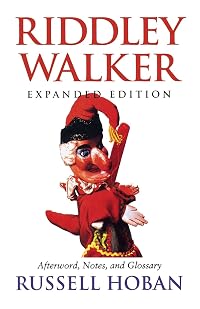
Riddley Walker: Expanded Edition
by Russell Hoban
On This Page
Description
Riddley Walker is a brilliant, unique, completely realized work of fiction. One reads it again and again, discovering new wonders every time through. Set in a remote future in a post-nuclear holocaust England (Inland), Hoban has imagined a humanity regressed to an iron-age, semi-literate state, and invented a language to represent it. Riddley is at once the Huck Finn and the Stephen Dedalus of his culture: rebel, change agent, and artist. Read this masterpiece of 20th century literature show more again or for the first time. show lessTags
Recommendations






Member Reviews
## Ful of the Moon Ful of the Moon,
## Ful of the Moon nor dont look back
## Folleree Folleroo on your track
## Oo hoo hoo Yoop yaroo
## Folleree Folleroo follering you
## If they catch you in the darga,
## Arga Warga
Reading Riddley Walker has been one of the most profound and moving experiences I've ever had with literature. Every sentence and every word stuck to me, and I couldn't help but want to get lost in the corrupted language.
[N.B. This review includes images, and was formatted for my site, dendrobibliography -- located here.]
Some 2347 years, give or take, after a nuclear holocaust has wiped out our present civilization, the world's been stagnating in its earliest stages. Riddley Walker's is a text written by its eponymous connexion show more man after his naming day (i.e., 12th birthday), which means the text is written in a form of English quite transformed from our own. His short-lived role of connexion man ties him as a go-between to the ruling elite of the local Inland and Eusa folk. In a dead world with no electricity, communications, methods of transportation, science, literature, &c., he’s trained to translate the Mincery’s (‘Ministry’) puppet renditions of Punch & Pooty (‘Judy’) shows and the teachings of Eusa (‘St. Eustace,’ taken from the Cambry (‘Canterbury’) cathedral).
Eusa’s dynamic teachings are the foundation for moral authority across the Inland (present-day Kent). He was, once upon a time, a religious martyr responsible for the 1 Big 1--tricked by the devil (‘Mr Clevver’) into splitting the atom (‘Little Shynin Man the Addom’) and causing the final holocaust. His head is spoken of as still speaking law at the mysterious island of Ram, where the ruling elite presumably live and dole out the Mincery’s law through puppet theater. His guilt is a guilt of a society driven by knowledge and power to be self-destructive, and it’s a guilt carried by the Eusa folk of Riddley’s time. Like many religious followers, the Eusa folk carry the suffering of Eusa in both physical and psychological mutations--their emotions form a telepathic connection between one another, and often packs of wild dogs. Riddley, as part of his connexion duties, has one version of Eusa’s Story and its core teachings memorized. The memorized text he uses for his work reflects modern religions: Its teachings were written long after the existence of Eusa, but centuries before Riddley Walker recites them, and the language itself is slightly less corrupted compared to the language the current Inlanders speak.
Punch & Judy pop up with significant influence throughout the book. At times, the creepy rebelliousness of Mr Punch is literally channeled through Riddley, who carries a pre-war, rotten Punch doll as a charm. For the central conflict, we even get a full performance of Punch & Judy mythologized for the people of the Inland. (Despite its unoriginality, that ranks among my favorite passages from any novel. I highly recommend those unfamiliar to give Neil Gaiman’s Tragical Comedy or Comical Tragedy of Mr Punch a look-see first. I’d wager his creepy graphic novel knowingly takes a lot from Hoban’s use of the doll.)
Riddley Walker’s difficult at times, but is balanced enough between catchy lyricism and a Joycean nightmare that its messy style is more a boon than a distraction. Even though the language is of its own world, its vocabulary is as limited as the culture employing it. Keeping it simple, then, Hoban has riddled the language with as many layers and allusions as he could. You still have to slow down, but at least you'll want to--and ain't that a clear sign of great writing if ever there was one! (Indeed, the 1998 edition features an afterword by the author, with a sample from his first draft written in standard English. It carries little of the published novel's weight.)
While some guiding themes are built from typical Cold War fears, they're written in a way that effects a timelessness in this new mythology Hoban created. The corruption of language, and mythopoeic reconstruction of a moral belief system in this future Dark Age keeps Walker's text from feeling dated by Cold War ideology and its technological trappings. E.g., the Inland's folklore is often peppered with broken references to science and technology, but the backwards, '70s understanding of it benefits the backwards state of the Inland society. Puter Leat is Computer Elite; Belnot Phist is Nobel Physicist; 1stoan Phist is Einstein Physicist; and--a favorite--the sovereign galaxies and nebulae above are the sarvering gallack seas and flaming nebyul eye.
Knowledge is the currency of power in the Inland, particularly the lost knowledge of the industrial age. This is probably why no one ever seems to be headed anywhere in Riddley Walker: They’re fighting to take Eusa’s very steps and split the Little Shynin Man once again, taking equal movements forward and back with each Ful of the Moon. Kinda sucky world, but I really wanna go back.
## Arga Warga. show less
## Ful of the Moon nor dont look back
## Folleree Folleroo on your track
## Oo hoo hoo Yoop yaroo
## Folleree Folleroo follering you
## If they catch you in the darga,
## Arga Warga
Reading Riddley Walker has been one of the most profound and moving experiences I've ever had with literature. Every sentence and every word stuck to me, and I couldn't help but want to get lost in the corrupted language.
[N.B. This review includes images, and was formatted for my site, dendrobibliography -- located here.]
Some 2347 years, give or take, after a nuclear holocaust has wiped out our present civilization, the world's been stagnating in its earliest stages. Riddley Walker's is a text written by its eponymous connexion show more man after his naming day (i.e., 12th birthday), which means the text is written in a form of English quite transformed from our own. His short-lived role of connexion man ties him as a go-between to the ruling elite of the local Inland and Eusa folk. In a dead world with no electricity, communications, methods of transportation, science, literature, &c., he’s trained to translate the Mincery’s (‘Ministry’) puppet renditions of Punch & Pooty (‘Judy’) shows and the teachings of Eusa (‘St. Eustace,’ taken from the Cambry (‘Canterbury’) cathedral).
Eusa’s dynamic teachings are the foundation for moral authority across the Inland (present-day Kent). He was, once upon a time, a religious martyr responsible for the 1 Big 1--tricked by the devil (‘Mr Clevver’) into splitting the atom (‘Little Shynin Man the Addom’) and causing the final holocaust. His head is spoken of as still speaking law at the mysterious island of Ram, where the ruling elite presumably live and dole out the Mincery’s law through puppet theater. His guilt is a guilt of a society driven by knowledge and power to be self-destructive, and it’s a guilt carried by the Eusa folk of Riddley’s time. Like many religious followers, the Eusa folk carry the suffering of Eusa in both physical and psychological mutations--their emotions form a telepathic connection between one another, and often packs of wild dogs. Riddley, as part of his connexion duties, has one version of Eusa’s Story and its core teachings memorized. The memorized text he uses for his work reflects modern religions: Its teachings were written long after the existence of Eusa, but centuries before Riddley Walker recites them, and the language itself is slightly less corrupted compared to the language the current Inlanders speak.
Punch & Judy pop up with significant influence throughout the book. At times, the creepy rebelliousness of Mr Punch is literally channeled through Riddley, who carries a pre-war, rotten Punch doll as a charm. For the central conflict, we even get a full performance of Punch & Judy mythologized for the people of the Inland. (Despite its unoriginality, that ranks among my favorite passages from any novel. I highly recommend those unfamiliar to give Neil Gaiman’s Tragical Comedy or Comical Tragedy of Mr Punch a look-see first. I’d wager his creepy graphic novel knowingly takes a lot from Hoban’s use of the doll.)
Riddley Walker’s difficult at times, but is balanced enough between catchy lyricism and a Joycean nightmare that its messy style is more a boon than a distraction. Even though the language is of its own world, its vocabulary is as limited as the culture employing it. Keeping it simple, then, Hoban has riddled the language with as many layers and allusions as he could. You still have to slow down, but at least you'll want to--and ain't that a clear sign of great writing if ever there was one! (Indeed, the 1998 edition features an afterword by the author, with a sample from his first draft written in standard English. It carries little of the published novel's weight.)
While some guiding themes are built from typical Cold War fears, they're written in a way that effects a timelessness in this new mythology Hoban created. The corruption of language, and mythopoeic reconstruction of a moral belief system in this future Dark Age keeps Walker's text from feeling dated by Cold War ideology and its technological trappings. E.g., the Inland's folklore is often peppered with broken references to science and technology, but the backwards, '70s understanding of it benefits the backwards state of the Inland society. Puter Leat is Computer Elite; Belnot Phist is Nobel Physicist; 1stoan Phist is Einstein Physicist; and--a favorite--the sovereign galaxies and nebulae above are the sarvering gallack seas and flaming nebyul eye.
Knowledge is the currency of power in the Inland, particularly the lost knowledge of the industrial age. This is probably why no one ever seems to be headed anywhere in Riddley Walker: They’re fighting to take Eusa’s very steps and split the Little Shynin Man once again, taking equal movements forward and back with each Ful of the Moon. Kinda sucky world, but I really wanna go back.
## Arga Warga. show less
It is a sad truth that if we ever lost the modern world with its electricity and all its communications infrastructure then within 3 generations we would be reduced to superstitious primitives surrounded by unfathomable artefacts.
If anyone could describe what the artefacts once did they would not be believed.
This one of those books that has had a profound impact on me.
I can say truly that this is one of the best books I have ever read, and I have read it several times.
First off it is written in a dystopian dialect of English that can make the beginning a bit difficult. But as you go through light bulbs flash on in your head as you "get" another word. It is set in Kent and the place names are names like
Basically, set in a post nuclear Britain, groups of people subsist in primitive compounds to protect them from the packs of wild dogs and other creatures. The olden times are remembered but only in a mystical, broken way. Everyone seems to talk in riddles and parables. They live in a dark age and know it.
Their lives are equal part ritual and equal part toil. It is a fragmented, superstitious world.
Riddley Walker is born into this and then one day something happens that changes everything. This is the story of Riddley Walker's journey
Every time I've read it more becomes apparent, it is composed of many layers od both narrative and meaning. It truly is a masterwork.
Here is a snippet that I think relates to ageing and a point in time when you can feel that your body is no longer what it was.
"Some times we dont fit. Some times it cant fynd the arm hoals and it tears us a part. I dont think I took all that much noatis of it when I ben yung. Now Im old I noatis it mor. It dont realy like to put me on no mor. Every morning I can feal how its tiret of me and readying to throw me a way. Iwl tel you some thing Riddley and keap this in memberment. What ever it is we dont come naturel to it. I said, Lorna I dont know what you mean. She said, We aint a naturel part of it. We dint begin when it begun we dint begin where it begun. It ben here befor us nor I dont know what we are to it. May be weare jus only sickness and a feaver to it or boyls on the arse of it I dont know. Now lissen what Im going to tel you Riddley. It thinks us but it dont think like us. It dont think the way we think. Plus like I said befor its afeart. I said, Whats it afeart of? She said, Its afeart of being beartht. I said, How can that be? You said it ben here befor us. If it ben here all this time it musve ben beartht some time. She said, No it aint ben beartht it never does get beartht its all ways in the woom of things its all ways on the road"
"People ask me how I got from St. Eustace to Riddley Walker and all I can say is that it's a matter of being friends with your head. Things come into the mind and wait to hook up with other things; there are places that can heighten your responses, and if you let your head go its own way it might, with luck, make interesting connections."
in "Riddley Walker by Russell Hoban
I was initially a doubter, even a hater of “Riddley Walker.” Thanks to this great RG and many friends from TLS, I was converted to a great admirer of Hoban and a mega fan of this extraordinary book. In the end, it has worked for me on every level. But I shall only comment on its spirituality from the angle of eastern mysticism, the most satisfying aspect for me.
The show more first major influence for our 12-year old hero is tel-woman Lorna. Her teaching is the 1st Knowing, the pure awareness at the background of all sense perceptions, thoughts and emotions. Riddley becomes in tune with this force of nature, that is generally obsured in humans by the over-busy mynding, programing, trying to outmanoeuvre the others, eg Goodparley for the Big Power. Riddley is able to tune out, of the human mind, to listen for directions from the 1st Knowing. He can be dog friendly, and later, is chosen by the dog leader, his nexters and the pack who eventually follow him and become his hevvys, while Ardship of Cambry is dropped. This is the great indicator that the Force is with Riddley.
But he is also almost lost to the resistible pull of the dark force when he senses the past Big Power at the now ruined Power Ring. There is a most powerful scene summarized like this: 'Not jus my coc* but all of me it wer like all of me wer coc* and all the worl a cun* and open to me.' That's the Power all the players succumb to: look at Abel, after losing everything and his eyes, once he knows Granser can make 1 Littl 1 happen, he forgets all and wants a piece of that Power again. But not Riddley, it is meant to be he cudnt hol it at the Power Ring, and he discovers the True meaning of the hart of the wud in the hart of the stoan: 'Onlyes Power if No Power'. Later he realises more: 'Its the not struggling for Power that’s where the Power is.' He stays away from Granser's experiment when they gone bang.
But the most important spiritual teaching is here when Riddley contemplates his one connexion experience: 'I begun with trying to pul it to gether poal by poal only my reveal dint come that way it snuck me woaly...Ready to cry ready to dy ready for any thing is how I come to it now. In fear and tremmering only not running a way. In emtyness and ready to be fult. Not to lern no body nothing I cant even lern my oan self all I can do is try not to get in front of whats coming. Jus trying to keep out of the way of it.'
And the final realization that: ' Or may be there aint no such thing as a 1 Big 1 or a Littl 1 its jus only all 1 and what diffrent things you see in the chayjing lites of the diffrent times of the girt dants of the every thing. Sum tyms bytin sum tyms bit.' In this light, what does it matter if Walker & Orfing are roading the New Show - the awful Punch show, them dogs are following, and new followers are attracted like Rightway and his brother, 'They boath of them have wives and childer the woal lot roadit out with us they jus slung ther bundels and a way.' I know I will if I wer there.
I think RW is like concentrated juice. You have to gradually dilute it to see all the intertwined themes and images it contains. Hoban has boiled down his original five hundred pages without losing any of the vitamins.
In Riddley's culture he is a young adult: we learn on page 1 that "my naming day when I come 12" is "the day I come a man". More importantly, Riddley's language is not badly-written modern English. Spelling, grammar, punctuation and word usage are completely consistent, except when Riddley is accurately reproducing what (to him) are ancient texts. You might ask whether it's realistic that a twelve-year old in any society could pull this off, but it's a literary convention that young protagonists tell their story without committing childish errors of language. Besides, Riddley is unusually smart. As Fister Crunchman tells him: "I aint no where near as qwick as you. Your myndy dont you see." The rest of this conversation shows us that despite his own protests Fister himself is pretty sharp.
The language is what makes this book, working at multiple levels. For a start, it gives the reader an instant sense of estrangement, telling us from the first line, at a gut level, that we are in a world very different from ours. Then, as Hoban has said, the difficulty of reading it slows the reader down to Riddley's own speed, and it makes you read unusually carefully. Like many science fiction novels, Riddley Walker has to tell many stories at once: as well as the surface plot, it has to describe Riddley's world and how it came to be. While some of this is done by the traditional stories Riddley tells us, a lot is told by the language itself. We don't need Lorna to tell us that "bint no writing for 100s and 100s of years" because it's obvious that spelling has been lost and re-invented. The fact that the language is full of computing metaphors tells us that the 1 Big 1 happened quite a long time in the future of the mid-'70s when it was written. Words like "crowd" for tribe and "hevvy" for warrior clue us in to how this society emerged from ours in the Bad Time.
The language of Riddley Walker is often described as broken or degenerate, but I think it has just evolved. Words have shifted and changed their meaning due to creative misunderstanding, but that's what drives language change all the time. Of course, with the loss of written literature, a lot of vocabulary have been lost ("I dont even know 1/2 these words" says Riddley, and neither does Goodparley, despite having access to all the Mincery's records). In modern English we usually have several words for a concept, each with its own overtones. For Riddley, it's the other way round: each word is overloaded with different meanings. No doubt this encourages his mystical bent. It also makes the text deeply poetic (along with Riddley's (or Hoban's) natural bent) which is why for many readers it lingers long in the mind.
NB: Review written a la Hoban. show less
in "Riddley Walker by Russell Hoban
I was initially a doubter, even a hater of “Riddley Walker.” Thanks to this great RG and many friends from TLS, I was converted to a great admirer of Hoban and a mega fan of this extraordinary book. In the end, it has worked for me on every level. But I shall only comment on its spirituality from the angle of eastern mysticism, the most satisfying aspect for me.
The show more first major influence for our 12-year old hero is tel-woman Lorna. Her teaching is the 1st Knowing, the pure awareness at the background of all sense perceptions, thoughts and emotions. Riddley becomes in tune with this force of nature, that is generally obsured in humans by the over-busy mynding, programing, trying to outmanoeuvre the others, eg Goodparley for the Big Power. Riddley is able to tune out, of the human mind, to listen for directions from the 1st Knowing. He can be dog friendly, and later, is chosen by the dog leader, his nexters and the pack who eventually follow him and become his hevvys, while Ardship of Cambry is dropped. This is the great indicator that the Force is with Riddley.
But he is also almost lost to the resistible pull of the dark force when he senses the past Big Power at the now ruined Power Ring. There is a most powerful scene summarized like this: 'Not jus my coc* but all of me it wer like all of me wer coc* and all the worl a cun* and open to me.' That's the Power all the players succumb to: look at Abel, after losing everything and his eyes, once he knows Granser can make 1 Littl 1 happen, he forgets all and wants a piece of that Power again. But not Riddley, it is meant to be he cudnt hol it at the Power Ring, and he discovers the True meaning of the hart of the wud in the hart of the stoan: 'Onlyes Power if No Power'. Later he realises more: 'Its the not struggling for Power that’s where the Power is.' He stays away from Granser's experiment when they gone bang.
But the most important spiritual teaching is here when Riddley contemplates his one connexion experience: 'I begun with trying to pul it to gether poal by poal only my reveal dint come that way it snuck me woaly...Ready to cry ready to dy ready for any thing is how I come to it now. In fear and tremmering only not running a way. In emtyness and ready to be fult. Not to lern no body nothing I cant even lern my oan self all I can do is try not to get in front of whats coming. Jus trying to keep out of the way of it.'
And the final realization that: ' Or may be there aint no such thing as a 1 Big 1 or a Littl 1 its jus only all 1 and what diffrent things you see in the chayjing lites of the diffrent times of the girt dants of the every thing. Sum tyms bytin sum tyms bit.' In this light, what does it matter if Walker & Orfing are roading the New Show - the awful Punch show, them dogs are following, and new followers are attracted like Rightway and his brother, 'They boath of them have wives and childer the woal lot roadit out with us they jus slung ther bundels and a way.' I know I will if I wer there.
I think RW is like concentrated juice. You have to gradually dilute it to see all the intertwined themes and images it contains. Hoban has boiled down his original five hundred pages without losing any of the vitamins.
In Riddley's culture he is a young adult: we learn on page 1 that "my naming day when I come 12" is "the day I come a man". More importantly, Riddley's language is not badly-written modern English. Spelling, grammar, punctuation and word usage are completely consistent, except when Riddley is accurately reproducing what (to him) are ancient texts. You might ask whether it's realistic that a twelve-year old in any society could pull this off, but it's a literary convention that young protagonists tell their story without committing childish errors of language. Besides, Riddley is unusually smart. As Fister Crunchman tells him: "I aint no where near as qwick as you. Your myndy dont you see." The rest of this conversation shows us that despite his own protests Fister himself is pretty sharp.
The language is what makes this book, working at multiple levels. For a start, it gives the reader an instant sense of estrangement, telling us from the first line, at a gut level, that we are in a world very different from ours. Then, as Hoban has said, the difficulty of reading it slows the reader down to Riddley's own speed, and it makes you read unusually carefully. Like many science fiction novels, Riddley Walker has to tell many stories at once: as well as the surface plot, it has to describe Riddley's world and how it came to be. While some of this is done by the traditional stories Riddley tells us, a lot is told by the language itself. We don't need Lorna to tell us that "bint no writing for 100s and 100s of years" because it's obvious that spelling has been lost and re-invented. The fact that the language is full of computing metaphors tells us that the 1 Big 1 happened quite a long time in the future of the mid-'70s when it was written. Words like "crowd" for tribe and "hevvy" for warrior clue us in to how this society emerged from ours in the Bad Time.
The language of Riddley Walker is often described as broken or degenerate, but I think it has just evolved. Words have shifted and changed their meaning due to creative misunderstanding, but that's what drives language change all the time. Of course, with the loss of written literature, a lot of vocabulary have been lost ("I dont even know 1/2 these words" says Riddley, and neither does Goodparley, despite having access to all the Mincery's records). In modern English we usually have several words for a concept, each with its own overtones. For Riddley, it's the other way round: each word is overloaded with different meanings. No doubt this encourages his mystical bent. It also makes the text deeply poetic (along with Riddley's (or Hoban's) natural bent) which is why for many readers it lingers long in the mind.
NB: Review written a la Hoban. show less
This is one of my favorite books ever. Probably not everyone's cup of tea, but it sure is immersive and unique. By the end of my reading experience, I felt like I knew Riddley Walker (the character) better than most if not all characters that have ever narrated a novel -- because we're getting to know Riddley not only through his voice but also through the language itself. There's a lot of dark humor in the book, and there's a lot of darkness too. There's also some of the best dialogue ever. It's one of the most realistic post-apocalyptic books I've read (meaning Riddley's life does not ever become a fun adventure romp). Best way to read this book, in my opinion:
*read it very slowly.
*take a lot of notes.
*read each chapter several show more times (ideally your notes would be a different color pen each time).
*take a look at Riddley Walker annotation page https://www.errorbar.net/rw/
*read it with a friend and discuss weekly. show less
*read it very slowly.
*take a lot of notes.
*read each chapter several show more times (ideally your notes would be a different color pen each time).
*take a look at Riddley Walker annotation page https://www.errorbar.net/rw/
*read it with a friend and discuss weekly. show less
'The onlyes power is no power. Wel now I sust that wernt qwite it. It aint that its no power. Its the not strurgling for power."
An extraordinary novel of imagination, craft, and heart. What happens when those of us that remain find ourselves wandering stunned and lost? Debating fight or flight? Measuring the degree to which moving on matters? If we're lucky we discover the moment, we release the ego, we let go and find acceptance. We embrace the only dance there is. I loved this book.
An extraordinary novel of imagination, craft, and heart. What happens when those of us that remain find ourselves wandering stunned and lost? Debating fight or flight? Measuring the degree to which moving on matters? If we're lucky we discover the moment, we release the ego, we let go and find acceptance. We embrace the only dance there is. I loved this book.
this post-apocalyptic tale told in the first-person by one Riddley Walker, weaves together mythology, religion, cultural evolution and transmission, and an exploration of humankind's violent nature when in competition with itself. the barren landscape, hints at a time just after the devastation of the planet when cannibalistic practices held sway and humankind foundered is reminiscent of Cormac McCarthy's The Road in its unflinching starkness and sense of melancholy buoyed by an underlying sense of dogged hope through perseverance. but probably the most interesting aspect of this book is the way it as written.
Hoban is often credited with creating a "new language" for the book. technically, this is not so. what he did was spell common show more English words more phonetically (from a Kentish accent) and parse them a little differently for meaning. if anything, he created a new dialect of English not a new language. akin to Anthony Burgess's A Clockwork Orange's use of language.
A couple of examples:
"What ben makes tracks for what wil be. Words in the air pirnt foot steps on the groun for us to put our feet in to."
"Becaws the manying and the millying its all 1 thing it dont have nothing to gether with. You look at lykens on a stoan its all them tiny manyings of it and may be each part of it myt think its sepert only we can see its all 1 thing. Thats how it is with what we are its all 1 girt big thing and divvyt up amongst the many. Its all 1 girt thing bigger nor the worl and lorn and loan and oansome. Tremmering it is and feart. It puts us on like we put on our cloes. Some times we dont fit. Some times it cant fynd the arm hoals and it tears us a part."
the language is supposed to reflect the linguistic evolution of English after 2000 years but i think it does not represent that process in a realistic manner. most of the changes to English come in the form of spelling changes because when you read the book out loud, you can readily understand what is being said apart from a few idiosyncratic phrases that are easy enough to figure out. no, the language does its job best by creating a sense of difference between the world of the reader and the world of the book. that is, it lets you know with each and every sentence that the world you're reading about is very different from what you're used to. it installs a sense of suspense in that Riddley's world becomes clearer as you become more familiar with the language. what's actually happening slowly fades to coherence as the language becomes less of a veil pulled across the reader's eyes.
this only adds to the theme running through the book of breaking and splitting and lessening but wanting more. just as the society Riddley lives in is a broken version of what came some 2347 years before when the "Puter Leat" (ie the computer elite) ruled the world in "Eusa's" name with "clevverness" before the "1 Big 1," (a nuclear bomb or war) so does their language. many words and phrases are broken apart into their constituent syllables- "Wes Mincer," "sir prises," "to gether"- reflecting this breaking of society and knowledge. the whole plot is counterpoint to this central trope as Riddley becomes aware of actions being taken by others within his world to regain the "clevverness" and build weapons again despite a prohibition on being "clevver" handed down to the people by the "Pry Mincer" and his "hevvies." in many ways, this reminds me of the Butlerian Jihad in Frank Herbert's Dune where they banned all thinking machines for fear of the machines rising against humanity again. in Riddley's world, this quasi-religious prohibition against technology and exploration is promulgated by a traveling Punch-n-Judy style puppet show that conveys its message of the dangers of being too clever in mythic tones derived largely from the St. Eustace hagiography and medieval mystery plays.
many of the names and stories told within the book are rich with symbolism and meaning, too. Riddley Walker himself, the main character and from who's point of view this tale is told, becomes the "connexion man" for his group when his father dies and then sets about on a journey to make actual connections-- that is, as far as i could glean, to make sense of the world and help everyone interpret meaning in the myths they tell one another and make sense of real-world occurrences. in other words, the main character steps outside of the typical person of his world and is, thus, a kind of "riddle" to them. because he is searching for knowledge and wisdom and justice, he is also full of holes in his understanding and, thus, "riddle-y" as in riddled with holes. forming that adjective in just that way fits exactly with the language in the book. his last name is "walker" and that is what he does: walks about "Inland" (ie England) looking for Truth and "clevverness."
while the language makes it hard to follow some of the actions, especially at first, this is a book that deserves a second or maybe even a third read because of the poignant tale it tells of humanity's bleak future and how we might cope with it. show less
Hoban is often credited with creating a "new language" for the book. technically, this is not so. what he did was spell common show more English words more phonetically (from a Kentish accent) and parse them a little differently for meaning. if anything, he created a new dialect of English not a new language. akin to Anthony Burgess's A Clockwork Orange's use of language.
A couple of examples:
"What ben makes tracks for what wil be. Words in the air pirnt foot steps on the groun for us to put our feet in to."
"Becaws the manying and the millying its all 1 thing it dont have nothing to gether with. You look at lykens on a stoan its all them tiny manyings of it and may be each part of it myt think its sepert only we can see its all 1 thing. Thats how it is with what we are its all 1 girt big thing and divvyt up amongst the many. Its all 1 girt thing bigger nor the worl and lorn and loan and oansome. Tremmering it is and feart. It puts us on like we put on our cloes. Some times we dont fit. Some times it cant fynd the arm hoals and it tears us a part."
the language is supposed to reflect the linguistic evolution of English after 2000 years but i think it does not represent that process in a realistic manner. most of the changes to English come in the form of spelling changes because when you read the book out loud, you can readily understand what is being said apart from a few idiosyncratic phrases that are easy enough to figure out. no, the language does its job best by creating a sense of difference between the world of the reader and the world of the book. that is, it lets you know with each and every sentence that the world you're reading about is very different from what you're used to. it installs a sense of suspense in that Riddley's world becomes clearer as you become more familiar with the language. what's actually happening slowly fades to coherence as the language becomes less of a veil pulled across the reader's eyes.
this only adds to the theme running through the book of breaking and splitting and lessening but wanting more. just as the society Riddley lives in is a broken version of what came some 2347 years before when the "Puter Leat" (ie the computer elite) ruled the world in "Eusa's" name with "clevverness" before the "1 Big 1," (a nuclear bomb or war) so does their language. many words and phrases are broken apart into their constituent syllables- "Wes Mincer," "sir prises," "to gether"- reflecting this breaking of society and knowledge. the whole plot is counterpoint to this central trope as Riddley becomes aware of actions being taken by others within his world to regain the "clevverness" and build weapons again despite a prohibition on being "clevver" handed down to the people by the "Pry Mincer" and his "hevvies." in many ways, this reminds me of the Butlerian Jihad in Frank Herbert's Dune where they banned all thinking machines for fear of the machines rising against humanity again. in Riddley's world, this quasi-religious prohibition against technology and exploration is promulgated by a traveling Punch-n-Judy style puppet show that conveys its message of the dangers of being too clever in mythic tones derived largely from the St. Eustace hagiography and medieval mystery plays.
many of the names and stories told within the book are rich with symbolism and meaning, too. Riddley Walker himself, the main character and from who's point of view this tale is told, becomes the "connexion man" for his group when his father dies and then sets about on a journey to make actual connections-- that is, as far as i could glean, to make sense of the world and help everyone interpret meaning in the myths they tell one another and make sense of real-world occurrences. in other words, the main character steps outside of the typical person of his world and is, thus, a kind of "riddle" to them. because he is searching for knowledge and wisdom and justice, he is also full of holes in his understanding and, thus, "riddle-y" as in riddled with holes. forming that adjective in just that way fits exactly with the language in the book. his last name is "walker" and that is what he does: walks about "Inland" (ie England) looking for Truth and "clevverness."
while the language makes it hard to follow some of the actions, especially at first, this is a book that deserves a second or maybe even a third read because of the poignant tale it tells of humanity's bleak future and how we might cope with it. show less
Breathtaking - on reflection I might have to upgrade with another star. I love books written in dialect and while Hoban has created the language of Riddley Walker's far future time, he's done such a great job that it has all the depth of a real language. I also love that I had no idea where the book was going from the start right to the end. While the narrator becomes a man on the first page he's only 12 and no more than a few weeks older by the end, but the book never for a moment slips into Young Adult mode. Brilliant.
Members
- Recently Added By
Author Information

Russell Hoban was born in Lansdale, Pennsylvania on February 4, 1925. He attended art school in Philadelphia and during World War II, he served in the Army and earned a Bronze Star. He taught art in New York and Connecticut, and also worked as an advertising copywriter and a freelance illustrator before beginning his career as a writer. He began show more publishing children's books in the late 1950s, including What Does It Do and How Does It Work?, Bedtime for Frances and the six other books featuring Frances, The Story of Hester Mouse Who Became a Writer, What Happened When Jack and Daisy Tried to Fool the Tooth Fairies, and The Mouse and His Child, which was adapted as an animated film in 1977. In 1973, he published his first adult novel, The Lion of Boaz-Jachin and Jachin-Boaz. His other books for adults include Turtle Diary, Pilgermann, and Ridley Walker. He received the John W. Campbell Memorial Award and the Australian Science Fiction Achievement Award for Ridley Walker. He died on December 13 at the age of 86. In 2015 he made the Kate Greenaway Medal shortlist for his title Jim's Lion wth illlustrator Alexis Deacon. (Bowker Author Biography) show less
Some Editions
Work Relationships
Is an expanded version of
Common Knowledge
- Canonical title
- Riddley Walker: Expanded Edition
- Important places
- Kent, England, UK
- Original language
- English
- Canonical DDC/MDS
- 813.0876220
Classifications
- Genres
- Fiction and Literature, Science Fiction, General Fiction
- DDC/MDS
- 813.0876220 — Literature & rhetoric American literature in English American fiction in English By type Genre fiction Adventure fiction Speculative fiction Science fiction Post-apocalypse Nuclear apocalypse
- LCC
- PS3558 .O336 .R5 — Language and Literature American literature American literature Individual authors 1961-
- BISAC
Statistics
- Members
- 1,464
- Popularity
- 15,908
- Reviews
- 54
- Rating
- (4.13)
- Languages
- English
- Media
- Paper, Ebook
- ISBNs
- 3
- ASINs
- 3