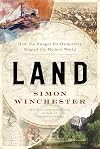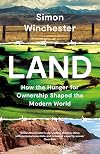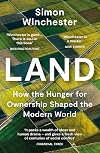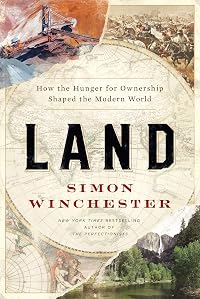
Land: How the Hunger for Ownership Shaped the Modern World
by Simon Winchester
On This Page
Description
The author of The Professor and the Madman and The Perfectionists explores the notion of property-our proprietary relationship with the land-through human history, how it has shaped us and what it will mean for our future. Land-whether meadow or mountainside, desert or peat bog, parkland or pasture, suburb or city-is central to our existence. It quite literally underlies and underpins everything. Employing the keen intellect, insatiable curiosity, and narrative verve that are the foundations show more of his previous bestselling works, Simon Winchester examines what we human beings are doing-and have done-with the billions of acres that together make up the solid surface of our planet. Land: The Ownership of Everywhere examines in depth how we acquire land, how we steward it, how and why we fight over it, and finally, how we can, and on occasion do, come to share it. Ultimately, Winchester confronts the essential question: who actually owns the world's land-and why does it matter? show lessTags
Recommendations






Member Recommendations
M_Clark Neil Oliver's History of Scotland covers a lot of the same issues as part of his explanation of Scotland's history. Also, both books start with Earth as a molten mass followed by continental drift.
M_Clark David Graeber's book talks about the motivation for paying property taxes as a means to assert and conserve ownership of property.
M_Clark Ramp Hollow talks about land ownership within the context of the settlement of Appalachia. It also explains that the Appalachian forests were treated as commons by the earliest settlers.
Member Reviews
TL/DR: Comprehensive, engaging and enlightening, though the stories covered are a bit hit or miss. The subtitle - “How the hunger for ownership shaped the modern world” gave expectations that the book did not fulfill. I found no discourse tying the stories back to the “hunger for ownership”. Nor is there an overarching argument why the shape of the modern world is either good or bad because of it, though which side the author comes down on that question comes through in the stories he chooses to tell. In the end the book is a collection of stories rather than a cohesive essay.
********************
This book sets out to tell us the story (or stories) of land - why it has meaning and value, what rules people have drawn up over time show more about its use and ownership, how much of it there is, how it's been mapped, how it’s been lived upon, divided, stewarded, stolen, exploited & restored, and fought over. It’s a sizable topic that Simon Winchester tackles here. He does a good job of laying out all of the things that might come to mind when thinking of “land” and then wrapping stories around them.
Winchester starts with the story of his own land. Toward the end of the last century Winchester purchased “123¼ acres of forested and rocky mountainside, located in the hamlet of Wassaic, in the village of Amenia, the town of Dover, the county of Dutchess, in the state of New York.” He is the first person in his family to own title to land, leaving aside his father’s “postage stamp” sized land back in the UK, purchased in retirement, where a humble cottage stood.
The Duchess County land that Winchester owns was originally peopled by Native Americans, most recently the Mohicans and Schaghticoke. Dutch settlers came next, followed by English, and then Americans - immigrants from Germany and Italy among them. The land was divided and subdivided and brought back together again over time. Its inhabitants held it in various types of ownership - from no particular sense of “owning” land right up to today’s deeded property with all the rights associated with that.
From his own land Winchester moves on to stories from, predominantly, the United States and the former British Empire. Winchester is a British American and he grounds this book in British ideas and rules about land. He tells stories of the UK origins of some of today’s notions around the ownership and use of land. Whether those are definitively THE origins, or simply the traditional British origins Winchester doesn’t distinguish. It does become a bit heavy handed at times. Reading this book, you might get the impression that the plow was invented in the British Isles, rather than in the Fertile Crescent, which is typically given as its birthplace.
That’s not to say that Winchester is comfortable with, or a proponent of, the rules and traditions he writes about. He’s dedicated the book to the Indian Chief Standing Bear, saying “In 1879 the U.S. government declared this Ponca chief to be a “person” under the law. But they still took away his lands.” His sympathy for the common usage of land comes clearly through, whether it's in the story of allowing deer hunters on his own land in New York, or stories of aboriginal peoples and their traditional land use methods, or stories around the system of lordly landholdings and “commons” that predominated in feudal Britain and has lasted almost to this day.
The hardcover edition is 464 pages including glossary, bibliography and index. Despite that length and Winchester’s thoroughness and erudition, I’m afraid in the end the book is not the overarching essay on “Land” that you would expect from the ambitious title and subtitle. It is though, for the most part, an engaging set of stories.
I listened to the audiobook. If you are interested in tackling this book, I think audio may be the way to go. You get a stronger sense of the Britishness of these ideas about land from listening to the author’s accent and intonations as he narrates. And he just has a voice that you could listen to for hours. show less
********************
This book sets out to tell us the story (or stories) of land - why it has meaning and value, what rules people have drawn up over time show more about its use and ownership, how much of it there is, how it's been mapped, how it’s been lived upon, divided, stewarded, stolen, exploited & restored, and fought over. It’s a sizable topic that Simon Winchester tackles here. He does a good job of laying out all of the things that might come to mind when thinking of “land” and then wrapping stories around them.
Winchester starts with the story of his own land. Toward the end of the last century Winchester purchased “123¼ acres of forested and rocky mountainside, located in the hamlet of Wassaic, in the village of Amenia, the town of Dover, the county of Dutchess, in the state of New York.” He is the first person in his family to own title to land, leaving aside his father’s “postage stamp” sized land back in the UK, purchased in retirement, where a humble cottage stood.
The Duchess County land that Winchester owns was originally peopled by Native Americans, most recently the Mohicans and Schaghticoke. Dutch settlers came next, followed by English, and then Americans - immigrants from Germany and Italy among them. The land was divided and subdivided and brought back together again over time. Its inhabitants held it in various types of ownership - from no particular sense of “owning” land right up to today’s deeded property with all the rights associated with that.
From his own land Winchester moves on to stories from, predominantly, the United States and the former British Empire. Winchester is a British American and he grounds this book in British ideas and rules about land. He tells stories of the UK origins of some of today’s notions around the ownership and use of land. Whether those are definitively THE origins, or simply the traditional British origins Winchester doesn’t distinguish. It does become a bit heavy handed at times. Reading this book, you might get the impression that the plow was invented in the British Isles, rather than in the Fertile Crescent, which is typically given as its birthplace.
That’s not to say that Winchester is comfortable with, or a proponent of, the rules and traditions he writes about. He’s dedicated the book to the Indian Chief Standing Bear, saying “In 1879 the U.S. government declared this Ponca chief to be a “person” under the law. But they still took away his lands.” His sympathy for the common usage of land comes clearly through, whether it's in the story of allowing deer hunters on his own land in New York, or stories of aboriginal peoples and their traditional land use methods, or stories around the system of lordly landholdings and “commons” that predominated in feudal Britain and has lasted almost to this day.
The hardcover edition is 464 pages including glossary, bibliography and index. Despite that length and Winchester’s thoroughness and erudition, I’m afraid in the end the book is not the overarching essay on “Land” that you would expect from the ambitious title and subtitle. It is though, for the most part, an engaging set of stories.
I listened to the audiobook. If you are interested in tackling this book, I think audio may be the way to go. You get a stronger sense of the Britishness of these ideas about land from listening to the author’s accent and intonations as he narrates. And he just has a voice that you could listen to for hours. show less
Don't think I finished the book but I cannot find it 5-21-2021. Found it!!! It is a good analysis of how land throughout the world is handled - probably as much as most of us can stand to read. Enlightening and disheartening at the same time. We, as human beings, never learn. We are continually greedy, grasping, mean, and brutal. What does it take to change us?
Simon Winchester’s new book Land is aptly titled because it is so general in its study of land. The story moves from measuring the size of the earth, to mapping the earth, to differing concepts of land among diverse peoples, to some very odd border situations, to the creation of new land in the Netherlands, to the loss of land due to climate change, to the shifting legal status of land in many countries, to “Wilding” efforts, to who owns the most land today, among many other subthemes. Winchester explores shifting laws and attitudes about land in all corners of the globe, mediæval to contemporary.
The book achieves coherence by looking the many historical, social, and political developments via the lens of how it affects land or show more how land influenced those developments. It is a land-centric view of cultures past and present.
Measuring the planet is one of Winchester’s first topics. Friedrich Wilhelm Georg von Struve spent forty years measuring the size of the earth. He was fortunate when Tsar Nicholas I came to power, who was an engineer by trade before ascending to the throne. Nicholas believed in the project and provided Struve with unlimited financing to obtain the best equipment in the world, and the staff he needed to assist as he traveled across, and measured, the earth. Struve’s measurements proved very accurate—40,008,696 meters compared with NASA’s measurement of 40,007, 017 meters using satellites.
Another aspect of land is borders. The oldest extant official border in the world Andorra’s. A Minnesota border around Angle Inlet (population 123) is an odd border. Access requires driving into Canada, then circling back to re-enter the US from above and enter Angle Inlet. Winchester offers several odd border situations.
The Netherlands gets the prize for most land added by humans to the planet (1.2 million acres). Look up the Zuider Zee works, brainchild of engineer Cornelis Lely, to see how one of the official Wonders of the World provided a major expansion to the nation’s landmass. On the opposite side, the book discusses land being gradually lost due to a rising sea level, with several examples.
Winchester explores land being essentially taken from people in Scotland due to legal changes such as “enclosures” and “clearances,” at the same time when huge amounts of land were being given away to anyone who would work it in the western US. Many of those losing land in Scotland came to the US to seize the opportunity.
The book briefly looks at the largest landowners in the world, and how they use the vast resource. The book illustrates the contrasting property laws among different nations, and how many are experimenting with returning land to nature, in a wide variety of different ways.
The book discusses many other land-related fascinating facts and phenomena—too many to summarize in this review. I wholeheartedly recommend Winchester’s Land story to anyone interested in any aspect of history, as land plays a rôle in so much of it. show less
The book achieves coherence by looking the many historical, social, and political developments via the lens of how it affects land or show more how land influenced those developments. It is a land-centric view of cultures past and present.
Measuring the planet is one of Winchester’s first topics. Friedrich Wilhelm Georg von Struve spent forty years measuring the size of the earth. He was fortunate when Tsar Nicholas I came to power, who was an engineer by trade before ascending to the throne. Nicholas believed in the project and provided Struve with unlimited financing to obtain the best equipment in the world, and the staff he needed to assist as he traveled across, and measured, the earth. Struve’s measurements proved very accurate—40,008,696 meters compared with NASA’s measurement of 40,007, 017 meters using satellites.
Another aspect of land is borders. The oldest extant official border in the world Andorra’s. A Minnesota border around Angle Inlet (population 123) is an odd border. Access requires driving into Canada, then circling back to re-enter the US from above and enter Angle Inlet. Winchester offers several odd border situations.
The Netherlands gets the prize for most land added by humans to the planet (1.2 million acres). Look up the Zuider Zee works, brainchild of engineer Cornelis Lely, to see how one of the official Wonders of the World provided a major expansion to the nation’s landmass. On the opposite side, the book discusses land being gradually lost due to a rising sea level, with several examples.
Winchester explores land being essentially taken from people in Scotland due to legal changes such as “enclosures” and “clearances,” at the same time when huge amounts of land were being given away to anyone who would work it in the western US. Many of those losing land in Scotland came to the US to seize the opportunity.
The book briefly looks at the largest landowners in the world, and how they use the vast resource. The book illustrates the contrasting property laws among different nations, and how many are experimenting with returning land to nature, in a wide variety of different ways.
The book discusses many other land-related fascinating facts and phenomena—too many to summarize in this review. I wholeheartedly recommend Winchester’s Land story to anyone interested in any aspect of history, as land plays a rôle in so much of it. show less
this was mostly interesting and definitely well researched. there were parts that i couldn't focus on or that i zoned out listening to. i think the really interesting bits will probably be different for everyone, and this is more than worth reading for those parts. i just wish the whole thing was on that level.
"'The law locks up the man or woman who steals the goose from off the common but lets the greater villain loose who steals the common of the goose.' -- Anonymous, 1821
"'The law locks up the man or woman who steals the goose from off the common but lets the greater villain loose who steals the common of the goose.' -- Anonymous, 1821
Simon Winchester sets out to tell the story of land—who owns it, how we divide it, and why it matters. What he delivers is a globe-trotting, genre-blurring wander that never quite settles down. The writing is elegant in places, but the book lacks a clear throughline, making it feel more like a series of loosely connected essays than a cohesive narrative. I didn’t come in with expectations, but I left with the sense that this sprawling topic deserved more focus. A few interesting facts, sure—but not enough to make up for the drift.
Enjoyable and interesting look at land ownership in different places and times, and especially about the social disruption caused by changes in the systems, and of course also about the iniquities of various systems. Mostly told with a wry sense of humor; but once in a while there’s a bit more preachiness than I thought required.
While I expected the book to be written on a popular level rather than an academic level, I expected the author would tackle land in a more traditional historical manner rather than by jumping from one incident to another in various parts of the world. On page 122 of 660 in the Kindle version, the author states, "No American, so far as I am aware, ever professed a deep and unsullied affection for the USGS topographical sheets that it is possible to order from government agencies. They are fine enough maps, and they cover the entirety of the nation. But seldom are they bought for the sheer pleasure of ownership, of the ability to pore over them and imagine, or remember, to draw contented admiration at their elegant appearance and show more scrupulous accuracy." My immediate thought was that he had never met a land-platting genealogist! Many purchased these maps for every location in which their ancestors lived or in which they were working for a client. Nowadays the maps are available online and most use software to plat the deeds so fewer maps are being purchased, but there are still many who prefer to own these maps. I realize the author was making a point about the availablility of Ordnance Survey maps in many places in the UK whereas they needed to be ordered from a single location in the United States, but he overstated his case. Unfortunately he exaggerated points in many places in the book. While I initially planned to purchase a copy of this pre-publication, but I'm glad I decided to read a library copy before purchasing. I do not need another dust catcher, and that's exactly what this book would do on my shelves. Its usefulness is minimal. show less
Members
- Recently Added By
Lists

Test
1 work; 1 member

Non-Fiction Worth Reading
1,016 works; 256 members

Unread books
1,063 works; 87 members

Science: Earth
109 works; 1 member
Author Information

53+ Works 38,664 Members
Simon Winchester was born in London, England on September 28, 1944. He read geology at St. Catherine's College, Oxford. After graduation in 1966, he joined a Canadian mining company and worked as field geologist in Uganda. The following year he decided to become a journalist. His first reporting job was for The Journal, Newcastle upon Tyne. In show more 1969, he joined The Guardian and was named Britain's Journalist of the Year in 1971. He also worked for the Daily Mail and the Sunday Times before becoming a freelancer. He is the author of numerous books including In Holy Terror, The River at the Center of the World, The Alice Behind Wonderland, The Professor and the Madman: A Tale of Murder, Insanity, the Making of the Oxford English Dictionary, and.Exactly: How Precision Engineers Created the Modern World. In 2006, he was made an Officer of the Order of the British Empire for services to journalism and literature. (Bowker Author Biography) show less
Common Knowledge
- Canonical title
- Land: How the Hunger for Ownership Shaped the Modern World
- Alternate titles
- Land: The Ownership of Everywhere
- Original publication date
- 2021
- Epigraph
- The first person who, having enclosed a plot of land, took it into his head to say this is mine, and found people simple enough to believe him, was the true founder of civil society. What crimes, wars, murders, what miseries... (show all) and horrors would the human race have been spared, had someone pulled up the stakes or filled in the ditch and cried out to his fellow men: "Do not listen to this imposter. You are lost if you forget that the fruits of the earth belong to all and the earth to no one!"
-Jean-Jacques Rousseau, 'Discourse on Inequality' (1755) - Dedication
- Dedicated to Chief Standing Bear
In 1879 the U.S. government declared this Ponca chief to be a "person" under the law.
But they still took away his lands. - First words
- On a warm midsummer's evening just before the end of the last century, in a book-lined lawyers' office in the pretty town of Kent, Connecticut, I handed over a check for a moderate sum in dollars to a second-generation Sicili... (show all)an American, a plumber named Cesare, who lived in the Bronx but who had driven up into the lush New England countryside especially for the brief formalities of this day.
- Last words
- (Click to show. Warning: May contain spoilers.)Nice and dark and deep, and in area six feet by three feet, exactly.
Classifications
Statistics
- Members
- 710
- Popularity
- 40,094
- Reviews
- 13
- Rating
- (3.77)
- Languages
- English, Italian
- Media
- Paper, Audiobook, Ebook
- ISBNs
- 16
- ASINs
- 4