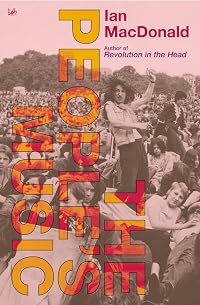
The People's Music
by Ian MacDonald
On This Page
Description
From the author of the acclaimed Revolution in the Head, Ian MacDonald takes us on a journey through the music of the sixties and seventies. Starting with one of the most important assessments of Bob Dylan to appear in print for many years, these essays range from the psychedelia of the Beatles and the rebellion of the Rolling Stones to the political activism of John Lennon, the 'dark doings' of David Bowie and the spiritual quest of Nick Drake. In the central essay of this collection, The show more People's Music, MacDonald argues that the emergence of the Beatles in the early sixties changed the world of music for ever, as the power in the industry shifted to the audience. Combining a close reading of the music with a detailed understanding of the times, this collection confirms Ian MacDonald's reputation as one of Britain's most important music journalists. Enlightening and entertaining, The People's Music is music writing as its best. show lessTags
Recommendations
















Member Reviews
The People's Music is a fluent collection of the music critic Ian MacDonald's writings. The sources of some of these writings are more obvious than others, as they are short, journalistic pieces reviewing certain albums - obviously collected from music magazines. Others are extensive essays which show just how academically some rock critics take their craft. But MacDonald never bores the reader; his academic arguments are insightful and are lightened by phrasings which neatly summarise his standpoints. For example, his argument that the music of the 1960s must be evaluated in its socio-political context is set up by the justificatory phrasing that such music was the sonic colouration of a social scene" more than anything before or since show more (pg. 156). Similarly, his argument that The Band's 1968 Music from Big Pink is the most influential album of all time is helped by his suggestion that its back-to-basics roots rock was a sort of "cultural detox" for the psychedelic excesses of the previous two years (pg. 83). Essentially, MacDonald's writing gifts dilute the showiness of his academic pretensions (which, to be fair, seem to be held by all music critics) and make his work more accessible to the ordinary reader.
MacDonald's main argument is in the article which lends itself to the book's title: 'The People's Music'. He contends that, post-1963, there was a power shift in the music industry away from the professionals (producers, publishers, record executives, etc.) towards the audience. The gifted amateur performers, self-taught and writing their own songs (e.g. the Beatles, Bob Dylan), changed the rulebook and, as they themselves were fans of the music that came before (i.e. 50s rock 'n' roll), were essentially the "audience cast in proto-professional form" (pg. 192). He notes the positives of this sea-change, such as the emergence of the album as an art form and the artistic freedom of musicians in a environment conducive to defying convention, resulting in fresher and more inspired songs. He also notes the negatives, such as the general decline in the quality of popular music over the last few decades, "something which is still taboo to recognise" (pg. 196). In furthering this argument, he perceptively speculates on the "increasing dilution of character" and personality in celebrities in contemporary popular culture (pg. 199) - where, he argues, are today's musicians who can rival a Dylan or a Lennon in terms of sheer force of personality? This is not the ramblings of an old curmudgeon lamenting how 'it was better back in my day' - MacDonald's arguments are coherent, perceptive and uncomfortable to hear.
Like every piece of rock criticism I've come across, there are some strange opinions. For example, he enthuses about Dylan's universally-derided 'born-again' period - "the music is electrifying - as great as gospel gets" - yet trashes his critically-acclaimed 1997 album Time Out of Mind as "a dispiriting... exercise in life-loathing misanthropy overgenerously welcomed as a rallying late masterpiece" (pp 35, 36). He also, for all his perceptive commentary on rock music, fundamentally fails to understand the arguments of the atheist Richard Dawkins in his final essay, wrongly equating atheism with shallow materialism. (This is a minor point, and I was willing to overlook it the first time he mentioned it, but then he brought it up a second time... This is always an infuriating argument for me, and is the second time in a month that I've come across it in otherwise decent books). There is also a lack of coherence about some of the articles selected here; an article on the late-70s/early-80s disco band Chic, for example, is out of place in a book which primarily argues about the emergence of 'the people's music' in the 60s and early 70s, and is shoehorned in between essays on the Beatles and Rolling Stones on one side, and Cream, the Beach Boys and Jimi Hendrix on the other. Some of the articles are rather dull ('Pulse of the Machine' and 'Minimalism and the Corporate Age' come to mind) but many are well-argued and have caused me to re-evaluate the artists covered (the articles on Dylan, Hendrix, Bob Marley, Cream and Simon & Garfunkel, in particular). His final chapter, 'Exiled from Heaven', discusses the music of Nick Drake and has encouraged me to listen to some of the man's albums in the near future. Having started the book with a great essay on Dylan entitled 'Wild Mercury', MacDonald ends it on a high with this Drake essay. These two bookends are a fine example of why MacDonald was one of the most respected rock critics of his day. 'Exiled in Heaven' is particularly poignant as he expertly deconstructs Drake's music and depicts the musician's struggles with depression, a disorder which also affected MacDonald and would lead him to take his own life just weeks after The People's Music's publication." show less
MacDonald's main argument is in the article which lends itself to the book's title: 'The People's Music'. He contends that, post-1963, there was a power shift in the music industry away from the professionals (producers, publishers, record executives, etc.) towards the audience. The gifted amateur performers, self-taught and writing their own songs (e.g. the Beatles, Bob Dylan), changed the rulebook and, as they themselves were fans of the music that came before (i.e. 50s rock 'n' roll), were essentially the "audience cast in proto-professional form" (pg. 192). He notes the positives of this sea-change, such as the emergence of the album as an art form and the artistic freedom of musicians in a environment conducive to defying convention, resulting in fresher and more inspired songs. He also notes the negatives, such as the general decline in the quality of popular music over the last few decades, "something which is still taboo to recognise" (pg. 196). In furthering this argument, he perceptively speculates on the "increasing dilution of character" and personality in celebrities in contemporary popular culture (pg. 199) - where, he argues, are today's musicians who can rival a Dylan or a Lennon in terms of sheer force of personality? This is not the ramblings of an old curmudgeon lamenting how 'it was better back in my day' - MacDonald's arguments are coherent, perceptive and uncomfortable to hear.
Like every piece of rock criticism I've come across, there are some strange opinions. For example, he enthuses about Dylan's universally-derided 'born-again' period - "the music is electrifying - as great as gospel gets" - yet trashes his critically-acclaimed 1997 album Time Out of Mind as "a dispiriting... exercise in life-loathing misanthropy overgenerously welcomed as a rallying late masterpiece" (pp 35, 36). He also, for all his perceptive commentary on rock music, fundamentally fails to understand the arguments of the atheist Richard Dawkins in his final essay, wrongly equating atheism with shallow materialism. (This is a minor point, and I was willing to overlook it the first time he mentioned it, but then he brought it up a second time... This is always an infuriating argument for me, and is the second time in a month that I've come across it in otherwise decent books). There is also a lack of coherence about some of the articles selected here; an article on the late-70s/early-80s disco band Chic, for example, is out of place in a book which primarily argues about the emergence of 'the people's music' in the 60s and early 70s, and is shoehorned in between essays on the Beatles and Rolling Stones on one side, and Cream, the Beach Boys and Jimi Hendrix on the other. Some of the articles are rather dull ('Pulse of the Machine' and 'Minimalism and the Corporate Age' come to mind) but many are well-argued and have caused me to re-evaluate the artists covered (the articles on Dylan, Hendrix, Bob Marley, Cream and Simon & Garfunkel, in particular). His final chapter, 'Exiled from Heaven', discusses the music of Nick Drake and has encouraged me to listen to some of the man's albums in the near future. Having started the book with a great essay on Dylan entitled 'Wild Mercury', MacDonald ends it on a high with this Drake essay. These two bookends are a fine example of why MacDonald was one of the most respected rock critics of his day. 'Exiled in Heaven' is particularly poignant as he expertly deconstructs Drake's music and depicts the musician's struggles with depression, a disorder which also affected MacDonald and would lead him to take his own life just weeks after The People's Music's publication." show less
Insightful on Steely Dan. Good on Bob Dylan. Witty send up of Philip Glass and minimalsim.
Collection of essays
Ratings
Members
- Recently Added By
Lists

04
34 works; 1 member
Author Information

5 Works 1,024 Members
Classifications
- Genres
- Music, Nonfiction, General Nonfiction, History
- DDC/MDS
- 782.421660904 — Arts & recreation Music Vocal music Secular forms of vocal music Songs General principles and musical forms Traditions of secular songs {genres} Rock songs modified standard subdivisions History, geographic treatment, biography
- LCC
- ML3470 — Music Literature on music Literature on music History and criticism Popular music
- BISAC
Statistics
- Members
- 46
- Popularity
- 650,474
- Reviews
- 3
- Rating
- (3.60)
- Languages
- English
- Media
- Paper
- ISBNs
- 1