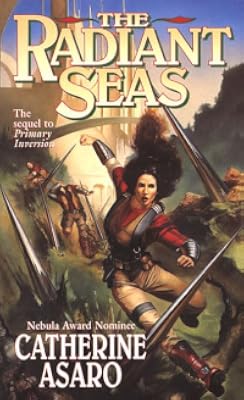
The Radiant Seas
by Catherine Asaro
Skolian Empire Publication Order (4), Skolian Empire Novels Chronological Order (2259), Skolian Empire Chronological Order (2259)
On This Page
Description
The Radiant Seas continues the story of Sauscony and Jaibriol, each the heir to an interstellar empire, as their lives become entangled again in the machinations of the Skolian Empire. They are beginning to pick up what's left of their lives, in exile on a deserted planet with their children, when the fate of much of the known universe comes to rest on the shoulders of their fragile young family. Interstellar war erupts, and Jaibriol is snatched away to be the unwilling ruler of the Highton show more Aristos. Sauscony must fight her way at the head of an invading space fleet to rescue him from his own empire-without revealing that they are married. And with much of interstellar civilization poised on the brink of destruction, it is the devotion of these two lovers, their sacrifices and their heroism, that might just found a new order. That, and the existence of their teenage son, who is the genetic heir to a legacy of pain he must rise above. show lessTags
Recommendations









Member Reviews
It was a good read, not as fabulous as the previous book of the series which is set on one planet and focussed mainly on one character, this one has more of the awkwardnesses of the first two. In fact, it is the direct sequel to book one..... (I am reading them in order of publication.) In this one Asaro pushed the bigger story of the dynamics between the three empires, Eube, Allied and Skolian forward and there are epic battle scenes with Klein bottles within Klein bottles creating fabulously gargantuan explosions and so on..... Thge Skolian Psiberweb is under direct attack by the Eubian Elite, also known as the Aristos. We get to know more about them, and that, apparently, if they live long enough .... no wait I can't do any spoiling, show more so I won't say more. There are moments when Asaro skirts true creepy kinkiness, but there's no other way to convey how dreadful the Aristos are. They are a bit evocative of the - oh I forget what their official name is - the perfect people in Star Trek that Khan leads, but not really as they have plenty of weaknesses and they are not psions. It kept me fully occupied during a three hour leg of my flight and I had to stay up late and just finish the damned thing -- so it probably rates a 4 1/2 at least! **** show less
The Radiant Seas is the fourth book in Asaro's Skolian Saga series, but it is the direct sequel to Primary Inversion, the first book in the series. After diverting the series to stories featuring other members of Sauscosny's extended family, the Saga returns to the two heirs to rival empires who faked their own deaths and fled to a deserted planet no one else is supposed to know about in order to be together. And although all they want is to be left alone, it should come as no surprise that pretending the rest of the universe doesn't exist is not sufficient to make the rest of the universe pretend you do not exist. And before too long the story has massive fleets of starships facing each other in bitter battles while cybernetically show more enhanced commandos launch surprise attacks on secret installations.
The first section of the book follows three mostly independent but linked stories. In the first, Sauscony and Jaibriol set about making their home on the planet they share together, and start a family. In the second, Kurj, Sauscony's brother and Imperator of Skolia, tries to decide the question of who will succeed him now that Sauscony is thought to be dead, and at the same time manage the herculean task of running an empire that is under siege by a more powerful adversary and seems to depend upon his micromanagment. Finally, the elder Emperor Jaibriol, ruler of the Eubian Concord, continues to plot against the Skolian Empire while attempting to navigate the snakepit of treacherous plots that seems to be the norm for Eubian politics.
The two critical turns of events in this segment when the Eubians are able to attack the weak link in the Skolian infrastructure: the rare and valuable Rhon telepaths. The first occurs when the Eubians employ a new weapon that interferes with the control portions of the Skolian ships and allows them to capture Prince Althor. For the Eubians, capturing Althor is a double coup as he is both of critical military value, and because he is a powerful Rhon telepath, and therefore the ultimate "provider" for a Eubian Aristo. Since the Eubians are, by nature, brutal and accomplished torturers, Althor is subjected to horrible treatment in an effort to wrest information out of him, which finally culminates in the revelation of information that reveals the location of Soz and Jai. But this information is made critical by the second turn of events, where the Eubians, via a piece of intelligence provided by an Earth Senator, ambush the Skolian Imperator Kurj in an effort to capture him, relying upon the same technology they used to expedite their capture of Althor. But in the interim the Skolians had come up with a counter, and Kurj is able to both foil his own capture and decapitate the Eubian government by killing its Emperor.
But with the Eubian government in disarray, and the now dead Emperor's widow feeling insecure in her position, recovering Jai as the legitimate heir of the Eubian throne to be installed as her puppet becomes critical. And while Jai's return makes sense as a matter of Eubian internal politics, it exposes one of the oddities of the Eubian Aristo's as villains that bothers me. Jai proved to be Soz's perfect soul mate because he was a Rhon telepath, a fact that he has to hide from all of the other Highton Aristos for fear that they will regard him as a subhuman "provider" and subject him to a life of torture. But being a Rhon telepath is established as being an incredibly valuable asset - the existence of Soz's family of Rhon telepaths is what allows for the existence of the psiberweb, the only technology that allows the Skolian Empire to hold its own against the much larger Eubian Concord. The backbone of the Skolian military is made up of telepaths, giving the Skolians a much-needed military edge. The Eubians, on the other hand, relegate telepaths to the bottom rung of their society, and abuse them horribly to the point that Skolian military telepaths prefer to kill themselves rather than be taken prisoner. And the reason they do is the Highton Aristos that sit at the top of the Eubian heap are born sadists who feed off of pain inflicted upon telepaths. In short, a hugely valuable asset is wasted by the Eubians in the name of the sadistic pleasure of its elite
This waste of the potential of telepaths wouldn't be such a perplexing element if the Aristos weren't so incredibly rare, which makes their iron grip on control of their Empire almost inexplicable. The Aristos essentially have no particular special powers that make them anything other than parasites on actual telepaths, and yet a few hundred of them can command an empire of billions. Not only that, oppress an empire of billions, as everyone in the Eubian Concord other than the Aristos are slaves. While the brutality of the Aristos is explained by their particular genetic heritage, their ability to retain power seems somewhat implausible. The Aristos are certainly villainous - born purveyors of cruelty - but whereas we are told that Rhon telepaths are naturally brilliant and possessing of mental abilities that are critical to the survival of their nation, the Aristos essentially seem to have no particular common characteristics other than their depravity. The Jedi in Star Wars have their force powers. The Lensmen in the Lensman series have their psychic abilities. In those cases, even if the elitist message bothers the reader, it is understandable how this political system came about. But the Aristos don't seem to have anything special about them other than their dependence upon actual telepaths for pleasure. And as a result, it is hard to figure out how the Aristos, essentially parasitical psychic vampires, rose to dominate the largest known space-faring nation, and how, despite systemically criminally wasting one of their most valuable assets, they manage to stay there.
Leaving the question of Eubian politics aside, once Jai has been located and seized by the Eubians and installed as their unwilling Emperor Soz has to return to the position of authority and responsibility that she abandoned to be with Jai. And with the two lovers installed as the heads of state of the two nations, what had been a long running mostly cold war explodes into a hot war. The war escalates the ongoing technological arms race that was started with the development of quasis interference generators that caused ships to lose control of parts of themselves, countered by hiding Klein bottles inside Klein bottles, and then moving on to the Eubians pressing their "providers" into service to try to counter the Skolian use of telepaths in their military forces, and finally to the hiding of entire fleets inside Klein bottles. The odd element is that the last development takes the most effort, but seems have the least usefulness, since once the "Radiance Fleet" encounters the Eubian forces they "decloak" and engage in a pretty standard battle formation.
Unfortunately, it is when the book focuses on the war between the Skolian and Eubian forces, it loses focus. While it makes sense that in a war between star spanning empires the confrontations would be between thousands of ships manned by million of personnel, but once the numbers get to that scale, it becomes very difficult to relate to the action. At a certain scale, when 750,000 ships face off against 500,000 ships the numbers detract from the story rather than add to it. As has been famously observed, "one death is a tragedy, a million deaths is a statistic". By ramping up the numbers to presumably realistic levels, Asaro transforms the tragedy of a massive war into a counting exercise. It is only when Soz separates herself from the massive fleet she leads and pursues a commando raid with a handful of soldiers that the war feels real.
And at its core the story is of the star-crossed lovers seeking to be reunited. Soz's raid into the heart of Eubian space is thought by everyone around her to be a foray intended to recover her brother Althor, but is actually the efforts of a lover seeking to recover her beau. This is intended to be wildly romantic, but to go on her crusade, Soz has to leave her children behind in the hands of a trusted friend on Earth for the duration of the war. And knowing her children have been left behind, her decision at the close of the novel seems not so much heroic or romantic, but rather irresponsible and almost callous. Granted, it does set up the political conclusion that forms the emotional peak of the book, but it seems out of character for someone who moved an entire nation to recover her lost husband to be willing to essentially abandon all of her children to go into self-imposed exile.
In the end, the book closes with everything changed, and in another sense nothing changed. Two Empires that have always been at war, go to war again. Two lovers have been thought dead, found, separated, and then reunited, and then are thought dead once more. The action starts with a secretive group of telepaths hiding in exile, and ends with much the same situation in place. But at the same time the war results in nations being decapitated, and a multigenerational plan that was conceived to topple one ends up neutering the other. Despite the somewhat wooden nature of the villains, and the dizzying scale of the conflict, it boils down a ferocious warrior seeking her lost love. The end result is sweeping space opera romance that moves the Skolian Saga in interesting directions.
This review has also been posted to my blog Dreaming About Other Worlds show less
The first section of the book follows three mostly independent but linked stories. In the first, Sauscony and Jaibriol set about making their home on the planet they share together, and start a family. In the second, Kurj, Sauscony's brother and Imperator of Skolia, tries to decide the question of who will succeed him now that Sauscony is thought to be dead, and at the same time manage the herculean task of running an empire that is under siege by a more powerful adversary and seems to depend upon his micromanagment. Finally, the elder Emperor Jaibriol, ruler of the Eubian Concord, continues to plot against the Skolian Empire while attempting to navigate the snakepit of treacherous plots that seems to be the norm for Eubian politics.
The two critical turns of events in this segment when the Eubians are able to attack the weak link in the Skolian infrastructure: the rare and valuable Rhon telepaths. The first occurs when the Eubians employ a new weapon that interferes with the control portions of the Skolian ships and allows them to capture Prince Althor. For the Eubians, capturing Althor is a double coup as he is both of critical military value, and because he is a powerful Rhon telepath, and therefore the ultimate "provider" for a Eubian Aristo. Since the Eubians are, by nature, brutal and accomplished torturers, Althor is subjected to horrible treatment in an effort to wrest information out of him, which finally culminates in the revelation of information that reveals the location of Soz and Jai. But this information is made critical by the second turn of events, where the Eubians, via a piece of intelligence provided by an Earth Senator, ambush the Skolian Imperator Kurj in an effort to capture him, relying upon the same technology they used to expedite their capture of Althor. But in the interim the Skolians had come up with a counter, and Kurj is able to both foil his own capture and decapitate the Eubian government by killing its Emperor.
But with the Eubian government in disarray, and the now dead Emperor's widow feeling insecure in her position, recovering Jai as the legitimate heir of the Eubian throne to be installed as her puppet becomes critical. And while Jai's return makes sense as a matter of Eubian internal politics, it exposes one of the oddities of the Eubian Aristo's as villains that bothers me. Jai proved to be Soz's perfect soul mate because he was a Rhon telepath, a fact that he has to hide from all of the other Highton Aristos for fear that they will regard him as a subhuman "provider" and subject him to a life of torture. But being a Rhon telepath is established as being an incredibly valuable asset - the existence of Soz's family of Rhon telepaths is what allows for the existence of the psiberweb, the only technology that allows the Skolian Empire to hold its own against the much larger Eubian Concord. The backbone of the Skolian military is made up of telepaths, giving the Skolians a much-needed military edge. The Eubians, on the other hand, relegate telepaths to the bottom rung of their society, and abuse them horribly to the point that Skolian military telepaths prefer to kill themselves rather than be taken prisoner. And the reason they do is the Highton Aristos that sit at the top of the Eubian heap are born sadists who feed off of pain inflicted upon telepaths. In short, a hugely valuable asset is wasted by the Eubians in the name of the sadistic pleasure of its elite
This waste of the potential of telepaths wouldn't be such a perplexing element if the Aristos weren't so incredibly rare, which makes their iron grip on control of their Empire almost inexplicable. The Aristos essentially have no particular special powers that make them anything other than parasites on actual telepaths, and yet a few hundred of them can command an empire of billions. Not only that, oppress an empire of billions, as everyone in the Eubian Concord other than the Aristos are slaves. While the brutality of the Aristos is explained by their particular genetic heritage, their ability to retain power seems somewhat implausible. The Aristos are certainly villainous - born purveyors of cruelty - but whereas we are told that Rhon telepaths are naturally brilliant and possessing of mental abilities that are critical to the survival of their nation, the Aristos essentially seem to have no particular common characteristics other than their depravity. The Jedi in Star Wars have their force powers. The Lensmen in the Lensman series have their psychic abilities. In those cases, even if the elitist message bothers the reader, it is understandable how this political system came about. But the Aristos don't seem to have anything special about them other than their dependence upon actual telepaths for pleasure. And as a result, it is hard to figure out how the Aristos, essentially parasitical psychic vampires, rose to dominate the largest known space-faring nation, and how, despite systemically criminally wasting one of their most valuable assets, they manage to stay there.
Leaving the question of Eubian politics aside, once Jai has been located and seized by the Eubians and installed as their unwilling Emperor Soz has to return to the position of authority and responsibility that she abandoned to be with Jai. And with the two lovers installed as the heads of state of the two nations, what had been a long running mostly cold war explodes into a hot war. The war escalates the ongoing technological arms race that was started with the development of quasis interference generators that caused ships to lose control of parts of themselves, countered by hiding Klein bottles inside Klein bottles, and then moving on to the Eubians pressing their "providers" into service to try to counter the Skolian use of telepaths in their military forces, and finally to the hiding of entire fleets inside Klein bottles. The odd element is that the last development takes the most effort, but seems have the least usefulness, since once the "Radiance Fleet" encounters the Eubian forces they "decloak" and engage in a pretty standard battle formation.
Unfortunately, it is when the book focuses on the war between the Skolian and Eubian forces, it loses focus. While it makes sense that in a war between star spanning empires the confrontations would be between thousands of ships manned by million of personnel, but once the numbers get to that scale, it becomes very difficult to relate to the action. At a certain scale, when 750,000 ships face off against 500,000 ships the numbers detract from the story rather than add to it. As has been famously observed, "one death is a tragedy, a million deaths is a statistic". By ramping up the numbers to presumably realistic levels, Asaro transforms the tragedy of a massive war into a counting exercise. It is only when Soz separates herself from the massive fleet she leads and pursues a commando raid with a handful of soldiers that the war feels real.
And at its core the story is of the star-crossed lovers seeking to be reunited. Soz's raid into the heart of Eubian space is thought by everyone around her to be a foray intended to recover her brother Althor, but is actually the efforts of a lover seeking to recover her beau. This is intended to be wildly romantic, but to go on her crusade, Soz has to leave her children behind in the hands of a trusted friend on Earth for the duration of the war. And knowing her children have been left behind, her decision at the close of the novel seems not so much heroic or romantic, but rather irresponsible and almost callous. Granted, it does set up the political conclusion that forms the emotional peak of the book, but it seems out of character for someone who moved an entire nation to recover her lost husband to be willing to essentially abandon all of her children to go into self-imposed exile.
In the end, the book closes with everything changed, and in another sense nothing changed. Two Empires that have always been at war, go to war again. Two lovers have been thought dead, found, separated, and then reunited, and then are thought dead once more. The action starts with a secretive group of telepaths hiding in exile, and ends with much the same situation in place. But at the same time the war results in nations being decapitated, and a multigenerational plan that was conceived to topple one ends up neutering the other. Despite the somewhat wooden nature of the villains, and the dizzying scale of the conflict, it boils down a ferocious warrior seeking her lost love. The end result is sweeping space opera romance that moves the Skolian Saga in interesting directions.
This review has also been posted to my blog Dreaming About Other Worlds show less
Romance/SciFi. By this time in the series, it is obvious where this is going. While the story did carry me along, the very weak 'science' in this book basically just made this a space romance. There are some really unbelievable parts.
The Radiant Seas by Catherine Asaro is the second book I’ve read in the Skolian Empire saga (which actually has three empires in it with the two main ones having different names so it gets confusing but that’s the term I’m going to stick with). The other book that I’ve read was Primary Inversion which, chronologically, immediately precedes The Radiant Seas. For this review to make sense, I’m going to have to include a spoiler for the end of Primary Inversion, but I’ll put in a warning when I get to that.
Asaro’s universe contains three interstellar empires:
~ The Skolians whose ruling family are powerful telepaths and who can communicate instantaneously through a telepathic web that three of the imperial family hold in place show more with their minds (and to do so they have to be the most powerful type of telepaths, a condition that involves recessive genes and can’t be genetically engineered.
~ The Eubians who are ruled by the irredeemably evil (and genetically specific) class of Aristos. Evil because they literally gain transcendent pleasure from being in proximity to the suffering of telepaths. Their mission in life is generally to acquire as many telepathic slaves as they can, the more powerful the better (and, incidentally, they don’t see anyone else as fully human, especially the telepaths but including ordinary humans).
~ And then there’s the Earth and Allied Worlds who try to stay out of the never ending conflicts between the other two empires and don’t entirely believe how horrible the Eubians are with their slavery and torture.
The main characters are mostly Skolian and the antagonists are all Eubian although they’re not all as automatically evil as it might seem (but most are) and do have proper motivations for what they do, always an important trait in bad guys. The story in The Radiant Seas picks up exactly where Primary Inversion left off and spans many (17ish) years.
Before I get to the spoilers, a few words on the science because I can’t review an SF book without commenting on that. Asaro’s science, real and made up, is pretty good and (most importantly ;-p ) didn’t annoy me. It was a good mix between made up stuff (the telepathy) told from a scientific point of view and fairly hard semi-plausible science like the propulsion systems. Asaro actually has a PhD in theoretical atomic and molecular physics so much of the quantum and relativity stuff is plausible. She even published a paper about the theory behind her faster than light travel system. In short, nothing to complain about here.
And to be able to talk about the plot, I have to mention a spoiler for the end of Primary Inversion…
image
~
SPOILER WARNING FOR PRIMARY INVERSION
***
WARNING OF SPOILERS
***
YOU HAVE BEEN SPOILER-WARNED FOR PRIMARY INVERSION (NOT RADIANT SEAS)
~
At the end of Primary Inversion, Soz, next in line to be the Imperator (Skolian), and Jabriol II, heir to the Imperial throne (Eubian), fall in love when Soz discovers Jabriol isn’t in fact an Aristo but part of a secret genetic experiment to breed telepathy into the imperial line. Rather than feeding on telepaths, he is the most powerful type of telepath himself (as is Soz). Since peace between their empires is inherently impossible while there are still Aristos running around, they ran off to a deserted planet together. The Radiant Seas picks up when they’re busy making copious babies while their families mourn them, then get on with waging war against each other.
Because the story spans so many years, it really felt like the first half was setting up the events of the second half. There were some action scenes in the first half and the story definitely progressed, but there were moments when it felt like it was dragging. In the second half, Soz and Jabriol (and their kids) rejoin civilisation and their respective empires, the story really picks up. Soz trying to rescue Jabriol was much more exciting than them making babies while their families fought.
Aside from the few boring bits (which weren’t enough to ruin anything, in my opinion), I quite enjoyed this novel. I mostly liked Soz because she kicks arse but I did find the whole running away from imperial duties thing a bit selfish. However, it was also nice to see an alternative narrative where duty isn’t held up as the most important thing and the character chooses family. (I still think they should’ve hung around to fix things up more first…)
Overall, I would recommend this book to people who enjoy science fiction with epic world-spanning empires, lots of political intrigue and long range plots. I definitely suggest reading Primary Inversion before The Radiant Seas, however, since a lot of world building and, more importantly, plot set up, takes place in the earlier book.
4 / 5 stars
You can read more of my reviews on my blog. show less
Asaro’s universe contains three interstellar empires:
~ The Skolians whose ruling family are powerful telepaths and who can communicate instantaneously through a telepathic web that three of the imperial family hold in place show more with their minds (and to do so they have to be the most powerful type of telepaths, a condition that involves recessive genes and can’t be genetically engineered.
~ The Eubians who are ruled by the irredeemably evil (and genetically specific) class of Aristos. Evil because they literally gain transcendent pleasure from being in proximity to the suffering of telepaths. Their mission in life is generally to acquire as many telepathic slaves as they can, the more powerful the better (and, incidentally, they don’t see anyone else as fully human, especially the telepaths but including ordinary humans).
~ And then there’s the Earth and Allied Worlds who try to stay out of the never ending conflicts between the other two empires and don’t entirely believe how horrible the Eubians are with their slavery and torture.
The main characters are mostly Skolian and the antagonists are all Eubian although they’re not all as automatically evil as it might seem (but most are) and do have proper motivations for what they do, always an important trait in bad guys. The story in The Radiant Seas picks up exactly where Primary Inversion left off and spans many (17ish) years.
Before I get to the spoilers, a few words on the science because I can’t review an SF book without commenting on that. Asaro’s science, real and made up, is pretty good and (most importantly ;-p ) didn’t annoy me. It was a good mix between made up stuff (the telepathy) told from a scientific point of view and fairly hard semi-plausible science like the propulsion systems. Asaro actually has a PhD in theoretical atomic and molecular physics so much of the quantum and relativity stuff is plausible. She even published a paper about the theory behind her faster than light travel system. In short, nothing to complain about here.
And to be able to talk about the plot, I have to mention a spoiler for the end of Primary Inversion…
image
~
SPOILER WARNING FOR PRIMARY INVERSION
***
WARNING OF SPOILERS
***
YOU HAVE BEEN SPOILER-WARNED FOR PRIMARY INVERSION (NOT RADIANT SEAS)
~
At the end of Primary Inversion, Soz, next in line to be the Imperator (Skolian), and Jabriol II, heir to the Imperial throne (Eubian), fall in love when Soz discovers Jabriol isn’t in fact an Aristo but part of a secret genetic experiment to breed telepathy into the imperial line. Rather than feeding on telepaths, he is the most powerful type of telepath himself (as is Soz). Since peace between their empires is inherently impossible while there are still Aristos running around, they ran off to a deserted planet together. The Radiant Seas picks up when they’re busy making copious babies while their families mourn them, then get on with waging war against each other.
Because the story spans so many years, it really felt like the first half was setting up the events of the second half. There were some action scenes in the first half and the story definitely progressed, but there were moments when it felt like it was dragging. In the second half, Soz and Jabriol (and their kids) rejoin civilisation and their respective empires, the story really picks up. Soz trying to rescue Jabriol was much more exciting than them making babies while their families fought.
Aside from the few boring bits (which weren’t enough to ruin anything, in my opinion), I quite enjoyed this novel. I mostly liked Soz because she kicks arse but I did find the whole running away from imperial duties thing a bit selfish. However, it was also nice to see an alternative narrative where duty isn’t held up as the most important thing and the character chooses family. (I still think they should’ve hung around to fix things up more first…)
Overall, I would recommend this book to people who enjoy science fiction with epic world-spanning empires, lots of political intrigue and long range plots. I definitely suggest reading Primary Inversion before The Radiant Seas, however, since a lot of world building and, more importantly, plot set up, takes place in the earlier book.
4 / 5 stars
You can read more of my reviews on my blog. show less
Sauscony and Jaibriol are in exile on a deserted planet, being happily domestic and happily away from the politics that could keep them apart. Things get more complicated when Jaibriol is snatched away and brought back into the politics of the Highton Aristo world, where he is the Emperor, but also, as a psychic, a puppet of the ruling caste and a valuable toy.
Sauscony has to try to rescue him and if that takes bringing in the Ruby Empire, so be it. However the repercussions could be terrible, and whether or not there will be a world where they can live in peace, is a major question.
It's one of the better of this series, she continues to be quite readable, but it's not amazing.
Sauscony has to try to rescue him and if that takes bringing in the Ruby Empire, so be it. However the repercussions could be terrible, and whether or not there will be a world where they can live in peace, is a major question.
It's one of the better of this series, she continues to be quite readable, but it's not amazing.
The premise: ganked from BN.com: Living in exile on a deserted planet, Sauscony and Jaibriol, each the heir to an interstellar empire, become entangled in the machinations of the Skolian Empire. Interstellar war erupts and Jaibriol is snatched away to be the unwilling ruler of the Highton Aristos. Sauscony must lead an invading space fleet to rescue him from his own Empire-without revealing that they are married. With much of interstellar civilization poised on the brink of destruction, it is the devotion of these two lovers, their sacrifices, and their heroism, that might just forge a new order.
My Rating: 5 - It's a Gamble
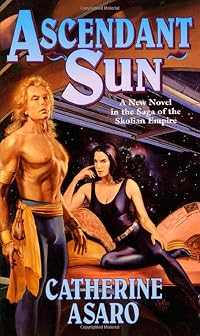
So, this is not the best book to start with if you haven't yet read any of Asaro's space opera/SFR. No, the best show more book to start with is Primary Inversion, and even that's been the best book of the series to date (and by date, I mean by how far I've read). Asaro's at her best when her characters have something to lose and she can focus on the action of bringing a story to a close. But in The Radiant Seas, there were a lot of world-building sections that had me utterly disengaged, and really, there were too many POV characters (I'm remembering at least eight) and that always dilutes a story for me. I was so tempted to put this book down and declare myself done with the series, but I pushed onward, because I want to see what else the series has to offer, and it didn't seem right to make this book a DNF and still read more of the series. And the ending does redeem my enjoyment of the book, though sadly, it takes a long, long time to get to that point. I still plan on continuing the series with the next book in the publication order, which is Ascendant Sun, but after that, I'll probably be taking a break.
Spoilers, yay or nay?: Yay. You'll get some spoilers for Primary Inversion too, so please, if this is a series you're interested in, don't read the full review. However, if you're caught up on at least Primary Inversion and The Radiant Seas, feel free to read the full review, which is in my blog and I've linked to it below. As always, comments and discussion are most welcome.
REVIEW: Catherine Asaro's THE RADIANT SEAS
Happy Reading! show less
My Rating: 5 - It's a Gamble
So, this is not the best book to start with if you haven't yet read any of Asaro's space opera/SFR. No, the best show more book to start with is Primary Inversion, and even that's been the best book of the series to date (and by date, I mean by how far I've read). Asaro's at her best when her characters have something to lose and she can focus on the action of bringing a story to a close. But in The Radiant Seas, there were a lot of world-building sections that had me utterly disengaged, and really, there were too many POV characters (I'm remembering at least eight) and that always dilutes a story for me. I was so tempted to put this book down and declare myself done with the series, but I pushed onward, because I want to see what else the series has to offer, and it didn't seem right to make this book a DNF and still read more of the series. And the ending does redeem my enjoyment of the book, though sadly, it takes a long, long time to get to that point. I still plan on continuing the series with the next book in the publication order, which is Ascendant Sun, but after that, I'll probably be taking a break.
Spoilers, yay or nay?: Yay. You'll get some spoilers for Primary Inversion too, so please, if this is a series you're interested in, don't read the full review. However, if you're caught up on at least Primary Inversion and The Radiant Seas, feel free to read the full review, which is in my blog and I've linked to it below. As always, comments and discussion are most welcome.
REVIEW: Catherine Asaro's THE RADIANT SEAS
Happy Reading! show less
I don't really know how this book came into my library (I know I didn't buy it, so I think it might have been a gift, but of the sort like: Here's a box of books. Want them?), but it's stayed in because it's signed.
I read it, and it was pretty interesting. Very much immersion into the very detailed world the author has created, but I didn't have any problem with that and it was the first book of this author that I read.
I read it, and it was pretty interesting. Very much immersion into the very detailed world the author has created, but I didn't have any problem with that and it was the first book of this author that I read.
Members
- Recently Added By
Lists

Best Feminist Science Fiction
188 works; 35 members
Author Information

59+ Works 9,229 Members
Oakland, California native Catherine Asaro received a doctorate in physics from Harvard University. She has published a number of papers on theoretical physics and was a physics professor until 1990, when she established Molecudyne Research, which she currently runs. A former ballerina, she has performed with ballets and in musicals on both show more coasts, and founded the Mainly Jazz Dance program at Harvard. She now teaches at the Caryl Maxwell Classical Ballet. Her husband is John Kendall Cannizzo, an astrophysicist at NASA show less
Some Editions
Awards and Honors
Series


Common Knowledge
- Canonical title
- The Radiant Seas
- Original publication date
- 1999
- People/Characters
- Sauscony Lahaylia Valdoria
- Epigraph
- See what a scourge is laid upon your hate
That heaven find means to kill your joys with love
And I, for winking at your discords too
Have lost a brace of kinsmen—all are punish'd.
—Romeo and Jul... (show all)iet, by William Shakespeare - Dedication
- In Memory of Jo Clayton
1939–98
A friend, mentor, and admired colleague who graced the world with her talent and her spirit - First words
- Kurj Skolia strode down the corridor, past walls lit with a muted radiance.
- Publisher's editor
- Hartwell, David G.
Classifications
Statistics
- Members
- 417
- Popularity
- 74,566
- Reviews
- 12
- Rating
- (3.93)
- Languages
- Czech, English, French, German
- Media
- Paper, Audiobook, Ebook
- ISBNs
- 18
- ASINs
- 2