On This Page
Description
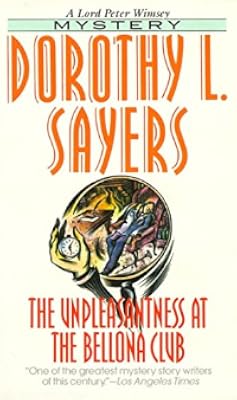
A wealthy general dies in his club, surrounded by fellow veterans, and Lord Peter must battle to solve the case. Even the Bellona Club's most devoted members would never call it lively. Its atmosphere is that of a morgue, or, at best, a funeral parlor, and on Armistice Day the gloom is only heightened. Veterans of the Great War gather at the Bellona not to hash over old victories, but to stare into their whiskies and complain about old injuries, shrinking pensions, and the lingering effects show more of shell shock. Though he acts jolly, Lord Peter Wimsey finds the holiday grim. And this Armistice Day, death has come to join the festivities. The aged General Fentiman, a hero of the Crimean War, expires sitting up in his favorite chair. Across town, his sister dies on the same day, throwing the General's half-million-pound inheritance into turmoil. As the nation celebrates and suspicions run riot, Lord Peter must discover what kind of soldier would have the nerve to murder a general. The Unpleasantness at the Bellona Club is the 5th book in the Lord Peter Wimsey Mysteries, but you may enjoy the series by reading the books in any order. This ebook features an illustrated biography of Dorothy L. Sayers including rare images from the Marion E. Wade Center at Wheaton College. show lessTags
Recommendations
















Member Reviews
Holds up well in rereading. The plot has interesting twists and turns and the characters are well drawn. This early Lord Peter is still a fairly frivolous seeming gentleman, but he displays incisive intelligence in questioning witnesses and suspects. Several years ago I cited this novel in a conference paper rebutting the idea that Golden Age mysteries ignored the condition of society. A mystery set in a men's club for military gentlemen is very clear on the physical and mental damage done to the veterans of WWI and their disappointment in the society to which they had returned. From the fathers giving commemorative dinners for the comrades of sons lost in the war, to the shell shocked George Fentiman, to Tin-Tummy Challoner, to the show more numerous women who will never find husbands, the England of Dorothy Sayers has been heavily marked by the war. show less
Reading Dorothy Sayers’ story collection Lord Peter Views the Body got me wondering about just how much her Lord Peter Wimsey series might be influenced by her Catholicism. Not in the sense of them being inspirational fiction, or in any way preachy, but in the way her religious beliefs infuse the worldview of the series. In the earlier post I had noticed that this was rather bleak, due mostly to the characters ranging from unlikeable to outright evil.
Compared to that, there seems to be a shift in Unpleasantness at the Bellona Club - although I cannot tell whether this is due to Dorothy Sayers changing her views, or to the greater length of the novel allowing more space for subtlety and nuance. The world described is still mostly a show more valley of tears, but the creatures that inhabit it are for the most part not so much evil as frail. It is like the world kept pushing and pushing and pushing at every individual, until those that are too weak or brittle eventually break, cave in or shatter, with only the strongest having a chance to withstand the constant pressure. And there is no exception to that, even Lord Peter is missing his usual joyful hedonism in this novel and appears unusually listless throughout. It should be kept in mind, though, that the main reason the world appears as harsh as it is, are the after-effects of the First World War that extend even to those who took no part in the fighting – which of course implies that it is man who causes the suffering after all.
The best part of Unpleasantness at the Bellona Club, however, is its beginning which is utterly brilliant both as opening puzzle for a whodunnit and as a striking emblem of the state of the British Empire at the time. It is wonderfully done, a scene nobody who has read it is likely to forget – maybe even a bit too brilliant as it threatens to outshine the rest of the novel and make the further events seem somewhat drab. show less
Compared to that, there seems to be a shift in Unpleasantness at the Bellona Club - although I cannot tell whether this is due to Dorothy Sayers changing her views, or to the greater length of the novel allowing more space for subtlety and nuance. The world described is still mostly a show more valley of tears, but the creatures that inhabit it are for the most part not so much evil as frail. It is like the world kept pushing and pushing and pushing at every individual, until those that are too weak or brittle eventually break, cave in or shatter, with only the strongest having a chance to withstand the constant pressure. And there is no exception to that, even Lord Peter is missing his usual joyful hedonism in this novel and appears unusually listless throughout. It should be kept in mind, though, that the main reason the world appears as harsh as it is, are the after-effects of the First World War that extend even to those who took no part in the fighting – which of course implies that it is man who causes the suffering after all.
The best part of Unpleasantness at the Bellona Club, however, is its beginning which is utterly brilliant both as opening puzzle for a whodunnit and as a striking emblem of the state of the British Empire at the time. It is wonderfully done, a scene nobody who has read it is likely to forget – maybe even a bit too brilliant as it threatens to outshine the rest of the novel and make the further events seem somewhat drab. show less
It must be noted from the onset that from me 3.5 stars to DLS is equivalent to 5 stars for most other writers. I hold her very high in the firmament of writing in general, hence my standards for her are appreciably higher.
One issue for me in terms of this most recent rereading was that I partly remembered whodunnit and why, probably because I watched the Ian Carmichael Wimsey series not so many years ago. Blessedly, my memory is flimsy enough that the ultimate crux of the matter escaped me completely, so from about the halfway point onwards I was as much in the dark as I was on first encountering this novel too many decades ago for me to care to count.
Putting aside that small inconvenience, I was happy as usual to be lead hither and show more thither through Sayers' complicated and intelligent plot-line, with the puzzle aspect immeasurably enriched by flashes of almost cheeky humour and stunning moments of intensely insightful observation, on human nature and the human condition. The most incidental of Sayers' characters have flesh on their bones to a remarkable degree.
The most enjoyable fleshing out for me, as ever, is that of our favourite characters: beloved Wimsey, of course, but also Parker and Bunter. The crumbs are coming together, the leavening is working its mysterious power, the dough is inexorably rising, I am mixing my metaphores like a mad thing, and the Wimsey loaf is beginning to show its bloom. show less
One issue for me in terms of this most recent rereading was that I partly remembered whodunnit and why, probably because I watched the Ian Carmichael Wimsey series not so many years ago. Blessedly, my memory is flimsy enough that the ultimate crux of the matter escaped me completely, so from about the halfway point onwards I was as much in the dark as I was on first encountering this novel too many decades ago for me to care to count.
Putting aside that small inconvenience, I was happy as usual to be lead hither and show more thither through Sayers' complicated and intelligent plot-line, with the puzzle aspect immeasurably enriched by flashes of almost cheeky humour and stunning moments of intensely insightful observation, on human nature and the human condition. The most incidental of Sayers' characters have flesh on their bones to a remarkable degree.
The most enjoyable fleshing out for me, as ever, is that of our favourite characters: beloved Wimsey, of course, but also Parker and Bunter. The crumbs are coming together, the leavening is working its mysterious power, the dough is inexorably rising, I am mixing my metaphores like a mad thing, and the Wimsey loaf is beginning to show its bloom. show less
I really love this book. For an unpretentious 1920s mystery novel, it really has a lot going on. There's the mystery itself, which has enough twists and turns to remain interesting. (I didn't guess the outcome, which is always a plus!). Then there is the social commentary: the plight of World War I veterans, the effects of poverty and unemployment, the changing role of women in society, relationships between men and women. And of course there is Peter Wimsey: intelligent, intuitive, funny and compassionate. Some scenes from this novel will remain with me for a long time: George Fentiman's breakdown, Peter's argument with Charles Parker, the easy camaraderie between Peter and Marjorie Phelps and Peter's conversation with Miss Dorland. show more Reading this book - and Dorothy L Sayers' other novels - makes me so much wish that I had known the author. What an interesting mind she had. show less
Where I got the book: my bookshelf. A re-read.
I have grown to love this Lord Peter Wimsey mystery because of its somberness, although I remember that when I first read it as a teen I found it uninteresting. Amazing how history (and, therefore, literature) becomes more complex and interesting as you age. The mystery LPW is called on to investigate is the time of death of ancient, doddery General Fentiman, which will make a big financial difference to one or more of three potential heirs. Of course things turn out to be way more complicated than the natural death of a very old soldier...
This novel is set against the background of the aftermath of World War I, hence its more realistic, sober tone than the earlier novels. LPW comes very show more well out of this book, with far fewer fantastic speeches or superhuman feats of everything than some of the Wimsey novels are prone to. I feel, though, that the writing's a little rougher than usual, as if Sayers were on a short deadline.
Another thing that struck me this time round (and I may be completely wrong) is that Ann Dorland, one of the heirs and thus a potential suspect, was a prototype of Harriet Vane, who will turn up in the next novel as LPW's love interest. Ann is an unhappy woman because she's been crossed in love, is a murder suspect but underneath it all (as LPW tells her) is a fine person with good taste. Does that sound familiar, Wimsey fans? Can't help thinking that at some point Sayers thought "hey, there's a little spark there. I could develop it for the next novel".
A good mystery, of course: Sayers is nothing if not ingenious (although this is two times in quick succession that the victim has been an elderly person who would soon die anyway...) But it's the brooding, foggy feel of the book that really gives it its worth. Even Parker (inside whose head we dwell rather disconcertingly at times) seems to be permanently depressed, and the end of the book sort of drifts off into the mist. One to read by a cheerful log fire with a glass of old brandy... show less
I have grown to love this Lord Peter Wimsey mystery because of its somberness, although I remember that when I first read it as a teen I found it uninteresting. Amazing how history (and, therefore, literature) becomes more complex and interesting as you age. The mystery LPW is called on to investigate is the time of death of ancient, doddery General Fentiman, which will make a big financial difference to one or more of three potential heirs. Of course things turn out to be way more complicated than the natural death of a very old soldier...
This novel is set against the background of the aftermath of World War I, hence its more realistic, sober tone than the earlier novels. LPW comes very show more well out of this book, with far fewer fantastic speeches or superhuman feats of everything than some of the Wimsey novels are prone to. I feel, though, that the writing's a little rougher than usual, as if Sayers were on a short deadline.
Another thing that struck me this time round (and I may be completely wrong) is that Ann Dorland, one of the heirs and thus a potential suspect, was a prototype of Harriet Vane, who will turn up in the next novel as LPW's love interest. Ann is an unhappy woman because she's been crossed in love, is a murder suspect but underneath it all (as LPW tells her) is a fine person with good taste. Does that sound familiar, Wimsey fans? Can't help thinking that at some point Sayers thought "hey, there's a little spark there. I could develop it for the next novel".
A good mystery, of course: Sayers is nothing if not ingenious (although this is two times in quick succession that the victim has been an elderly person who would soon die anyway...) But it's the brooding, foggy feel of the book that really gives it its worth. Even Parker (inside whose head we dwell rather disconcertingly at times) seems to be permanently depressed, and the end of the book sort of drifts off into the mist. One to read by a cheerful log fire with a glass of old brandy... show less
This mixes a touch of gallows humor and some sharp social commentary into to a cleverly plotted Golden Age mystery. What starts out as an inquiry into the time of death for an unfortunate member of the exclusive Bellona Club becomes a twisty-turny, complex whodunnit that never bogs down. I’m giving all the credit to amateur sleuth Lord Peter Wimsey and his non-stop banter with a large cast of quirky characters but the post Great War setting plays a large part in it too. I'm hoping for more of Wimsey's gentleman's gentleman Bunter in the next entry.
One of the earlier Lord Peter Wimsey novels, and the only one which I hadn’t read. (I haven’t read all the short stories, either.)
The elderly General Fentiman is discovered dead behind his newspaper at his London club. Some time later Wimsey is asked by the family’s solicitor to see if he can discover more precisely the time when General died, as the General’s sister also died that morning and her Will varies depending upon who survived whom.
I enjoyed the novelty of an investigation which doesn’t begin as a whodunit, and enjoyed wondering if (and if so, how) it might turn into a murder investigation. Also interesting is that several of the characters -- not just Wimsey -- fought in the war, and this has affected them in show more different ways.
Somewhere in the middle I began to find the clue-gathering a bit dry, but then the plot twisted in ways I hadn’t expected. There were more scenes which reminded me of the Sayers who wrote Gaudy Night. While there are women connected to the case, the Bellona Club is a wholly masculine world, and earlier on the women are often pushed to the edges. But when they do take centre stage, it’s in a way that takes them and their concerns seriously, and highlights the way they have been mistreated or misrepresented by others. I’m not sure if Sayers is completely successful here -- I suppose, when she wrote this she wasn’t yet exactly the person, or perhaps more accurately she wasn’t exactly the writer, she was seven years later -- but it makes the novel potentially reread-able (for me).
I suspect I am much more interested in Lord Peter as a person than I am in Wimsey as a detective. It is hard to separate the two, and then of course I’m usually most interested in the bits about detectives’ personal lives and opinions and so on... But what I appreciate most about Lord Peter Wimsey has a lot less to do with his skills of deduction and investigation, and more to do with just how he talks to people -- his faculty for quotation, his intelligence and the way he respects others. (Would I be interested in a crime-free novel in which he goes to parties and talks to people about whatever is going on in their lives? Maybe?)
“[...] It’s the books and paintings I want to look at. H’m! Books, you know, Charles, are like lobster-shells. We surround ourselves with ’em and leave ’em behind, as evidences of our earlier stages of development.” show less
The elderly General Fentiman is discovered dead behind his newspaper at his London club. Some time later Wimsey is asked by the family’s solicitor to see if he can discover more precisely the time when General died, as the General’s sister also died that morning and her Will varies depending upon who survived whom.
I enjoyed the novelty of an investigation which doesn’t begin as a whodunit, and enjoyed wondering if (and if so, how) it might turn into a murder investigation. Also interesting is that several of the characters -- not just Wimsey -- fought in the war, and this has affected them in show more different ways.
Somewhere in the middle I began to find the clue-gathering a bit dry, but then the plot twisted in ways I hadn’t expected. There were more scenes which reminded me of the Sayers who wrote Gaudy Night. While there are women connected to the case, the Bellona Club is a wholly masculine world, and earlier on the women are often pushed to the edges. But when they do take centre stage, it’s in a way that takes them and their concerns seriously, and highlights the way they have been mistreated or misrepresented by others. I’m not sure if Sayers is completely successful here -- I suppose, when she wrote this she wasn’t yet exactly the person, or perhaps more accurately she wasn’t exactly the writer, she was seven years later -- but it makes the novel potentially reread-able (for me).
I suspect I am much more interested in Lord Peter as a person than I am in Wimsey as a detective. It is hard to separate the two, and then of course I’m usually most interested in the bits about detectives’ personal lives and opinions and so on... But what I appreciate most about Lord Peter Wimsey has a lot less to do with his skills of deduction and investigation, and more to do with just how he talks to people -- his faculty for quotation, his intelligence and the way he respects others. (Would I be interested in a crime-free novel in which he goes to parties and talks to people about whatever is going on in their lives? Maybe?)
“[...] It’s the books and paintings I want to look at. H’m! Books, you know, Charles, are like lobster-shells. We surround ourselves with ’em and leave ’em behind, as evidences of our earlier stages of development.” show less
Members
- Recently Added By
Lists

Best of British Literature
226 works; 41 members

British Mystery
469 works; 13 members

Best Private Eye stories
28 works; 8 members

World War I Fiction
94 works; 15 members

Books About Murder
313 works; 7 members

Detective Stories
343 works; 5 members

Books mentioned in Julian Symons’ Bloody Murder
438 works; 6 members

Books Read in 2014
2,343 works; 89 members

In and About the 1920s
181 works; 31 members

I Could Live There
185 works; 12 members

Books Set in London
49 works; 3 members

unread and uncatalogued
48 works; 1 member

Books Read in 2018
4,360 works; 110 members

Books Read in 2022
5,168 works; 114 members
Author Information

278+ Works 70,843 Members
Dorothy Sayers's impressive reputation as a contemporary master of the classic detective story is eclipsed only by Agatha Christie's. Sayers was born in Oxford and attended Somerville College, where she received a B.A. in 1915 and an M.A. in 1920. During that period, Sayers worked as an instructor of modern languages at Hull High School for Girls show more in Yorkshire and as a reader for a publisher in Oxford. Her early literary work was in poetry; she published several volumes and served as an editor for the journal Oxford Poetry from 1917 to 1919. Sayers also worked as a copywriter for a major advertising firm in London. She was president of the Modern Language Association from 1939 to 1945 and of the Detection Club in the 1950s. Around 1920 Sayers developed the idea for her detective hero Lord Peter Wimsey, and she soon published her first mystery, Whose Body? (1923), in which Lord Peter is introduced. For the next dozen or so years, Sayers wrote prolifically about Wimsey, creating in the process what many critics of the genre consider to be the finest detective novels in the English language. Perhaps her most famous Wimsey mystery was The Nine Tailors (1934). Although Sayers essentially followed the classic form in her detective fiction---a formula in which the plot assumes a greater importance than do the characters---Sayers maintained that a detective hero's greatness depended on how effectively the character was portrayed. All but one of Sayers's mysteries feature Lord Peter Wimsey. By the late 1930s, Sayers had apparently tired of writing detective fiction. She stated in 1947 that she would write no more mysteries, that she wrote detective fiction only when she was young and in need of money. Thus saying, Sayers turned her attention to her early loves, medieval and religious literature, spending her remaining years lecturing on and translating Dante (see Vol. 2). (Bowker Author Biography) show less
Some Editions
Series

Belongs to Publisher Series
SaPo (2)
Penguin Books (5)
Goldmann Krimi (3067)
Colecção Vampiro (35)
Ullstein Buch (703)
Mirabilia (59)
Pocket Books (74)
Zephyr Books (87)
Den svarte serie (155)
Work Relationships
Is contained in
Lord Peter Takes the Case (Clouds of Witness / Unnatural Death / The Five Red Herrings / The Unpleasantness at the Bellona Club) by Dorothy L. Sayers
The Unpleasantness at the Bellona Club | Strong Poison | The Five Red Herrings | Have His Carcase by Dorothy L. Sayers
Clouds of Witness - The Unpleasantness at the Bellona Club - Strong Poison - Hangman's Holiday - Murder Must Advertise by Dorothy L. Sayers
The Lord Peter Wimsey Collection: Books 1-5: Whose Body?; Clouds of Witness; Unnatural Death; Lord Peter Views the Body; The Unpleasantness at the Bellona Club by Dorothy L. Sayers
Whose Body? | Unnatural Death | The Unpleasantness at the Bellona Club | Strong Poison | Have His Carcase | Busman's Honeymoon | In the Teeth of Evidence by Dorothy L. Sayers
The Unpleasantness at the Bellona Club | Murder Must Advertise | In the Teeth of the Evidence by Dorothy L. Sayers
Common Knowledge
- Canonical title*
- Ubehagelig episode i Bellona-klubben
- Original title
- The Unpleasantness at the Bellona Club
- Original publication date
- 1928
- People/Characters
- Peter Death Bredon Wimsey (Lord Peter Wimsey); Mervyn Bunter; Ann Dorland; General Fentiman; George Fentiman; Robert Fentiman (show all 10); Colonel Marchbanks; Charles Parker (Inspector); Dr. Penberthy; Marjorie Phelps
- Important places
- the Bellona Club, London, England, UK
- Related movies
- The Unpleasantness at the Bellona Club (1972 | IMDb)
- First words
- "What in the world, Wimsey, are you doing in this morgue?" demanded Captain Fentiman, flinging aside the "Evening Banner" with the air of a man released from an irksome duty.
[Afterword] The year 1920 is the generally accepted dawn of the Golden Age of detective fiction. - Last words
- (Click to show. Warning: May contain spoilers.)I don't know what's come to this Club.
(Click to show. Warning: May contain spoilers.)[Afterword] Although her career as a detective novelist spanned a mere fourteen years--from 'Whose Body?' (1923) to 'Busman's Honeymoon (1937)--she continued until her premature death to contribute to the promotion and acceptance of the literary from with which her name is forever linked. - Original language
- English
- Canonical DDC/MDS
- 823.912
- Canonical LCC
- PR6037.A95
- Disambiguation notice
- This is the main work for The Unpleasantness at the Bellona Club. It should not be combined with any adaptation, abridgement, etc.
*Some information comes from Common Knowledge in other languages. Click "Edit" for more information.
Classifications
Statistics
- Members
- 3,382
- Popularity
- 4,977
- Reviews
- 97
- Rating
- (3.86)
- Languages
- 16 — Catalan, Danish, Dutch, English, Estonian, Finnish, French, German, Greek, Italian, Norwegian (Bokmål), Norwegian, Polish, Portuguese, Spanish, Swedish
- Media
- Paper, Audiobook, Ebook
- ISBNs
- 75
- UPCs
- 1
- ASINs
- 72