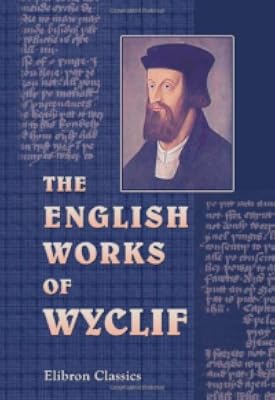
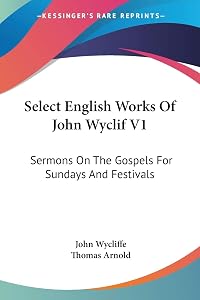
The English Works of Wyclif Hitherto Unprinted
by John Wycliffe
On This Page
Description
This Elibron Classics title is a reprint of the original edition published by Tr bner & Co. in London, 1880.Tags
Recommendations










Member Reviews
It doesn't have to be said that John Wyclif was instrumental in the early stages of the reformation. His English works seem to be the only ones currently available even though his most influential were the ones he composed in Latin. Jan Hus (the founder of the first true Protestant church) was heavily indebted to Wyclif, so much so that today we would probably consider him guilty of plagiarism; but it is doubtful that Wyclif would have seen it that way since both Hus and Wyclif always stated that they were just teaching the Gospel. It also seems that Wyclif and Hus were both indebted to Gratian's decretals to some extent.
Most of the writings contained here are Wyclif's (and maybe other Wyclifite writings mistakenly attributed to Wyclif) show more polemics against: indulgences, immorality of priests, abuses of the poor by clergy, instituting of non-Biblical dogmas, priests not being dedicated to poverty etc.
Excellent book and really a must for any library that features influential Christian works. It must be stated upfront that this book is in 14th century Old English. I did not know this when I purchased it. It takes a little while to read it fluently. There is a glossary and a marginal synopsis which makes it easily doable if one wants to take the time to do it, otherwise I would say that you may want to find a modern English translation because at first look 14th century English looks almost like a foreign language. show less
Most of the writings contained here are Wyclif's (and maybe other Wyclifite writings mistakenly attributed to Wyclif) show more polemics against: indulgences, immorality of priests, abuses of the poor by clergy, instituting of non-Biblical dogmas, priests not being dedicated to poverty etc.
Excellent book and really a must for any library that features influential Christian works. It must be stated upfront that this book is in 14th century Old English. I did not know this when I purchased it. It takes a little while to read it fluently. There is a glossary and a marginal synopsis which makes it easily doable if one wants to take the time to do it, otherwise I would say that you may want to find a modern English translation because at first look 14th century English looks almost like a foreign language. show less
Ex-lib. MED (no. 603)
Ratings
Members
- Recently Added By
Author Information

55 Works 319 Members
John Wyclif was an English philosopher, theologian, and reformer. Many of his beliefs varied from traditional Church teachings, and some views put him outside of the orthodox fold. He argued, for instance, that ecclesiastical authorities not in a state of grace could be deprived of their endowments by civil authority and that there was no show more scriptural foundation for the religious orders. He also argued against the doctrine of transubstantiation, desiring rather to emphasize the moral and spiritual effects of the Eucharist, a position later condemned by the English church. Wyclif's greatest influence was, interestingly, not in England but in Bohemia, where John Hus preached Wyclif's theology. (Bowker Author Biography) show less
Classifications
- Genres
- Religion & Spirituality, Nonfiction, Biography & Memoir, Literature Studies and Criticism
- DDC/MDS
- 270.5092 — Religion History of Christianity History, geographic treatment, biography of Christianity Later medieval; Renaissance (1200-1517)
- LCC
- BR75 — Philosophy, Psychology and Religion Christianity Christianity
- BISAC
Statistics
- Members
- 20
- Popularity
- 1,283,452
- Reviews
- 2
- Rating
- (5.00)
- Languages
- English
- Media
- Paper
- ISBNs
- 6