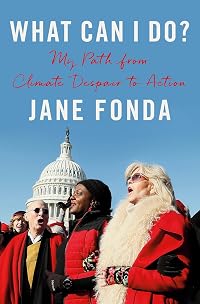
What Can I Do?: My Path from Climate Despair to Action
by Jane Fonda
On This Page
Description
"In the fall of 2019, frustrated with the obvious inaction of politicians and inspired by Greta Thunberg, Naomi Klein, and student climate strikers, Jane Fonda moved to Washington, DC to lead weekly climate change demonstrations on Capitol Hill. On October 11, she launched Fire Drill Fridays (FDF), and has since led thousands of people in non-violent civil disobedience, risking arrest to protest for action. In her new book, Fonda weaves her deeply personal journey as an activist alongside show more interviews with leading climate scientists, and discussions of specific issues, such as water, migration, and human rights, to emphasize what is at stake. Most significantly, Fonda provides concrete solutions, and things the average person can do to combat the climate crisis in their community. No stranger to protest, Fonda's life has been famously shaped by activism. And now, on the eve of the next presidential election, she is once again galvanizing the public to take to the streets. Too many of us understand that our climate is in a crisis, and realize that a moral responsibility rests on our shoulders. 2019 saw atmospheric concentrations of greenhouse gases hit the highest level ever recorded in human history, and our window of opportunity to avoid disaster is quickly closing. We are facing a climate crisis, but we're also facing an empathy crisis, an inequality crisis. It isn't only earth's life-support systems that are unraveling. So too is our social fabric. This is going to take an all-out war on drilling and fracking and deregulation and racism and misogyny and colonialism and despair all at the same time"-- show lessTags
Recommendations






Member Reviews
Jane Fonda’s What Can I Do?: My Path from Climate Despair to Action describes her activist work focused on the Fire Drill Friday protests she helped organize and lead in 2019. The goal of the Fire Drill Fridays was to “pass a Green New Deal, stop fossil fuel expansion immediately, phase out fossil fuels as soon as possible but definitely within thirty years, secure a fair deal for workers and communities most impacted by the transition” as well as to educate the public (pg. 20). This book helps fulfill that final goal, with chapters devoted to subjects such as local efforts to combat climate change, how it affects sea life, the impact on women and gender relations, and more. Fonda worked to ensure that the Fire Drill Friday show more protests involved more than the usual older, white male experts, bringing in women, young people, Indigenous leaders, POC, and more to ensure an equitable movement (pg. 178).
Fonda hopes that this work will help dispel the fatalism many in the West feel about climate change, assuming they have any awareness of its true impact at all, by including breakdowns at the end of each chapter about what people can do. Fonda summarizes the work of Yale researcher Anthony Leiserowitz, who studied awareness of climate change and concluded “the three countries where people are the least aware of the climate crisis are the United States, Canada, and the U.K.” because “those are the countries where individualism has taken root the most, especially in the last thirty years, fanned by right-wing news outlets like Fox and other Murdoch-owned media” (pg. 67). Fonda summarizes Ben Cohen and Jerry Greenfield’s interpretation of national security, namely that “money spent improving the living conditions here at home is national security spending. That, not war, is what makes us safe. How secure is a country where children are being poisoned by toxic fumes in their homes, where we are ill-prepared for a pandemic, where too many can’t afford health care and a decent education, and millions are homeless?” (pgs. 86-87). Describing the threat of climate change to water resources, Fonda writes, “Water is no longer infinite… The UN predicts that by 2050 that lack of access to clean water could affect five billion people, half the planet. We may feel safe here in America, but when the U.S. Government Accountability Office surveyed water managers in 2013, it found that forty out of fifty of them anticipated water shortages by 2023” (pg. 120).
What Can I Do? was published during the COVID-19 pandemic and Fonda writes, “Just about every single thing that this government of ours has done is exactly the opposite of what must happen – with a pandemic or with the climate crisis: denial, lack of preparedness, disregard for science, viewing the federal government as merely a ‘backup.’ This is not a drill! It is a vital teachable moment” (pgs. 209-210). Fonda concludes, “It has become clear to me that the fossil fuel industry is anathema to democracy. We cannot continue to depend on fossil fuels and live in a country that calls itself a democracy… Two-thirds of Americans want our government to pass a binding climate treaty. But in 2013, the fossil fuel industry spent $326 million to persuade congressional Republicans and some Democrats to kill just such a treaty” while fossil fuel industries further spend at the state and local levels to quash any attempts to limit their profiteering and extraction at the expense of health and climate concerns (pg. 260). Fonda’s book serves as both a warning of how dire things have become as well as a roadmap for actions everyday people can take and hopefully help our society survive, minimize, and begin to reverse the effects climate change. show less
Fonda hopes that this work will help dispel the fatalism many in the West feel about climate change, assuming they have any awareness of its true impact at all, by including breakdowns at the end of each chapter about what people can do. Fonda summarizes the work of Yale researcher Anthony Leiserowitz, who studied awareness of climate change and concluded “the three countries where people are the least aware of the climate crisis are the United States, Canada, and the U.K.” because “those are the countries where individualism has taken root the most, especially in the last thirty years, fanned by right-wing news outlets like Fox and other Murdoch-owned media” (pg. 67). Fonda summarizes Ben Cohen and Jerry Greenfield’s interpretation of national security, namely that “money spent improving the living conditions here at home is national security spending. That, not war, is what makes us safe. How secure is a country where children are being poisoned by toxic fumes in their homes, where we are ill-prepared for a pandemic, where too many can’t afford health care and a decent education, and millions are homeless?” (pgs. 86-87). Describing the threat of climate change to water resources, Fonda writes, “Water is no longer infinite… The UN predicts that by 2050 that lack of access to clean water could affect five billion people, half the planet. We may feel safe here in America, but when the U.S. Government Accountability Office surveyed water managers in 2013, it found that forty out of fifty of them anticipated water shortages by 2023” (pg. 120).
What Can I Do? was published during the COVID-19 pandemic and Fonda writes, “Just about every single thing that this government of ours has done is exactly the opposite of what must happen – with a pandemic or with the climate crisis: denial, lack of preparedness, disregard for science, viewing the federal government as merely a ‘backup.’ This is not a drill! It is a vital teachable moment” (pgs. 209-210). Fonda concludes, “It has become clear to me that the fossil fuel industry is anathema to democracy. We cannot continue to depend on fossil fuels and live in a country that calls itself a democracy… Two-thirds of Americans want our government to pass a binding climate treaty. But in 2013, the fossil fuel industry spent $326 million to persuade congressional Republicans and some Democrats to kill just such a treaty” while fossil fuel industries further spend at the state and local levels to quash any attempts to limit their profiteering and extraction at the expense of health and climate concerns (pg. 260). Fonda’s book serves as both a warning of how dire things have become as well as a roadmap for actions everyday people can take and hopefully help our society survive, minimize, and begin to reverse the effects climate change. show less
Surprisingly excellent! It's intelligent, well organized, personal, thoughtful, and relevant.
I normally pay no attention to celebrities who soapbox for their pet issues, but Fonda has a 50 year track record of activism and is effective in using her fame/infamy to surround herself with a strong and diverse team of organizers, influencers, and climate experts. As she describes the weekly rallies/teach-ins, we learn along with her about the various aspects of the climate crisis. Not a ton of new information for people who have been following the issues, but she lays out an eye-opening experience for those who aren't as familiar with the content. There's also a lot of actionable information that answers the title's questions, on a wide show more range of issues.
I was worried that the partnership with Greenpeace would lead to preaching to a radical leftist choir, but there's thankfully very little of that. Instead, the influence is felt in the call to direct action including civil disobedience, but it's more in the style of Greta Thunberg than Paul Watson.
The audiobook narration is passionate, clear, and compelling. show less
I normally pay no attention to celebrities who soapbox for their pet issues, but Fonda has a 50 year track record of activism and is effective in using her fame/infamy to surround herself with a strong and diverse team of organizers, influencers, and climate experts. As she describes the weekly rallies/teach-ins, we learn along with her about the various aspects of the climate crisis. Not a ton of new information for people who have been following the issues, but she lays out an eye-opening experience for those who aren't as familiar with the content. There's also a lot of actionable information that answers the title's questions, on a wide show more range of issues.
I was worried that the partnership with Greenpeace would lead to preaching to a radical leftist choir, but there's thankfully very little of that. Instead, the influence is felt in the call to direct action including civil disobedience, but it's more in the style of Greta Thunberg than Paul Watson.
The audiobook narration is passionate, clear, and compelling. show less
Ratings
Members
- Recently Added By
Lists

Climate Change
50 works; 1 member
Author Information

57+ Works 1,487 Members
Jane Fonda was born in New York City on December 21, 1937. She is an award-winning actress and has appeared in numerous movies including Cat Ballou, Barefoot in the Park, Barbarella, They Shoot Horses, Don't They?, Fun with Dick and Jane, Julia, The Electric Horseman, Nine to Five, The Morning After, Monster in Law, and Georgia Rule. She won the show more Academy Award for Best Actress in 1971 for Klute and in 1978 for Coming Home. She also produced and starred in over 20 exercise videos released between 1982 and 1995. She has written several books including Jane Fonda's Workout Book, My Life So Far, and Prime Time. In 2014 her title Being a Teen: Everything Teen Girls and Boys Should Know about Relationships, Sex, Love, Health, Identity and More made The New York Times Best Seller List. (Bowker Author Biography) show less
Classifications
- Genres
- Science & Nature, Nonfiction, General Nonfiction, Biography & Memoir
- DDC/MDS
- 363.738 — Society, government, & culture Social problems and social services Public Safety - Police, Crime Investigation Environmental Issues - Pollution, Recycling, Global Warming Pollution Pollutants by source
- LCC
- QC902.8 .F66 — Science Physics Physics Meteorology. Climatology
- BISAC
Statistics
- Members
- 96
- Popularity
- 336,188
- Reviews
- 2
- Rating
- (4.13)
- Languages
- English
- Media
- Paper, Audiobook, Ebook
- ISBNs
- 14
- ASINs
- 1