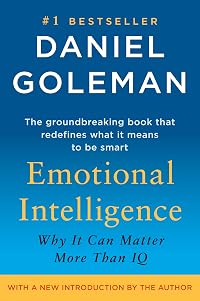
Emotional Intelligence: Why It Can Matter More Than IQ
by Daniel Goleman
On This Page
Description
#1 BESTSELLER • The groundbreaking book that redefines what it means to be smart, with a new introduction by the author “A thoughtfully written, persuasive account explaining emotional intelligence and why it can be crucial.”— USA Today Everyone knows that high IQ is no guarantee of success, happiness, or virtue, but until Emotional Intelligence, we could only guess why. Daniel Goleman's brilliant report from the frontiers of psychology and neuroscience offers startling show more new insight into our “two minds”—the rational and the emotional—and how they together shape our destiny. Drawing on groundbreaking brain and behavioral research, Goleman shows the factors at work when people of high IQ flounder and those of modest IQ do surprisingly well. These factors, which include self-awareness, self-discipline, and empathy, add up to a different way of being smart—and they aren’t fixed at birth. Although shaped by childhood experiences, emotional intelligence can be nurtured and strengthened throughout our adulthood—with immediate benefits to our health, our relationships, and our work. The twenty-fifth-anniversary edition of Emotional Intelligence could not come at a better time—we spend so much of our time online, more and more jobs are becoming automated and digitized, and our children are picking up new technology faster than we ever imagined. With a new introduction from the author, the twenty-fifth-anniversary edition prepares readers, now more than ever, to reach their fullest potential and stand out from the pack with the help of EI. show lessTags
Recommendations

Member Reviews
I don't usually find myself buying or reading books labeled "Self-Help." Not that I don't like myself, or consider myself unworthy of help--or beyond the realm of needing help--but I find the books labeled and marketed this way to be largely vapid and boring.
This was not the case with Daniel Goleman's Emotional Intelligence. This is a thoughtful, sober, and careful analysis of specific issues related to character formation and the steady slide of young people in society into a situation of being incapable of articulating, let alone controlling, their passions--as they would have been called in the 18th century--and directing their attentions and efforts in pursuits likely to lead to productive, healthy, and contented lives. What could show more be more urgent and important?
The book details interesting scientific discoveries, data from studies and experiments, and intelligent and non-pedantic descriptions of complex phenomenon with ease. While offering ideas for solutions, Goleman is never so obnoxious as to pretend that providing training in emotional intelligence to young people will solve all of society's ills. In an age of mass shootings, youth nihilism and despair, and generations lacking the ability to toss their phones aside and pay attention to something for more than two minutes, focusing on a way to drive home the usefulness and almost unlimited upside of character formation (which Goleman concedes is actually what he's talking about at the end) seems a tremendous imperative. While the book begins with philosophy--where the answers ultimately lay--Goleman hopes to avoid that field by keeping the majority of the book in the hard(ish) sciences.
However, if he wishes to succeed in reforming education along the conservative/classical (though thoroughly secular and traditionally liberal) lines he proposes here, he will need to get a bit more explicitly philosophical. There, I fear he will collapse into a heap of utilitarianism and collectivism and squander the good that this book hints towards and wishes to promise. show less
This was not the case with Daniel Goleman's Emotional Intelligence. This is a thoughtful, sober, and careful analysis of specific issues related to character formation and the steady slide of young people in society into a situation of being incapable of articulating, let alone controlling, their passions--as they would have been called in the 18th century--and directing their attentions and efforts in pursuits likely to lead to productive, healthy, and contented lives. What could show more be more urgent and important?
The book details interesting scientific discoveries, data from studies and experiments, and intelligent and non-pedantic descriptions of complex phenomenon with ease. While offering ideas for solutions, Goleman is never so obnoxious as to pretend that providing training in emotional intelligence to young people will solve all of society's ills. In an age of mass shootings, youth nihilism and despair, and generations lacking the ability to toss their phones aside and pay attention to something for more than two minutes, focusing on a way to drive home the usefulness and almost unlimited upside of character formation (which Goleman concedes is actually what he's talking about at the end) seems a tremendous imperative. While the book begins with philosophy--where the answers ultimately lay--Goleman hopes to avoid that field by keeping the majority of the book in the hard(ish) sciences.
However, if he wishes to succeed in reforming education along the conservative/classical (though thoroughly secular and traditionally liberal) lines he proposes here, he will need to get a bit more explicitly philosophical. There, I fear he will collapse into a heap of utilitarianism and collectivism and squander the good that this book hints towards and wishes to promise. show less
I've been meaning to read this for ten years or so - it's a little out of date but still relevant. In the midst of all of our hand-wringing about gun violence and the wilding of young people, here's a proposal to cultivate (officially, and in public schools) this thing known to the ancient Greeks as "character." The thesis here is that emotional management skills can be taught and can ward off depression and anxiety and reduce rates of violence, crime, drug abuse, etc. The question is, can we all agree that this sort of thing falls under the purview of the public school?
Deri në ditën kur psikologu Daniel Goleman botoi këtë libër, njerëzimi ishte i fiksuar me idenë që njeriu duhet të mësojë të zgjidhë ushtrime logjike të komplikuara, sa më shumë dhe sa më shpejt të jetë e mundur, në mënyrë që të jetë i sukseshëm në biznes dhe në jetë. Por a mundet të “zgjidhësh” dashurinë si ushtrim logjik? Inteligjenca emocionale na shpjegon ne se ka më shumë rëndësi aftësia jonë për të vepruar në kushtet e emocioneve, për të marrë vendime ndërsa na rreh zemra dhe jo aftësia për të llogaritur përmendësh sa bëjnë 257*1234.
I found this book to contain quite an academic (and at times scientific) view of emotion that includes some good story-telling.
It started very dry but I found it got more engaging about 60 pages in. I found the book to be more focussed on describing emotional intelligence as opposed to providing much guidance about how to improve your emotional intelligence. Despite this, I did however find that it contained a wealth of interesting information.
It started very dry but I found it got more engaging about 60 pages in. I found the book to be more focussed on describing emotional intelligence as opposed to providing much guidance about how to improve your emotional intelligence. Despite this, I did however find that it contained a wealth of interesting information.
This book was recommended reading for a 2012 management program for which I was selected. I admit up front that I typically would not read it, but I thought I'd give it a shot and tried to keep an open mind. If "tried" foreshadows my conclusions...well, I tried.
Three quarters bio-anatomy (quite a number of surveys/studies cited, "suggesting" correlation), one sixth bold statements and conclusions from those surveys, leaving one twelfth that might have value in the workplace. That is, after all, the reason the subject was recommended. Actually, one twelfth is a bit generous (being 25 pages.) I flagged less than 20 to pull tidbits from. Opinion, yes, but this is my "review", thus my opinion counts.
I read this so that I might add to my show more leadership toolbox. Instead, I came away with a lesser impression of Goleman's position: "See? Biology supports this. I'm right, even if I can't make my case very convincing to people who don't think like me." Not to say that someone more emotionally attuned wouldn't buy into the entire theory, but I had too hard a time shaking off the questions I couldn't quite form in my head as I read the book. I felt there were too many forced conclusions. I don't fault Goleman for corralling the research supporting his model, but I wonder if he could look at the data and come up with something else, or if his bias drove him to seek out the studies that seemed to support his conclusions.
In short, the book did little to explain to me the subtitle "Why it can matter more than IQ" in - and I'll take the blame for this - terms I could accept, and worse, did a poor sell of the cover (10th anniversary edition) superlative "The groundbreaking book that redefined what it means to be smart."
Why is the business world so susceptible to faddish theories? Demings's Total Quality Managment...Six Sigma...life coaching...emotional intelligence. In a oddly serendipitous infrequent check on my LinkedIn page as I read this book, I noticed someone suggested as someone I might know was a "Certified Emotional Intelligence Consultant." Apparently, I am way behind the curve on this one. And like most things ignored, now that I am aware of emotional intelligence (EQ), I'm sure I'll see more of it.
Too little of the book was spent on anything practical and too much seemed to be spent on justifying the conclusions. Part Men Are From Mars..., part take-your-pick of self-help tracts, part disconnected psycho-studies, it seemed to me that Goleman could see only his conclusion from any scenario presented. "The single most important element in group intelligence, it turns out, is not the average IQ in the academic sense, but rather in terms of emotional intelligence." The "single most"? "it turns out"? Very definite, yet not very rigorous, nor conclusive. But while I admit not having the skills/background to point out where Goleman may be wrong, his absolute pronouncements registered discordant with me. How can you state so conclusively that what separates achieves is not their IQ (which Goleman rightly pegs as a measure of potential academic success, not as being "intelligent") but their EQ? Reaching.
"There is an old-fashioned word for the body of skills that emotional intelligence represents: character."
"old-fashioned"? Not in my book. If "character" fits, why invent a new term?
Lumping together common sense concepts such as cooperation and workplace harmony and rebranding them as "emotional intelligence" is brilliant. And a tad saccharine. Disclosing my aversion to diet sweeteners, you can see my reaction to this book. But I can appreciate those who can sell this serpentine lubricant - until the next fad. show less
Three quarters bio-anatomy (quite a number of surveys/studies cited, "suggesting" correlation), one sixth bold statements and conclusions from those surveys, leaving one twelfth that might have value in the workplace. That is, after all, the reason the subject was recommended. Actually, one twelfth is a bit generous (being 25 pages.) I flagged less than 20 to pull tidbits from. Opinion, yes, but this is my "review", thus my opinion counts.
I read this so that I might add to my show more leadership toolbox. Instead, I came away with a lesser impression of Goleman's position: "See? Biology supports this. I'm right, even if I can't make my case very convincing to people who don't think like me." Not to say that someone more emotionally attuned wouldn't buy into the entire theory, but I had too hard a time shaking off the questions I couldn't quite form in my head as I read the book. I felt there were too many forced conclusions. I don't fault Goleman for corralling the research supporting his model, but I wonder if he could look at the data and come up with something else, or if his bias drove him to seek out the studies that seemed to support his conclusions.
In short, the book did little to explain to me the subtitle "Why it can matter more than IQ" in - and I'll take the blame for this - terms I could accept, and worse, did a poor sell of the cover (10th anniversary edition) superlative "The groundbreaking book that redefined what it means to be smart."
Why is the business world so susceptible to faddish theories? Demings's Total Quality Managment...Six Sigma...life coaching...emotional intelligence. In a oddly serendipitous infrequent check on my LinkedIn page as I read this book, I noticed someone suggested as someone I might know was a "Certified Emotional Intelligence Consultant." Apparently, I am way behind the curve on this one. And like most things ignored, now that I am aware of emotional intelligence (EQ), I'm sure I'll see more of it.
Too little of the book was spent on anything practical and too much seemed to be spent on justifying the conclusions. Part Men Are From Mars..., part take-your-pick of self-help tracts, part disconnected psycho-studies, it seemed to me that Goleman could see only his conclusion from any scenario presented. "The single most important element in group intelligence, it turns out, is not the average IQ in the academic sense, but rather in terms of emotional intelligence." The "single most"? "it turns out"? Very definite, yet not very rigorous, nor conclusive. But while I admit not having the skills/background to point out where Goleman may be wrong, his absolute pronouncements registered discordant with me. How can you state so conclusively that what separates achieves is not their IQ (which Goleman rightly pegs as a measure of potential academic success, not as being "intelligent") but their EQ? Reaching.
"There is an old-fashioned word for the body of skills that emotional intelligence represents: character."
"old-fashioned"? Not in my book. If "character" fits, why invent a new term?
Lumping together common sense concepts such as cooperation and workplace harmony and rebranding them as "emotional intelligence" is brilliant. And a tad saccharine. Disclosing my aversion to diet sweeteners, you can see my reaction to this book. But I can appreciate those who can sell this serpentine lubricant - until the next fad. show less
In Emotional Intelligence, Goleman discusses the psychological principle “flow.” Described as a “state of self-forgetfulness and focused attention, a state of joy, even rapture,” this so-called modern notion was actually described by St. Paul in 1 Cor 15:10 where self-forgetfulness, joy, and rapture find a fuller expression when Paul discusses his work and claims that it is “by the grace of God I am what I am... I labored even more than all of them, yet not I, but the grace of God with me.” Herein we can begin to see the crack in Goleman’s system.
Whereas Goleman exalts self-efficacy as ultimately underlying hope and optimism (and therefore performance and success in life), Paul sees the opposite. It is not in our ability show more to control our destiny that one finds hope and joy but rather in acknowledging the reality of the world: that Christ is Lord and you are not, and consequently you do not (and cannot) master the events of your life. For, according to Paul, if hope relied on you self-efficacy, all would be lost. Instead, hope rests in the sovereign lord of the universe’s promise to pull you through despite your shortcomings.
Goleman arrives at his conclusions because he’s building on a shaky foundation and erecting an innovative framework that has not withstood the test of time. Instead he begins with the premise that the emotional side of the human brain is an out-dated byproduct of human evolution, a wiring system that biology demands we reckon with, but which our minds begrudge because of its non-rationality. It’s hard to see, since so much of the work is focused on EI over IQ, but when Goleman suggests that we “should strive to find an intelligent balance of reason and emotion” we see that intelligence must remain in the driver’s seat of our lives, even when EI is brought to center stage.
Goleman’s imperative to seek balance also reveals the second of his foundational flaws: Actions are best when they are balanced, not necessarily when they are “right” or “virtuous.” To be sure, the right and virtuous action in most situations is often better described as “nuanced” rather than “extreme.” But seeking the middle for the middle’s sake is not path to success in this work—that is the path that seeks to avoid evil and hardships, not preserver through them and destroy them.
As for Goleman’s specific advice, there is much to be commended. The problem is not that any of his pragmatic practices are bad or unhealthy by themselves, but rather that when done with the understanding that doing so gives you more control over life and its outcomes it sets people with a false hope.
Goleman ultimately moves towards the conclusion that “cultivating intelligence is a cost-effective management imperative,” which beside giving misleading assurance in the reliability of inherently broken human beings, positions EI-informed practices’ value not in the quality of humans it produces, but in the stability and certainty of the work those humans create. show less
Whereas Goleman exalts self-efficacy as ultimately underlying hope and optimism (and therefore performance and success in life), Paul sees the opposite. It is not in our ability show more to control our destiny that one finds hope and joy but rather in acknowledging the reality of the world: that Christ is Lord and you are not, and consequently you do not (and cannot) master the events of your life. For, according to Paul, if hope relied on you self-efficacy, all would be lost. Instead, hope rests in the sovereign lord of the universe’s promise to pull you through despite your shortcomings.
Goleman arrives at his conclusions because he’s building on a shaky foundation and erecting an innovative framework that has not withstood the test of time. Instead he begins with the premise that the emotional side of the human brain is an out-dated byproduct of human evolution, a wiring system that biology demands we reckon with, but which our minds begrudge because of its non-rationality. It’s hard to see, since so much of the work is focused on EI over IQ, but when Goleman suggests that we “should strive to find an intelligent balance of reason and emotion” we see that intelligence must remain in the driver’s seat of our lives, even when EI is brought to center stage.
Goleman’s imperative to seek balance also reveals the second of his foundational flaws: Actions are best when they are balanced, not necessarily when they are “right” or “virtuous.” To be sure, the right and virtuous action in most situations is often better described as “nuanced” rather than “extreme.” But seeking the middle for the middle’s sake is not path to success in this work—that is the path that seeks to avoid evil and hardships, not preserver through them and destroy them.
As for Goleman’s specific advice, there is much to be commended. The problem is not that any of his pragmatic practices are bad or unhealthy by themselves, but rather that when done with the understanding that doing so gives you more control over life and its outcomes it sets people with a false hope.
Goleman ultimately moves towards the conclusion that “cultivating intelligence is a cost-effective management imperative,” which beside giving misleading assurance in the reliability of inherently broken human beings, positions EI-informed practices’ value not in the quality of humans it produces, but in the stability and certainty of the work those humans create. show less
Is IQ destiny? Not nearly as much as we think. Daniel Goleman's fascinating and persuasive book argues that our view of intelligence is too narrow, ignoring a crucial range of abilities that matter immensely for how we do in life.
Drawing on groundbreaking brain and behavioural research, Goleman shows the factors at work when people of high IQ flounder and those of modest IQ do surprisingly well. These factors, which include self-awareness, self-discipline, and empathy, add up to a different way of being smart -- one he terms "emotional intelligence". While childhood is a critical time for its development, emotional intelligence is not fixed at birth. It can be nurtured and strengthened throughout adulthood -- with immediate benefits to show more our health, our relationship, and our work.
This eye-opening book offers a new vision of excellence that can change the future for us and for our children. show less
Drawing on groundbreaking brain and behavioural research, Goleman shows the factors at work when people of high IQ flounder and those of modest IQ do surprisingly well. These factors, which include self-awareness, self-discipline, and empathy, add up to a different way of being smart -- one he terms "emotional intelligence". While childhood is a critical time for its development, emotional intelligence is not fixed at birth. It can be nurtured and strengthened throughout adulthood -- with immediate benefits to show more our health, our relationship, and our work.
This eye-opening book offers a new vision of excellence that can change the future for us and for our children. show less
Members
- Recently Added By
Lists

Best Self Help Books
87 works; 18 members
Wisdom
31 works; 5 members

Psicología - Clásicos
165 works; 2 members

Blue Pyramid 1,276 Best Books of All Time
1,248 works; 32 members

Tom's Bookstore
346 works; 2 members

Shaykh Hamza's Book Recommendations
439 works; 3 members

My List
302 works; 1 member

Men's healing resources
750 works; 1 member

Books You Couldn't Finish
202 works; 32 members
Author Information

99+ Works 19,492 Members
Psychologist Daniel Goleman was born on March 7, 1946 in Stockton, California. He earned a Ph.D. from Harvard. Goleman wrote his first book, "The Meditative Mind" after studying ancient psychology systems and meditation practices in India and Sri Lanka. Goleman wrote about psychology and related fields for the New York Times for 12 years beginning show more in 1984. In 1993 he co-founded the Collaborative for Academic, Social, and Emotional Learning. He is also a co-chairman of The Consortium for Research on Emotional Intelligence in Organizations and a member of the Mind and Life Institute's board of directors. Goleman has written several popular books, including "Emotional Intelligence," "Social Intelligence," "Ecological Intelligence" and "Focus: The Hidden Driver of Excellence." He received a Career Achievement award for journalism from the American Psychological Association and was elected a Fellow of the American Association for the Advancement of Science to recognize his efforts to communicate the behavioral sciences to the public. (Bowker Author Biography) show less
Some Editions
Awards and Honors
Distinctions
Series
Belongs to Publisher Series
dtv (36020)
Work Relationships
Is contained in
Common Knowledge
- Canonical title
- Emotional Intelligence: Why It Can Matter More Than IQ
- Original title
- Emotional Intelligence: Why It Can Matter More Than IQ
- Alternate titles*
- Sociale Intelligentie
- Original publication date
- 1995
- Dedication*
- Voor Tara, bron van emotionele wijsheid
- First words
- It was an unbearably steamy August afternoon in New York City, the kind of sweaty day that makes people sullen with discomfort.
- Last words
- (Click to show. Warning: May contain spoilers.)Shouldn't we be teaching these most essential skills for life to every child--now more than ever? And if not now, when?
- Original language
- English
*Some information comes from Common Knowledge in other languages. Click "Edit" for more information.
Classifications
Statistics
- Members
- 8,113
- Popularity
- 1,379
- Reviews
- 88
- Rating
- (3.70)
- Languages
- 39 — Albanian, Arabic, Bulgarian, Catalan, Czech, Danish, Dutch, English, Estonian, Finnish, French, Georgian, German, Greek, Hebrew, Hungarian, Indonesian, Italian, Japanese, Latvian, Lithuanian, Macedonian, Norwegian (Bokmål), Norwegian, Farsi/Persian, Polish, Romanian, Russian, Serbian, Croatian, Slovak, Slovenian, Spanish, Swedish, Turkish, Ukrainian, Portuguese (Portugal), Portuguese (Brazil), Chinese, traditional
- Media
- Paper, Audiobook, Ebook
- ISBNs
- 149
- UPCs
- 2
- ASINs
- 53