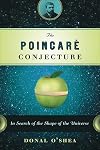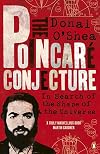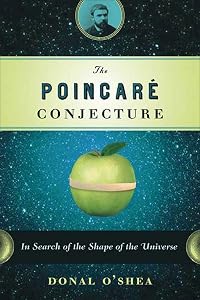
The Poincare Conjecture: In Search of the Shape of the Universe
by Donal O'Shea
On This Page
Description
Conceived in 1904, the Poincaré conjecture, a puzzle that speaks to the possible shape of the universe and lies at the heart of modern topology and geometry, has resisted attempts by generations of mathematicians to prove or to disprove it. Despite a million-dollar prize for a solution, Russian mathematician Grigory Perelman, posted his solution on the Internet instead of publishing it in a peer-reviewed journal. This book "tells the story of the fascinating personalities, institutions, show more and scholarship behind the centuries of mathematics that have led to Perelman's dramatic proof." The author also chronicles dramatic events at the 2006 International Congress of Mathematicians in Madrid, where Perelman was awarded a Fields Medal for his solution, which he declined. show lessTags
Recommendations




Member Recommendations
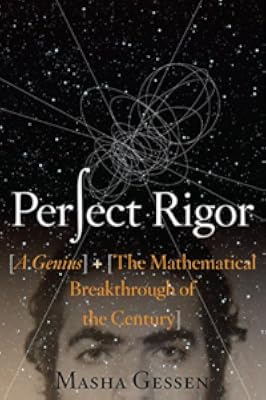
br77rino Perfect Rigor describes the Russian man who solved the conjecture but steadfastly refused the prize.
Member Reviews
This is one of the most beautifully written popular science books I have ever encountered. It is simple and intuitive enough to be understood by someone not familiar with the field, but is also in depth enough to be fascinating to people with some mathematical background. It explores some of the basic concepts of topology all while placing the mathematics within the context of the fascinating story of the Poincare Conjecture. Absolutely brilliant.
Very well written story of the history of mathematics leading up to topologies, geometries, manifolds, and of course the Poincare Conjecture regarding topological spheres. The text is interesting and lucid, with no equations outside of the footnotes, and very few even there. This could be because this form of mathematics lends itself to descriptions more than most other mathematics. An excellent book for the mathematically curious.
This is one of the most beautifully written popular science books I have ever encountered. It is simple and intuitive enough to be understood by someone not familiar with the field, but is also in depth enough to be fascinating to people with some mathematical background. It explores some of the basic concepts of topology all while placing the mathematics within the context of the fascinating story of the Poincare Conjecture. Absolutely brilliant.
A thoroughly researched, but easily accessible story of the (very likely satisfactory) solution of a very difficult problem in mathematics called the Poincare Conjectue. Donal O'Shea takes a subject that the vast majority of the world's mathematicians do not understand and makes it real to the non-mathematician reader. His approach describes the historic development of almost endless new math methods which resulted from the many attempts over more than 100 years to prove an obscure conjecture made in 1904 by Henri Poincare. He also shows that almost every new result in math builds on previous works and ideas. Poincare's conjecture has very likely been solved, finally, by a Russian Mathematician Grigory Perlman. Perlman has been awarded show more the highest award in mathematics (the Fields Medal) which he declined to accept and and long as his proof stands for 2 years will win $1,000,000 from the Clay Mathematics Institute. There is considerable speculation about whether he will accept the money. O'Shea's book proivdes some insight into the minds of those we call mathematicians, and the extremely complex relationships between their individual work , the work of their peers and those who preceeded them. show less
In The Poincaré Conjecture, Donal O’Shea explains a conjecture in topology from 1904 that had remained unsolved for nearly a century. Aside from its importance in topology, the conjecture also has implications on determining the shape of our own universe. It is also one of the seven Millennium Prize problems listed by the Clay Institute in 2000, with a one million dollar reward for a correct solution. It was finally solved in 2002 by Grigory Perelman and since then his solution has been accepted. He may be eligible for the Millennium Prize but does not appear to be interested. In 2006, he was awarded the Fields medal—the highest honor for mathematicians and which also carries a monetary reward—for his work but he declined the show more award.
In this book, O’Shea takes us through the history of the conjecture and the attempts at solving it, and also takes some time to give us the historical context along the way by describing the social and political climate surrounding each mathematician that has sought to prove the conjecture. He does a good job of providing relatively clear and simple explanations of the complex ideas in topology and non-Euclidean geometry involved, but the book does move at a fairly brisk pace (minus the notes at the end the main text is only 200 pages long) so some work is still required to follow along, but I never felt completely lost. This book contains a nice mix of mathematical ideas and history for a general audience, and it managed to keep my interest throughout. show less
In this book, O’Shea takes us through the history of the conjecture and the attempts at solving it, and also takes some time to give us the historical context along the way by describing the social and political climate surrounding each mathematician that has sought to prove the conjecture. He does a good job of providing relatively clear and simple explanations of the complex ideas in topology and non-Euclidean geometry involved, but the book does move at a fairly brisk pace (minus the notes at the end the main text is only 200 pages long) so some work is still required to follow along, but I never felt completely lost. This book contains a nice mix of mathematical ideas and history for a general audience, and it managed to keep my interest throughout. show less
This book is about a part of mathematics called topology (the word topology goes back to the 1850s, but when I was young, a century ago, it was not used: the disciplin of topology was still part of "geometry"). The good news is that you can understand the book, because I did.
Despite the subtitle "In search of the shape of the universe," it is not about physics or astronomy at all, it is a book about an interesting mathematical problem. The author Donal O'Shea succombed to the influence of his friends and tried to interest us in the subject by showing that it can be useful. Math is math: often it is useful, sometimes it is not, sometimes it becomes useful centuries after a mathemematical discovery. We got to live with that. Math is show more interesting in itself, like games and puzzles: it gives the brain jolts of pleasure, even if you are not a mathematician.
O'Shea does a terrible job at making topology look useful: the idea that with everything we knew about maps at the time of Columbus, we could have concluded (but we did not) that the earth is a doughnut is irritating and ludicrous. It does not help. You can skip the first chapters and start at page 21 and get to the meaty part of the thing.
What I like about the book:
1. It is a neat problem
2. I understand what the author says
3. It has a compassionate look on the fate of mathematicians, and the history part is very well done. show less
Despite the subtitle "In search of the shape of the universe," it is not about physics or astronomy at all, it is a book about an interesting mathematical problem. The author Donal O'Shea succombed to the influence of his friends and tried to interest us in the subject by showing that it can be useful. Math is math: often it is useful, sometimes it is not, sometimes it becomes useful centuries after a mathemematical discovery. We got to live with that. Math is show more interesting in itself, like games and puzzles: it gives the brain jolts of pleasure, even if you are not a mathematician.
O'Shea does a terrible job at making topology look useful: the idea that with everything we knew about maps at the time of Columbus, we could have concluded (but we did not) that the earth is a doughnut is irritating and ludicrous. It does not help. You can skip the first chapters and start at page 21 and get to the meaty part of the thing.
What I like about the book:
1. It is a neat problem
2. I understand what the author says
3. It has a compassionate look on the fate of mathematicians, and the history part is very well done. show less
This was a decent book, but a bit of a hard read.
Firstly, the book introduces many concepts by name, with some short descriptions, and then goes on to discuss them in some qualitative detail; how one concept leads to another; how concepts fail to connect. For me, at least, this was difficult to follow. Granted, in order to truly understand what is being discussed, you would need to understand the mathematics; perhaps this is just an insurmountable problem in trying to translate high-level and difficult mathematics into lay-language.
Secondly, there are too many sections where names and dates and attempted proofs of such-and-such a conjecture/theory/etc. are listed; in these sections it very much feels like the only people who would be show more able to pull much meaning would be already quite familiar with the topics. There is much more of this in the last third or quarter of the book.
The middle 85% of the book isn't about the Poincare Conjecture per se. In this, I would describe the book as the history of mathematicians and mathematics, from ancient times to today, as told from the point of view of the Poincare Conjecture. An analogy might be something like a book that details the life of some famous figure by telling the history of their family/ancestry and the times and events their family lived through. show less
Firstly, the book introduces many concepts by name, with some short descriptions, and then goes on to discuss them in some qualitative detail; how one concept leads to another; how concepts fail to connect. For me, at least, this was difficult to follow. Granted, in order to truly understand what is being discussed, you would need to understand the mathematics; perhaps this is just an insurmountable problem in trying to translate high-level and difficult mathematics into lay-language.
Secondly, there are too many sections where names and dates and attempted proofs of such-and-such a conjecture/theory/etc. are listed; in these sections it very much feels like the only people who would be show more able to pull much meaning would be already quite familiar with the topics. There is much more of this in the last third or quarter of the book.
The middle 85% of the book isn't about the Poincare Conjecture per se. In this, I would describe the book as the history of mathematicians and mathematics, from ancient times to today, as told from the point of view of the Poincare Conjecture. An analogy might be something like a book that details the life of some famous figure by telling the history of their family/ancestry and the times and events their family lived through. show less
Members
- Recently Added By
Author Information

4 Works 693 Members
Donal O'Shea is the Elizabeth T. Kennan Professor of Mathematics and the dean of faculty and vice president for academic affairs at Mount Holyoke College in Massachusetts
Some Editions
Common Knowledge
- Original publication date
- 2007
- People/Characters
- Anaximander; Aristotle; Janos Bolyai; Christopher Columbus; Eratosthenes; Euclid (show all 16); Carl Gauss; Felix Klein; Nikolai Lobachevsky; Grigory Perelman; Plato; Henri Poincaré; Ptolemy; Pythagoras; Bernhard Riemann; Thales of Miletus
- Important places
- Alexandria, Egypt; Samos, Greek Islands, Greece; Göttingen University, Göttingen, Lower Saxony, Germany
- First words
- Revolutions in mathematics are quiet affairs. No clashing armies and no guns. Brief news stories far from the front page. Unprepossessing. Just like the raw damp Monday afternoon of April 7, 2003, in Cambridge, Massachusetts.... (show all)
Young and old crowded the lecture theater at the Massachusetts Institute of Technology (MIT). They sat on the floor and in the aisles, and stood at the back. The speaker, Russian mathematician Grigory Perelman, wore a rumpled dark suit and sneakers, and paced while he was introduced.
Classifications
Statistics
- Members
- 474
- Popularity
- 64,322
- Reviews
- 12
- Rating
- (3.71)
- Languages
- 8 — Czech, English, French, German, Italian, Portuguese, Spanish, Turkish
- Media
- Paper, Ebook
- ISBNs
- 15
- ASINs
- 4