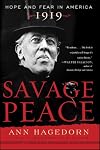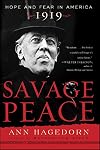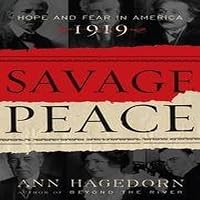
Savage Peace: Hope and Fear in America, 1919
by Ann Hagedorn
On This Page
Description
The surprising story of America in the year 1919--democracy under stress. In the aftermath of an unprecedented world war and a flu pandemic, Americans were full of hope for the benefits of peace. But instead, the fear of terrorism filled their days. Bolshevism was the new menace, and the federal government, utilizing a vast network of domestic spies, began to watch anyone deemed suspicious. A young lawyer named J. Edgar Hoover headed a brand-new intelligence division (later to become the show more FBI). Bombs exploded on the doorstep of the attorney general's home in Washington, D.C. Wartime legislation to curb criticism of the government was extended and even strengthened. Labor strife was a daily occurrence. Decorated African-American soldiers, returning home to claim the democracy for which they had risked their lives, were badly disappointed. Weaving together the stories of a panoramic cast of characters, from Albert Einstein to Helen Keller, author Hagedorn illuminates America at a pivotal moment.--From publisher description. show lessTags
Recommendations




Member Reviews
Ann Hagedorn's Savage Peace: Hope and Fear in America, 1919 (Simon & Schuster, 2007) is unlike any book I can recall ever having read. The story of a single year, told using many different characters and many different aspects of cultural, political, social and economic life. Hagedorn doesn't stop at chronicling the political turmoil surrounding the debate over Treaty of Versailles and the League of Nations, nor does she simply comment on the racial tensions of the time, or the fight over women's suffrage, or the Red Scare, or the flu pandemic, or the fixed World Series, or the effort to confirm Einstein's theory of relativity. No, she tackles all of these topics, and more.
With the pacing of a suspense novel (and the cliffhanger chapter show more endings of one, too), the narrative flair of a good journalistic essay, and the deep research of a classic historical tome, Savage Peace manages to bring together several disparate genres at once, and does so brilliantly. At first I was unnerved by the attempt to bring together so many different leading characters in such an unfamiliar way, but after a few chapters I was absolutely enthralled. The book is 450 pages long (exclusive of notes and index), but I read it in under two days, and it felt like much less than that.
My one concern is the notes, which, while perfectly fine, are unmarked in the text, making it burdensome to find them. Overall, though, a true pleasure to read. I suspect that any of the specific topics covered here may be covered in more depth elsewhere, but I don't think I'm going too far out on a limb in saying that you'll find no better overall treatment of the period than Hagedorn's. It's also possible that others with more knowledge of the era than I (my focus is generally much earlier) may have quibbles or concerns with Hagedorn's book that I missed entirely - but that's their point to make. I enjoyed the book very much, and am bound to look at Hagedorn's earlier works while I await her next.
http://philobiblos.blogspot.com/2008/12/book-review-savage-peace.html show less
With the pacing of a suspense novel (and the cliffhanger chapter show more endings of one, too), the narrative flair of a good journalistic essay, and the deep research of a classic historical tome, Savage Peace manages to bring together several disparate genres at once, and does so brilliantly. At first I was unnerved by the attempt to bring together so many different leading characters in such an unfamiliar way, but after a few chapters I was absolutely enthralled. The book is 450 pages long (exclusive of notes and index), but I read it in under two days, and it felt like much less than that.
My one concern is the notes, which, while perfectly fine, are unmarked in the text, making it burdensome to find them. Overall, though, a true pleasure to read. I suspect that any of the specific topics covered here may be covered in more depth elsewhere, but I don't think I'm going too far out on a limb in saying that you'll find no better overall treatment of the period than Hagedorn's. It's also possible that others with more knowledge of the era than I (my focus is generally much earlier) may have quibbles or concerns with Hagedorn's book that I missed entirely - but that's their point to make. I enjoyed the book very much, and am bound to look at Hagedorn's earlier works while I await her next.
http://philobiblos.blogspot.com/2008/12/book-review-savage-peace.html show less
A great book about little known topics in world, though chiefly American, history. Focusing chiefly on race relations and the Red Scare in 1919, Hagedorn relates the degree of paranoia in post-war America, as well as the disturbing degree of domestic surveillance.
Though the American involvement in Versailles peace accords is related, it is not a chief focus of the book, and better can be found elsewhere. Hagedorn also includes some tasty tidbits about the efforts to prove Einstein's Theory of Relativity, and the first transatlantic flights.
One of my favorite books of 2007
Though the American involvement in Versailles peace accords is related, it is not a chief focus of the book, and better can be found elsewhere. Hagedorn also includes some tasty tidbits about the efforts to prove Einstein's Theory of Relativity, and the first transatlantic flights.
One of my favorite books of 2007
Ratings
Members
- Recently Added By
Author Information

9 Works 690 Members
Ann Hagedorn has been a writer for The Wall Street Journal and special projects editor for the New York Daily News and has taught narrative writing at Columbia's Graduate School of Journalism. She currently lives in Ripley, Ohio.
Awards and Honors
Common Knowledge
- Original publication date
- 2007
- Important events
- World War I
- Epigraph
- History is a record of the incessant struggle of humanity against ignorance and oppression.
--Helen Keller, 1918 - Dedication
- In memory of Dwight
and
To Elizabeth - First words
- (Prologue)
Somewhere beyond the mist and the misery on that November morning, six men met in a railcar to end a war.
(Part 1, Chapter 1)
On December 4, 1918, three weeks after the Armistice, Woodrow WIlson boarded the USS George Washington bound for the Paris Peace Conference with the grand mission of cutting through the darkness ... (show all)at the center of the universe to release a light of peace. - Last words
- (Click to show. Warning: May contain spoilers.)And then with a touch of Grayson, he ended the book with a poem that reflected his now deep understanding of all truth seekers who boldly pursue a cause:
Curious, in time, I stand, noting the efforts of heroes:
Is the deferment long? Bitter the slander, poverty, death?
Lies the seed unreck'd for centuries in the ground?
Lo! To God's due occasion,
Uprising in the night, it sprouts, blooms,
And fills the earth with use and beauty.
Classifications
- Genres
- History, Nonfiction, General Nonfiction, Politics and Government
- DDC/MDS
- 973.913 — History & geography History of North America United States 1901- World Wars and Depression Era (1901-1953) Woodrow Wilson, (1913-1921) World War I, Federal Reserve Act, Treaty of Versailles
- LCC
- E766 .H34 — History of the United States United States Twentieth century Wilson's administrations, 1913-1921
- BISAC
Statistics
- Members
- 210
- Popularity
- 155,021
- Reviews
- 2
- Rating
- (3.97)
- Languages
- English
- Media
- Paper, Ebook
- ISBNs
- 3
- UPCs
- 1
- ASINs
- 4