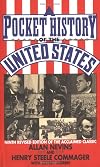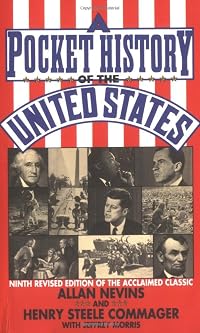
A Pocket History of the United States
by Allan Nevins, Henry Steele Commager (Author)
On This Page
Description
A Pocket History * of the * United States traces the history of the nation that is, today, the oldest constitutional democracy in the world. Written by distinguished American historians, it has more than 2,000,000 copies in print worldwide and is one of the classic works in its field. The United States, with its variety of peoples and races, its cultures inherited and new, is the most ambitious experiment in the history of nations-an experiment still very much alive. There are few parallels show more in modern history to the adventure of its swift expansion across a giant continent and the growth of a few struggling colonies into a nation of fifty states, united by religious tolerance, economic opportunity and political democracy. Now revised and updated, this remarkable volume presents and interprets the rise of the American people from their earliest settlements to the emergence of the U.S. as a world power, through the latest changes in foreign and domestic politics, up to and including the 1991 war with Iraq. Maps * Bibliographies * Index. show lessTags
Recommendations


















Member Reviews
An old-fashioned account of the history of the United States that doesn't cover up America's bad aspects, but it generally treats America as a progressively better nation (for bad or good). It is a sort of 1940s progressive liberal/Whig history of the US. It does lean towards Democrats beginning in the 20th century and needs many more maps, but it is still good.
That is, up until the modern update courtesy of Jeffrey Morris, which might be described as: Democrats good, Republicans bad. Nowhere is this most apparent when he talks about Reagan, who comes across as a genial cipher (the "amiable dunce" myth). And Morris just makes stupid, ahistorical comments, case in point, p. 624: "The President's overarching goal in the area of domestic show more policy was to reduce the role of the federal government, a policy traditionally associated with the party of Jefferson, not that of Lincoln." REALLY? Maybe the analogy holds true for Jefferson and Lincoln themselves, but not their parties, at least not since the 1890s. Has Morris ever heard of, I don't know, Republicans like Harding and Coolidge who pruned government? or government growers like Wilson, FDR, and LBJ, who created bloated bureaucracies? What party did the last three belong to? Hint, they ain't Republicans. Absolutely and utterly biased against conservatives. show less
That is, up until the modern update courtesy of Jeffrey Morris, which might be described as: Democrats good, Republicans bad. Nowhere is this most apparent when he talks about Reagan, who comes across as a genial cipher (the "amiable dunce" myth). And Morris just makes stupid, ahistorical comments, case in point, p. 624: "The President's overarching goal in the area of domestic show more policy was to reduce the role of the federal government, a policy traditionally associated with the party of Jefferson, not that of Lincoln." REALLY? Maybe the analogy holds true for Jefferson and Lincoln themselves, but not their parties, at least not since the 1890s. Has Morris ever heard of, I don't know, Republicans like Harding and Coolidge who pruned government? or government growers like Wilson, FDR, and LBJ, who created bloated bureaucracies? What party did the last three belong to? Hint, they ain't Republicans. Absolutely and utterly biased against conservatives. show less
A decent short narrative history of the United States, running from 'the planting of the colonies' to World War II.
It has a few flaws, although its not terrible overall. Its main problems are that the prose is sometimes tinted with a bit of romaticism-- it would have been better if the authors had written slightley more seriously, and not tried to give it the air of an amusing school textbook-- and that the text is sometimes a bit cluttered by relatively unimportant facts-- it may be a short narrative, but it isn't tight....
And of course, it's also pretty old-fashioned, for better or worse. On the whole, not terrible, but certainly not great.
(7/10)
It has a few flaws, although its not terrible overall. Its main problems are that the prose is sometimes tinted with a bit of romaticism-- it would have been better if the authors had written slightley more seriously, and not tried to give it the air of an amusing school textbook-- and that the text is sometimes a bit cluttered by relatively unimportant facts-- it may be a short narrative, but it isn't tight....
And of course, it's also pretty old-fashioned, for better or worse. On the whole, not terrible, but certainly not great.
(7/10)
Ratings
Members
- Recently Added By
Author Information

114+ Works 3,810 Members
Allan Nevins, 1890 - 1971 Educator, historian and biographer Allan Nevins was born in Camp Point, Illinois. He was educated at the University of Illinois. From 1913-1931, he was on the editorial staff of various newspapers and periodicals in New York City. From 1931 until his retirement in 1958, he was the professor of American history at Columbia show more University. He died in Menlo Park, California, in 1971. His historical and biographical writings were thoroughly researched and two of his books, "Grover Cleveland" (1932) and "Hamilton Fish" (1936), won Pulitzer Prizes. Other titles include "The Ordeal of the Union" (8 vol. 1947-1971) and "The Emergence of Lincoln" (2 vol. 1950). He also edited letters and diaries, which included "The Diary of John Quincy Adams" (1928). (Bowker Author Biography) show less

Henry Steele Commager was born in Pittsburgh, Pennsylvania on October 25, 1902. He was educated at the University of Chicago. He taught history at New York University, Columbia University, and Amherst College. In addition to lecturing at many universities throughout the world, he was Harmsworth Professor at Oxford University and Pitt Professor at show more Cambridge University, where he was also an honorary fellow at Peterhouse College. His writings range widely over such topics as education, the Civil War, civil liberties, the Enlightenment, and immigration. Many of his books reflect his keen interest in constitutional history and civil liberties. He was also a documentarian, who has said to consider Documents of American History (1934), the 1988 edition of which he coedited with Milton Cantor, to be his most significant contribution. He died on March 2, 1998. (Bowker Author Biography) Henry Steele Commager was a well-known American historian who taught at New York University, Columbia, and Amherst. His many books won numerous prizes. He died in 1998 at age ninety-five. (Publisher Provided) show less
Some Editions
Series
Belongs to Publisher Series
The Pocket Library (PL-512)
Common Knowledge
- Canonical title
- A Pocket History of the United States
- Original title
- A Pocket history of the United States
- Original publication date
- 1942 (1e édition originale américaine) (1e édition originale américaine); 1942 (1e traduction et édition française, Overseas Editions) (1e traduction et édition française, Overseas Editions); 1989 (8e édition française ∙ Economica) (8e édition française ∙ Economica)
- Important places*
- Etats-Unis
- Original language*
- Anglais (Etats-Unis) (Etats-Unis)
*Some information comes from Common Knowledge in other languages. Click "Edit" for more information.
Classifications
Statistics
- Members
- 427
- Popularity
- 72,253
- Reviews
- 2
- Rating
- (3.60)
- Languages
- English, French, Spanish
- Media
- Paper
- ISBNs
- 12
- ASINs
- 30