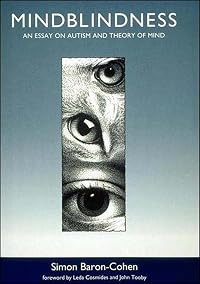
Mindblindness: An Essay on Autism and Theory of Mind
by Simon Baron-Cohen
On This Page
Description
In Mindblindness, Simon Baron-Cohen presents a model of the evolution and development of "mindreading." He argues that we mindread all the time, effortlessly, automatically, and mostly unconsciously. It is the natural way in which we interpret, predict, and participate in social behavior and communication. We ascribe mental states to people: states such as thoughts desires, knowledge, and intentions. Building on many years of research, Baron-Cohen concludes that children with autism suffer show more from "mindblindness" as a result of a selective impairment in mindreading. For these children the world is essentially devoid of mental things. Baron-Cohen develops a theory that draws on data from comparative psychology, from developmental psychology, and from neuropsychology. He argues that specific neurocognitive mechanisms have evolved that allow us to mindread, to make sense of actions, to interpret gazes as meaningful, and to decode "the language of the eyes." show lessTags
Recommendations

































Member Reviews
As much as I like Baron-Cohen's work, this book is a bit too neurologically-focussed for the layperson.
Ratings
Members
- Recently Added By
Lists

Books in the Bibliography of The Illusion of Conscious Will by Daniel Wegne
273 works; 1 member
Author Information

23+ Works 1,669 Members
Simon Baron-Cohen is professor of psychology and psychiatry at Cambridge University and director of its Autism Research Centre
Series
Belongs to Publisher Series
Common Knowledge
- Original publication date
- 1995
- People/Characters
- Nicholas Humphrey; Steven Pinker
- Epigraph
- I have no serious doubt that this theory (what I call "commonsense belief/desire psychology") it pretty close to being true. My reason for believing this... is that commonsense belief/desire psychology explains vastly more ab... (show all)out behavior than any of the other theories available. It could hardly fail to do so: there are no alternative theories available. (Fodor 1983, p. x)
- First words
- Foreword [by John Tooby and Leda Cosmides]
Just as common sense is the faculty that tells us that the world is flat, so too it tells us many other things that are equally unpredictable.
On the Term "Mindblindness"
I first coined the term "mindblindness" to describe autism in an article entitled "Autism: A specific cognitive disorder of mindblindness" (International Review of Psychiatry 2 (1990): 79... (show all)-88).
Classifications
- Genres
- Nonfiction, Science & Nature, General Nonfiction
- DDC/MDS
- 616.89 — Applied science & technology Medicine & health Diseases, Allergies, Skin Conditions Nervous Disorders: Autism, Anorexia, OCD Mental disorders: bi-polar/schizophrenia
- LCC
- BF444 .B37 — Philosophy, Psychology and Religion Psychology Psychology Consciousness. Cognition
- BISAC
Statistics
- Members
- 145
- Popularity
- 226,375
- Reviews
- 1
- Rating
- (3.57)
- Languages
- English
- Media
- Paper, Ebook
- ISBNs
- 4
- ASINs
- 1