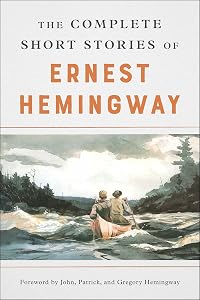
The Complete Short Stories of Ernest Hemingway: The Finca Vigía Edition
by Ernest Hemingway 
On This Page
Description
The definitive collection by the man whose craft and vision remains an enduring influence on generations of readers and writers. Contains twenty-one stories not included in the 1938 omnibus "The first forty-nine."Tags
Recommendations




Member Reviews
In his short story Hills like White Elephants, Ernest Hemingway writes as on onlooker showing the full perspective of a situation between and man and a “girl” debating whether or not to have an abortion. In a way Hemingway is using this scene to represent the role that many men and women often find themselves playing in today’s society. In his story the female is continuously referred to as the “girl” representing that she is of lesser power then the man who she is in a relationship. When making decision in real life it would make more sense that a man would have the power over a young girl, and often times this is how men in societies treat women. It is even how many religions are still taught.
Throughout the entire piece the show more girl is only trying to win over the man’s approval. She states to him, “If I do it you’ll be happy and things will be like they were and you’ll love me?” demonstrating how she is only trying to please him.
Hemingway uses the symbolism of the shadow to further support idea that women are constantly in the darkness of the decisions the men around them make. When the girl attempts to walk into the sun light to create an opinion of her own as to whether bringing in a new life to the world is something she wants, the man asks her to “Come back into the shade,” as if to tell her to stop thinking and having her own opinions. show less
Throughout the entire piece the show more girl is only trying to win over the man’s approval. She states to him, “If I do it you’ll be happy and things will be like they were and you’ll love me?” demonstrating how she is only trying to please him.
Hemingway uses the symbolism of the shadow to further support idea that women are constantly in the darkness of the decisions the men around them make. When the girl attempts to walk into the sun light to create an opinion of her own as to whether bringing in a new life to the world is something she wants, the man asks her to “Come back into the shade,” as if to tell her to stop thinking and having her own opinions. show less
How can I review a book that took me 30 years to read? This is not just a book, it is part of my life. I have been working on The Complete Short Stories of Ernest Hemingway longer than all my formal education, two marriages, and my law practice.
But I can’t review Hemingway, especially when my attitudes about his writing have changed over the decades. I was unquestionably awed as a teenager, snide as a college English major, a genuine fan as an adult, and now just a little weary.
His writing is masterful. He was a genius with spare dialog and creating reality with only a few brush strokes. (Of course, because he taught Americans a new way of writing, reading the original does not pack the wallop it must have before everyone copied show more him.) What wore me out was the subject matter – the bull fights and the Spanish Civil War in particular. It just got to be a chore for me to get to the end.
Longer version posted on Rose City Reader. show less
But I can’t review Hemingway, especially when my attitudes about his writing have changed over the decades. I was unquestionably awed as a teenager, snide as a college English major, a genuine fan as an adult, and now just a little weary.
His writing is masterful. He was a genius with spare dialog and creating reality with only a few brush strokes. (Of course, because he taught Americans a new way of writing, reading the original does not pack the wallop it must have before everyone copied show more him.) What wore me out was the subject matter – the bull fights and the Spanish Civil War in particular. It just got to be a chore for me to get to the end.
Longer version posted on Rose City Reader. show less
Strangely enough, even though I find Hemingway's misogyny disgusting, I find he's generally more interesting and readable when he is in bitter, misogynistic mode (as in "The Short, Happy Life of Francis Macomber") than when he is in his celebrate-fishing-and-male-companionship mode (as in "Big, Two-Hearted River"), since the latter comes off as forced while his misogyny is clearly the Real McCoy.
Having read several of Hemingway's longer novels (The Sun Also Rises, A Farewell to Arms and For Whom the Bell Tolls) I looked forward to this collection with great anticipation. My appetite was only whetted with the first story in the collection, "The Short Happy Life of Francis Macomber", which I found to be magnificent. Alas, it proved to be the star of the collection.
While several of the remaining stories were certainly outstanding (in particular "Fifty Grand", A Way You'll never Be", "Under the Ridge", "An African Story" and "I Guess Everything Reminds You of Something"), a number of the stories were less than spectacular. Particularly disappointing were the numerous efforts of under 750 words.
Now, you may be a brilliant writer, show more and even a master of the art of story telling, but in my opinion, you cannot tell a story in two pages. You can set a scene; you can paint a picture, but you cannot tell a story. I counted ten such SHORT SHORT short stories and another fifteen only slightly longer. Those stories which ran beyond 6-8 pages were, by and large quite enjoyable.
Having read several of Hemingway's longer works and found them to be, in some cases, in need of editing, and now having read a number of his works which can only be described as overly brief, I'm left with the opinion that he is best enjoyed in those works of 10-200 pages, not coincidentally the length of his Pulitzer Prize winning novella, "The Old Man and the Sea".
I'm struck by a passage in "For Whom the Bell Tolls" in which the Communist partisan Pilar recounts the revolution within her village in which the Fascists (a/k/a the successful citizens) were rounded up and murdered. Those twenty pages, lifted out, would have qualified as one of the greatest short stories ever written, yet it becomes somewhat lost in a story that wanders at times.
Certainly, this book will be enjoyed by anyone who has developed a taste for Hemingway and to a lesser extent, those who enjoy the art of the short story. I only gave high marks to roughly a third of the offerings, however those 23 stories account for almost 75% of the pages in the book. The other efforts are simply too short for my taste, and they account for a majority of the stories in the collection. show less
While several of the remaining stories were certainly outstanding (in particular "Fifty Grand", A Way You'll never Be", "Under the Ridge", "An African Story" and "I Guess Everything Reminds You of Something"), a number of the stories were less than spectacular. Particularly disappointing were the numerous efforts of under 750 words.
Now, you may be a brilliant writer, show more and even a master of the art of story telling, but in my opinion, you cannot tell a story in two pages. You can set a scene; you can paint a picture, but you cannot tell a story. I counted ten such SHORT SHORT short stories and another fifteen only slightly longer. Those stories which ran beyond 6-8 pages were, by and large quite enjoyable.
Having read several of Hemingway's longer works and found them to be, in some cases, in need of editing, and now having read a number of his works which can only be described as overly brief, I'm left with the opinion that he is best enjoyed in those works of 10-200 pages, not coincidentally the length of his Pulitzer Prize winning novella, "The Old Man and the Sea".
I'm struck by a passage in "For Whom the Bell Tolls" in which the Communist partisan Pilar recounts the revolution within her village in which the Fascists (a/k/a the successful citizens) were rounded up and murdered. Those twenty pages, lifted out, would have qualified as one of the greatest short stories ever written, yet it becomes somewhat lost in a story that wanders at times.
Certainly, this book will be enjoyed by anyone who has developed a taste for Hemingway and to a lesser extent, those who enjoy the art of the short story. I only gave high marks to roughly a third of the offerings, however those 23 stories account for almost 75% of the pages in the book. The other efforts are simply too short for my taste, and they account for a majority of the stories in the collection. show less
In Ernest Hemingway’s Hills Like White Elephants, Hemingway describes a couples’ experience in a bar halfway between Madrid and Barcelona. Hemingway does this in a very intriguing and unique way. The couple is discussing having an abortion but Hemingway never straight out says that. He uses many literary devices to convey what is happening between them.
Hemingway is an excellent writer, he knows how to use symbolism, characters, settings, and point of view to give the reader all the information they need but they still have to figure it out for themselves. He forces the reader to connect the dots. Everything in Hills Like White Elephants has a purpose and every sentence plays an integral part in the story.
The train station in the show more story resembles that the couple is going in two different directions. They are in the middle of two important things, a metaphor because physically they are between Barcelona and Madrid, but emotionally they are in the midst of a huge decision, to keep or to abort their baby. But at the moment they are in the middle of nowhere, as in nowhere close to making a decision on the matter. The hills in the background of the train station resemble a baby bump. The couple orders drink after drink at the bar in an attempt to avoid their obvious problems. The two are clearly disconnected from one another. Hemingway portrays the complications in the relationship in a couple of ways. He never gives the reader the name of “the girl,” she is referred to as Jig a couple of times but that is it. Additionally he never gives “the American” a name either. The girl is very dependent on the American, she cannot speak Spanish, so he is the one ordering for her and he is the one who carries their bags to the other side of the station. These may be little details, but, in this story nothing is irrelevant, every sentence has a calculated purpose in the story.
Personally I enjoyed reading the short story, it showed abortion, a very controversial topic in a new light. It took me a while to understand the metaphors because they are by no means explicit, but once I made the connection it made the story a lot more interesting and very unique. Even though I have never been in a situation remotely like the one Jig is in I still found it pretty relatable. Every relationship has its weaknesses and theirs is clearly communication. I feel like the American and the girl are on totally different planes. He does not want the baby because he seems immature and is afraid of change. While the girl, originally is doubting herself and her ability to care for a baby but once she thinks about it a little more it seems to me that she wants to keep the child. Either way it is an incredibly difficult and emotional decision to make and they need to openly and honestly discuss it with one another. show less
Hemingway is an excellent writer, he knows how to use symbolism, characters, settings, and point of view to give the reader all the information they need but they still have to figure it out for themselves. He forces the reader to connect the dots. Everything in Hills Like White Elephants has a purpose and every sentence plays an integral part in the story.
The train station in the show more story resembles that the couple is going in two different directions. They are in the middle of two important things, a metaphor because physically they are between Barcelona and Madrid, but emotionally they are in the midst of a huge decision, to keep or to abort their baby. But at the moment they are in the middle of nowhere, as in nowhere close to making a decision on the matter. The hills in the background of the train station resemble a baby bump. The couple orders drink after drink at the bar in an attempt to avoid their obvious problems. The two are clearly disconnected from one another. Hemingway portrays the complications in the relationship in a couple of ways. He never gives the reader the name of “the girl,” she is referred to as Jig a couple of times but that is it. Additionally he never gives “the American” a name either. The girl is very dependent on the American, she cannot speak Spanish, so he is the one ordering for her and he is the one who carries their bags to the other side of the station. These may be little details, but, in this story nothing is irrelevant, every sentence has a calculated purpose in the story.
Personally I enjoyed reading the short story, it showed abortion, a very controversial topic in a new light. It took me a while to understand the metaphors because they are by no means explicit, but once I made the connection it made the story a lot more interesting and very unique. Even though I have never been in a situation remotely like the one Jig is in I still found it pretty relatable. Every relationship has its weaknesses and theirs is clearly communication. I feel like the American and the girl are on totally different planes. He does not want the baby because he seems immature and is afraid of change. While the girl, originally is doubting herself and her ability to care for a baby but once she thinks about it a little more it seems to me that she wants to keep the child. Either way it is an incredibly difficult and emotional decision to make and they need to openly and honestly discuss it with one another. show less
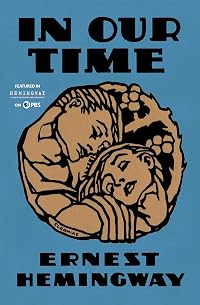
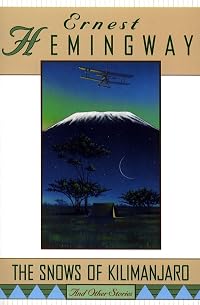
The Complete Short Stories consists of the First Forty-Nine (itself a compilation of stories from In Our Time, Men Without Women, Winner Take Nothing and The Snows of Kilimanjaro), 14 stories published after 1938, and 7 unpublished stories, some of which are actually drafts for a novel.
I absolutely love Hemingway. I sometimes wish I didn't, as some of these stories are completely depressing, but there it is. I haven't read most of the novels, but the short stories are magnificent, and I'm going to stop there, give away my copies of The Sun Also Rises, For Whom the Bell Tolls, and A Farewell to Arms, and let the stories stand on their own.
I absolutely love Hemingway. I sometimes wish I didn't, as some of these stories are completely depressing, but there it is. I haven't read most of the novels, but the short stories are magnificent, and I'm going to stop there, give away my copies of The Sun Also Rises, For Whom the Bell Tolls, and A Farewell to Arms, and let the stories stand on their own.
This book is certainly a collection that outstrips The First Forty-Nine, but some of the "bonus stories" are fileted from other books instead of being short stories in their own true rights, making this collection a step away from "perfect" or "complete" as the title would indicate. I would get the Everyman Library Collected Stories instead of this for people who really want to dig into Hemingway's short story prowess.
Members
- Recently Added By
Lists

Favorite Short Fiction
228 works; 99 members

New Lifetime Reading Plan by Fadiman and Major
225 works; 5 members
Author Information

660+ Works 173,791 Members
Ernest Miller Hemingway was born in the family home in Oak Park, Ill., on July 21, 1899. In high school, Hemingway enjoyed working on The Trapeze, his school newspaper, where he wrote his first articles. Upon graduation in the spring of 1917, Hemingway took a job as a cub reporter for the Kansas City Star. After a short stint in the U.S. Army as a show more volunteer Red Cross ambulance driver in Italy, Hemingway moved to Paris, and it was here that Hemingway began his well-documented career as a novelist. Hemingway's first collection of short stories and vignettes, entitled In Our Time, was published in 1925. His first major novel, The Sun Also Rises, the story of American and English expatriates in Paris and on excursion to Pamplona, immediately established him as one of the great prose stylists and preeminent writers of his time. In this book, Hemingway quotes Gertrude Stein, "You are all a lost generation," thereby labeling himself and other expatriate writers, including F. Scott Fitzgerald, T.S. Eliot, and Ford Madox Ford. Other novels written by Hemingway include: A Farewell To Arms, the story, based in part on Hemingway's life, of an American ambulance driver on the Italian front and his passion for a beautiful English nurse; For Whom the Bell Tolls, the story of an American who fought, loved, and died with the guerrillas in the mountains of Spain; and To Have and Have Not, about an honest man forced into running contraband between Cuba and Key West. Non-fiction includes Green Hills of Africa, Hemingway's lyrical journal of a month on safari in East Africa; and A Moveable Feast, his recollections of Paris in the Roaring 20s. In 1954, Hemingway won the Nobel Prize in Literature for his novella, The Old Man and the Sea. A year after being hospitalized for uncontrolled high blood pressure, liver disease, diabetes, and depression, Hemingway committed suicide on July 2, 1961, in Ketchum, Idaho. (Bowker Author Biography) show less
Ernest Hemingway has a Legacy Library. Legacy libraries are the personal libraries of famous readers, entered by LibraryThing members from the Legacy Libraries group.
Some Editions
Work Relationships
Is contained in
Contains
Has as a student's study guide
Common Knowledge
- Canonical title
- The Complete Short Stories of Ernest Hemingway: The Finca Vigía Edition
- Original publication date
- 1987
- First words
- (Foreword) When Papa and Marty first rented in 1940 the Finca Vigía which was to be his home for the next twenty-two years until his death, there was still a real country on the south side.
(Publisher's Preface) There has long been a need for a complete and up-to-date edition of the short stories of Ernest Hemingway.
(Preface to "The First Forty-nine") The first four stories are the last ones I have written. The others follow in the order in which they were originally published. - Disambiguation notice
- The Finca Vigía edition collects all the stories Hemingway published in his lifetime, those published posthumously, and seven that are appearing in print for the first time (altogether 70 stories).
Classifications
Statistics
- Members
- 5,104
- Popularity
- 2,704
- Reviews
- 27
- Rating
- (4.26)
- Languages
- 5 — English, French, German, Portuguese, Spanish
- Media
- Paper, Ebook
- ISBNs
- 10
- ASINs
- 34