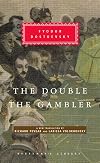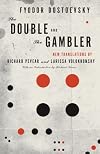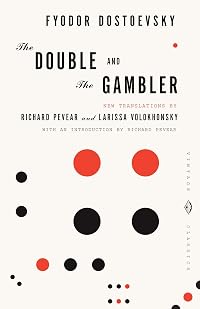
The Double / The Gambler
by Fyodor Dostoyevsky 
On This Page
Description
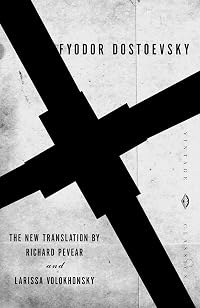
The two original short novels brought together here - in new translations by award-winning translators - were both literary gambles of a sort for Dostoevsky. The Double, written in Dostoevsky's youth, was a sharp turn away from the realism of his first novel, Poor Folk. The first real expression of his genius, The Double is a surprisingly modern hallucinatory nightmare in which a minor official named Goliadkin becomes aware of a mysterious doppelganger - a man who has his name and his face show more and who gradually and relentlessly begins to displace him with his friends and colleagues. In the dilemma of this increasingly paranoid hero, Dostoevsky makes vividly concrete the inner disintegration of consciousness that would become a major theme of his work. The Gambler was written twenty years later, under the pressure of crushing debt. It is a stunning psychological portrait of a young man's exhilarating and destructive addiction, a compulsion that Dostoevsky - who once gambled away his young wife's wedding ring - knew intimately from his own experience. In the disastrous love affairs and gambling adventures of his character, Alexei Ivanovich, Dostoevsky explores the irresistible temptation to look into the abyss of ultimate risk that he believed was an essential part of the Russian national character. show lessTags
Recommendations










Member Reviews
Two literary works that function simultaneously as feasts and ordeals. Dostoyevsky (with THANK GOD readable translations by Pevear and Volokhonsky) makes you climb near word mountains to disassemble and reassemble his text. It's not that what is going on, at least on the surface, is too complicated to understand, but Dostoyevsky describes everything (read EVERYTHING)in such profound and maddening depth that it can, at times, make reading even one chapter, hell, one damn paragraph a labor.
But unlike so many other authors who offer thickets and mazes of obtuse and abstract word jumbles leaving you only chasing your own (or their) image or grasping at air (or even telling you nothing at all) Dostoyevsky does nearly everything with purpose show more and a skilled (close to insane) hand.
I loved these stories but both require a level of intense dedication and concentration, yes, even in translation. But it really feels like you're wringing out bits of what (i think, don't sue hemingway estate) hemingway called 'true writing'.
Hopefully this book will serve as the 'gentle' segue way into the author's longer novels, fingers kind of crossed on that one. show less
But unlike so many other authors who offer thickets and mazes of obtuse and abstract word jumbles leaving you only chasing your own (or their) image or grasping at air (or even telling you nothing at all) Dostoyevsky does nearly everything with purpose show more and a skilled (close to insane) hand.
I loved these stories but both require a level of intense dedication and concentration, yes, even in translation. But it really feels like you're wringing out bits of what (i think, don't sue hemingway estate) hemingway called 'true writing'.
Hopefully this book will serve as the 'gentle' segue way into the author's longer novels, fingers kind of crossed on that one. show less
Dostoevsky is one of the greatest writers of all time. A contemporary of Dickens and Tolstoy - his literature has stood the test of time and serves as a prime example of the human capability to express one-self. Some of his novels are deep thought provoking works of philosophical content. Both "The Double" and "The Gambler" are light on philosophy, but present richly crafted, intensely dramatic character studies; one short novella involves the actions of a man deeply troubled and confused, and the other novella explores the personality and actions of a compulsive gambler. A genius in the art of descriptive narratives, Dostoevsky lays the groundwork, sets the stage, and then leads the reader into an emotionally charged labyrinth filled show more with colorful characters.
"The Double" was published in 1846 - one of Dostoevsky’s first attempts at fiction - at the age of 25. He may have lacked polish, but the genius of his style was already visible. The Double is a darkly complex capsule of several days in the life of a government clerk - Vakov Petrovich Goliadkin. Vakov is shy, introverted, a poor conversationalist and clearly at odds with his co-workers and society in general. He visits a Dr. for advice on how to deal with his social anxiety and is told to change his habits, “visit friends and acquaintances, and along with that be no enemy to the bottle; likewise keep merry company.” Anyone who has ever suffered social anxiety knows that is easier said than done, and for someone on a downward spiral who has already alienated most everyone, it could be an impossible task.
It quickly becomes apparent that Vakov is suffering hallucinations. He is suddenly confronted by a twin - with his own name - who invades Vakov’s life - gets a job in the same office - goes to the same parties, the same eating establishments, even comes to visit Vakov at his home. It is sometimes uncertain if the double does exist and Vakov is merely imagining some other man looks just like him, or if the entire being of this other person is all a mirage. And if you delve into Vakov’s psyche you can only wonder if his double is Vakov’s way of sub-consciously trying to re-establish a connection with the outer world, or a desperate attempt to ignore a split personality.
"The Gambler" was written in 1866 and takes place in some unnamed cosmopolitan city - an international gambling mecca. The story centers around a Russian tutor who is traveling abroad with his employer’s family. His employer is a General who surrounds himself with an entourage of exotic people; an English gentleman, a French Count, and a young Russian Countess traveling with her mother. They are all waiting for the General’s wealthy eccentric mother to die - hoping to cash in on the wealth, and in the meantime biding their time, living large on borrowed money.
If you’ve ever pondered the mystery of the gambling addiction, this novella will give you a first hand view of how irrational a compulsive gambler behaves... feel the exhilaration of winning, and experience the nauseating desperation that manically possesses an addict on a losing streak. Dostoevsky gives excellent descriptions... based on his own personal agonizing addictive experiences.
I highly recommend the Everyman’s Library modern translation by Richard Pevear and Larissa Volokhonsky. show less
"The Double" was published in 1846 - one of Dostoevsky’s first attempts at fiction - at the age of 25. He may have lacked polish, but the genius of his style was already visible. The Double is a darkly complex capsule of several days in the life of a government clerk - Vakov Petrovich Goliadkin. Vakov is shy, introverted, a poor conversationalist and clearly at odds with his co-workers and society in general. He visits a Dr. for advice on how to deal with his social anxiety and is told to change his habits, “visit friends and acquaintances, and along with that be no enemy to the bottle; likewise keep merry company.” Anyone who has ever suffered social anxiety knows that is easier said than done, and for someone on a downward spiral who has already alienated most everyone, it could be an impossible task.
It quickly becomes apparent that Vakov is suffering hallucinations. He is suddenly confronted by a twin - with his own name - who invades Vakov’s life - gets a job in the same office - goes to the same parties, the same eating establishments, even comes to visit Vakov at his home. It is sometimes uncertain if the double does exist and Vakov is merely imagining some other man looks just like him, or if the entire being of this other person is all a mirage. And if you delve into Vakov’s psyche you can only wonder if his double is Vakov’s way of sub-consciously trying to re-establish a connection with the outer world, or a desperate attempt to ignore a split personality.
"The Gambler" was written in 1866 and takes place in some unnamed cosmopolitan city - an international gambling mecca. The story centers around a Russian tutor who is traveling abroad with his employer’s family. His employer is a General who surrounds himself with an entourage of exotic people; an English gentleman, a French Count, and a young Russian Countess traveling with her mother. They are all waiting for the General’s wealthy eccentric mother to die - hoping to cash in on the wealth, and in the meantime biding their time, living large on borrowed money.
If you’ve ever pondered the mystery of the gambling addiction, this novella will give you a first hand view of how irrational a compulsive gambler behaves... feel the exhilaration of winning, and experience the nauseating desperation that manically possesses an addict on a losing streak. Dostoevsky gives excellent descriptions... based on his own personal agonizing addictive experiences.
I highly recommend the Everyman’s Library modern translation by Richard Pevear and Larissa Volokhonsky. show less
Two very different novellas, that perhaps would go better separately. 'The Double' is, as the blurb tells us, 'surprisingly modern,' but, as the blurb neglects to tell us, 'surprisingly modern' need not mean 'really good.' Instead, it's a bit too long, a bit over-written, and most of all it's not as good as the late novels. Of course, not much is. 'The Gambler' is entirely different--not at all modern, but also just as far from the excellence of the later works. It's enjoyable enough, particularly, as another reviewer has commented, once the grandmother shows up. Well, well. I'd rather have re-read Demons.
Well, I liked this a ton better than the other Dostoevsky I've read (Brothers Karamazov). Maybe just because it's tighter, maybe because I'm in a different place, maybe it's actually better. It has real force to it, anyway. Dostoevsky's loopy but airtight craftsmanship is on full display here.
Trivia: a) you already heard this one, but Dostoevsky once gambled away his wife's wedding ring; b) this book was in itself a gamble. He took a loan from a guy in exchange for the following gamble: if he didn't present the guy with a novel on a certain date, the guy would own all rights to his other books up to that point. He procrastinated in order to write The Idiot, ended up hiring a stenographer with weeks to spare and dictating this whole show more thing to her, got it to the guy on the very last day and promptly married the stenographer. That is a good story. show less
Trivia: a) you already heard this one, but Dostoevsky once gambled away his wife's wedding ring; b) this book was in itself a gamble. He took a loan from a guy in exchange for the following gamble: if he didn't present the guy with a novel on a certain date, the guy would own all rights to his other books up to that point. He procrastinated in order to write The Idiot, ended up hiring a stenographer with weeks to spare and dictating this whole show more thing to her, got it to the guy on the very last day and promptly married the stenographer. That is a good story. show less
The Double was a challenge and read a little like Tsarist Russian Fight Club. Very trippy. The Gambler was much more straight forward and quite sad, especially considering Dostoevsky himself was a gambler who lost all he had at the Roulette table. He used his experience to expert effect in his short novel.
Much of the "neurotic narrator" character considered to be perfected by Dostoevsky in "Notes From The Underground" is first explored in this, his second novel, published the same year as his first, "Poor Folk." I enjoyed this translation more than the George Bird translation, mainly because the way the main character, Mr. Goliadkin (Sr.), keeps repeatedly addressing his doctor as "Krestyan Ivanovich" (his first name and patronymic), rather than Bird's version in which Golyadkin simpy repeats, "Dr. Rutensptitz." That might seem like a strange reason to prefer one translation to another, but maybe it's just that, to my non-Russian ear, the constant repetition of "So you see, Krestyan Ivanovich," sounds like such a mouthful I can't help show more but laugh. Constance Garnett's version also uses "Krestyan Ivanovich," and I generally prefer her translations. Maybe one day I'll actually get around to learning some Russian so I'll be a more fit judge. show less
Golyadkin is a government clerk who, decreed by fate, encounters a man who not only resembles him exactly but is also his namesake. Golyadkin's own musings and foreshadowing along with his curious actions all afford hints and glimpses of a psychological realism that persists throughout the novel. On a stormy night in which Golyadkin tried to regain his composure after the hails of slights had descended him at a private party of the high society, he met his double. The double (who was subsequently being referred as the Golyadkin junior and the adversary), with bold effrontery, went out his own way to show Golyadkin impudence, insulted Golyadkin, and purloined Golyadkin's papers in order to win approbation of the double's superiors at show more work.
Like "Notes From Underground", "The Double" is a close examination of human consciousness, through an unreliable narrator. I repeatedly raise the question whether this imposture really happens? Does the Golyadkin junior (the double) really exist in cold fact? What really happens at the end? Perhaps the real horror of Golyadkin senior (whom Dostoyevsky eventually refers him as our hero) is that he unconsciously knows his double simply being the side of his own nature that he disapproves, despises and fears? Regardless of the existence of the double, the imposter has simply trampled Golyadkin in the mire, perfidiously intruded him, and showed clearly that the senior and also the genuine Golyadkin is not genuine at all but a counterfeit, and that Golyadkin junior himself is the real one. The book is a portrait of the darker side of despicable personality that magnifies to the full actuality. show less
Like "Notes From Underground", "The Double" is a close examination of human consciousness, through an unreliable narrator. I repeatedly raise the question whether this imposture really happens? Does the Golyadkin junior (the double) really exist in cold fact? What really happens at the end? Perhaps the real horror of Golyadkin senior (whom Dostoyevsky eventually refers him as our hero) is that he unconsciously knows his double simply being the side of his own nature that he disapproves, despises and fears? Regardless of the existence of the double, the imposter has simply trampled Golyadkin in the mire, perfidiously intruded him, and showed clearly that the senior and also the genuine Golyadkin is not genuine at all but a counterfeit, and that Golyadkin junior himself is the real one. The book is a portrait of the darker side of despicable personality that magnifies to the full actuality. show less
Members
- Recently Added By
Author Information

1,447+ Works 180,178 Members
One of the most powerful and significant authors in all modern fiction, Fyodor Dostoevsky was the son of a harsh and domineering army surgeon who was murdered by his own serfs (slaves), an event that was extremely important in shaping Dostoevsky's view of social and economic issues. He studied to be an engineer and began work as a draftsman. show more However, his first novel, Poor Folk (1846), was so well received that he abandoned engineering for writing. In 1849, Dostoevsky was arrested for being a part of a revolutionary group that owned an illegal printing press. He was sentenced to be executed, but the sentence was changed at the last minute, and he was sent to a prison camp in Siberia instead. By the time he was released in 1854, he had become a devout believer in both Christianity and Russia - although not in its ruler, the Czar. During the 1860's, Dostoevsky's personal life was in constant turmoil as the result of financial problems, a gambling addiction, and the deaths of his wife and brother. His second marriage in 1887 provided him with a stable home life and personal contentment, and during the years that followed he produced his great novels: Crime and Punishment (1886), the story of Rodya Raskolnikov, who kills two old women in the belief that he is beyond the bounds of good and evil; The Idiots (1868), the story of an epileptic who tragically affects the lives of those around him; The Possessed (1872), the story of the effect of revolutionary thought on the members of one Russian community; A Raw Youth (1875), which focuses on the disintegration and decay of family relationships and life; and The Brothers Karamazov (1880), which centers on the murder of Fyodor Karamazov and the effect the murder has on each of his four sons. These works have placed Dostoevsky in the front rank of the world's great novelists. Dostoevsky was an innovator, bringing new depth and meaning to the psychological novel and combining realism and philosophical speculation in his complex studies of the human condition. (Bowker Author Biography) show less
Fyodor Dostoyevsky has a Legacy Library. Legacy libraries are the personal libraries of famous readers, entered by LibraryThing members from the Legacy Libraries group.
Some Editions
Series
Belongs to Publisher Series
Work Relationships
Contains
Common Knowledge
- Canonical title
- The Double / The Gambler
- Original publication date
- 1846 - The Double; 1867 - The Gambler
- Original language
- Russian
Classifications
- Genres
- General Fiction, Fiction and Literature
- DDC/MDS
- 813 — Literature & rhetoric American literature in English American fiction in English
- LCC
- PG3326 .D8 — Language and Literature Slavic languages and literatures. Baltic languages. Albanian language Slavic. Baltic. Albanian Russian literature Individual authors and works 1800-1870 Dostoyevsky
- BISAC
Statistics
- Members
- 888
- Popularity
- 30,379
- Reviews
- 11
- Rating
- (3.94)
- Languages
- English, Hungarian, Russian
- Media
- Paper, Audiobook, Ebook
- ISBNs
- 9
- UPCs
- 1
- ASINs
- 6