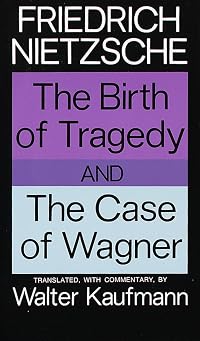
The Birth of Tragedy and The Case of Wagner
by Friedrich Nietzsche 
On This Page
Description
Two representative and important works in one volume by one of the greatest German philosophers. The Birth of Tragedy (1872) was Nietzsche's first book. Its youthful faults were exposed by Nietzsche in the brilliant "Attempt at a Self-Criticism" which he added to the new edition of 1886. But the book, whatever its excesses, remains one of the most relevant statements on tragedy ever penned. It exploded the conception of Greek culture that was prevalent down through the Victorian era, and it show more sounded themes developed in the twentieth century by classicists, existentialists, psychoanalysts, and others. The Case of Wagner (1888) was one Nietzsche's last books, and his wittiest. In attitude and style it is diametrically opposed to The Birth of Tragedy. Both works transcend their ostensible subjects and deal with art and culture, as well as the problems of the modern age generally. Each book in itself gives us an inadequate idea of its auth∨ together, they furnish a striking image of Nietzsche's thought. The distinguished translations by Walter Kaufmann superbly reflect in English Nietzsche's idiom and the vitality of his style. Professor Kaufmann has also furnished running footnote commentaries, relevant passages from Nietzsche's correspondence, a bibliography, and, for the first time in any edition, an extensive index to each book. show lessTags
Recommendations


















Member Reviews
A used to read a lot of Nietzsche in my early 20s--almost obsessively, really. Just on outside of that I purchased this paperback compendium of basically his first and last work from the sadly gone A Common Reader (R.I.P.). I finally gotten around to read it and it makes me want to once again read a lot of Nietzsche. This introductions and footnotes from the eminent, enlightening, and elucidating Walter Kaufmann make this a translation and presentation worth seeking out. Kaufmann helps paint for me a troubled genius flung into academic heights and controversies suddenly while philosophizing during the Franco-Prussian_War and to an audience steeped in the classics. I doubt I or most any reader has the familiarity with Greek literature show more and the evolution of the Greek stage dramatic arts to truly get these works. Kaufmann does a lot to fill in that gap.
I happened to read a fair amount of this in a Movie Tavern bar awaiting The Avengers: Endgame and I can't help what the author of considerations like this would have thought of this decade-long arc:
This reading did much for me to see how the Apollinian (Kaufmann explains why this is a better translation) versus Dionysian is not a simplistic duality of opposites but a blending mix; more a yin and yang centered around a reverential and mystical view of music and the mythopoeic thought: a hypothetical stage of human thought (prior to scientific thought) that produces myths.
Here also, connections to Arthur Schopenhauer which are clarified by Kaufmann. Much here resonates with me in the myth-respecting views of C. G. Jung and Joseph Campbell:
Here the mystical appeal of music to Nietzsche and one of the passages that made me double-down and buy the ebook, too:
This is hints to one of the many misconceptions the Nazis has on Nietzsche and how much he would have loathed their co-opting his terminology for their Degenerate Art Exhibition. show less
I happened to read a fair amount of this in a Movie Tavern bar awaiting The Avengers: Endgame and I can't help what the author of considerations like this would have thought of this decade-long arc:
... out of the original Titanic divine order of terror, the Olympian divine order of joy gradually evolved through the Apollinian impulse toward beauty, just as roses burst from thorny bushes. How else could this people, so sensitive, so vehement in its desires, so singularly capable of suffering , have endured existence, if it had not been revealed to them in their gods, surrounded with a higher glory?
The same impulse which calls art into being, as the complement and consummation of existence, seducing one to a continuation of life, was also the cause of the Olympian world which the Hellenic “will” made use of as a transfiguring mirror. Thus do the gods justify the life of man: they themselves live it—the only satisfactory theodicy! Existence under the bright sunshine of such gods is regarded as desirable in itself, and the real pain of Homeric men is caused by parting from it, especially by early parting: so that now, reversing the wisdom of Silenus, we might say of the Greeks that “to die soon is worst of all for them, the next worst—to die at all.”
This reading did much for me to see how the Apollinian (Kaufmann explains why this is a better translation) versus Dionysian is not a simplistic duality of opposites but a blending mix; more a yin and yang centered around a reverential and mystical view of music and the mythopoeic thought: a hypothetical stage of human thought (prior to scientific thought) that produces myths.
Perhaps we may touch on this fundamental problem by asking: what aesthetic effect results when the essentially separate art-forces, the Apollinian and the Dionysian, enter into simultaneous activity? Or more briefly: how is music related to image and concept? Schopenhauer, whom Richard Wagner, with special reference to this point, praises for an unsurpassable clearness and clarity of exposition, expresses himself most thoroughly on the subject in the following passage which I shall cite here at full length ( Welt als Wille und Vorstellung , I, p. 309 87 ): “According to all this, we may regard the phenomenal world, or nature, and music as two different expressions of the same thing, 88 which is therefore itself the only medium of their analogy, so that a knowledge of it is demanded in order to understand that analogy. Music, therefore, if regarded as an expression of the world, is in the highest degree a universal language, which is related indeed to the universality of concepts, much as they are related to the particular things. Its universality, however, is by no means that empty universality of abstraction, but of quite a different kind, and is united with thorough and experience and applicable to them all a priori , and yet are not abstract but perceptible and thoroughly determinate. All possible efforts, excitements, and manifestations of will, all that goes on in the heart of man and that reason includes in the wide, negative concept of feeling, may be expressed by the infinite number of possible melodies, but always in the universal, in the mere form, without the material, always according to the thing-in-itself, not the phenomenon, the inmost soul, as it were, of the phenomenon without the body. This deep relation which music has to the true nature of all things also explains the fact that suitable music played to any scene, action, event, or surrounding seems to disclose to us its most secret meaning, and appears as the most accurate and distinct commentary upon it. This is so truly the case that whoever gives himself up entirely to the impression of a symphony, seems to see all the possible events of life and the world take place in himself; yet it he reflects, he can find no likeness between the music and the things that passed before his mind. For, as we have said, music is distinguished from all the other arts by the fact that it is not a copy of the phenomenon, or, more accurately, of the adequate objectivity of the will, but an immediate copy of the will itself, and therefore complements everything physical in the world and every phenomenon by representing what is metaphysical, the thing in itself. We might, therefore, just as well call the world embodied music as embodied will; and this is the reason why music makes every painting, and indeed every scene of real life and of the world, at once appear with higher significance, certainly all the more, in proportion as its melody is analogous to the inner spirit of the given phenomenon. Therefore we are able to set a poem to music as a song, or a visible representation as a pantomime, or both as an opera. Such particular pictures of human life, set to the universal language of music, are never bound to it or correspond to it with stringent necessity; but they stand to it only in the relation of an example chosen at will to a general concept.
Here also, connections to Arthur Schopenhauer which are clarified by Kaufmann. Much here resonates with me in the myth-respecting views of C. G. Jung and Joseph Campbell:
But without myth every culture loses the healthy natural power of its creativity: only a horizon defined by myths completes and unifies a whole cultural movement. Myth alone saves all the powers of the imagination and of the Apollinian dream from their aimless wanderings. The images of the myth have to be the unnoticed omnipresent demonic guardians, under whose care the young soul grows to maturity and whose signs help the man to interpret his life and struggles. Even the state knows no more powerful unwritten laws than the mythical foundation that guarantees its connection with religion and its growth from mythical notions.
By way of comparison let us now picture the abstract man, untutored by myth; abstract education; abstract morality; abstract law; the abstract state; let us imagine the lawless roving of the artistic imagination, unchecked by any native myth; let us think of a culture that has no fixed and sacred primordial site but is doomed to exhaust all possibilities and to nourish itself wretchedly on all other cultures—there we have the present age, the result of that Socratism which is bent on the destruction of myth. And now the mythless man stands eternally hungry, surrounded by all past ages, and digs and grubs for roots, even if he has to dig for them among the remotest antiquities. The tremendous historical need of our unsatisfied modern culture, the assembling around one of countless other cultures, the consuming desire for knowledge—what does all this point to, if not to the loss of myth, the loss of the mythical home, the mythical maternal womb? Let us ask ourselves whether the feverish and uncanny excitement of this culture is anything but the greedy seizing and snatching at food of a hungry man—and who would care to contribute anything to a culture that cannot be satisfied no matter how much it devours, and at whose contact the most vigorous and wholesome nourishment is changed into “history and criticism”?
Here the mystical appeal of music to Nietzsche and one of the passages that made me double-down and buy the ebook, too:
“The joy aroused by the tragic myth has the same origin as the joyous sensation of dissonance in music. The Dionysian, with its primordial joy experienced even in pain, is the common source of music and tragic myth.”
This is hints to one of the many misconceptions the Nazis has on Nietzsche and how much he would have loathed their co-opting his terminology for their Degenerate Art Exhibition. show less
Ratings
Members
- Recently Added By
Author Information

1,382+ Works 78,296 Members
The son of a Lutheran pastor, Friedrich Wilhelm Nietzsche was born in 1844 in Roecken, Prussia, and studied classical philology at the Universities of Bonn and Leipzig. While at Leipzig he read the works of Schopenhauer, which greatly impressed him. He also became a disciple of the composer Richard Wagner. At the very early age of 25, Nietzsche show more was appointed professor at the University of Basel in Switzerland. In 1870, during the Franco-Prussian War, Nietzsche served in the medical corps of the Prussian army. While treating soldiers he contracted diphtheria and dysentery; he was never physically healthy afterward. Nietzsche's first book, The Birth of Tragedy Out of the Spirit of Music (1872), was a radical reinterpretation of Greek art and culture from a Schopenhaurian and Wagnerian standpoint. By 1874 Nietzsche had to retire from his university post for reasons of health. He was diagnosed at this time with a serious nervous disorder. He lived the next 15 years on his small university pension, dividing his time between Italy and Switzerland and writing constantly. He is best known for the works he produced after 1880, especially The Gay Science (1882), Thus Spake Zarathustra (1883-85), Beyond Good and Evil (1886), On the Genealogy of Morals (1887), The Antichrist (1888), and Twilight of the Idols (1888). In January 1889, Nietzsche suffered a sudden mental collapse; he lived the last 10 years of his life in a condition of insanity. After his death, his sister published many of his papers under the title The Will to Power. Nietzsche was a radical questioner who often wrote polemically with deliberate obscurity, intending to perplex, shock, and offend his readers. He attacked the entire metaphysical tradition in Western philosophy, especially Christianity and Christian morality, which he thought had reached its final and most decadent form in modern scientific humanism, with its ideals of liberalism and democracy. It has become increasingly clear that his writings are among the deepest and most prescient sources we have for acquiring a philosophical understanding of the roots of 20th-century culture. (Bowker Author Biography) show less
Friedrich Nietzsche has a Legacy Library. Legacy libraries are the personal libraries of famous readers, entered by LibraryThing members from the Legacy Libraries group.
Some Editions
Series
Belongs to Publisher Series
Work Relationships
Common Knowledge
- Original publication date
- 1888
- People/Characters
- Richard Wagner
Classifications
- Genres
- Philosophy, Nonfiction, General Nonfiction, Literature Studies and Criticism
- DDC/MDS
- 111.85 — Philosophy & psychology Metaphysics (existence, purpose, and the nature of reality) Ontology Properties of being Aesthetics
- LCC
- B3313 .G42 .E55 — Philosophy, Psychology and Religion Philosophy (General) By period Modern By region or country
- BISAC
Statistics
- Members
- 1,126
- Popularity
- 22,485
- Reviews
- 1
- Rating
- (3.90)
- Languages
- English
- Media
- Paper, Ebook
- ISBNs
- 3
- ASINs
- 9