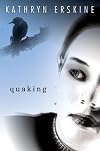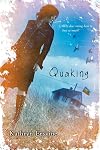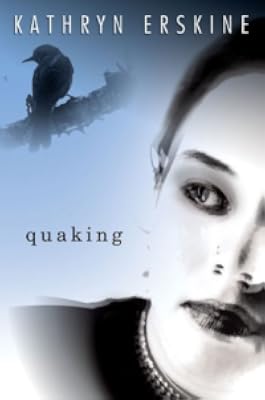
Quaking
by Kathryn Erskine
On This Page
Description
In a Pennsylvania town where anti-war sentiments are treated with contempt and violence, Matt, a fourteen-year-old girl living with a Quaker family, deals with the demons of her past as she battles bullies of the present, eventually learning to trust in others as well as herself.Tags
Recommendations


















Member Reviews
Orphaned Matt (do not call her Matilda!) has reached the end of living with distant relatives. She's now finds herself in a completely different living situation in the home of a Quaker couple in a small Pennsylvania town, Sam and Jessica. They have previously adopted a special-needs boy, who is five years old but doesn't yet talk, instead he makes annoying noises in Matt's eyes. It doesn’t pay to get attached, Matt has learned, so she keeps every potential family at arm’s length. But Sam and Jessica aren’t put off so easily. As Matt slowly, very slowly, warms to them, she learns they are in danger from the same violent forces bullying her at school in the name of “patriotism.”
This is clearly meant to evoke the first post-9/11 show more years, after we’d gone to war, though the setting is never made explicit. Matt’s history teacher bullies her but her chief bully is a boy she has dubbed The Rat. Both are drastically opposed to peace for completely different reasons. The anti-peace “patriots” in town are methodically vandalizing houses of worship that promote peace vigils. The teacher Matt calls “Mr. Warhead” assigns papers like, “The Role of Our Great Nation in the Middle Eastern Theater” — with points taken off for “wrong” answers, or actually views he opposes.
Sam and Jessica aren’t perfect, but they are determined to do right by their difficult children. It’s a lovely exploration of the Quaker faith and how it comes to fill a hole in Matt that she didn’t want to believe she had.
To me this was a powerful book that dealt with bulling and discrimination in a way that both angers the reader, but also offers some satisfaction. I was sad when the book ended. I felt I needed to know more about what would happen next, but that probably was my wanting to get revenge on the bullies. show less
This is clearly meant to evoke the first post-9/11 show more years, after we’d gone to war, though the setting is never made explicit. Matt’s history teacher bullies her but her chief bully is a boy she has dubbed The Rat. Both are drastically opposed to peace for completely different reasons. The anti-peace “patriots” in town are methodically vandalizing houses of worship that promote peace vigils. The teacher Matt calls “Mr. Warhead” assigns papers like, “The Role of Our Great Nation in the Middle Eastern Theater” — with points taken off for “wrong” answers, or actually views he opposes.
Sam and Jessica aren’t perfect, but they are determined to do right by their difficult children. It’s a lovely exploration of the Quaker faith and how it comes to fill a hole in Matt that she didn’t want to believe she had.
To me this was a powerful book that dealt with bulling and discrimination in a way that both angers the reader, but also offers some satisfaction. I was sad when the book ended. I felt I needed to know more about what would happen next, but that probably was my wanting to get revenge on the bullies. show less
Reviewed by Julie M. Prince for TeensReadToo.com
How can you not love a book that starts like this:
"Families come in all varieties but with no warranties. I have lived with first cousins twice removed, second cousins once removed, and now a third cousin who is removing herself. I call her Loopy. Because of her large earrings. And because she is insane.
Loopy drives like a ten-year-old car thief on a sugar high."
From the very beginning, Matt (not Mattie, and certainly not Matilda) has a chip on her shoulder. She's angry and cynical, and she has good reason to be. Loopy is about to dump her off at "the next hostile takeover."
"I finally found a second cousin of mine, but you need to make it work, Matt. This is the end of the line for show more you."
The end of the line is the home of Sam and Jessica Fox and their disabled foster son, the Blob. These aren't Matt's kind of people. For one thing, they're Quakers. They believe so strongly in peace that they don't even have the good sense to run and hide when bullies challenge them. They just stand there. That's what Sam calls it--taking a stand. As far as Matt can tell, it's just being plain stupid. Everyone knows you're supposed to run from bullies, and that's just what she intends to do if the Rat decides to make her the next Victim of bullying at her new school.
Kathryn Erskine never underestimates her readers as she allows this story to push the limits and tackle issues that most sweep under the rug when company is coming. I love Matt's sarcastic commentary on the state of the world as she faces the challenge of her own life. There is no doubt that this character is strong and capable--much like the writer who created her.
This is a book I'll keep on my shelf and come back to again and again. show less
How can you not love a book that starts like this:
"Families come in all varieties but with no warranties. I have lived with first cousins twice removed, second cousins once removed, and now a third cousin who is removing herself. I call her Loopy. Because of her large earrings. And because she is insane.
Loopy drives like a ten-year-old car thief on a sugar high."
From the very beginning, Matt (not Mattie, and certainly not Matilda) has a chip on her shoulder. She's angry and cynical, and she has good reason to be. Loopy is about to dump her off at "the next hostile takeover."
"I finally found a second cousin of mine, but you need to make it work, Matt. This is the end of the line for show more you."
The end of the line is the home of Sam and Jessica Fox and their disabled foster son, the Blob. These aren't Matt's kind of people. For one thing, they're Quakers. They believe so strongly in peace that they don't even have the good sense to run and hide when bullies challenge them. They just stand there. That's what Sam calls it--taking a stand. As far as Matt can tell, it's just being plain stupid. Everyone knows you're supposed to run from bullies, and that's just what she intends to do if the Rat decides to make her the next Victim of bullying at her new school.
Kathryn Erskine never underestimates her readers as she allows this story to push the limits and tackle issues that most sweep under the rug when company is coming. I love Matt's sarcastic commentary on the state of the world as she faces the challenge of her own life. There is no doubt that this character is strong and capable--much like the writer who created her.
This is a book I'll keep on my shelf and come back to again and again. show less
"Quaking" is written in the first person by Matt (Matilday, but don't call her that!), a fourteen-year-old who has experienced domestic violence in her parents' home. As a result, she has been shunted from one relative to another and she is confused about her identity when she arrives at the home of her last remaining relatives, a Quaker couple. In the early chapters some of Matt's observations of Friends are hilariously on-point. As the story moves on, things become deadly serious. Matt is bullied at school and as the faith communities of the town begin to speak out against the war in Iraq, they are threatened by individuals in the town who see them as unpatriotic.
I'm not sure I completely buy the realism of the protagonist's voice, but this is a very compelling story. A very bright child of an abusive parent, Matilda (called Matt) gets moved from family member to family member after after her mother dies. She finds a home with a young Quaker couple who help her learn to voice her own opinions on violence, aggression, and seeking peace.
Matt is a character I'd love to get inside of more, but I feel like her voice comes across more like something an adult would imagine a child thinking than what a child actually thinks--I'm not sure anyone is as self-aware as Matt is. I enjoy figuring out what makes a character tick, and I didn't always get that privilege here.
Matt is a character I'd love to get inside of more, but I feel like her voice comes across more like something an adult would imagine a child thinking than what a child actually thinks--I'm not sure anyone is as self-aware as Matt is. I enjoy figuring out what makes a character tick, and I didn't always get that privilege here.
Two-dimensionality of villains aside, I enjoyed this. It’s a lovely exploration of the Quaker faith and how it comes to fill a hole in Matt that she didn’t want to believe she had. (Full review at http://www.parenthetical.net/2011/03/09/review-quaking-kathryn-erskine/)
Fourteen-year-old Matt (Matilda) is a Goth, but that's partially a pose to keep the world away. She uses her look, and her humor — a knife-like sarcasm — to avoid making connections and taking action. But she finds at her new home that the parents, in particular the father Sam, are devout Quakers and activists engaged in the anti-Iraq war movement. As she moves closer to Sam, those same beliefs lead to her harassment at school by a big mouth bully and a pro-war civics teacher. As the title suggests, after years of an almost dormant emotional life, Matt begins "quaking" and moving toward action. The ending — which echoes that of Crutcher's Whale Talk — is tragic, and thus befits a book about the Iraq war. Review originally show more appeared in Novelist show less
Matt - short for Matilda - has spent years bouncing from one distant relative to the next. She expects her time with Sam and Matt to be more of the same. However, she is surprised to discover that her new family are Quakers, and that they seem to accept her as she is. Fearful, but intrigued by the message of love and peace that Sam and Matt share; her new found beliefs bring her into conflict with a pro-war teacher and a bully who uses the Iraq conflict as an excuse for violence.
I liked-not-loved this book. I thought it was an interesting approach to a topical subject, but felt that Erskine was trying to do too much. As a book about Matt or a book about violence against peace demonstrators, this book would have shined. As a mishmash of show more both, it felt muddled and rushed. show less
I liked-not-loved this book. I thought it was an interesting approach to a topical subject, but felt that Erskine was trying to do too much. As a book about Matt or a book about violence against peace demonstrators, this book would have shined. As a mishmash of show more both, it felt muddled and rushed. show less
Members
- Recently Added By
Author Information

11 Works 4,213 Members
Awards and Honors
Awards
Common Knowledge
- Canonical title
- Quaking
- People/Characters
- Matilda "Matt"; Bernice (aka "Loopy"); Sam Fox; Jessica; Rory (aka "The Blob"); Richard (aka "The Rat") (show all 7); Mr. Morehead (aka "Mr. Warhead")
- Important places
- Franklin High School
- Dedication
- To Bill--thanks for being our Sam.
- First words
- Families come in all varieties but with no warranties.
- Quotations
- In grade school, they tell you just to give the Beasts “I” messages:
I feel hurt when you kick me.
I do not like it when you tease me and make me cry.
I would appreciate it if you would stop shoving your fist int... (show all)o my ribs repeatedly.
By second grade, even the stupidest kids figure out that saying “I feel bad when you hurt me” only encourages the Beasts. The Beasts have their own “I” messages:
I feel great that I am hurting you.
I am happy that you are suffering.
I will continue terrorizing you, now that I know how succesful I truly am.
“I” messages do not stop them from saying that you are ugly. Or stupid. Or that they are bigger and stronger than you and they will get you somewhere, sometime, no matter what. - Last words
- (Click to show. Warning: May contain spoilers.)Even though I am crying I nod. "Yes!"
Classifications
- Genres
- Fiction and Literature, Tween, Teen, Children's Books, Young Adult
- DDC/MDS
- 188 — Philosophy & psychology Ancient, medieval & eastern philosophy Stoic philosophy
- LCC
- PZ7 .E7388 .Q — Language and Literature Fiction and juvenile belles lettres Fiction and juvenile belles lettres Juvenile belles lettres
- BISAC
Statistics
- Members
- 179
- Popularity
- 183,360
- Reviews
- 12
- Rating
- (3.67)
- Languages
- English
- Media
- Paper, Ebook
- ISBNs
- 7
- ASINs
- 2