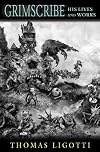
Grimscribe: His Lives and Works
by Thomas Ligotti
On This Page
Description
This modern masterpiece of the macabre is an unforgettable journey through a landscape of nightmares that the critics are comparing to the timeless works of Edgar Allen Poe, Nathaniel Hawthorne, and H.P. Lovecraft. Quite unlike anything else being published . . . one of the most unique voices in the field.-- Science Fiction Chronicle.Tags
Recommendations





















Member Reviews
Despite his relatively small output, Ligotti is our modern day Poe or Lovecraft, but unlike Lovecraft, he's actually a good writer and prose stylist. He still leans heavily towards the verbose, and will have you re-reading some passages over, but it's in a brilliant stylistic way like Nabokov would write. He's also infamous for his extreme nihilism and anti-natalism, and while he doesn't explicitly outline his philosophy in these stories, they're all doom-suffused, and open about how life and consciousness are inherently evil and full of suffering. As someone who's felt the same in my worst moments of mental illness, I can relate to his pessimism. The stand-out story of the collection is the first one, The Last Feast of Harlequin, which show more is almost novella length, and combines folk horror with cosmic horror. The rest of the stories are more in the line of mood pieces, and while not always successful, they are readable, and beautiful in their crepuscular way. I will definitely be coming back for more. 4.5 rounded up to a 5. show less
After bathing in the dark imagination of American contemporary horror fiction writer Tomas Ligotti’s first collection, “Songs of a Dead Dreamer,” I was keen to read his second book of thirteen macabre yarns entitled “Grimscribe.” My experience did not disappoint – in the tradition of Poe and Lovecraft, absolutely first-rate, well-crafted bizarre and ghoulish first-person narratives to make your hair stand on end and keep you up at night, as in these two eerie bone chillers: novella, “The Last Feast of Harlequin” and short story “The Spectacles in the Drawer.”
The Last Feast of Harlequin
Our narrator, an anthropologist and college instructor, explains that the phenomenon of clowns goes well beyond traditional notions of show more a red nose in a circus, how clowns have performed many functions and roles in various cultures around the world and how, to not only further his own academic research but experience great self-satisfaction, he cherishes participating in festivals as a clown himself, which he does at least once a year. Thus, when he learns of a little-publicized festival with clowns in the Midwestern town of Mirocaw, his interest is piqued.
In late summer the opportunity presents itself to make a side trip to Mirocaw and he takes it. Right from the start, things seem to be peculiarly out of sync – the various parts of the town do not appear to fit together; the steep roofs of the houses behind the town’s main street, due to the hilly terrain, strike him as floating in air at odd angles; indeed, he compares the entire town to an album of snapshots where the camera has been continually jostled resulting in crooked photos. Rolling down his car window to ask directions to the town hall from a shabbily dressed old man who looks vaguely familiar, he is greeted by a distance, imbecilic gaze. And after finally arriving at the building and making inquiries about the festival, he is handed a cheap copy of a flyer and learns the festival is December 19-21 and there are “clowns of a sort.”
If all this sounds creepy, even sinister, that’s exactly what the narrator feels, however, he continues to explore this most unusual town and on finally taking his leave, vows to return with his clown costume for the December festival. At this point, the narrator tells us how his former anthropology teacher, one Dr. Raymond Thoss, wrote a paper entitled “The Last Feast of Harlequin” with references to Syrian Gnosticis who called themselves Saturnians. He also tells us that he now knows why that shabby man on the street looked familiar – he was none other than Raymond Thoss. The plot thickens.
Once back in Mirocaw, things turn very weird very quickly. He discovers, among other disturbing facts, this festival features two sets of clowns: more traditional clowns chosen from the townspeople that are, to his astonishment, picked on and pushed around as they walk the streets and a second group of clowns, shabbily dressed, gaunt, with faces painted white and mouths wide in terror, bringing to mind the famous painting by Edvard Munch. Upon reflection, he now understands he is witnessing two festivals, a festival within a festival. Returning to his hotel, he makes the decision to dress up as one of those shabby, gaunt, wide-mouthed clowns. Events then take even weirder and much more frightening twists. Not a reading experience for the fainthearted.
The Spectacles in the Drawer
The narrator receives uninvited visits to his run down residence from his disciple, a man he considers a bit of a pest, a man named Plomb, a man who is fascinated with all his odd curiosities, archaic objects and forbidden texts, things Plomb regards as treasures of the occult. But what the narrator really wants is Plomb out of his life. We read, “The plan was simple: to feed Plomb’s hunger for mysterious sensations to the point of nausea . . . and beyond. The only thing to survive would be a gutful of shame and regret for a defunct passion.” To this end, he takes clear-glass, wire-rimmed spectacles out of a white case and places them on Plomb’s face and tells him how, among other extraordinary powers, these fantastic lenses will make you one with the objects you see: unimaginable diversity of form and motion and the most cryptic, mysterious, hidden phenomenon one could ever imagine. Hoping he will never see Plomb again, he gives him these glasses as a parting gift.
However, as it turns out, the narrator has much underestimated the power of suggestion and how, when giving a suggestion to a subject with an overactive and lively imagination, the suggestion can rebound back to the person who did the suggesting in the first place. The narrator attempts to rid himself of recurrent nightmares of his former disciple but all his efforts are without success: “Thus I attempted to reason my way back to self-possession. But no measure of my former serenity was forthcoming. On the contrary, my days as well as my nights were now poisoned by an obsession with Plomb. Why had I given him those spectacles! More to the point, why did I allow him to retain them?” One of the creepiest stories I’ve ever read, most fitting for this Thomas Ligotti collection. show less
Out of the early Ligotti collections, I'd say this one is the strongest. (The other two I'm counting are Songs of a Dead Dreamer and Noctuary.) Among the stories in this collection, there is not one that fails to send a shiver up the spine. However, at the risk of sounding elitist, I'd say you really have to ask yourself, "Am I ready for Ligotti?"
He is easily one the most unique authors in horror of the last 20 years, but while more conventional horror works on the shock, on getting you to check the closet for bogeymen. Ligotti, on the other hand, is engaged on a wholesale assault on both reality and horror fiction itself. If Borges had a heart of utter darkness, this is the sort of fiction he would have written. This assault is so show more complete yet sophisticated, that you never become fully aware of it. And then one day, you open up a more conventional horror work and find Ligotti's words ringing in the back of your head: "Ah, it's just another abstract monster of metaphysics."
Because if you spend enough time in his works, you'll find his words will colonize your brain, making you conscious of the tropes you have read before yet also investing them with a new mystery you cannot quite get a hold of.
In this particular volume, for example, it all starts innocently enough with "The Last Feast of Harlequin," one of the first pieces of fiction Ligotti ever wrote. The scholar who travels to an isolated town to learn more about an obscure seasonal rite is a common Lovecraftian trope. And "Harlequin" is one of the most powerful Lovecraft pastiches ever commited to paper. But Ligotti's just getting started.
From there we progress to "The Spectacles in the Drawer" which suggests, in its own way, that the darkest, most evil grimoires are not ancient but are, in fact, yet to be written. We proceed down a series of nightmares, including the brilliant "Nethescurial." If "Harlequin" suggests a Lovecraft tale, "Nethescurial" is the Lovecraftian tale which devours itself, then not yet satiated, turns on the narrator and the reader. (Though that distinction is a tenuous one.)
It all ends in "The Shadow at the Bottom of the World," already a rarity in being a horror story successfully told in the first-person plural. In it, a rural community is beset by a strange season. Though most of the community will escape with their lives, a darker truth will be revealed to them.
So, a brilliant collection but not for everybody. show less
He is easily one the most unique authors in horror of the last 20 years, but while more conventional horror works on the shock, on getting you to check the closet for bogeymen. Ligotti, on the other hand, is engaged on a wholesale assault on both reality and horror fiction itself. If Borges had a heart of utter darkness, this is the sort of fiction he would have written. This assault is so show more complete yet sophisticated, that you never become fully aware of it. And then one day, you open up a more conventional horror work and find Ligotti's words ringing in the back of your head: "Ah, it's just another abstract monster of metaphysics."
Because if you spend enough time in his works, you'll find his words will colonize your brain, making you conscious of the tropes you have read before yet also investing them with a new mystery you cannot quite get a hold of.
In this particular volume, for example, it all starts innocently enough with "The Last Feast of Harlequin," one of the first pieces of fiction Ligotti ever wrote. The scholar who travels to an isolated town to learn more about an obscure seasonal rite is a common Lovecraftian trope. And "Harlequin" is one of the most powerful Lovecraft pastiches ever commited to paper. But Ligotti's just getting started.
From there we progress to "The Spectacles in the Drawer" which suggests, in its own way, that the darkest, most evil grimoires are not ancient but are, in fact, yet to be written. We proceed down a series of nightmares, including the brilliant "Nethescurial." If "Harlequin" suggests a Lovecraft tale, "Nethescurial" is the Lovecraftian tale which devours itself, then not yet satiated, turns on the narrator and the reader. (Though that distinction is a tenuous one.)
It all ends in "The Shadow at the Bottom of the World," already a rarity in being a horror story successfully told in the first-person plural. In it, a rural community is beset by a strange season. Though most of the community will escape with their lives, a darker truth will be revealed to them.
So, a brilliant collection but not for everybody. show less
I guess excessively flowery prose and Lovecraftian horror just aren't my thing.
I rather enjoyed Ligotti's first collection, Songs of a Dead Dreamer, but there was something about Grimscribe that didn't work for me. The horror element felt a lot more obtuse this time around and the prose a bit more inhibiting. It was just generally, a couple of stories aside, a collection I couldn't settle into (as much as you can settle into Ligotti's works).
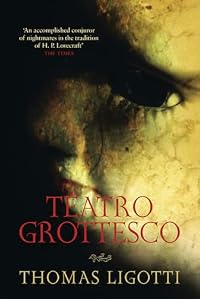
Out of the books of his that I've read thus far - SOADD, Grimscribe and Teatro Grottesco - this set of Ligotti stories is definitely my least favourite.
I rather enjoyed Ligotti's first collection, Songs of a Dead Dreamer, but there was something about Grimscribe that didn't work for me. The horror element felt a lot more obtuse this time around and the prose a bit more inhibiting. It was just generally, a couple of stories aside, a collection I couldn't settle into (as much as you can settle into Ligotti's works).
Out of the books of his that I've read thus far - SOADD, Grimscribe and Teatro Grottesco - this set of Ligotti stories is definitely my least favourite.
After bathing in the dark imagination of American contemporary horror fiction writer Tomas Ligotti’s first collection, Songs of a Dead Dreamer, I was keen to read his second book of thirteen macabre yarns entitled Grimscribe.
My experience did not disappoint – in the tradition of Poe and Lovecraft, absolutely first-rate, well-crafted bizarre and ghoulish narratives told by first-person narrators to make your hair stand on end and keep you up at night. As by way of example, I will focus on two eerie bone chillers: the novella, The Last Feast of Harlequin and a unforgettable short story, The Spectacles in the Drawer.
THE LAST FEAST OF HARLEQUIN
Our narrator, an anthropologist and college instructor, explains that the phenomenon of show more clowns goes well beyond traditional notions of a red nose in a circus, how clowns have performed many functions and roles in various cultures around the world. Thus to not only further his own academic research but experience great self-satisfaction, he cherishes participating in festivals as a clown himself, which he does at least once a year. When he learns of a little-publicized festival with clowns in the Midwestern town of Mirocaw, his interest is piqued.
In late summer the opportunity presents itself to make a side trip to Mirocaw and he takes it. Right from the start, things seem to be peculiarly out of sync – the various parts of the town do not appear to fit together; the steep roofs of the houses behind the town’s main street, due to the hilly terrain, strike him as floating in air at odd angles.
Indeed, he compares the entire town to an album of snapshots where the camera has been continually jostled that results in page after page of crooked photos.
Rolling down his car window to ask directions to the town hall from a shabbily dressed old man who looks vaguely familiar, he is greeted by a distance, imbecilic gaze. And after finally arriving at the building and making inquiries about the festival, he is handed a cheap copy of a flyer and learns the festival is December 19-21 and there are “clowns of a sort.”
If all this sounds creepy, even sinister, that’s exactly what the narrator feels, however, he continues to explore this most unusual town and on finally taking his leave, vows to return with his clown costume for the December festival.
At this point, the narrator tells us how his former anthropology teacher, one Dr. Raymond Thoss, wrote a paper entitled The Last Feast of Harlequin with references to Syrian Gnosticis who called themselves Saturnians. He also tells us that he now knows why that shabby man on the street looked familiar – he was none other than Raymond Thoss. The thick plottens.
Once back in Mirocaw, things turn very weird very quickly. He discovers, among other disturbing facts, this festival features two sets of clowns: more traditional clowns chosen from the townspeople that are, to his astonishment, picked on and pushed around as they walk the streets and a second group of clowns, shabbily dressed, gaunt, with faces painted white and mouths wide in terror, bringing to mind the famous painting by Edvard Munch.
Upon reflection, he now understands he is witnessing two festivals, a festival within a festival. Returning to his hotel, he makes the decision to dress up as one of those shabby, gaunt, wide-mouthed clowns. Events then take even weirder and much more frightening twists. Not a reading experience for the fainthearted.
THE SPECTACLES IN THE DRAWER
The narrator receives uninvited visits to his run down residence from his disciple, a man he considers a bit of a pest, a man named Plomb, a man who is fascinated with all his odd curiosities, archaic objects and forbidden texts, things Plomb regards as treasures of the occult.
But what the narrator really wants is Plomb out of his life. We read, “The plan was simple: to feed Plomb’s hunger for mysterious sensations to the point of nausea and beyond. The only thing to survive would be a gutful of shame and regret for a defunct passion.”
To this end, he takes clear-glass, wire-rimmed spectacles out of a white case and places them on Plomb’s face and tells him how, among other extraordinary powers, these fantastic lenses will make you one with the objects you see: unimaginable diversity of form and motion and the most cryptic, mysterious, hidden phenomenon one could ever imagine. Hoping he will never see Plomb again, he gives him these glasses as a parting gift.
However, as it turns out, the narrator has much underestimated the power of suggestion and how, when giving a suggestion to a subject with an overactive and lively imagination, the suggestion can rebound back to the person who did the suggesting in the first place.
The narrator attempts to rid himself of recurrent nightmares of his former disciple but all his efforts are without success: “Thus I attempted to reason my way back to self-possession. But no measure of my former serenity was forthcoming. On the contrary, my days as well as my nights were now poisoned by an obsession with Plomb. Why had I given him those spectacles! More to the point, why did I allow him to retain them?”
One of the creepiest stories I’ve ever read, most fitting for this Thomas Ligotti collection.
“To my mind, a well-developed sense of humor is the surest indication of a person's humanity, no matter how black and bitter that humor may be.” - American author Thomas Ligotti, Born 1953 show less
This was quite a good collection of stories by Ligotti. I thought it was stronger than his earlier short story collection and that it explored more the nuances and undercurrents of the horror that he permeates our consciousness with. Overall, I would recommend it for those interested in horror, short stories, and contemporary writing. It's worth it.
4 stars.
4 stars.
Ratings
Members
- Recently Added By
Lists

Weird and Weirder Fiction
267 works; 34 members

Jones & Newman: Best Horror Books Further Recommended Reading
577 works; 4 members

Books Read in 2025
4,090 works; 97 members
Author Information

82+ Works 6,204 Members
Awards and Honors
Awards
Series
Belongs to Publisher Series
Work Relationships
Common Knowledge
- Original publication date
- 1991
- People/Characters
- Dr. Raymond Thoss; Klaus Klingman; Bartholomew Gray
- Important places
- Nethescurial; Nortown; Muelenberg; Mirocraw
- Dedication
- To my brother Bob
- First words
- HIS NAME IS...
- Quotations
- In the rooms of houses and beyond their walls -- beneath dark waters and across moonlit skies -- below earth mound and above mountain peak -- in northern leaf and southern flower -- inside each star and the voids between them... (show all) -- within blood and bone, through all souls and spirits -- among the watchful winds of this and the several worlds -- behind the faces of the living and the dead...
Thus far we can see that the drama enacted is a familiar one: the stage is rigidly traditional and the performers upon it are caught up in its style. For these actors are not so much people as they are puppets from the old sh... (show all)ows, the ones that have told the same story for centuries, the ones that can still be very strange to us.
Traipsing through the same old foggy scene, seeking the same old isolated house, the puppets in these plays always find everything new and unknown, because they have no memories to speak of and can hardly recall making these ... (show all)stilted motions countless times in the past. They struggle through the same gestures, repeat the same lines, although in rare moments they may feel a dim suspicion that this has all happened before. How like they are to the human race itself! This is what makes them our perfect representatives -- this and the fact that they are handcarved in the image of maniacal victims who seek to share the secrets of their individual torments as their strings are manipulated by the same master.
The problem is that such supernatural inventions are indeed quite difficult to imagine. So often they fail to materialize in the mind, to take on a mental texture, and thus remain unfelt but as an abstract monster of metaphys... (show all)ics -- an elegant or akward schematic that cannot rise from the paper to touch us. - Last words
- (Click to show. Warning: May contain spoilers.)So we buried him deep in a bottomless grave.
Classifications
Statistics
- Members
- 367
- Popularity
- 85,247
- Reviews
- 6
- Rating
- (4.05)
- Languages
- English, German, Spanish
- Media
- Paper, Ebook
- ISBNs
- 6
- ASINs
- 4