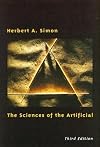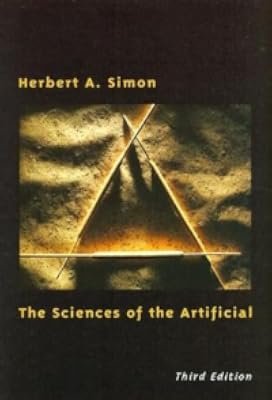
The Sciences of the Artificial
by Herbert A. Simon
On This Page
Description
Continuing his exploration of the organization of complexity and the science of design, this new edition of Herbert Simon's classic work on artificial intelligence adds a chapter that sorts out the current themes and tools--chaos, adaptive systems, genetic algorithms--for analyzing complexity and complex systems. There are updates throughout the book as well. These take into account important advances in cognitive psychology and the science of design while confirming and extending the book's show more basic thesis: that a physical symbol system has the necessary and sufficient means for intelligent action. The chapter "Economic Reality" has also been revised to reflect a change in emphasis in Simon's thinking about the respective roles of organizations and markets in economic systems. show lessTags
Recommendations















Member Reviews
This is my first exposure to "systems thinking" from a member of the generation which kicked that term off, along with its sister term "cybernetics". The book reads not so much as a thesis, but as a way of thinking applied to a variety of closely related systems. He uses his new theory of the artificial to exploring his research on the internal environment of the human brain, and how it makes decisions, as well as the economy, and government.
The book includes a window into the research going on in Simon's cohort in the 1960s, from computational brain models such as SOAR, to chess playing bots, to highway planners, to theses on management decision-making. Simon draws on these papers to find the underlying constants that tie the common show more attributes of the systems together, such as the structure as hierarchical or almost-hierarchical. This is a mix of obvious and misleading. I would say that taking such a fundamental view on systems will give us profound ideas only if we can see them, it will show us obvious ideas which were non-obvious at the time, and will show us gaps in our thought that might be good candidates for exploration. One of these is a learning system which can search a tree of concepts MCTS style but applies an idea learned on one leaf immediately to other leaves which might contain similar ideas. Basically, an MCTS which tries to learn and apply patterns.
I'm really happy I discovered this, because it launched my exploration of design as a field. show less
The book includes a window into the research going on in Simon's cohort in the 1960s, from computational brain models such as SOAR, to chess playing bots, to highway planners, to theses on management decision-making. Simon draws on these papers to find the underlying constants that tie the common show more attributes of the systems together, such as the structure as hierarchical or almost-hierarchical. This is a mix of obvious and misleading. I would say that taking such a fundamental view on systems will give us profound ideas only if we can see them, it will show us obvious ideas which were non-obvious at the time, and will show us gaps in our thought that might be good candidates for exploration. One of these is a learning system which can search a tree of concepts MCTS style but applies an idea learned on one leaf immediately to other leaves which might contain similar ideas. Basically, an MCTS which tries to learn and apply patterns.
I'm really happy I discovered this, because it launched my exploration of design as a field. show less
The Sciences of the Artificial ("Sciences") is clear and concise. Simon is his usual impressive self. I suppose it needs to be understood that this book, aimed to argue for the existence of a class of science, contains overviews of various computing and psychological concepts. These overviews are dated, of course, and even then not free of typographical errors.
Still, I am enjoying this one very much.
Still, I am enjoying this one very much.
. This is another one of those books that gets referenced so often that I added it to my list. I have seen references to this work in the context of design, artificial intelligence, and economics. I confess that I don't see what is so impressive about it. Perhaps the ideas it introduces were revolutionary in its time but now have become so accepted that it seems obvious? One concrete contribution is the idea of "satisficing", meeting the constraints of a problem without finding the optimal solution.
Good writing, the philosophy is a little outdated in the early 2000's. Gets a little rambling past the first third of the book.
very good for its time, and much of it is still meaningful and insightful.
There are so many concepts in the multiple fields that owe a debt that this work that first appeared here, that it almost seems strange to revisit it. I actually wore my first copy out. The second addition was amended, and added to. Had I realized how different the new edition was, I'd have kept the original.
Ratings
Members
- Recently Added By
Lists

Books in the bibliography of Godel, Escher, Bach by Douglas Hofstadter
97 works; 3 members

In Our Time books
4,934 works; 2 members
Author Information

46+ Works 1,637 Members
Series
Belongs to Publisher Series
Common Knowledge
- Canonical title
- The Sciences of the Artificial
- Original title
- The Sciences of the Artificial
Classifications
Statistics
- Members
- 636
- Popularity
- 45,732
- Reviews
- 6
- Rating
- (4.17)
- Languages
- English, French, German, Italian
- Media
- Paper, Ebook
- ISBNs
- 17
- ASINs
- 4