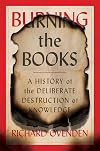
Burning the Books: A History of Knowledge Under Attack
by Richard Ovenden
On This Page
Description
In Burning the Books, Richard Ovenden describes the deliberate destruction of knowledge held in libraries and archives from ancient Alexandria to contemporary Sarajevo, from smashed Assyrian tablets in Iraq to the destroyed immigration documents of the UK Windrush generation. He examines both the motivations for these acts and the broader themes that shape this history. He also looks at attempts to prevent and mitigate attacks on knowledge, exploring the efforts of librarians and archivists show more to preserve information, often risking their own lives in the process. More than simply repositories for knowledge, libraries and archives inspire and inform citizens. In preserving notions of statehood recorded in such historical documents as the Declaration of Independence, libraries support the state itself. By preserving records of citizenship and records of the rights of citizens as enshrined in legal documents such as the Magna Carta and the decisions of the US Supreme Court, they support the rule of law. In this book, Ovenden takes a polemical stance on the social and political importance of the conservation and protection of knowledge, challenging governments in particular, but also society as a whole, to improve public policy and funding for these essential institutions. show lessTags
Recommendations



























Member Reviews
Deeply knowledgeable and fluently written, this is an extremely engaging book about libraries as repositories of knowledge, and the destruction of libraries through declining funding, religious or political conflict.
Richard Ovenden tells a fascinating and enjoyable story, including examples from history starting in Mesopotamia and Alexandria, taking us forward through medieval monastic and university libraries (including the Bodleian of which the author is the librarian), national libraries such as America’s Washington library, to personal libraries saved, or not, for posterity such as Byron’s, Kafka’s, Plath’s and Larkin’s.
The author then details the political destruction, or retention, of libraries in a broader sense, show more including records created or held by the state, such as the Stasi secret personnel records in East Germany in 1989 and the early 1990’s, political records in Iraq in 2003 and 2013, the country’s library and records in the targeted Serbian destruction of Bosnia’s national library in 1992, and the destruction or removal of colonial records when the colonies of European countries became independent mainly in the second half of the twentieth century.
Ovenden then considers the problems of retaining records now that so much is created online. This part of the book is optimistic in setting out the issues and suggesting an approach to dealing with the current shortfall in funding, especially due to austerity measures.
Highly recommended. show less
Richard Ovenden tells a fascinating and enjoyable story, including examples from history starting in Mesopotamia and Alexandria, taking us forward through medieval monastic and university libraries (including the Bodleian of which the author is the librarian), national libraries such as America’s Washington library, to personal libraries saved, or not, for posterity such as Byron’s, Kafka’s, Plath’s and Larkin’s.
The author then details the political destruction, or retention, of libraries in a broader sense, show more including records created or held by the state, such as the Stasi secret personnel records in East Germany in 1989 and the early 1990’s, political records in Iraq in 2003 and 2013, the country’s library and records in the targeted Serbian destruction of Bosnia’s national library in 1992, and the destruction or removal of colonial records when the colonies of European countries became independent mainly in the second half of the twentieth century.
Ovenden then considers the problems of retaining records now that so much is created online. This part of the book is optimistic in setting out the issues and suggesting an approach to dealing with the current shortfall in funding, especially due to austerity measures.
Highly recommended. show less
This book gives a history of libraries and archives that have been damaged or destroyed from ancient times to today. It is obviously not a complete history, but it tells the story of some of the most notable losses. It also reports on a couple of cases of personal papers or memoirs that were deliberately destroyed to prevent publication and/or protect reputations. Or in the case of governmental archives, to cover up the actions of colonial/government workers. The famous case of the Library of Alexandria is included. Although its destruction has variously been blamed on the Roman army, early Christians, and Muslims in the 7th century, Ovenden believes these are myths and that the library most likely disappeared due to slow decline, show more underfunding, and neglect.
A number of libraries were deliberately attacked and destroyed over the years, in attempts to suppress a religion or a specific culture. All the stories are heartbreaking to me, because of the loss of knowledge and history. And unfortunately it still continues today. Serbia's deliberate destruction of the National Library of Bosnia occurred only 30 years ago.
Ovenden also addresses the move to the digital world, and how much of current social discussion takes place online. He is greatly concerned about the loss of history for future research if what is online is not preserved. So much of it is currently under the control of a few large tech companies, whose purpose is to make money, not to preserve information for the future. Ovenden feels that libraries and archives need much better funding so that they can carry out the task of preserving this information for the future. At the end, he makes a plea to "the holders of power" to adequately fund libraries and archives.
I thought the book was interesting and very well written. Highly recommended. show less
A number of libraries were deliberately attacked and destroyed over the years, in attempts to suppress a religion or a specific culture. All the stories are heartbreaking to me, because of the loss of knowledge and history. And unfortunately it still continues today. Serbia's deliberate destruction of the National Library of Bosnia occurred only 30 years ago.
Ovenden also addresses the move to the digital world, and how much of current social discussion takes place online. He is greatly concerned about the loss of history for future research if what is online is not preserved. So much of it is currently under the control of a few large tech companies, whose purpose is to make money, not to preserve information for the future. Ovenden feels that libraries and archives need much better funding so that they can carry out the task of preserving this information for the future. At the end, he makes a plea to "the holders of power" to adequately fund libraries and archives.
I thought the book was interesting and very well written. Highly recommended. show less
The title is a tad misleading: Ovenden does not lay the groundwork of how "knowledge" relates to "books" or other relevant levels, like "information" or "archives." All in all, while solid, this book does not seem to benefit from having been written by a professional librarian as opposed to an interested lay scholar or journalist. In that regard it disappoints. If, however, the reader is happy to do without the deep dive into just what libraries are all about (and does not really care how they are not the same as archives), the stories he relates will satisfy.
For the record, though, I'll throw in a bit of what Ovenden omits. Libraries are at the opposite end of the spectrum from archives, because if archives are important because they show more are the raw data of interest (e.g., government records, personal diaries, etc.), libraries are full of the reflective works that are written drawing upon that information. It is after this "transmutation," or ingestion, that archival information becomes knowledge. Archives, therefore, contain no knowledge, but only the basis to discern knowledge. Archival records do not speak for themselves, as Ovenden appears to suggest; for their story to emerge they must be studied, collated, compiled, contextualized. The outcomes of that process is "knowledge," and these conclusions are what are found in libraries. For many purposes this is a distinction without a difference, but Ovenden throughout the text displays his primary interest in archival work (it is where he has spent his professional life, not in libraries per se), and thus gives libraries short shrift. Both are relevant and important and worthy of preservation, but arguably no good purpose is served by careless conflation of important distinctions, especially by someone heading one of the premiere university libraries. show less
For the record, though, I'll throw in a bit of what Ovenden omits. Libraries are at the opposite end of the spectrum from archives, because if archives are important because they show more are the raw data of interest (e.g., government records, personal diaries, etc.), libraries are full of the reflective works that are written drawing upon that information. It is after this "transmutation," or ingestion, that archival information becomes knowledge. Archives, therefore, contain no knowledge, but only the basis to discern knowledge. Archival records do not speak for themselves, as Ovenden appears to suggest; for their story to emerge they must be studied, collated, compiled, contextualized. The outcomes of that process is "knowledge," and these conclusions are what are found in libraries. For many purposes this is a distinction without a difference, but Ovenden throughout the text displays his primary interest in archival work (it is where he has spent his professional life, not in libraries per se), and thus gives libraries short shrift. Both are relevant and important and worthy of preservation, but arguably no good purpose is served by careless conflation of important distinctions, especially by someone heading one of the premiere university libraries. show less
Another book on a serious topic that left me feeling hopeful. I guess it’s the stories of people risking their lives to save books and pieces of paper.
Of all the stories the Sarajevo library bombing bothered me the most. (I love the Olympics, and the Sarajevo Olympics was one of the first ones I really remember watching. The bombing of the city when I was in high school hit me really hard and remains one that shaped my political thinking.)
Of all the stories the Sarajevo library bombing bothered me the most. (I love the Olympics, and the Sarajevo Olympics was one of the first ones I really remember watching. The bombing of the city when I was in high school hit me really hard and remains one that shaped my political thinking.)
I listened to the audiobook of this. Interesting overview of libraries and archives since ancient times and how they have been destroyed both accidently and deliberately. So it was often quite depressing. The author uses the final chapters to tackle the digital deluge and the power of indifference to destroy libraries and archives. He uses a lot of "shoulds" but sadly my cynical hat says that none of these things will happen. Short termism always wins. This should be read by those with the money but it won't be.
Excellent review of the history of libraries. I was amazed at how libraries have been deliberately destroyed, and there is no culture or political party that has not engaged in the destruction for its own purposes. It is an ugly facet of human nature. I had not fully appreciated the importance of books and libraries to our sense of national and ethic identity, I had only gotten a whiff of it through the cultural wars taking place now in our schools and public libraries. I am always relieved and impressed when my own quite political public library buys a book I suggest.
The author of Book Burning does a great job of analyzing the intentional destruction of knowledge over the centuries and makes great arguments for the archiving and digital preservation of social media. Written by the principal librarian of Oxford University's the Bodleian libraries, Ovenden reflects on how libraries and archives reflect the culture, history and society that people live in and when knowledge is destroyed, with it goes the foundations of that society.
Members
- Recently Added By
Published Reviews
Opening with the notorious bonfires of ‘un-German’ and Jewish literature in 1933 that offered such a clear signal of Nazi intentions, Burning the Books takes us on a 3000-year journey through the destruction of knowledge and the fight against all the odds to preserve it.
Richard Ovenden, director of the world-famous Bodleian Library, explains how attacks on libraries and archives have been show more a feature of history since ancient times but have increased in frequency and intensity during the modern era.
Libraries are far more than stores of literature, through preserving the legal documents such as Magna Carta and records of citizenship, they also support the rule of law and the rights of citizens.
Today, the knowledge they hold on behalf of society is under attack as never before.
In this fascinating book, he explores everything from what really happened to the Great Library of Alexandria to the Windrush papers, from Donald Trump’s deleting embarrassing tweets to John Murray’s burning of Byron’s memoirs in the name of censorship.
At once a powerful history of civilisation and a manifesto for the vital importance of physical libraries in our increasingly digital age, Burning the Books is also a very human story animated by an unlikely cast of adventurers, self-taught archaeologists, poets, freedom-fighters — and, of course, librarians and the heroic lengths they will go to preserve and rescue knowledge, ensuring that civilisation survives.
From the rediscovery of the Dead Sea Scrolls in the desert, hidden from the Romans and lost for almost 2000 years to the medieval manuscript that inspired William Morris, the knowledge of the past still has so many valuable lessons to teach us and we ignore it at our peril. show less
Richard Ovenden, director of the world-famous Bodleian Library, explains how attacks on libraries and archives have been show more a feature of history since ancient times but have increased in frequency and intensity during the modern era.
Libraries are far more than stores of literature, through preserving the legal documents such as Magna Carta and records of citizenship, they also support the rule of law and the rights of citizens.
Today, the knowledge they hold on behalf of society is under attack as never before.
In this fascinating book, he explores everything from what really happened to the Great Library of Alexandria to the Windrush papers, from Donald Trump’s deleting embarrassing tweets to John Murray’s burning of Byron’s memoirs in the name of censorship.
At once a powerful history of civilisation and a manifesto for the vital importance of physical libraries in our increasingly digital age, Burning the Books is also a very human story animated by an unlikely cast of adventurers, self-taught archaeologists, poets, freedom-fighters — and, of course, librarians and the heroic lengths they will go to preserve and rescue knowledge, ensuring that civilisation survives.
From the rediscovery of the Dead Sea Scrolls in the desert, hidden from the Romans and lost for almost 2000 years to the medieval manuscript that inspired William Morris, the knowledge of the past still has so many valuable lessons to teach us and we ignore it at our peril. show less
added by AntonioGallo
Lists

Books Read in 2024
4,623 works; 126 members

Books We Discovered On LibraryThing
530 works; 130 members
Author Information

Some Editions
Awards and Honors
Awards
Distinctions
The Guardian Book of the Day (2020-08-31)
Common Knowledge
- Canonical title
- Burning the Books: A History of Knowledge Under Attack
- Alternate titles
- Burning The Books: A History of the Deliberate Destruction of Knowledge
- Original publication date
- 2020
- Dedication
- For Lyn
- First words
- In Berling, on 10 May 1933, a bonfire was held on Unter der Linden, the capitol's most important thoroughfare. -Introduction
The ancient Greek general and historian Xenophon, writing in his most famous work, the Anabasis or Persian Expedition, recounted the dramatic story of how he led a stranded army of 10,000 Greek mercenaries out of Mesopotamia ... (show all)and back to Greece. -Chapter 1, Cracked Clay Under the Mounds - Blurbers
- Grafton, Anthony; Battles, Matthew; de Hamel, Christopher; Warner, Marina; Frankopan, Peter
- Original language*
- Englisch
- Canonical DDC/MDS
- 363.3109
- Canonical LCC
- Z657
*Some information comes from Common Knowledge in other languages. Click "Edit" for more information.
Classifications
- Genres
- History, General Nonfiction, Nonfiction
- DDC/MDS
- 363.3109 — Society, government, & culture Social problems and social services Public Safety - Police, Crime Investigation Terrorism, Disasters, Civil Defense Censorship
- LCC
- Z657 — Bibliography, Library Science and Information Resources Book industries and trade Freedom of the press. Censorship
- BISAC
Statistics
- Members
- 635
- Popularity
- 45,612
- Reviews
- 15
- Rating
- (3.81)
- Languages
- 6 — Chinese, English, German, Italian, Portuguese, Spanish
- Media
- Paper, Audiobook, Ebook
- ISBNs
- 18
- ASINs
- 10