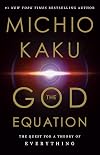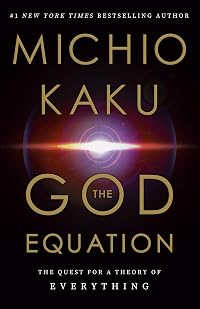
The God Equation: The Quest for a Theory of Everything
by Michio Kaku
On This Page
Description
"Michio Kaku, renowned theoretical physicist and author of Hyperspace and The Future of Humanity, tells the story of the greatest quest in science. When Newton discovered the laws of motion and gravity, he unified the rules of heaven and earth. From then on, physicists have been discovering new forces and incorporating them into ever-greater theories. But the major breakthroughs of the 20th century--relativity and quantum mechanics--are incompatible, and so since then, physicists have been show more endeavoring to combine these two theories. This would ultimately tie all the forces in the universe together into one beautiful equation that can unlock the deepest mysteries of space and time. That epic journey is the story of this book"-- show lessTags
Recommendations


Member Reviews
I call this book bullshit, not only because it’s bullshit but because bullshit always needs contextualising before it can be considered thus. Of course, one person’s bullshit is another person’s existential identity and profound truth. I see Kaku’s latest (gone are the days when he was publishing good stuff) as bullshit because once this book, a not very interesting sounding book btw, gets down to the nitty-gritty one suspects that some very powerful bullshitters will become increasingly uneasy about such attempts at a TOE and will pull the plug. I've always found this guy more than slightly annoying, his habit of invoking "spooky woo-woo" just turns me straight off. Entitling a book "The God Equation" just proves it for me. show more I’m not saying going for a TOE is bad, i.e., it’s not to say GR and QM can't be unified or that we shouldn't try, just that a bit of sound physics wouldn't go amiss. For starters there is no sure bet that such a theory will explain dark matter let alone dark energy. As far as I'm aware there is no experimental evidence for string theory even though there has been major effort to find it. The recent possible new physics concerning the bottom/beauty quark is only at 3-sigma and could float away in the breeze with any new data or the next re-run of the statistics package. As far as I'm concerned this book is a waste of electrons (or trees; take your pick); much rather have a good take-away and an Erdinger Dunkel Bier thank you. I hope you will all forgive me if I lapse into technical jargon to describe this pop-science book: it is what we call in the field horseshit. Also, one suspects that the pop-science writers will eventually find out that actually, people love bullshit and will pay handsomely for it and even protest and riot if bullshit is not forthcoming. Bullshit gets them through the night and makes the day more bearable, gives them a raison d'etre and thus the course can consider its lesson on how to sell bullshit and keep bullshit flowing which is of course…the pop-science writers’ dream…
As Herman Hesse's Siddhartha would say: "I can think. I can wait. I can fast". I’d add: “I can smell-bullshit-a-mile-away”. show less
As Herman Hesse's Siddhartha would say: "I can think. I can wait. I can fast". I’d add: “I can smell-bullshit-a-mile-away”. show less
More than 2,000 years ago, the ancient Greeks asked a simple question: What is the world made of? In setting out to provide an answer using only the tools of logic and reason—and guided by careful observation—the Greeks set humanity on an epic journey spanning thousands of years to uncover the secrets and fundamental composition of the universe.
The Greeks suspected that—behind all the complexity and apparent diversity of nature—the universe is composed of a smaller set of simpler elements that obey natural, rather than supernatural, laws. Since then, philosophers and scientists throughout the ages have sought the holy grail of all science—the long-coveted theory of everything that can explain the universe in its entirety, show more from the smallest subatomic particles to the largest galaxies and beyond.
This incredible story of scientific discovery and human ingenuity is the topic of physicist Michio Kaku’s latest book, The God Equation: The Quest for a Theory of Everything.
While not the first book to recount the history of physics, The God Equation does uniquely capture the central role of unification in physics. Kaku demonstrates how the major advances in physics have always followed the unification of forces and concepts, captured in beautiful, symmetrical equations.
The story of unification—like so many others—begins in ancient Greece, where philosophers made the attempt to unify nature’s diversity into a single, fundamental substance. Thales of Miletus, often described as the first philosopher, proposed that all matter was made of water, while his student Anaximander thought the substance was an indefinite material called Apeiron. Anaximenes, Anaximander’s student, identified the fundamental substance as air, while Heraclitus thought it was fire.
While ultimately off-the-mark, these philosophers introduced a critical idea: that hidden beneath the apparent diversity of nature is a single substance, and, further, that all physical phenomena operate according to natural, rather than supernatural, laws. This eventually led to ancient Greece’s crowning scientific hypothesis: the atomic theory of matter. The ancient Greek conception of an atom was, of course, very different from the modern view, but the idea that there is an invisible, indestructible substrate to reality that operates according to rational mathematical laws is the foundation for all future advances in physics.
As kaku wrote:
“So at least two great theories of our world emerged from ancient Greece: the idea that everything consists of invisible, indestructible atoms and that the diversity of nature can be described by the mathematics of vibrations [as established by Pythagoras when he discovered the relationship between musical notes and scales and the physical vibrations of strings].”
Unfortunately, the rise of Christianity put a stranglehold on the rational and mathematical investigation of the world for about 1,000 years. In fact, it was not until the 15th century Renaissance—or the rediscovery of classical learning and culture—that humanity would once again break free of the shackles of superstition to pursue the project of unification.
The reintroduction of classical learning—and the idea that humans could transcend the teachings of the past and make progress in knowledge—led straight to Isaac Newton, who took the principle of unification to the next level. Building on the work of his predecessors, Newton demonstrated, through his universal laws of motion and gravity, that nature operates according to precise mathematical laws and that these laws hold anywhere in the universe. In other words—contrary to the religious teachings at the time—there were not separate laws for the earthly and heavenly realms, but rather one set of laws applicable across all of space and time. It’s hard to imagine how revolutionary this idea must have been to those living in the 17th century.
Newtonian physics—the driving force behind the industrial revolution and the operation of all mechanical devices—unified all natural phenomena anywhere in the universe as conforming to the same mathematical laws and principles. At the time, it may have seemed that Newton had, in fact, discovered the final theory of everything. But as scientific knowledge progressed, problems with Newton’s theory would emerge, as Albert Einstein would later demonstrate.
The next major milestone in unification came with James Clerk Maxwell’s unification of electricity and magnetism. In formulating the classic theory of electromagnetic radiation, Maxwell was able to show that electricity, magnetism, and light are all manifestations of the same phenomenon. Once again, apparently disparate elements of nature turned out to be, in reality, unified under a single mathematical framework.
There was a problem, however. The twin pillars of physics at the time—Newton’s laws and electromagnetism—turned out to be fundamentally incompatible, as Albert Einstein was to discover. In brief, since the speed of light must remain constant (according to Maxwell’s equations), space and time cannot be absolute (as described by Newton’s laws). And so Newton—long considered the greatest scientist of all time—turned out to be wrong, or at least his laws were incomplete.
In resolving the paradox, Einstein introduced yet another process of unification: this time, the unification of space and time and matter and energy, as captured in the theories of special and general relativity.
It turns out that space and time, contrary to what Newton believed, are not absolute; rather, spacetime is a single four-dimensional property of the universe that bends and curves and expands and contracts, and it is this curvature that creates the illusion of gravitational force. The sun, for example, does not “pull” the earth towards it with the force of gravity; instead, the mass of the sun warps spacetime—like a bowling ball set in the middle of a trampoline—and the planets, including earth, orbit this curved path.
Einstein also set out the equivalence of matter and energy in the famous equation E=MC2 that demonstrates that matter and energy are two sides of the same coin. This explains, among other things, why the sun shines (some of the mass of the hydrogen gets converted to energy at very high temperatures), and how atomic bombs work.
But this isn’t the end of the story. Einstein would spend the rest of his life trying (and failing) to pursue the final project of unification: the unification of general relativity (gravity) with the most mysterious scientific branch of all—quantum mechanics.
This is where we stand today. General relativity accurately describes large-scale phenomena, such as orbiting planets and the expansion of the universe, and is responsible for technologies such as GPS navigation, while quantum mechanics is equally successful at predicting small-scale phenomena such as atomic motion and decay and is responsible for various electronic technologies including the transistor, the laser, the electron microscope, and magnetic resonance imaging (MRI).
The problem is, while these two theories have been experimentally verified and are practically useful, they are also fundamentally incompatible, and present competing views of nature. Relativity, representing the force of gravity, presents a smooth, deterministic universe, while quantum mechanics, representing the three other physical forces (electromagnetism and the nuclear forces), presents a non-deterministic universe guided by the laws of probability and other counterintuitive laws that do not hold when scaled up.
We therefore find ourselves, as Kaku points out, in an analogous situation as the one faced by Einstein. As Kaku wrote:
“We saw earlier that around 1900, there were two great pillars of physics: Newton’s law of gravity and Maxwell’s equations for light. Einstein realized that these two great pillars were in conflict with each other. One of them would have to collapse. The fall of Newtonian mechanics set into motion the great scientific revolutions of the twentieth century.”
It seems as if history may be repeating itself. We currently have two great pillars of physics (relativity and quantum mechanics), and, since they are incompatible, it seems that one must fall if we are to ever achieve the next and final step in the unification project: the unification of all known forces into one mathematical equation—the God equation.
Kaku believes that we will eventually achieve this final grand unification and that it will be represented by some form of string theory, which replaces the point-like particles of particle physics with one-dimensional objects called strings. The vibrations of these strings are thought to account for all other emergent properties, including particle mass and charge and even gravity, thus providing a unified framework for all four physical forces. The problem is, string theory introduces an additional ten dimensions and, most critically, is impossible to directly test at the scales in which it deals. String theory therefore suffers from the following paradox: if it’s true, it’s too inaccessible to verify.
As Kaku admits, a particle accelerator the size of our galaxy would have to be built to directly test the theory. Still, he is confident that the theory can eventually be tested and confirmed via more indirect methods, or perhaps even mathematically.
The other possibility is that we’ve simply reached the limits of our understanding. Just as you can’t teach a dog calculus, perhaps we don’t have the cognitive or perceptual capacity to achieve a God-like perspective on the complete workings of the universe. After all, physicists know that dark energy—the mysterious force that drives the expansion of the universe but that we know very little about—makes up 68 percent of the universe. Additionally, dark matter, which is equally mysterious, makes up another 27 percent. So that means, everything on earth plus everything else we’ve ever observed with all our instruments adds up to less than 5 percent of the universe. It’s little surprise, then, that the theory of everything eludes us.
Kaku would point out, however, that decades and centuries can pass before the next great scientific revolution or between the proposal and confirmation of theories. Black holes, for example, were first predicted in 1783 by John Michell, but the first conclusive pictures of their event horizons were not produced until 2019, 236 years later.
String theory was first proposed only 60 years ago, in the 1960s. Perhaps we are still waiting for its confirmation. Some believe that, given the difficulty of directly testing string theory, we will be waiting indefinitely, but we should keep in mind that major scientific revolutions are rarely predictable.
We must also consider the following question: If we can’t test string theory directly, can we prove it mathematically, and, if so, does a mathematically consistent view of the universe necessarily correlate with its actual workings?
Alternatively, will some as of yet undeveloped theory unite the physical forces, or even demonstrate that either relativity or quantum mechanics is, in fact, wrong or incomplete, just as Newtonian physics was proven incomplete by Einstein in the early twentieth century? These are fascinating, open questions that are a long way from being resolved. show less
The Greeks suspected that—behind all the complexity and apparent diversity of nature—the universe is composed of a smaller set of simpler elements that obey natural, rather than supernatural, laws. Since then, philosophers and scientists throughout the ages have sought the holy grail of all science—the long-coveted theory of everything that can explain the universe in its entirety, show more from the smallest subatomic particles to the largest galaxies and beyond.
This incredible story of scientific discovery and human ingenuity is the topic of physicist Michio Kaku’s latest book, The God Equation: The Quest for a Theory of Everything.
While not the first book to recount the history of physics, The God Equation does uniquely capture the central role of unification in physics. Kaku demonstrates how the major advances in physics have always followed the unification of forces and concepts, captured in beautiful, symmetrical equations.
The story of unification—like so many others—begins in ancient Greece, where philosophers made the attempt to unify nature’s diversity into a single, fundamental substance. Thales of Miletus, often described as the first philosopher, proposed that all matter was made of water, while his student Anaximander thought the substance was an indefinite material called Apeiron. Anaximenes, Anaximander’s student, identified the fundamental substance as air, while Heraclitus thought it was fire.
While ultimately off-the-mark, these philosophers introduced a critical idea: that hidden beneath the apparent diversity of nature is a single substance, and, further, that all physical phenomena operate according to natural, rather than supernatural, laws. This eventually led to ancient Greece’s crowning scientific hypothesis: the atomic theory of matter. The ancient Greek conception of an atom was, of course, very different from the modern view, but the idea that there is an invisible, indestructible substrate to reality that operates according to rational mathematical laws is the foundation for all future advances in physics.
As kaku wrote:
“So at least two great theories of our world emerged from ancient Greece: the idea that everything consists of invisible, indestructible atoms and that the diversity of nature can be described by the mathematics of vibrations [as established by Pythagoras when he discovered the relationship between musical notes and scales and the physical vibrations of strings].”
Unfortunately, the rise of Christianity put a stranglehold on the rational and mathematical investigation of the world for about 1,000 years. In fact, it was not until the 15th century Renaissance—or the rediscovery of classical learning and culture—that humanity would once again break free of the shackles of superstition to pursue the project of unification.
The reintroduction of classical learning—and the idea that humans could transcend the teachings of the past and make progress in knowledge—led straight to Isaac Newton, who took the principle of unification to the next level. Building on the work of his predecessors, Newton demonstrated, through his universal laws of motion and gravity, that nature operates according to precise mathematical laws and that these laws hold anywhere in the universe. In other words—contrary to the religious teachings at the time—there were not separate laws for the earthly and heavenly realms, but rather one set of laws applicable across all of space and time. It’s hard to imagine how revolutionary this idea must have been to those living in the 17th century.
Newtonian physics—the driving force behind the industrial revolution and the operation of all mechanical devices—unified all natural phenomena anywhere in the universe as conforming to the same mathematical laws and principles. At the time, it may have seemed that Newton had, in fact, discovered the final theory of everything. But as scientific knowledge progressed, problems with Newton’s theory would emerge, as Albert Einstein would later demonstrate.
The next major milestone in unification came with James Clerk Maxwell’s unification of electricity and magnetism. In formulating the classic theory of electromagnetic radiation, Maxwell was able to show that electricity, magnetism, and light are all manifestations of the same phenomenon. Once again, apparently disparate elements of nature turned out to be, in reality, unified under a single mathematical framework.
There was a problem, however. The twin pillars of physics at the time—Newton’s laws and electromagnetism—turned out to be fundamentally incompatible, as Albert Einstein was to discover. In brief, since the speed of light must remain constant (according to Maxwell’s equations), space and time cannot be absolute (as described by Newton’s laws). And so Newton—long considered the greatest scientist of all time—turned out to be wrong, or at least his laws were incomplete.
In resolving the paradox, Einstein introduced yet another process of unification: this time, the unification of space and time and matter and energy, as captured in the theories of special and general relativity.
It turns out that space and time, contrary to what Newton believed, are not absolute; rather, spacetime is a single four-dimensional property of the universe that bends and curves and expands and contracts, and it is this curvature that creates the illusion of gravitational force. The sun, for example, does not “pull” the earth towards it with the force of gravity; instead, the mass of the sun warps spacetime—like a bowling ball set in the middle of a trampoline—and the planets, including earth, orbit this curved path.
Einstein also set out the equivalence of matter and energy in the famous equation E=MC2 that demonstrates that matter and energy are two sides of the same coin. This explains, among other things, why the sun shines (some of the mass of the hydrogen gets converted to energy at very high temperatures), and how atomic bombs work.
But this isn’t the end of the story. Einstein would spend the rest of his life trying (and failing) to pursue the final project of unification: the unification of general relativity (gravity) with the most mysterious scientific branch of all—quantum mechanics.
This is where we stand today. General relativity accurately describes large-scale phenomena, such as orbiting planets and the expansion of the universe, and is responsible for technologies such as GPS navigation, while quantum mechanics is equally successful at predicting small-scale phenomena such as atomic motion and decay and is responsible for various electronic technologies including the transistor, the laser, the electron microscope, and magnetic resonance imaging (MRI).
The problem is, while these two theories have been experimentally verified and are practically useful, they are also fundamentally incompatible, and present competing views of nature. Relativity, representing the force of gravity, presents a smooth, deterministic universe, while quantum mechanics, representing the three other physical forces (electromagnetism and the nuclear forces), presents a non-deterministic universe guided by the laws of probability and other counterintuitive laws that do not hold when scaled up.
We therefore find ourselves, as Kaku points out, in an analogous situation as the one faced by Einstein. As Kaku wrote:
“We saw earlier that around 1900, there were two great pillars of physics: Newton’s law of gravity and Maxwell’s equations for light. Einstein realized that these two great pillars were in conflict with each other. One of them would have to collapse. The fall of Newtonian mechanics set into motion the great scientific revolutions of the twentieth century.”
It seems as if history may be repeating itself. We currently have two great pillars of physics (relativity and quantum mechanics), and, since they are incompatible, it seems that one must fall if we are to ever achieve the next and final step in the unification project: the unification of all known forces into one mathematical equation—the God equation.
Kaku believes that we will eventually achieve this final grand unification and that it will be represented by some form of string theory, which replaces the point-like particles of particle physics with one-dimensional objects called strings. The vibrations of these strings are thought to account for all other emergent properties, including particle mass and charge and even gravity, thus providing a unified framework for all four physical forces. The problem is, string theory introduces an additional ten dimensions and, most critically, is impossible to directly test at the scales in which it deals. String theory therefore suffers from the following paradox: if it’s true, it’s too inaccessible to verify.
As Kaku admits, a particle accelerator the size of our galaxy would have to be built to directly test the theory. Still, he is confident that the theory can eventually be tested and confirmed via more indirect methods, or perhaps even mathematically.
The other possibility is that we’ve simply reached the limits of our understanding. Just as you can’t teach a dog calculus, perhaps we don’t have the cognitive or perceptual capacity to achieve a God-like perspective on the complete workings of the universe. After all, physicists know that dark energy—the mysterious force that drives the expansion of the universe but that we know very little about—makes up 68 percent of the universe. Additionally, dark matter, which is equally mysterious, makes up another 27 percent. So that means, everything on earth plus everything else we’ve ever observed with all our instruments adds up to less than 5 percent of the universe. It’s little surprise, then, that the theory of everything eludes us.
Kaku would point out, however, that decades and centuries can pass before the next great scientific revolution or between the proposal and confirmation of theories. Black holes, for example, were first predicted in 1783 by John Michell, but the first conclusive pictures of their event horizons were not produced until 2019, 236 years later.
String theory was first proposed only 60 years ago, in the 1960s. Perhaps we are still waiting for its confirmation. Some believe that, given the difficulty of directly testing string theory, we will be waiting indefinitely, but we should keep in mind that major scientific revolutions are rarely predictable.
We must also consider the following question: If we can’t test string theory directly, can we prove it mathematically, and, if so, does a mathematically consistent view of the universe necessarily correlate with its actual workings?
Alternatively, will some as of yet undeveloped theory unite the physical forces, or even demonstrate that either relativity or quantum mechanics is, in fact, wrong or incomplete, just as Newtonian physics was proven incomplete by Einstein in the early twentieth century? These are fascinating, open questions that are a long way from being resolved. show less
FB kept showing me this book (I think I "liked" Kaku's page a long time ago) so when it came out, well, the ad worked enough for me to read this. Really, I would have anyway as I've read other Kaku books that I liked. Dr. Kaku did a great job here reducing incredibly complex concepts to soundbites that anyone can understand...well, I don't think a certain 75 million Americans would understand, but anyone smarter than a fifth grader would. From the ancients to Newton, to Einstein, the quantum crowds of electro- and chromodynamics, to the different string theories, Dr. Kaku points out the successes, gaps, failures and other issues with our evolutionary progress of understanding fundamental physics of the universe. I did have a few show more heartburns with some of his word choices (later) but overall, this is a great book as a primer for digging deeper.
Selections from some of my highlights and notes:
On the collapse of classical (Western) civilization: "Darkness spread over the Western world, and scientific inquiry was largely replaced by belief in superstition, magic, and sorcery." Sadly, we've still not recovered.
So nothingness was actually frothing with quantum activity
And this is something to file in the toolbox for the tiresome arguments about how something can't come from nothing: Hawking showed "So nothingness was actually frothing with quantum activity."
Some of my peeves:
"In 1894, Guglielmo Marconi introduced this new form of communication to the public. He showed that you could send wireless messages across the Atlantic Ocean at the speed of light." Tesla was first, but didn’t introduce his concepts to the public so the marketer won out for a long time. I thought Kaku should have noted that.
On proof of Einstein's relativistic theories, Kaku cites the corrections that have to be made for the "GPS System" to be accurate. "GPS" stands for Global Positioning System, so GPS System is redundant. And if some aren't paying attention, "The black hole is truly a monster, weighing in at a staggering five billion times the mass of the sun." Weighing? Yeas, it's a phrase, but even a pop-science author should be a little more accurate. (He also used words like "miraculously"...)
Of course he had to wax philosophical at the end in his last chapter "Finding Meaning in the Universe" He says,
Bottom line, as noted above, an excellent introduction. I need to look more into string theory, and I need to find Karl Schwarzchild's paper with his solution to Einstein's equations. show less
Selections from some of my highlights and notes:
On the collapse of classical (Western) civilization: "Darkness spread over the Western world, and scientific inquiry was largely replaced by belief in superstition, magic, and sorcery." Sadly, we've still not recovered.
So nothingness was actually frothing with quantum activity
Physicist Jeremy Bernstein once said, “Everyone who had any substantial contact with Einstein came away with an overwhelming sense of the nobility of the man. A descriptive term for him that recurs again and again is ‘humanitarian’—a reference to the simple, lovable quality of his character.”On Planck's realization that blackbody radiation was not continuous like Newton's theory predicted:
But at high frequency, the energy of light should eventually become infinite [using Maxwell's equations], which was ridiculous. To a physicist, infinity is just a sign that the equations aren’t working, that they don’t understand what is happening.For the nutjobs who think that quantum effects can have significant influence on the macro universe, or psychology, or silly biocentrism:
If we let Planck’s constant gradually go to zero, then all the equations of the quantum theory reduce to the equations of Newton. (This means that the bizarre behavior of subatomic particles, which often violate common sense, gradually reduces to the familiar Newtonian laws of motion as Planck’s constant is manually set to zero.) That is why we rarely see quantum effects in daily life.Because "To our senses, the world seems very Newtonian because Planck’s constant is a very small number and only affects the universe on the subatomic level."
And this is something to file in the toolbox for the tiresome arguments about how something can't come from nothing: Hawking showed "So nothingness was actually frothing with quantum activity."
Some of my peeves:
"In 1894, Guglielmo Marconi introduced this new form of communication to the public. He showed that you could send wireless messages across the Atlantic Ocean at the speed of light." Tesla was first, but didn’t introduce his concepts to the public so the marketer won out for a long time. I thought Kaku should have noted that.
On proof of Einstein's relativistic theories, Kaku cites the corrections that have to be made for the "GPS System" to be accurate. "GPS" stands for Global Positioning System, so GPS System is redundant. And if some aren't paying attention, "The black hole is truly a monster, weighing in at a staggering five billion times the mass of the sun." Weighing? Yeas, it's a phrase, but even a pop-science author should be a little more accurate. (He also used words like "miraculously"...)
Of course he had to wax philosophical at the end in his last chapter "Finding Meaning in the Universe" He says,
As the great biologist Thomas H. Huxley said in 1863, “The question of all questions for humanity, the problem which lies behind all others and is more interesting than any of them, is that of the determination of man’s place in Nature and his relation to the Cosmos.” But this still leaves open a question: What does the theory of everything have to say about meaning in the universe?Why does there always have to be meaning? And on Thomas Aquinas's Cosmological Proof
Finally, if one states that the multiverse is a logical consequence of the theory of everything, then we have to ask, Where did the theory of everything come from? At this point, physics stops, and metaphysics begins. Physics says nothing about where the laws of physics themselves come from. So the cosmological proof of Saint Thomas Aquinas concerning the First Mover or First Cause is left relevant even today.I find that to be a circular argument that is meaningless. The laws are because they are. And that undermines all of physics and science by introducing nonsense.
Bottom line, as noted above, an excellent introduction. I need to look more into string theory, and I need to find Karl Schwarzchild's paper with his solution to Einstein's equations. show less
Kaku takes one rapidly through the theories of gravity, relativity, particle physics and electromagnetism, as he explains the search for a unified theory. He writes well, and organizes the book historically. The simple and clear writing ispart of the problem: one reads this very quickly and comes away thinking there is something missing in understanding the concepts. He refers many times to "symmetry" as a powerful tool for finding physical theories, but the explanation of symmetry in a mathematical equation is absent. The final solution may be string theory, but it only works in 10 dimensions. He writes about black holes, wormholes, time travel and other exotic topics, and ends with a chapter on God and religious belief. I was pulled show more right along by the prose, but left a little underwhel show less
I am of two minds about Michio Kaku's new book.
I found his overview of the history of physics was told with enthusiasm, even if its a bit dated. It's written at a high enough level that even we mere mortals can grasp the concepts.
But as the book went on I became frustrated that there wasn't more depth. It's all a bit breezy, which I guess is in keeping with his public persona as a "popularizer of science". When we reach string theory, to which he notes he has devoted much of his career, the history gets more detailed but the actual theory itself is not really brought out in any depth. Nor do we get the story behind his own contributions as one of the co-founders of the string field theory, which was disappointing to me.
In another vein, show more I found the book to be more philosophical than I anticipated, and I admit that in the end I enjoyed Kaku's philosophical ruminations. But, as always when reading popular science by physicists, I remain skeptical of the claims that physics somehow will answer basic questions about the meaning of life.
To give Kaku credit, he expresses some of that same skepticism himself even as he professes the importance and meaning of finding the God Equation - the single unifying "theory of everything" that will answer all the questions and sew together all the avenues of physics.
I rate The God Equation Three Stars ⭐⭐⭐. If you have not read any popular science on physics (by say Stephen Hawking or Neil deGrasse Tyson) but are interested in the topic then by all means pick this book up - it's a short worthwhile read. If your bookshelf is well stocked with popular science books on physics you may find this one less enlightening than you might hope. show less
I found his overview of the history of physics was told with enthusiasm, even if its a bit dated. It's written at a high enough level that even we mere mortals can grasp the concepts.
But as the book went on I became frustrated that there wasn't more depth. It's all a bit breezy, which I guess is in keeping with his public persona as a "popularizer of science". When we reach string theory, to which he notes he has devoted much of his career, the history gets more detailed but the actual theory itself is not really brought out in any depth. Nor do we get the story behind his own contributions as one of the co-founders of the string field theory, which was disappointing to me.
In another vein, show more I found the book to be more philosophical than I anticipated, and I admit that in the end I enjoyed Kaku's philosophical ruminations. But, as always when reading popular science by physicists, I remain skeptical of the claims that physics somehow will answer basic questions about the meaning of life.
To give Kaku credit, he expresses some of that same skepticism himself even as he professes the importance and meaning of finding the God Equation - the single unifying "theory of everything" that will answer all the questions and sew together all the avenues of physics.
I rate The God Equation Three Stars ⭐⭐⭐. If you have not read any popular science on physics (by say Stephen Hawking or Neil deGrasse Tyson) but are interested in the topic then by all means pick this book up - it's a short worthwhile read. If your bookshelf is well stocked with popular science books on physics you may find this one less enlightening than you might hope. show less
I elected to read this book because I previously read The Big Bang by Simon Singh some years ago and I wanted to see what progress had been made. Answer: a lot and none. The thrust now seems to be to know what was before the Big Bang. I have several reactions to this book:
It is a fun read. Whether the author intended to or not, he has produced a book that is filled with humor. Rather than describing scientists with their noses pressed against floor-to-ceiling chalkboards on three sides of a room, he has presented a work that sounds more like an adventure.
He spins a good yarn. What he tells could take volumes but he has compressed it into a very small book.
It is instructive. At times, I was totally at sea and floundering. I am not a show more scientist and the multitude of terms was confusing. But then, he'd rescue me and get me back on board.
It is perplexing. At the end, I am torn between two thoughts: either scientists are truly seeking THE answer, whatever that may be, or they just keep discovering things to write and publish about.
All in all, this book led me to appreciate my comfort in my belief in God. show less
It is a fun read. Whether the author intended to or not, he has produced a book that is filled with humor. Rather than describing scientists with their noses pressed against floor-to-ceiling chalkboards on three sides of a room, he has presented a work that sounds more like an adventure.
He spins a good yarn. What he tells could take volumes but he has compressed it into a very small book.
It is instructive. At times, I was totally at sea and floundering. I am not a show more scientist and the multitude of terms was confusing. But then, he'd rescue me and get me back on board.
It is perplexing. At the end, I am torn between two thoughts: either scientists are truly seeking THE answer, whatever that may be, or they just keep discovering things to write and publish about.
All in all, this book led me to appreciate my comfort in my belief in God. show less
I often find that verbose physicists come off a little contrived, and few are as eloquent and vivid as Kaku. His genius is matched by his ability to communicate complex ideas in a way that is accessible to just about anyone. The God Equation is a triumph of scientific communication.
Members
- Recently Added By
Lists

Science: Astronomy
62 works; 2 members
Author Information

39+ Works 15,119 Members
Michio Kaku was born January 24, 1947 in San Jose California. Kaku attended Cubberley High School in Palo Alto in the early 1960s and played first board on their chess team. At the National Science Fair in Albuquerque, New Mexico, he attracted the attention of physicist Edward Teller, who took Kaku as a protégé, awarding him the Hertz show more Engineering Scholarship. Kaku graduated summa cum laude from Harvard University with a B.S. degree in 1968 and was first in his physics class. He attended the Berkeley Radiation Laboratory at the University of California, Berkeley and received a Ph.D. in 1972 and held a lectureship at Princeton University in 1973. During the Vietnam War, Kaku completed his U.S. Army basic training at Fort Benning, Georgia and his advanced infantry training at Fort Lewis, Washington. Kaku currently holds the Henry Semat Chair and Professorship in theoretical physics and a joint appointment at City College of New York, and the Graduate Center of the City University of New York, where he has lectured for more than 30 years. He is engaged in defining the "Theory of Everything", which seeks to unify the four fundamental forces of the universe: the strong nuclear force, the weak nuclear force, gravity and electromagnetism. He was a visiting professor at the Institute for Advanced Study in Princeton, and New York University. He is a Fellow of the American Physical Society. He is listed in Who's Who in Science and Engineering, and American Men and Women of Science. He has published research articles on string theory from 1969 to 2000. In 1974, along with Prof. K. Kikkawa, he wrote the first paper on string field theory, now a major branch of string theory, which summarizes each of the five string theories into a single equation. In addition to his work on string field theory, he also authored some of the first papers on multi-loop amplitudes in string theory. Kaku is the author of several doctoral textbooks on string theory and quantum field theory and has published 170 articles in journals covering topics such as superstring theory, supergravity, supersymmetry, and hadronic physics. He is also author of the popular science books: Visions, Hyperspace, Einstein's Cosmos, Parallel Worlds, The Future of the Mind, and The Future of Humanity: Terraforming Mars, Interstellar Travel, Immortality, and Our Destiny Beyond. (Bowker Author Biography) show less
Some Editions
Awards and Honors
Common Knowledge
- Canonical title
- The God Equation: The Quest for a Theory of Everything
- Original title
- The God Equation: The Quest for a Theory of Everything
- Original publication date
- 2021-04-06
- People/Characters
- Isaac Newton; Albert Einstein
- Important places
- Earth; Milky Way Galaxy; Universe
- Dedication
- To my loving wife, Shizue, and my daughters,
Dr. Michelle Kaku and Alyson Kaku - First words
- Gazing at the magnificent splendor of the night sky, surrounded by all the brilliant stars in the heavens, it is easy to be overwhelmed by its sheer, breathtaking magesty. Our concerns turn to some of the most mysterious ques... (show all)tions of all.
- Last words
- (Click to show. Warning: May contain spoilers.)If we find the answer to that, it would be the ultimate triumph of human reason - for then we would know the mind of God.
- Original language
- English
Classifications
Statistics
- Members
- 468
- Popularity
- 65,145
- Reviews
- 14
- Rating
- (3.94)
- Languages
- 7 — Czech, English, French, German, Italian, Portuguese, Spanish
- Media
- Paper, Audiobook, Ebook
- ISBNs
- 22
- ASINs
- 6