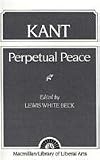
Perpetual Peace
by Immanuel Kant
On This Page
Description
Presents the translation of Immanuel Kant's Perpetual Peace, where he illuminates his philosophy of life.Tags
Recommendations

















Member Reviews
A nice find on Librivox. Agree or disagree with Kant, he definitely has a very comprehensive and elaborate philosophy. Would be interesting to know how Kant would have interpreted the United Nations and NATO.
Kant's most directly political work. It anticipates the international system of our own day.
Recopilación de los opúsculos políticos de Kant.
La libertà, considerata innata, inscindibilmente legata all’umanità dell’uomo, e inalienabile – proprio come entro le Dichiarazioni rivoluzionarie (americana e francese) dei diritti che precedono i singoli dettati costituzionali –, è definita qui «facoltà di non obbedire ad altra legge se non a quella a cui avrei potuto dare il mio consenso».
E' incredibile vedere come gli Stati siano andati nella direzione auspicata nel 1795 da Kant. Siamo ancora molto lontani dalla pace perpetua (e mondiale), ma sembra proprio che il processo sia in corso d'opera. Al tempo di Kant, l'Unione Europea o le Nazioni Unite erano un miraggio, mentre oggi sono realtà quotidiana. Quanto efficaci è ancora da vedere, ma Kant stesso affermava che show more la pace perpetua era un ideale al quale bisognava sforzarsi di avvicinarsi il più possibile. show less
E' incredibile vedere come gli Stati siano andati nella direzione auspicata nel 1795 da Kant. Siamo ancora molto lontani dalla pace perpetua (e mondiale), ma sembra proprio che il processo sia in corso d'opera. Al tempo di Kant, l'Unione Europea o le Nazioni Unite erano un miraggio, mentre oggi sono realtà quotidiana. Quanto efficaci è ancora da vedere, ma Kant stesso affermava che show more la pace perpetua era un ideale al quale bisognava sforzarsi di avvicinarsi il più possibile. show less
Aug 2, 2023Italian
Vers la paix perpétuelle est un texte d'Emmanuel Kant publié en 1795, Kant y formule un certain nombre de principes destinés à créer les conditions d’une « paix perpétuelle » (par opposition à une simple « cessation des hostilités » provisoire) qui est la seule forme de paix possible tant que « l’état de nature » continue de régner entre les États. C'est également dans cette œuvre que Kant parle de la « Publicité » (au sens d'« Öffentlichkeit », non de « réclame », mais de caractère public des décisions), concept dont Jürgen Habermas (qui le reprit à Kant) fera la fortune. On rappelle la métaphore des arbres : les arbres poussent haut et droit quand leur proximité les met en concurrence pour show more chercher l'air et la lumière, mais un arbre seul s'étend rabougri dans sa solitude. Cette métaphore suggère qu'il faut retenir de la guerre le conflit qui fait que l'on peut grandir en s'opposant ou en rivalisant, mais non la violence directe. C'est une sorte de proposition d'une Europe non pas supranationale mais postanationale où les nations ne s'évanouissent pas, mais se mesurent les unes aux autres et s'ouvrent les unes aux autres. Ce qui est un peu la position de Jean-Marc Ferry. Kant, cependant, voyait les nations rivaliser par le commerce, alors que Ferry voit cette émulation se produire plutôt entre les nations comme « civilisations », « cultures », ou comme « identités ». show less
Nov 12, 2010French
mmanuel Kant (1724-1804), um dos maiores filósofos da civilização ocidental, acreditava que o entendimento entre os homens levaria a uma pacificação entre as nações. A Paz Perpétua, que foi um enorme sucesso entre a intelectualidade da época, é uma verdadeira surpresa para o leitor atual devido à sua clareza e ao seu pragmatismo. Publicado inicialmente na Alemanha em 1795, é o resultado de toda uma vida de estudo e reflexão crítica sobre a humanidade. Para Kant, as premissas básicas para se chegar a esse estágio de pacificação incluem um governo republicano, liberdade de pensamento para os cidadãos e respeito à autonomia das federações. Neste ensaio, Kant ressalta não só como alcançar a paz perpétua, como show more também esboça o projeto de um órgão responsável por promover a união entre as nações, o papel que hoje cabe à Organização das Nações Unidas (ONU). O que será que se perdeu pelo caminho? show less
May 13, 2021Portuguese (Portugal)
Esta obrita se ha hecho famosa porque en ella Kant prefigura algunos de los elementos que han sido más importantes en la política internacional del siglo XX, sobre todo la idea de que la única forma de asegurar la paz entre los Estados es la existencia de un orden internacional consensuado por todos y aceptado por sí mismo. Me parece que Kant se hubiera sentido muy satisfecho con la ONU, a pesar de todos sus defectos.
Dec 11, 2010Spanish
Members
- Recently Added By
Lists

Política - Clásicos
164 works; 2 members

How to Read a Book's Recommended Reading List
309 works; 10 members
Author Information

The greatest of all modern philosophers was born in the Baltic seaport of Konigsberg, East Prussia, the son of a saddler and never left the vicinity of his remote birthplace. Through his family pastor, Immanuel Kant received the opportunity to study at the newly founded Collegium Fredericianum, proceeding to the University of Konigsberg, where he show more was introduced to Wolffian philosophy and modern natural science by the philosopher Martin Knutzen. From 1746 to 1755, he served as tutor in various households near Konigsberg. Between 1755 and 1770, Kant published treatises on a number of scientific and philosophical subjects, including one in which he originated the nebular hypothesis of the origin of the solar system. Some of Kant's writings in the early 1760s attracted the favorable notice of respected philosophers such as J. H. Lambert and Moses Mendelssohn, but a professorship eluded Kant until he was over 45. In 1781 Kant finally published his great work, the Critique of Pure Reason. The early reviews were hostile and uncomprehending, and Kant's attempt to make his theories more accessible in his Prolegomena to Any Future Metaphysics (1783) was largely unsuccessful. Then, partly through the influence of former student J. G. Herder, whose writings on anthropology and history challenged his Enlightenment convictions, Kant turned his attention to issues in the philosophy of morality and history, writing several short essays on the philosophy of history and sketching his ethical theory in the Foundations of the Metaphysics of Morals (1785). Kant's new philosophical approach began to receive attention in 1786 through a series of articles in a widely circulated Gottingen journal by the Jena philosopher K. L. Reinhold. The following year Kant published a new, extensively revised edition of the Critique, following it up with the Critique of Practical Reason (1788), treating the foundations of moral philosophy, and the Critique of Judgment (1790), an examination of aesthetics rounding out his system through a strikingly original treatment of two topics that were widely perceived as high on the philosophical agenda at the time - the philosophical meaning of the taste for beauty and the use of teleology in natural science. From the early 1790s onward, Kant was regarded by the coming generation of philosophers as having overthrown all previous systems and as having opened up a whole new philosophical vista. During the last decade of his philosophical activity, Kant devoted most of his attention to applications of moral philosophy. His two chief works in the 1790s were Religion Within the Bounds of Plain Reason (1793--94) and Metaphysics of Morals (1798), the first part of which contained Kant's theory of right, law, and the political state. At the age of 74, most philosophers who are still active are engaged in consolidating and defending views they have already worked out. Kant, however, had perceived an important gap in his system and had begun rethinking its foundations. These attempts went on for four more years until the ravages of old age finally destroyed Kant's capacity for further intellectual work. The result was a lengthy but disorganized manuscript that was first published in 1920 under the title Opus Postumum. It displays the impact of some of the more radical young thinkers Kant's philosophy itself had inspired. Kant's philosophy focuses attention on the active role of human reason in the process of knowing the world and on its autonomy in giving moral law. Kant saw the development of reason as a collective possession of the human species, a product of nature working through human history. For him the process of free communication between independent minds is the very life of reason, the vocation of which is to remake politics, religion, science, art, and morality as the completion of a destiny whose shape it is our collective task to frame for ourselves. (Bowker Author Biography) Philosopher Immanuel Kant was born in 1724 in Konigsberg, East Prussia. He studied at the University of Konigsberg, where he would act as a lecturer and professor after a brief career as a private tutor. Kant was an incredibly influential philosopher, his theories having impact on the likes of Schopenhauer and Hegel. Kant's most prominent works include Critique of Pure Reason (1781), Foundations of the Metaphysics of Morals (1785) and Critique of Practical Reason (1788). He died in 1804. (Bowker Author Biography) show less
Some Editions
Awards and Honors
Notable Lists
Series
Belongs to Publisher Series
Work Relationships
Is contained in
Crítica de la razón práctica ; En torno al tópico: "eso vale para la teoría pero no sirve de nada en la práctica" ; Hacia la paz perpetua ; Sobre un presunto derecho de mentir por filantropía by Immanuel Kant
Common Knowledge
- Canonical title*
- Zum ewigen Frieden
- Original title
- Zum ewigen Frieden. Ein philosophischer Entwurf
- Original publication date
- 1795
- Quotations
- Republicanism is the political principle of the separation of the executive power (the administration) from the legislative; despotism is that of the autonomous execution by the state of laws which it has itself decreed. […... (show all)] Therefore, we can say: the smaller the personnel of the government (the smaller the number of rulers), the greater is their representation and the more nearly the constitution approaches to the possibility of republicanism; thus the constitution may be expected by gradual reform finally to raise itself to republicanism […]. None of the ancient so-called "republics" knew this system, and they all finally and inevitably degenerated into despotism under the sovereignty of one, which is the most bearable of all forms of despotism.
- Original language*
- Deutsch
*Some information comes from Common Knowledge in other languages. Click "Edit" for more information.
Classifications
- Genres
- Philosophy, Nonfiction, General Nonfiction, Politics and Government
- DDC/MDS
- 100 — Philosophy & psychology Philosophy Philosophy, parapsychology and occultism, psychology
- LCC
- JX1946 .K3 — Political Science International law, see JZ and KZ (obsolete) International law, see JZ and KZ International arbitration, organization, etc.
- BISAC
Statistics
- Members
- 700
- Popularity
- 40,754
- Reviews
- 10
- Rating
- (3.57)
- Languages
- 17 — Danish, Dutch, English, Finnish, French, German, Hebrew, Hungarian, Indonesian, Italian, Japanese, Norwegian (Bokmål), Portuguese (Portugal), Romanian, Slovak, Spanish, Swedish
- Media
- Paper, Audiobook, Ebook
- ISBNs
- 113
- ASINs
- 31