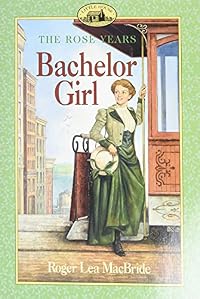
Bachelor Girl
by Roger Lea MacBride
Little House: The Rose Years (8), Little House Novels, Chronological Order (The Rose Years — book 40)
On This Page
Description
Having left her parents' Missouri farm for good and trained to become a telegraph operator in Kansas City, teenage Rose moves out to San Francisco and joins the thousands of "bachelor girls" supporting themselves.Tags
Recommendations









Member Reviews
Rose is definitely her own person. She makes some questionable choices, and doesn't always follow the path her parents laid out for her, but she isn't meek and obedient, either.
She pays back the money her parents lent her, often by going hungry. She wants to make her own way, fight for her own living... and fight for the rights of others, like the working class and suffragettes.
She loves the idea of being in love, but slowly realizes that Paul wants her to be a happy, pretty homemaker while he goes out to be a racist go-getter... and realizes that a match between them won't work.
I think she does an amazing job of coping with being 17, still in puberty, on her own in the city, dealing with (probably) being bipolar, being broke, show more refusing her friends' encouragements to kiss men and drink alcohol, and having a very high intelligence at a time when women were supposed to be ditzy & dependent.
I see the rants from other readers who were 'ashamed' of Rose. Apparently they just wanted yet another good girl, not a 20th century feminist. Shame on them for dissing the story that they could have read, had they read with more care, instead of missing the story they wanted to read.
Re' accuracy: Sure, some Facts are wrong. But I get the impression that the Truth of this pioneering woman is here, ready for the open-minded reader. show less
She pays back the money her parents lent her, often by going hungry. She wants to make her own way, fight for her own living... and fight for the rights of others, like the working class and suffragettes.
She loves the idea of being in love, but slowly realizes that Paul wants her to be a happy, pretty homemaker while he goes out to be a racist go-getter... and realizes that a match between them won't work.
I think she does an amazing job of coping with being 17, still in puberty, on her own in the city, dealing with (probably) being bipolar, being broke, show more refusing her friends' encouragements to kiss men and drink alcohol, and having a very high intelligence at a time when women were supposed to be ditzy & dependent.
I see the rants from other readers who were 'ashamed' of Rose. Apparently they just wanted yet another good girl, not a 20th century feminist. Shame on them for dissing the story that they could have read, had they read with more care, instead of missing the story they wanted to read.
Re' accuracy: Sure, some Facts are wrong. But I get the impression that the Truth of this pioneering woman is here, ready for the open-minded reader. show less
I'm waffling between 2 and 3 stars on this book. It suffered from the same disjointedness as the previous book (like that one, probably due to the author having died before finishing it). Like other readers, I'm not super fond of the person Rose has turned out to be (although, unlike some, I'm relieved that she and Paul Cooley didn't end up together; he'd turned from someone who had supported Rose's dreams when they were only dreams to someone who worked to thwart them as they started to become a reality ).
I think though, the ultimate cause of my dissatisfaction compared to the earlier books though, is that it was just badly written. I think I see what MacBride was trying to get at: Everywhere Rose goes, she is in but not of. Her new show more friends are missing the grounding of her life at home, but her life at home was a world being increasingly left behind. Rose was trying to find how to be an independent modern woman in a world where her main options were to be traditional or flighty. That's the tension I think the book was trying to navigate, but while MacBride's storytelling was sufficient for the earlier slice-of-life narratives, it did not live up to this more difficult challenge.
That said, I was glad to see Rose's childhood rounded off. show less
I think though, the ultimate cause of my dissatisfaction compared to the earlier books though, is that it was just badly written. I think I see what MacBride was trying to get at: Everywhere Rose goes, she is in but not of. Her new show more friends are missing the grounding of her life at home, but her life at home was a world being increasingly left behind. Rose was trying to find how to be an independent modern woman in a world where her main options were to be traditional or flighty. That's the tension I think the book was trying to navigate, but while MacBride's storytelling was sufficient for the earlier slice-of-life narratives, it did not live up to this more difficult challenge.
That said, I was glad to see Rose's childhood rounded off. show less
This last volume of Little House: The Rose Years sees Rose Wilder truly on her own. She returns home to her parents' farm after her high school graduation and year in Louisiana. Life is relatively comfortable, but boring. She's in love, but her beau has yet to propose--he's trying to make a good enough living as a telegraph operator to support both a wife and his widowed mother. When he lands a job in Sacramento, California, Rose is despondent. She finally acts on an old idea of learning telegraphy herself. With her parents' help, she heads off to Kansas City to a telegraphy school. From there she struggles to overcome various challenges to make a new life for itself. It's an interesting tale, one worth checking out, though I didn't show more find it a very satisfying one. The book tries to make a connection between Rose's experience and the pioneer heritage of her parents and grandparents. While I concede that there is a connection, it seems more like she's trading in the pioneer values so prevalent in the previous books for ones that are more urban and 20th Century. Maybe I can't appreciate it because the series is starting to move from a setting that is, for me, a fantasy to one that is all too familiar and real. Or maybe it's because I've read Rose Wilder Lane's biography and know that Bachelor Girl's happy ending is still many years away from "happily ever after".
--J. show less
--J. show less
Rose has started out on her own- empowered by her time in Louisiana, she is ready to become a self-supporting woman. She goes to telegraph school to join Paul’s profession, and switches jobs several times while making her way. Her biggest self-discovery comes when she realizes that she and Paul are going on different paths in life.
love this series!!!!!
Ratings
Members
- Recently Added By
Author Information

27+ Works 11,270 Members
Series


Common Knowledge
- Canonical title
- Bachelor Girl
- Original publication date
- 1999
- People/Characters
- Rose Wilder Lane
- Important places
- San Francisco, California, USA
- Dedication
- To Foster Winan, builder of his own little house, with profound gratitude and respect.
- First words
- In a sweltering June afternoon, soon after she had returned home from Louisiana, Rose paused in the shade of the post-office doorway, leaned against the jamb and sighed.
- Last words
- (Click to show. Warning: May contain spoilers.)Already she could feel her life beginning anew. She could not wait for what the future would bring.
Classifications
- Genres
- Kids, Fiction and Literature, Children's Books
- DDC/MDS
- 813.54 — Literature & rhetoric American literature in English American fiction in English 1900-1999 1945-1999
- LCC
- PZ7 .M12255 .B — Language and Literature Fiction and juvenile belles lettres Fiction and juvenile belles lettres Juvenile belles lettres
- BISAC
Statistics
- Members
- 650
- Popularity
- 44,313
- Reviews
- 5
- Rating
- (3.41)
- Languages
- Danish, English
- Media
- Paper
- ISBNs
- 12
- ASINs
- 2