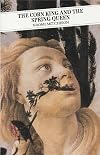
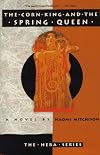
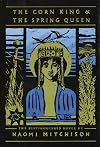
The Corn King and the Spring Queen
by Naomi Mitchison
On This Page
Description
Set more than 2,000 years ago on the calm and fertile shores of the Black Sea, The Corn King and the Spring Queen tells of ancient civilizations where tenderness, beauty, and love vie with brutality and dark magic.Tags
Recommendations













Member Recommendations
isabelx Both books contain a slightly magical version of the Classical world.

by anonymous user
Member Reviews
I read this book because it was mentioned as a sort of prequel to Travelling Light. As Travelling Light was a tiny light fairy story of a read, I was quite surprised when 750 pages of historical fiction in a dense font landed on my doorstep.
What is this book? It is a big historical fiction. It starts in the barbarian land of Marob, where the Corn King and Spring Queen lead their people in rituals, but becomes the whole history of Kleomenes, king of Sparta. My classical education is sorely lacking, which made the book much more of an emotional rollercoaster than it would have been if I’d known the tragedy at the start.
There is a lot of complexity in the relationships -Erif and Tarrik as a destined couple, despite his rape and her show more attempt to kill him and all their infidelities. The foursome of Kleomenes, Panteus, Agiatis, and Philylla. There is grief and loss and honour and magic and pain.
It is a very good book for a long train journey, but quite a hard book to read in snatches around everyday life. show less
What is this book? It is a big historical fiction. It starts in the barbarian land of Marob, where the Corn King and Spring Queen lead their people in rituals, but becomes the whole history of Kleomenes, king of Sparta. My classical education is sorely lacking, which made the book much more of an emotional rollercoaster than it would have been if I’d known the tragedy at the start.
There is a lot of complexity in the relationships -
It is a very good book for a long train journey, but quite a hard book to read in snatches around everyday life. show less
I was so glad when I finally got hold of a copy of "The Corn King and the Spring Queen", as it was such a long time since I originally read it, and it was just as good as I remembered.
It is partially set in Sparta at a time when they were trying to re-introduce the old Spartan system after it had fallen out of use and the nobility had reverted to the pursuit of luxury like the other Greek cities. In the book the king and his supporters are very idealistic about their plans for social engineering, and the new system starts with all debts being cancelled, and the land and wealth shared out equally among the men, so it is very popular with the poorer citizens. I re-read it just after seeing a three part documentary about Sparta, and the show more harshness and cruelty of the system isn't apparent in this story. show less
It is partially set in Sparta at a time when they were trying to re-introduce the old Spartan system after it had fallen out of use and the nobility had reverted to the pursuit of luxury like the other Greek cities. In the book the king and his supporters are very idealistic about their plans for social engineering, and the new system starts with all debts being cancelled, and the land and wealth shared out equally among the men, so it is very popular with the poorer citizens. I re-read it just after seeing a three part documentary about Sparta, and the show more harshness and cruelty of the system isn't apparent in this story. show less
Long, occasionally interesting, often tedious, with frequent unexpected changes in point of view in the middle of a paragraph to add confusion, this book was a slog for me. The main characters were well-developed and complex, as one would hope with so long a book with no particular plot, and mostly sympathetic. The details and philosophizing bogged down. The descriptions, in spite of being abundant, were often unclear. There was a lot of exposition that could have made it easier to understand that the author didn’t include, I guess so that she could make room for digressions into secondary characters or artistic process or philosophy. The outcomes of the various conflicts were often unsatisfying and of the whole book more so. I’m show more glad I’m finished and am not convinced I shouldn’t have just quit. show less
Set in fictional Marob as well as Sparta and Alexandria, this is a novel about the roles of kings and the part that godhead plays in kingship. At the beginning of the novel, Tarrik and Erif are the Corn King and Spring Queen of Marob, the most important roles in the harvest rites, but not in harmony with each other. Life takes Erif and her artist/scultor brother Berris to Sparta, where they get to know the Kleomenes the king of Sparta, and Erif makes friends with Philylla, a Spartan girl who is one of the queen's women. Eventually Erif and Berris follow the defeated Kleomenes to Alexandria.
There is a lot going on in this novel, and I'm not sure I picked up on all the important strands, but I enjoyed what I read.
There is a lot going on in this novel, and I'm not sure I picked up on all the important strands, but I enjoyed what I read.
I read this book many years ago, probably in the 1980's; came across it by accident in a book store and liked it so much; it was unusual; a combination of novel and feminism and mythology, but very well done. In 2008 I bought another of Mitchison's books because of this one; she was out of print and now in again; eventually I will read and review the new one
Ritual king and queen from Black Sea visit Sparta and Ptolemaic Egypt
Originally published as The Corn King and the Spring Queen. Set between 228 B.C. and 187 B.C. partly in an imaginary (but archaeologically based) kingdom of Marob on the Black Sea and partly in Sparta in the time of King Kleomenes and Ptolemaic Egypt.
Members
- Recently Added By
Lists

Books whose title names an object usually found in the kitchen
171 works; 14 members
Author Information

93+ Works 2,244 Members
Some Editions
Awards and Honors
Series
Belongs to Publisher Series
Work Relationships
Is abridged in
Common Knowledge
- Canonical title*
- Kornkönig und Frühlingsbraut
- Original title
- The Corn King and the Spring Queen
- Alternate titles
- The Barbarian
- Original publication date
- 1931
- People/Characters
- Erif Der; Tarrik; Berris Der; Harn Der; Sphaeros; Cleomenes III of Sparta (show all 10); Philylla; Agiatis; Panteus; Ptolemy IV Philopator
- Important places
- Marob; Sparta, Greece; Alexandria, Egypt
- Dedication
- To Mr. X who went to outland on a small aeroplane Wednesday week
- First words
- Erif Der was sitting on a bank of shingle and throwing pebbles into the Black Sea; for a girl, she threw very straight.
- Last words
- (Click to show. Warning: May contain spoilers.)And in Marob everything is alright.
*Some information comes from Common Knowledge in other languages. Click "Edit" for more information.
Classifications
Statistics
- Members
- 303
- Popularity
- 106,264
- Reviews
- 9
- Rating
- (3.77)
- Languages
- English, German
- Media
- Paper, Ebook
- ISBNs
- 11
- ASINs
- 7