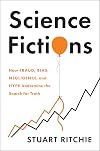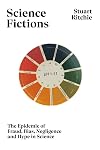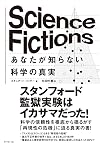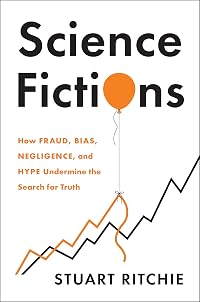
Science Fictions: How Fraud, Bias, Negligence, and Hype Undermine the Search for Truth
by Stuart Ritchie
On This Page
Description
"Science is how we understand the world. Yet critical flaws in peer review, statistical methods, and publication procedures have rendered a shocking number of scientific studies useless-or worse, badly misleading. Drawing on surprising new data from "meta-science" (the science of how science works), Science Fictions documents the errors that have distorted our knowledge on issues as varied as cancer biology, nutrition, genetics, immigration, education, and extraterrestrial life. Stuart show more Ritchie's own work challenging an infamous psychology experiment helped spark what's now widely known as the "replication crisis," the realization that many supposed scientific truths cannot be relied upon. Now, he reveals the very human biases, mistakes, and deceptions that undermine the scientific endeavor: from contamination in science labs to the secret vaults of failed studies that nobody gets to see; from outright cheating with fake data to the more common but still ruinous temptation to exaggerate mediocre results for a shot at scientific fame. Yet Science Fictions is far from a counsel of despair. Rather, it's a defense of the scientific method against the pressures and perverse incentives that lead scientists to bend the rules. By illustrating the ways that science goes wrong, Ritchie gives us the knowledge we need to spot dubious research, and points the way to reforms that might save science from itself"-- show lessTags
Recommendations













Member Reviews
The title summarizes the book's topic well. Chapter 2 recounts some egregious cases of fraud, like Stapel and Macchiarini, who made up data and lied about patients dying and suffering, respectively. But perhaps more worrying is the likely more widespread low-level p-hacking, selective reporting of findings and various small adjustments of the analysis and data to obtain publishable results that he turns to next. I know from personal experience that these are big issues in social science, but learnt here that they exist also in the harder sciences. The unfortunate result is that we cannot trust the scientific literature. I believe Ritchie is spot on when he identifies the perverse incentives faced by researchers as a major factor in show more these problems. Good publications are the key to tenure, promotions, salary increases, funding, prestige and the competition to obtain these publications have tempted many to tweak their analysis, underplay uncertainty and oversell their findings. What can be done? There is room for more honest behavior from individuals, but it is too much to hope for that that will be all that is needed. In the final chapter, Fixing science, Ritchie highlights a 2016 meta-analysis on antidepressant drug trials that illustrates many of the preceding problems and details how publication bias, p-hacking/outcome switching, spin, and citation bias may distort the scientific literature [The cumulative effect of reporting and citation biases on the apparent efficacy of treatments: the case of depression by de Vries and others.]. Instead of focusing on a specific solution, Ritchie lists a number of possible improvements. Some of these are ok, though not attacking the more structural problems or seem to labor intensive to do so, like naming and shaming, independent investigation of misconduct, algorithms to detect fake data/images/etc., hiring on merit rather than bean counting and a review service for pre-prints. Suggestions that seem to me to have more potential are journals being more acceptive of replications and null results (but needs to be accompanied by credit given by others), more comprehensive analysis like multiverse approaches and pre-registration, ideally combined with reviews in a registered report format. However, the problems with the trustworthiness of the scientific literature are so large that we should try multiple approaches. Highly recommended. show less
Really enjoyed this description of some of the big problems in science today. This is not in any way an anti-science book, Ritchie makes clear that he wants to improve science, not to dispense with it. Along with describing problems he also describes much of the process of science which I enjoyed.
He spends a lot of time on the reproducibility crises, p-hacking and other statistical cheating, and many other issues that one hears about when science problems get in the news.
This book has been well reviewed in general publications, but I was curious how science journals would review it. The only review I found in a professional science periodical (in the ultra-prestigious Nature) was basically positive with a few criticisms.
He spends a lot of time on the reproducibility crises, p-hacking and other statistical cheating, and many other issues that one hears about when science problems get in the news.
This book has been well reviewed in general publications, but I was curious how science journals would review it. The only review I found in a professional science periodical (in the ultra-prestigious Nature) was basically positive with a few criticisms.
This book covers the "replication crisis" in science and some of the causes of it -- not merely "how bad science is done" but also the motivations and "why". There has been some progress in the past few years in fighting this, but there are a lot of motivations for why people will continue to do things which are bad or counterproductive (including unintentionally). I'm somewhat optimistic science will ultimately figure out better was to communicate and value research which will help solve the problem, but it's going to be a long process.
Intriguing if worrying account. Science is the road to demonstrable testable truth but pressure, dishonesty, mistakes, venality, ambition for fame, desire for tenure and promotion disturb the process. Unsurprising perhaps that, of all subjects , psychology scores the worst.
Well written plea for greater scientific rigor.
Ratings
Members
- Recently Added By
Author Information
2 Works 350 Members
Some Editions
Awards and Honors
Classifications
Statistics
- Members
- 270
- Popularity
- 119,155
- Reviews
- 5
- Rating
- (4.21)
- Languages
- English, Japanese
- Media
- Paper, Audiobook, Ebook
- ISBNs
- 10
- ASINs
- 3