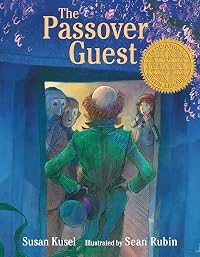
The Passover Guest
by Susan Kusel
On This Page
Description
In Washington, D.C., during the Great Depression, Muriel and her family have no money to prepare the seder meal until a mysterious stranger performs a Passover miracle. Includes notes on the Passover holiday, the Great Depression, and the history of the D.C. Jewish community.Tags
Recommendations


















Member Reviews
This picture book for children ages 4 and older retells the famous I.L. Peretz story, “The Magician,” originally written in Yiddish and illustrated by Marc Chagall, the most famous Jewish painter of the 20th century.
Peretz’s story riffed on Jewish folklore tales about Elijah the Prophet, whose appearance is hoped for during the Passover Seder, the ritual meal commemorating the exodus of the Israelites from Egypt. At the seder, a chair is always left empty for Elijah, a special cup of wine is poured at the place set for him, and when possible, the front door is left open to facilitate his arrival.
In Jewish tradition, Elijah has had a number of roles making him a most welcome Passover guest, including the herald of the Messiah, show more miracle worker, healer, and promoter of social justice and welfare.
This current book is set in Washington, D.C. in the spring of 1933 during the Great Depression. It recounts what happened to Muriel, a young girl who was not looking forward to the Passover Seder celebration because her family was too poor to have one.
In spite of having next to nothing, Muriel gave her last penny to a magician seeking donations who entertained her on the steps of the Lincoln Memorial. He advised her to hurry home so she didn’t miss her seder.
Miriam was somewhat disbelieving that her family would be having a seder, yet the man was - after all - a worker in magic, and he sounded so confident! She hurried home past the beautiful monuments and memorials, back to her apartment. When she opened the door, however, there was only an empty table.
Then she and her parents heard a knock at the door, and a mysterious stranger asked to join them for their seder. Muriel’s father said, “You are welcome to share anything we have, but this year, we have nothing.” The man responded, “I have everything we need.”
Suddenly the room was no longer shabby and the table was overflowing with food. Muriel ran to get the rabbi and ask if they could proceed with the astonishing meal. He and his curious guests followed Muriel back home. The stranger was gone but the cornucopia of food was still there, and they all celebrated together. By the empty cup set out for Elijah, there sat the penny Muriel had given the magician.
The author and illustrator both add notes after the end of the story, and there is also an explanation of the Passover holiday.
Illustrator Sean Rubin reports that he wanted his work to harken back to Chagall’s approach to art, reflecting aspects of Chagall's typical palette, as well as his unique arrangements of color, lighting, and surrealist images. Rubin has chosen to idenity the time of year for readers by the beautiful profusion of cherry blossoms, and enhances the narrative's suggestion of community cohesion by his street scenes in the Jewish neighborhood that evoke the close-knit shtetl, albeit updated. (Shtetls were small Jewish villages that existed in Central and Eastern Europe before the Holocaust.) In addition, Muriel’s red hat - always causing her to stand out in every scene - reminded me of the little girl in the red coat in “Schindler’s List.” The red coat is said to have represented hope, innocence, and the continuation of Jewish life and tradition, and I think the same could be said of Muriel in her red hat.
Evaluation: This book is not an ordinary picture book, in the sense that it is actually a “page turner” - readers will be champing at the bit to find out what happens after Muriel hurries home. I also loved the way that an old Yiddish folktale was retold rather faithfully in spite of the new world setting.
The book features an excellent message that is not explicitly articulated, but doesn’t need to be: small acts of kindness, generosity, and compassion are not only “mitzvahs” (or good deeds) in and of themselves. Occasionally, they can even yield repayment in ways you could never have imagined. It could take the form of tangible rewards, but regardless there will be the intangible but more lasting benefits of making you a better person and the world a better place. show less
Peretz’s story riffed on Jewish folklore tales about Elijah the Prophet, whose appearance is hoped for during the Passover Seder, the ritual meal commemorating the exodus of the Israelites from Egypt. At the seder, a chair is always left empty for Elijah, a special cup of wine is poured at the place set for him, and when possible, the front door is left open to facilitate his arrival.
In Jewish tradition, Elijah has had a number of roles making him a most welcome Passover guest, including the herald of the Messiah, show more miracle worker, healer, and promoter of social justice and welfare.
This current book is set in Washington, D.C. in the spring of 1933 during the Great Depression. It recounts what happened to Muriel, a young girl who was not looking forward to the Passover Seder celebration because her family was too poor to have one.
In spite of having next to nothing, Muriel gave her last penny to a magician seeking donations who entertained her on the steps of the Lincoln Memorial. He advised her to hurry home so she didn’t miss her seder.
Miriam was somewhat disbelieving that her family would be having a seder, yet the man was - after all - a worker in magic, and he sounded so confident! She hurried home past the beautiful monuments and memorials, back to her apartment. When she opened the door, however, there was only an empty table.
Then she and her parents heard a knock at the door, and a mysterious stranger asked to join them for their seder. Muriel’s father said, “You are welcome to share anything we have, but this year, we have nothing.” The man responded, “I have everything we need.”
Suddenly the room was no longer shabby and the table was overflowing with food. Muriel ran to get the rabbi and ask if they could proceed with the astonishing meal. He and his curious guests followed Muriel back home. The stranger was gone but the cornucopia of food was still there, and they all celebrated together. By the empty cup set out for Elijah, there sat the penny Muriel had given the magician.
The author and illustrator both add notes after the end of the story, and there is also an explanation of the Passover holiday.
Illustrator Sean Rubin reports that he wanted his work to harken back to Chagall’s approach to art, reflecting aspects of Chagall's typical palette, as well as his unique arrangements of color, lighting, and surrealist images. Rubin has chosen to idenity the time of year for readers by the beautiful profusion of cherry blossoms, and enhances the narrative's suggestion of community cohesion by his street scenes in the Jewish neighborhood that evoke the close-knit shtetl, albeit updated. (Shtetls were small Jewish villages that existed in Central and Eastern Europe before the Holocaust.) In addition, Muriel’s red hat - always causing her to stand out in every scene - reminded me of the little girl in the red coat in “Schindler’s List.” The red coat is said to have represented hope, innocence, and the continuation of Jewish life and tradition, and I think the same could be said of Muriel in her red hat.
Evaluation: This book is not an ordinary picture book, in the sense that it is actually a “page turner” - readers will be champing at the bit to find out what happens after Muriel hurries home. I also loved the way that an old Yiddish folktale was retold rather faithfully in spite of the new world setting.
The book features an excellent message that is not explicitly articulated, but doesn’t need to be: small acts of kindness, generosity, and compassion are not only “mitzvahs” (or good deeds) in and of themselves. Occasionally, they can even yield repayment in ways you could never have imagined. It could take the form of tangible rewards, but regardless there will be the intangible but more lasting benefits of making you a better person and the world a better place. show less
A delightful story with some deep messages, like all good picture books.
The book is based on Peretz's "Der Kunzen-Macher (The Magician)," but with changes to address some of the concerns the author had with his story and, perhaps, to make it more accessible to children by including an American child as the main character. Making the book take place in Washington, D.C., during the Depression explains why the girl's family has so little money and lets the author include cherry blossoms. Having the rabbi be at a seder makes more sense than his being alone studying. While Elijah doesn't hang around and bring the Messiah, the community coming together to celebrate is how the messianic age should start.
The illustrator, in the endnotes, show more explains his use of musical instruments during a Jewish holiday when, traditionally, musical instruments are not even touched is his way of paying homage to Chagall. show less
The book is based on Peretz's "Der Kunzen-Macher (The Magician)," but with changes to address some of the concerns the author had with his story and, perhaps, to make it more accessible to children by including an American child as the main character. Making the book take place in Washington, D.C., during the Depression explains why the girl's family has so little money and lets the author include cherry blossoms. Having the rabbi be at a seder makes more sense than his being alone studying. While Elijah doesn't hang around and bring the Messiah, the community coming together to celebrate is how the messianic age should start.
The illustrator, in the endnotes, show more explains his use of musical instruments during a Jewish holiday when, traditionally, musical instruments are not even touched is his way of paying homage to Chagall. show less
Beautifully illustrated story of the hope of Passover. Muriel lives in Washington D.C. in 1933 during the depression when thousands of people were out of work and people went hungry. She knew her parents wouldn't be able to make a Seder. She gives an amazing juggler her last penny and he tells her to hurry home for Passover.
She does but finds her parents dressed up but with no food. But the juggler comes knocking on their door and leaves a miraculous Passover feast for Muriel, her family and the whole neighborhood to enjoy.
Lovely, sweet and truly amazing.
She does but finds her parents dressed up but with no food. But the juggler comes knocking on their door and leaves a miraculous Passover feast for Muriel, her family and the whole neighborhood to enjoy.
Lovely, sweet and truly amazing.
This retelling of I.L. Peretz's story (The Magician, Uri Shulevitz) is set in the spring of 1933 in Washington, D.C., where Muriel's family has been hard-hit by the Depression. Muriel, on her way home, is impressed by a street magician and gives him her only penny; when she arrives home, a miraculous Passover feast is there, along with a strange guest. Muriel's family invites their rabbi and neighbors, and though they forget to open the door for Elijah, his cup of wine is drunk.
See also: The Gardener by Sarah Stewart
See also: The Gardener by Sarah Stewart
In Washington, D.C. during the Great Depression, Muriel invites a ragged juggler to celebrate Passover with her family. When he arrives, they are stunned to discover a magnificent feast to share with their neighbors. Based on I. L. Peretz’s “The Magician” and illustrated in the style of Marc Chagall, Kusel’s debut picture book will resonate with readers young and old. (Sydney Taylor Picture Book Award Winner)
Good author's and illustrator's notes. Interesting setting. Important theme. But somehow it just didn't make any sort of impact on me.
Muriel assumes her family is too poor to hold a Passover Seder this year-- but an act of kindness and a mysterious magician change everything.
Members
- Recently Added By
Lists

Books Set in Washington DC
34 works; 7 members
Author Information
All Editions
Awards and Honors
Awards
Distinctions
Common Knowledge
- Original publication date
- 2021
- People/Characters
- Muriel; Elijah
- Important places
- Washington, D.C., USA
- Important events
- Passover; Great Depression
- First words
- Muriel loved Washington in the springtime.
- Last words
- (Click to show. Warning: May contain spoilers.)Now she knew who the mysterious stranger was.
- Original language
- English
- Disambiguation notice
- Adapted from Der Kunzen-Macher (The Magician) by I.L. Peretz.
Classifications
Statistics
- Members
- 103
- Popularity
- 315,127
- Reviews
- 8
- Rating
- (4.22)
- Languages
- English
- Media
- Paper
- ISBNs
- 2