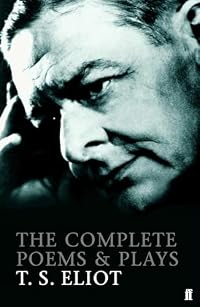
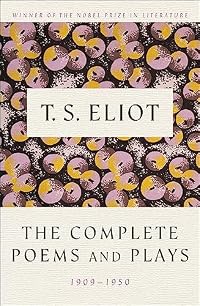
The Complete Poems and Plays
by T. S. Eliot
On This Page
Description
Poet, dramatist, critic and editor, T. S. Eliot was one of the defining figures of twentieth-century poetry. This edition of The Complete Poems and Plays, published for the first time in paperback, includes all of his verse and work for the stage, from Prufrock and Other Observations (1917) to Four Quartets (1943), and includes such literary landmarks as The Waste Land, Old Possum's Book of Practical Cats and Murder in the Cathedral.'Each year Eliot's presence reasserts itself at a deeper show more level, to an audience that is surprised to find itself more chastened, more astonished, more humble.' Ted Hughes show lessTags
Recommendations












Member Recommendations
Member Reviews
Best to read Eliot's poetry several times over a leisurely timeframe. Meaning arises only after the piece is somewhat familiar, the first few encounters establish mood & setting, and perhaps voice. Allow these elements to coalesce of themselves, initially enjoy the cadence and phrasing, maybe tease out his allusions.
Daniel Schwarz writes that Eliot sees verse as "the means of working out his most compelling personal dilemmas", but also "a way of putting it" for an audience. Even before reading this take (and it is but one opinion), Eliot's verse didn't seem pretentious so much as careful: he is writing for himself, worrying at something personally significant, important to put down properly. Unsurprising that so much of it isn't show more immediately apparent to me or anyone else.
The poems almost all employ quotation or an epigraph in Greek, Latin, French; several of his early poems are entirely in French. There are no translations, and in several cases no indication of the source being quoted. Yet many of his poems are a pleasure even when inscrutable: I'm immediately drawn to "Prufrock" or The Waste Land, for example, even though I'm hardpressed to discern even partial meaning from them on first or second reading, and some like "Gerontion" are stubbornly opaque and lack the shape or wordfeel to reward me on those merits alone.
As difficult as these poems are, they've entered the culture and literature, music, other poetry. I recognise lines first encountered elsewhere, and that is a primary aspect of my appreciation. Eldritch is detectable in several places, lifting lines & phrases, and I wonder now if his approach (personal meanings nested in songs meant for a listening public, crafting new pieces built around allusions) is modeled deliberately after Eliot.
This edition has no commentary save Eliot's notes to The Waste Land (at publisher request to add pages, later rued by Eliot). Worth reading commentary on specific poems and revisiting regularly.
//
2012 reading of verse, omitting the plays (which apparently are written as dramatic verse). Paired with the Wagner-Martin critical anthology. Look into Eliot's essays, perhaps starting with The Sacred Wood. show less
Daniel Schwarz writes that Eliot sees verse as "the means of working out his most compelling personal dilemmas", but also "a way of putting it" for an audience. Even before reading this take (and it is but one opinion), Eliot's verse didn't seem pretentious so much as careful: he is writing for himself, worrying at something personally significant, important to put down properly. Unsurprising that so much of it isn't show more immediately apparent to me or anyone else.
The poems almost all employ quotation or an epigraph in Greek, Latin, French; several of his early poems are entirely in French. There are no translations, and in several cases no indication of the source being quoted. Yet many of his poems are a pleasure even when inscrutable: I'm immediately drawn to "Prufrock" or The Waste Land, for example, even though I'm hardpressed to discern even partial meaning from them on first or second reading, and some like "Gerontion" are stubbornly opaque and lack the shape or wordfeel to reward me on those merits alone.
As difficult as these poems are, they've entered the culture and literature, music, other poetry. I recognise lines first encountered elsewhere, and that is a primary aspect of my appreciation. Eldritch is detectable in several places, lifting lines & phrases, and I wonder now if his approach (personal meanings nested in songs meant for a listening public, crafting new pieces built around allusions) is modeled deliberately after Eliot.
This edition has no commentary save Eliot's notes to The Waste Land (at publisher request to add pages, later rued by Eliot). Worth reading commentary on specific poems and revisiting regularly.
//
2012 reading of verse, omitting the plays (which apparently are written as dramatic verse). Paired with the Wagner-Martin critical anthology. Look into Eliot's essays, perhaps starting with The Sacred Wood. show less
20th Century poetry at its greatest! From post-war chaos and disarray (The Waste Land), through repentance and self-analysis (Ash Wednesday) to the exquisite musicality and peaceful perfection of Four Quartets, following in the footsteps of the great master of the past (Dante Alighieri!). My "book of the soul"
Probably the only poet I have read the entire collected works of. (Verse work he chose to publish in his lifetime, that is.) Having not been prolific, Eliot achieved an extraordinarily high average standard.
I do not profess to "understand" some of Eliot's more notoriously obscure poems, however, I love them for the sound they make.
I do not profess to "understand" some of Eliot's more notoriously obscure poems, however, I love them for the sound they make.
My edition of this book (Harcourt, Brace and World, 1952) has no notes, a most unfortunate omission.
Ratings
Members
- Recently Added By
Published Reviews
ThingScore 100
Early in her novel Wise Blood, Flannery O’Connor describes protagonist Hazel Motes, leader of the Church without Christ, by the silhouette he casts on the sidewalk. “Haze’s shadow,” she writes, “was now behind him and now before him.” It’s a strange way to situate a character — skulking between his shadows — but it’s not unprecedented. In The Waste Land, T.S. Eliot’s show more narrator refers to “Your shadow at morning striding behind you/Or your shadow at evening rising to meet you.” Coincidence? Nobody can say for certain. But in the rare case of a critic linking O’Connor and Eliot, Sally Fitzgerald (O’Connor’s close friend) wrote that “it was Eliot and his Waste Land who provided for her the first impetus to write such a book as Wise Blood.” show less
added by elenchus
Author Information

500+ Works 47,713 Members
T. S. Eliot is considered by many to be a literary genius and one of the most influential men of letters during the half-century after World War I. He was born on September 26, 1888, in St. Louis, Missouri. Eliot attended Harvard University, with time abroad pursuing graduate studies at the Sorbonne, Marburg, and Oxford. The outbreak of World War show more I prevented his return to the United States, and, persuaded by Ezra Pound to remain in England, he decided to settle there permanently. He published his influential early criticism, much of it written as occasional pieces for literary periodicals. He developed such doctrines as the "dissociation of sensibility" and the "objective correlative" and elaborated his views on wit and on the relation of tradition to the individual talent. Eliot by this time had left his early, derivative verse far behind and had begun to publish avant-garde poetry (including "The Love Song of J. Alfred Prufrock" (1915), which exploited fresh rhythms, abrupt juxtapositions, contemporary subject matter, and witty allusion. This period of creativity also resulted in another collection of verse (including "Gerontian") and culminated in The Waste Land, a masterpiece published in 1922 and produced partly during a period of psychological breakdown while married to his wife, Vivienne Haigh-Wood Eliot. In 1922, Eliot became a director of the Faber & Faber publishing house, and in 1927 he became a British citizen and joined the Church of England. Thereafter, his career underwent a change. With the publication of Ash Wednesday in 1930, his poetry became more overtly Christian. As editor of the influential literary magazine The Criterion, he turned his hand to social as well as literary criticism, with an increasingly conservative orientation. His religious poetry culminated in Four Quartets, published individually from 1936 onward and collectively in 1943. This work is often considered to be his greatest poetic achievement. Eliot also wrote poetry in a much lighter vein, such as Old Possum's Book of Practical Cats (1939), a collection that was used during the early 1980s as the basis for the musical, Cats. In addition to his contributions in poetry and criticism, Eliot is the pivotal verse dramatist of this century. He followed the lead of William Butler Yeats in attempting to revive metrical language in the theater. But, unlike Yeats, Eliot wanted a dramatic verse that would be self-effacing, capable of expressing the most prosaic passages in a play, and an insistent, undetected presence capable of elevating itself at a moment's notice. His progression from the pageant The Rock (1934) and Murder in the Cathedral (1935), written for the Canterbury Festival, through The Family Reunion (1939) and The Cocktail Party (1949), a West End hit, was thus a matter of neutralizing obvious poetic effects and bringing prose passages into the flow of verse. Recent critics have seen Eliot as a divided figure, covertly attracted to the very elements (romanticism, personality, heresy) he overtly condemned. His early attacks on romantic poets, for example, often reveal him as a romantic against the grain. The same divisions carry over into his verse, where violence struggles against restraint, emotion against order, and imagination against ironic detachment. This Eliot is more human and more attractive to contemporary taste. During his lifetime, Eliot received many honors and awards, including the Nobel Prize for literature in 1948. (Bowker Author Biography) show less
Awards and Honors
Distinctions
Notable Lists
Work Relationships
Contains
Poems by T. S. Eliot
Common Knowledge
- Canonical title
- The Complete Poems and Plays
- Original title
- The complete poems and plays of T.S. Eliot
- Original publication date
- 1952
- People/Characters
- Alexander MacColgie Gibbs
- First words
- Let us go then, you and I,
When the evening is spread out against the sky
Like a patient etherised upon a table; - Quotations
- We are the hollow men, the stuffed men
- Last words
- (Click to show. Warning: May contain spoilers.)Now he is grren, dry and stained
With the shadow in his mouth.
(Click to show. Warning: May contain spoilers.)Lavinia: Oh, I'm glad. It's begun.
Curtain - Original language
- English
Classifications
Statistics
- Members
- 1,149
- Popularity
- 21,756
- Reviews
- 4
- Rating
- (4.48)
- Languages
- English
- Media
- Paper, Ebook
- ISBNs
- 3
- ASINs
- 17