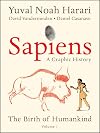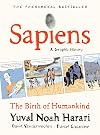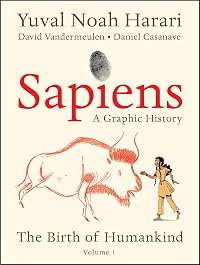
Sapiens: A Graphic History, Vol. 1: The Birth of Humankind
by Yuval Noah Harari, Daniel Casanave (Illustrator), David Vandermeulen (Author)
Sapiens: A Graphic History (1)
On This Page
Description
"In this first volume of the full-color illustrated adaptation of his groundbreaking book, renowned historian Yuval Harari tells the story of humankind's creation and evolution, exploring the ways in which biology and history have defined us and enhanced our understanding of what it means to be 'human'. From examining the role evolving humans have played in the global ecosystem to charting the rise of empires, Sapiens challenges us to reconsider accepted beliefs, connect past developments show more with contemporary concerns, and view specific events within the context of larger ideas."--Publisher's description. show lessTags
Recommendations






















Member Reviews
I have been curious about Harari's book for a while and when I saw it had been turned into a graphic novel, I had to check it out. The adaptation is utterly brilliant. There are so many various ways that have been found to visually show us the various concepts really make the information digestible and entertaining without being overwhelming. The art work is lovely and the lettering makes it easy to read. I do have some questions about some of the conclusions that Harari draws but the work of Vandermeulen and Casanave earn this 5 stars.
Wow! There are some mind-blowing concepts masterfully laid out in this history of the rise of mankind as a species, from the critical roles of gossip and cooperation in our success to the delusional lies that form the bedrock of our social constructs to our ability to initiate ecological disasters long before the industrial age and global warming.
I can't wait for Volume Two; I want to read the original book from which this is adapted.
I can't wait for Volume Two; I want to read the original book from which this is adapted.
Considering the fact that SAPIENS by Yuval Noah Harari was one of the best books I have read, EVER, I expected to love this graphical interpretation at least a little a bit. A problem is that I tend to be annoyed by graphic novels. They feel gimmicky. And this one was high on gimmick factor. It didn't just illustrate Harari's ideas... it introduced a young inquisitive niece character, Zoe; and an obese Indian woman scientist who carried a small dog everywhere. I honestly have no idea why. Any of it.
Most of the time I felt the book was at the level of the Zoe character - for children; older, genuinely science-curious children, but still... children. (Notwithstanding lots of nudity.) I kept wondering what I was getting out of it.
But in show more the end - though it seems I always have to spend a lot of any review being a nattering nabob of negativity - I DID get things out of it. It made me think about us all being animals... evolving from and with animals... animals, our brothers, our OLDER brothers, as I read in another scientific book of a different stripe recently, BRAIDING SWEETGRASS. Here in the graphic SAPIENS, the pictures did add something more than a gimmick, I have to admit: I remember a picture of a doe-eyed doe, and it made me think about being a nearly-evolved sapiens looking that doe in the eye, as an equal.
Another idea still persisting in my mind: "Our brains are still adapted for life as hunter-gatherers. Our eating habits, our conflicts, and our sexuality are all the result of our hunter-gatherer minds grappling with a post-industrial world." I can't be blamed for the fact that I simply cannot resist a plate of fries or a pie crust when they are sitting right in front of me. The hunter-gatherer in me would KILL - literally! - for that amount of delicious fat.
Also: One reason we can't look at modern-day hunter-gatherers as a stand-in for what life was like for our early ancestors is that what's left of today's foragers are all living in the most marginal places. "Modern forager societies have mostly survived in regions with difficult climatic conditions, and inhospitable terrain that doesn't lend itself to agriculture." I've always tended to think of hunting-gathering with a big fat "No, thanx!" Agriculture is my favorite invention. When people talk about eating wild foodstuffs, it's about as appealing to me as dumpster diving. Yay, a handful of fiddleheads, some mushrooms that hopefully don't poison us; and maybe, if it is exactly the right time of year, some really seedy blackberries! Sounds WONDERFUL! Please, bring on the agriculture already.
But the hunter-gatherers in pre-agricultural times weren't all trying to make a living on my 3 acres in Vermont. Think about our most fertile agricultural land, our most abundant seacoasts and forests. They lived in the good places. I'm not saying food was as thick on the ground as it is in your intensively cultivated plot of garden, maybe; but then again, maybe it wasn't far from it, either.
They lived in the good places, and they lived all over the world. Before agriculture, think about it - we were already everywhere. We had an abundance of lifestyles and cultures, just like today. We just didn't live in towns, or on farms. We all just lived on the land. Like the animals. Because that's what we are. show less
Most of the time I felt the book was at the level of the Zoe character - for children; older, genuinely science-curious children, but still... children. (Notwithstanding lots of nudity.) I kept wondering what I was getting out of it.
But in show more the end - though it seems I always have to spend a lot of any review being a nattering nabob of negativity - I DID get things out of it. It made me think about us all being animals... evolving from and with animals... animals, our brothers, our OLDER brothers, as I read in another scientific book of a different stripe recently, BRAIDING SWEETGRASS. Here in the graphic SAPIENS, the pictures did add something more than a gimmick, I have to admit: I remember a picture of a doe-eyed doe, and it made me think about being a nearly-evolved sapiens looking that doe in the eye, as an equal.
Another idea still persisting in my mind: "Our brains are still adapted for life as hunter-gatherers. Our eating habits, our conflicts, and our sexuality are all the result of our hunter-gatherer minds grappling with a post-industrial world." I can't be blamed for the fact that I simply cannot resist a plate of fries or a pie crust when they are sitting right in front of me. The hunter-gatherer in me would KILL - literally! - for that amount of delicious fat.
Also: One reason we can't look at modern-day hunter-gatherers as a stand-in for what life was like for our early ancestors is that what's left of today's foragers are all living in the most marginal places. "Modern forager societies have mostly survived in regions with difficult climatic conditions, and inhospitable terrain that doesn't lend itself to agriculture." I've always tended to think of hunting-gathering with a big fat "No, thanx!" Agriculture is my favorite invention. When people talk about eating wild foodstuffs, it's about as appealing to me as dumpster diving. Yay, a handful of fiddleheads, some mushrooms that hopefully don't poison us; and maybe, if it is exactly the right time of year, some really seedy blackberries! Sounds WONDERFUL! Please, bring on the agriculture already.
But the hunter-gatherers in pre-agricultural times weren't all trying to make a living on my 3 acres in Vermont. Think about our most fertile agricultural land, our most abundant seacoasts and forests. They lived in the good places. I'm not saying food was as thick on the ground as it is in your intensively cultivated plot of garden, maybe; but then again, maybe it wasn't far from it, either.
They lived in the good places, and they lived all over the world. Before agriculture, think about it - we were already everywhere. We had an abundance of lifestyles and cultures, just like today. We just didn't live in towns, or on farms. We all just lived on the land. Like the animals. Because that's what we are. show less
Nesta versão graphic novel de Sapiens: Uma breve história da humanidade , que vendeu mais de 16 milhões de exemplares em sessenta idiomas mundo afora, você é convidado a viajar pelo lado selvagem da história, acompanhado por personagens como Bill Pré-Histórico, dra. Ficção e detetive Lopez, e tendo o historiador e filósofo Yuval Noah Harari como guia. Com roteiro do belga David Vandermeulen e arte do francês Daniel Casanave, o formato HQ dá uma nova perspectiva ao passado e às nossas origens. A evolução humana é repensada como um reality show. O primeiro encontro entre os sapiens e os neandertais se dá através das obras-primas da arte moderna. A extinção dos mamutes e dos tigres-dentes-de-sabre é recontada como um show more filme policial.
Esta série em quadrinhos é uma versão radical da história da humanidade, recheada de inteligência, humor e personagens pitorescos, e pensada para cativar quem gostaria de saber, entre outros assuntos, como um reles primata se tornou governante do planeta Terra, capaz de dividir átomos, viajar à Lua e manipular o código genético da vida. show less
Esta série em quadrinhos é uma versão radical da história da humanidade, recheada de inteligência, humor e personagens pitorescos, e pensada para cativar quem gostaria de saber, entre outros assuntos, como um reles primata se tornou governante do planeta Terra, capaz de dividir átomos, viajar à Lua e manipular o código genético da vida. show less
In Sapiens: A Graphic History, Volume One, Yuval Noah Harari, David Vandermeulen, and Daniel Casanave adapt Harari’s Sapiens: a Brief History of Humankind. Harari appears as the narrator, leading the reader through interactions with various experts in biology, physiology, chemistry, and more as they examine how Homo sapiens became the dominant human species, what this meant for other human species, and how we changed the biosphere as we spread around the world. The graphic medium works particularly well for tackling these complex topics in an accessible format for readers of all ages. The creative team never talks down to their audience, but they work to clearly explain each topic and its deeper connection to the overall theme of the show more book. More to the point, there’s a sense of fun about Sapiens: A Graphic History that increases the accessibility of these topics. show less
This was. . . fine? I read the book it's based on, which I liked more. I think I was hoping the info would be lifted out of the text more, but instead, there were lots of panels with people just saying true things. I wish they had taken more advantage of the medium. It felt like they attempted flights of fancy but then seemed to be tethered to reality (in presentation) due to an obligation to be factual.
I'd say this would be ideal for anyone who hasn't read the other book and isn't sure if it's right for them and/or they're not ready to tackle a big chunk of non-fiction.
I'd say this would be ideal for anyone who hasn't read the other book and isn't sure if it's right for them and/or they're not ready to tackle a big chunk of non-fiction.
This graphic novel adaptation of Harari's book Sapiens, the first of (I believe) four volumes, is okay. While I wasn't in love with the illustration style, I'll likely continue with subsequent volumes because the content is interesting to me, and a periodic information refresher is always welcome. Overall, I'd recommend the full-length book over the graphic novel.
Members
- Recently Added By
Lists

Best Graphic Novel Nonfiction
199 works; 101 members

Favorite Kids Graphic Novels
262 works; 1 member
Author Information

37+ Works 31,853 Members
Yuval Noah Harari received a PhD in history from the University of Oxford. He lectures at the Hebrew University of Jerusalem, specializing in world history. He has written several books including Sapiens: A Brief History of Humankind which became a 2016 New York Times Bestsellers. (Bowker Author Biography)

All Editions
Awards and Honors
Awards
Notable Lists
Series

Work Relationships
Is contained in
Is an adaptation of
Common Knowledge
- Canonical title
- Sapiens: A Graphic History, Vol. 1: The Birth of Humankind
- Original publication date
- 2020-10-07
- People/Characters
- Yuval Noah Harari; Zoe [Sapiens] (niece of Yuval Noah Harari); Arya Saraswati (professor); Lucy Australopithecus; Prehistoric Bill (Bill Sapiens); Bill Sapiens (Prehistoric Bill) (show all 32); Cindy Sapiens; Ann Gibbons; Charles Darwin [Charles Robert: 1809-1882]; Karl Marx; Albert Einstein; Robin Dunbar; Brad Pitt; Angelina Jolie; Doctor Fiction; Armand Peugeot; Iron Kaiser; Captain Dollar; Lady Justice; Lady Liberty; Liberty Mary-Ann; The Corp; Lionman; Skyman; Aiko Yoshita (professor); Dr. Duarte (anthropologist); Doctor Father Klüg (archaeologist); Graow (Neanderthal); Charlie Chaplin; Selena Lopez [Sapiens] (police detective); Adamski (lawyer); Judge Gaia
- Important places
- England, UK; France; Vézère Valley, France; Valentigney, France; Berlin, Germany; Australia (show all 22); Paraguay; Rio de Janeiro, Brazil; New Ireland; New Britain; Lascaux cave, France; Siberia, Russia; Kentucky, USA; Jebel Sahaba, Sudan; Ukraine; New York, New York, USA; New Zealand; Wrangel Island, Russia; Mauritius; Beringia; Madagascar; Galápagos Islands, Ecuador
- Dedication
- To the extinct, the lost and the forgotten. Everything that comes together is bound to be dissolved. - Yuval Noah Harari
- First words
- About 14 billion years ago, matter, energy, time and space came into being in what is known as the Big Bang.
- Last words
- (Click to show. Warning: May contain spoilers.)"As I cannot be impartial . . . "
"Pssst . . . If you need a good lawyer . . . "
" . . . I will therefore be referring this case to the Supreme Court of the future. We are all responsible, and we will all have to answer for our actions." - Original language
- French
- Disambiguation notice
- 2020 French graphic novel adaptation of Sapiens: A Brief History of Humankind, a book first published in Hebrew in 2011.
Classifications
Statistics
- Members
- 961
- Popularity
- 27,606
- Reviews
- 22
- Rating
- (4.07)
- Languages
- 11 — Catalan, Dutch, English, Finnish, French, German, Italian, Polish, Portuguese, Spanish, Swedish
- Media
- Paper, Ebook
- ISBNs
- 22
- ASINs
- 5