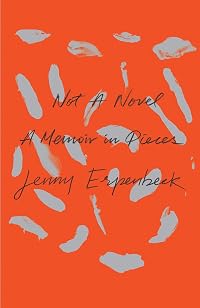
Not a Novel: A Memoir in Pieces
by Jenny Erpenbeck
On This Page
Description
"Jenny Erpenbeck's highly acclaimed novel Go, Went, Gone was a New York Times notable book and launched one of Germany's most admired writers into the American spotlight. In the New Yorker, James Wood wrote: "When Erpenbeck wins the Nobel Prize in a few years, I suspect that this novel will be cited." On the heels of this literary breakthrough comes Not a Novel, a book of personal, profound, often humorous meditations and reflections. Erpenbeck writes, "With this collection of texts, I am show more looking back for the first time at many years of my life, at the thoughts that filled my life from day to day." Starting with her childhood days in East Berlin ("I start with my life as a schoolgirl ... my own conscious life begins at the same time as the socialist life of Leipziger Strasse"), Not a Novel provides a glimpse of growing up in the GDR and of what it was like to be twenty-two when the wall collapsed; it takes us through Erpenbeck's early adult years, working in a bakery after immersing herself in the worlds of music, theater, and opera, and ultimately discovering her path as a writer. There are lively essays about her literary influences (Thomas Bernhard, the Brothers Grimm, Kafka, and Thomas Mann), unforgettable reflections on the forces at work in her novels (including history, silence, and time), and scathing commentaries on the dire situation of America and Europe today. "Why do we still hear laments for the Germans who died attempting to flee over the wall, but almost none for the countless refugees who have drowned in the Mediterranean in recent years, turning the sea into a giant grave?" With deep insight and warm intelligence, Jenny Erpenbeck provides us with a collection of unforgettable essays that take us into the heart and mind of "one of the finest and most exciting writers alive" (Michel Faber)"-- show lessTags
Recommendations







Member Reviews
For some time now, Jenny Erpenbeck (° 1967) is one of the better German writers. Her novels are not always easy to read, but they are always worth it. This is a non-fiction book, with a collection of lectures she gave on various themes. To begin with, the struggle with her East German past: like no other, Erpenbeck puts into words how traumatic the sudden disappearance of the GDR was, as if part of her own identity was cut off, and how derogatory the attitude of many Westerners still is about that past. She links this, as in her beautiful novel Go, Went, Gone, to how disruptive the life of illegal refugees in today's Germany must be. And she immediately opens that up to how life can fundamentally change for each of us from one moment show more to the next, and how that affects our own identity: “We know that transformations lie before us, we know that transformations lie behind us, and we know, according to scientific findings, that the present belongs to us for precisely 3 seconds before it plunges down the throat of the past. That means that every 3 seconds, we produce ourselves again as strangers. What should I say, then, when I’m asked to say who I am?”
The most clever contributions in this book are about language, literature, and especially the act of writing. In very thoughtful, slowly digging circular movements, Erpenbeck exposes what a phenomenally given language is, and how literature both creates reality and exposes the unfathomability of that reality: “Literature tells us that what we know is never the whole truth, but literature also tells us that the whole truth is waiting for us, if only we could read. And with that, it begins to teach us to read, even if that lesson requires more time to learn than we have in our own lifetimes. It also teaches us — and here I include myself as a writer — that the truth never ends where we want it to end.” For Erpenbeck, the pinnacle of literature can be found on stage, where an inimitable play takes place between actions, words and silences, which can only be compared to music: “And so in silence, in every silence that is not dead and empty, but rather filled to the brim with what is truly essential, literature and music meet. Both literature and music are closely connected to this silence, in their essence they are nothing but interpretations of this silence, at least insofar as they aim to arrive at something like truth. And both music and literature — which creates sounds in our minds, even when we are reading silently — have the privilege that they can take those things that cannot or will not be spoken of directly, and make them audible in other ways.” This book is chock full of reflections and contemplations that testify to a very alert, empathic mind. Highly recommended. show less
The most clever contributions in this book are about language, literature, and especially the act of writing. In very thoughtful, slowly digging circular movements, Erpenbeck exposes what a phenomenally given language is, and how literature both creates reality and exposes the unfathomability of that reality: “Literature tells us that what we know is never the whole truth, but literature also tells us that the whole truth is waiting for us, if only we could read. And with that, it begins to teach us to read, even if that lesson requires more time to learn than we have in our own lifetimes. It also teaches us — and here I include myself as a writer — that the truth never ends where we want it to end.” For Erpenbeck, the pinnacle of literature can be found on stage, where an inimitable play takes place between actions, words and silences, which can only be compared to music: “And so in silence, in every silence that is not dead and empty, but rather filled to the brim with what is truly essential, literature and music meet. Both literature and music are closely connected to this silence, in their essence they are nothing but interpretations of this silence, at least insofar as they aim to arrive at something like truth. And both music and literature — which creates sounds in our minds, even when we are reading silently — have the privilege that they can take those things that cannot or will not be spoken of directly, and make them audible in other ways.” This book is chock full of reflections and contemplations that testify to a very alert, empathic mind. Highly recommended. show less
Collected non-fiction occasional pieces, as Erpenbeck’s title declares, do not constitute a novel. They also, however, may not amount to a memoir. They are, at best, a publisher’s amalgam enabling the publisher to strike, as it where, while the iron is hot. Jenny Erpenbeck’s literary iron is rather hot and certainly there are sparks that fly here when she brings her hammer down, especially in the opening six pieces under the heading, “Life.” As we are presented these pieces in chronological order, it is clear that Erpenbeck’s skill as an essayist develops over time. She passes through an ungainly period of introspection on her writing talents, but flourishes again when considering the works of those she admires, such as show more Fallada or Mann. The result is thus somewhat uneven. And, given the forms she is set — e.g. the award acceptance speech — there is a fair bit of repetition.
Still, there is no doubting her talent. I only regret that she is so often called away from the serious business of crafting her small literary masterpieces to write such pieces as these, despite their sometime charm.
The fans of Erpenbeck will read this collection without my recommendation. For others, I recommend any one of Erpenbeck’s novels. show less
Still, there is no doubting her talent. I only regret that she is so often called away from the serious business of crafting her small literary masterpieces to write such pieces as these, despite their sometime charm.
The fans of Erpenbeck will read this collection without my recommendation. For others, I recommend any one of Erpenbeck’s novels. show less
A miscellaneous set of collected talks and speeches by the well-known German novelist and opera director (both roles are relevant here, but mostly the former). But scarcely the “memoir in pieces” claimed by the subtitle of the English translation. There are a few pieces where she reflects on her early life and on the slightly disturbing coincidence that the country she spent her childhood in ceased to exist just as her childhood ended. But most of the book is given over to her thoughts on books, music, pictures and the refugee crisis.
On books, there are several interesting lectures where she talks about the writing of her own novels, including a fascinating one where we are taken in detail through the process of revising a single show more difficult sentence from Aller Tage Abend. And, inevitably, there’s a slew of acceptance speeches for literary prizes, many of them awarded by towns we would have trouble finding on a map and named after writers of formidable obscurity. Erpenbeck conscientiously finds something interesting and positive to say about all of them, and a couple of times she even made me stop to take a note of the dedicatee to go and look for their books.
The music section was a bit of a disappointment, as it’s dominated by a long essay about Wagner’s Siegfried that is quite interesting, but utterly fails to disguise its origin as a college dissertation. It would have been nice to have a bit more about the actual work of staging operas, but that is mostly confined to the margins of pieces about other things.
As usual with this kind of book, it’s an interesting addition to the picture we have of the author, and it contains a few pieces I’ll certainly come back to, but it’s not likely to be of very much interest if you don’t know Erpenbeck’s novels. show less
On books, there are several interesting lectures where she talks about the writing of her own novels, including a fascinating one where we are taken in detail through the process of revising a single show more difficult sentence from Aller Tage Abend. And, inevitably, there’s a slew of acceptance speeches for literary prizes, many of them awarded by towns we would have trouble finding on a map and named after writers of formidable obscurity. Erpenbeck conscientiously finds something interesting and positive to say about all of them, and a couple of times she even made me stop to take a note of the dedicatee to go and look for their books.
The music section was a bit of a disappointment, as it’s dominated by a long essay about Wagner’s Siegfried that is quite interesting, but utterly fails to disguise its origin as a college dissertation. It would have been nice to have a bit more about the actual work of staging operas, but that is mostly confined to the margins of pieces about other things.
As usual with this kind of book, it’s an interesting addition to the picture we have of the author, and it contains a few pieces I’ll certainly come back to, but it’s not likely to be of very much interest if you don’t know Erpenbeck’s novels. show less
Ratings
Members
- Recently Added By
Lists

Books Read in 2026
1,919 works; 66 members
Author Information

23+ Works 4,112 Members
Jenny Erpenbeck was born on March 12, 1967 in East Berlin. She is a German director and writer. In Berlin she attended an Advanced High School, where she graduated in 1985. She then completed a two-year apprenticeship as a bookbinder before working at several theaters as props and wardrobe supervisor. From 1988 to 1990 Erpenbeck studied theatre at show more the Humboldt University of Berlin. In 1990 she changed her studies to Music Theater Director studying with Ruth Berghaus. After the completion of her studies in 1994 she spent some time as an assistant director at the opera house in Graz, where in 1997 she did her own productions of Schoenberg's Erwartung, Bartók's Duke Bluebeard's Castle and a world premiere of her own piece Cats Have Seven Lives. As a freelance director, she directed in 1998 different opera houses in Germany and Austria, including Monteverdi's L'Orfeo in Aachen, Acis and Galatea at the Berlin State Opera and Wolfgang Amadeus Mozart's Zaide in Nuremberg/Erlangen. In the 1990s Erpenbeck started a writing career in addition to her directing. She is author of narrative prose and plays: in 1999, History of the Old Child, her debut; in 2001, her collection of stories Trinkets; in 2004, the novella Dictionary; and in February 2008, the novel Visitation. In March 2007, Erpenbeck took over a column by Nicole Krauss in the Frankfurter Allgemeine Zeitung. In 2015 won the Independent Foreign Fiction Prize with her title The End of Days. (Bowker Author Biography) show less
Awards and Honors
Common Knowledge
- Original title
- Kein Roman: Texte 1992 bis 2018
- Original publication date
- 2019
Classifications
Statistics
- Members
- 127
- Popularity
- 256,821
- Reviews
- 3
- Rating
- (3.68)
- Languages
- English, German
- Media
- Paper, Audiobook, Ebook
- ISBNs
- 5
- ASINs
- 4