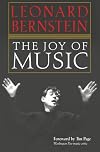
The Joy of Music
by Leonard Bernstein
On This Page
Description
Employing the creative device of "Imaginary Conversations" in the first section of his book, Bernstein illuminates the importance of the symphony in America, the greatness of Beethoven, and the art of composing. The book also includes a photo section and a third section with the transcripts from his televised Omnibus music series, including "Beethoven's Fifth Symphony," "The World of Jazz," "Introduction to Modern Music," and "What Makes Opera Grand?"Tags
Recommendations
















Member Reviews
Il libro contiene la trascrizione (ricca di illustrazioni e di esempi con notazione musicale) di alcune lezioni tenute dal 1958 ai primi anni '70 da Bernstein di fronte a un pubblico di bambini. Come si dice in quarta di copertina, sia grandi che piccoli possono apprezzare molto questo libro di alfabetizzazione musicale. A mio avviso il destinatario migliore è un adulto che, davanti a un pianoforte, abbia l'opportunità di leggere con calma il testo e strimpellare gli esempi che contiene. Per un bambino alcuni temi (per esempio gli intervalli o i modi) mi sembrano raccontati in maniera fin troppo complessa, ma forse mi sbaglio dato il successo delle lezioni di Bernstein, trasmesse per lunghi anni in televisione (altri tempi, altre show more nazioni...). In ogni caso, ottimo e piacevolissimo. show less
A compilation of made-up dialogue and TV transcripts that shed light on the craft of songwriting. Bernstein's sharp intellect and sense of humor bring to life commentary on everything from modern jazz and musical comedies to classical composers. All things considered, this is a fun read for any true music enthusiast.
When I was a little girl, there was a sporadic series of "specials" on Saturday afternoons called "Young People's Concerts." It was hosted by Leonard Bernstein, conducting the New York Philharmonic, and was my introduction to classical music. How I looked forward to those hours! I learned about musical modes, sonatas (illustrated by Bernstein's badly sung rendition of a Beatles' song), concertos, symphonies, and many other things that still enrich my life today.
This book is a synthesis of what Bernstein taught in those concerts. It's not quite as entertaining, although it still held my rapt attention -- for all his other talents, I think he loved teaching the best.
If you are ever fortunate enough to run across a copy of this book while show more you wander a used book shop, grab it. Hold onto it and pass it on to your children and grandchildren. Let the Maestro teach them how much joy all music -- not just rock -- can hold for them. show less
This book is a synthesis of what Bernstein taught in those concerts. It's not quite as entertaining, although it still held my rapt attention -- for all his other talents, I think he loved teaching the best.
If you are ever fortunate enough to run across a copy of this book while show more you wander a used book shop, grab it. Hold onto it and pass it on to your children and grandchildren. Let the Maestro teach them how much joy all music -- not just rock -- can hold for them. show less
This really is Bernstein's Joy of Music, all that he loves about it and why, with some musical knowledge helpful but not needed. The initial chapters were all conversations on music with a variety of people and very enjoyable the later half was scripts from some television programs that he did. They might have been better with the music included but still were quite enjoyable on their own. Refreshing and quite a treat, thanks Bhuri!
Witty and insightful guide into some of the deeper meanings of music. The music scores added to the experience, especially when I decided to play the relevant pieces on Youtube, or something similar. Good stuff.
Well, at least I read the parts that were in words. The musical notation, not so much. For a more up-to-date discourse on classical music (and also some jazz) read Haruki Murakami's conversation with Seiji Ozawa.
[b:Absolutely on Music: Conversations with Seiji Ozawa|28092838|Absolutely on Music Conversations with Seiji Ozawa|Haruki Murakami|https://i.gr-assets.com/images/S/compressed.photo.goodreads.com/books/1482476628l/28092838._SY75_.jpg|48095356]
[b:Absolutely on Music: Conversations with Seiji Ozawa|28092838|Absolutely on Music Conversations with Seiji Ozawa|Haruki Murakami|https://i.gr-assets.com/images/S/compressed.photo.goodreads.com/books/1482476628l/28092838._SY75_.jpg|48095356]
transcripts of his highly enlightening and successful young peoples concerts broadcasts
Members
- Recently Added By
Talk Discussions
Past Discussions
The Rest is Noise #1 in Le Salon Littéraire du Peuple pour le Peuple (June 2012)
Author Information

601+ Works 4,208 Members
Considered by many the greatest figure in American music, Leonard Bernstein was a charismatic and controversial conductor, a gifted teacher, an accomplished pianist, and a highly admired composer. As a teacher, Bernstein communicated his love for music, whether classical or popular, through his Young People's Concerts, many of which were show more televised. At the Tanglewood Music Center in Lenox, Massachusetts, he taught many students who are now present-day conductors of American symphony orchestras. As a composer Bernstein is best known for his popular works, including the Broadway musicals West Side Story (1958), Candide (1956), and Wonderful Town; the film score for On the Waterfront ; and the ballet Fancy Free (1958). However, it was as a conductor with an exuberant, dynamic, and dramatic style that Bernstein captured the attention of the American public. Born to Russian-Jewish immigrants in Lawrence, Massachusetts, in 1918, Bernstein started taking piano lessons at the age of 10, using his own allowance to pay for the lessons. He continued his musical studies at the Curtis Institute of Music, in Philadelphia, where he quickly displayed his varied talents as a pupil of renowned conductor Fritz Reiner. At the age of 25, Bernstein became an overnight sensation when he substituted for an ailing conductor during a concert. In 1958, when he was named musical director of the New York Philharmonic, Bernstein became the first native-born American to head a symphony orchestra. His association with the New York Philharmonic lasted until 1969, when he resigned to concentrate on composing. Bernstein died in 1990. (Bowker Author Biography) show less
Awards and Honors
Distinctions
Notable Lists
Series
Belongs to Publisher Series
Common Knowledge
- Canonical title
- The Joy of Music
- Original publication date
- 1954
- Dedication
- This book is affectionately dedicated to HELEN COATES with deep appreciation for fifteen selfless years
- First words
- Ever since I can remember I have talked about music, with friends, colleagues, teachers, students, and just plain, simple citizens.
- Last words
- (Click to show. Warning: May contain spoilers.)With the greatest operas—the Don Giovannis and Tristans and Otellos and Rosenkavaliers and Wozzecks—we enter fully into such a world; and when we come out we are enriched and ennobled.
Classifications
Statistics
- Members
- 569
- Popularity
- 51,651
- Reviews
- 7
- Rating
- (3.87)
- Languages
- 6 — Czech, English, German, Hungarian, Italian, Swedish
- Media
- Paper
- ISBNs
- 14
- UPCs
- 1
- ASINs
- 18