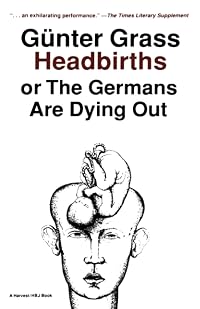
Headbirths: Or the Germans Are Dying Out
by Günter Grass
On This Page
Description
Harm and Dö rte Peters, the quintessential couple, are on vacation in Asia. But wherever they are, they can't get away from the political upheaval back home. With irony and wit, Grass takes aim at capitalism, communism, religion-even reproduction; nothing escapes unscathed. Translated by Ralph Manheim. A Helen and Kurt Wolff BookTags
Recommendations






















Member Reviews
Grass builds up a nice Swiftian satire around the perennial German panic about low birth-rates and an ageing population — if the Germans were to die out, he suggests, that would neatly solve the "German problem" in European politics, get rid of the Berlin Wall, and give his own books the extra kudos of having been written in a "dead language" — and describes the process he would go through to concoct a film script on this topic with his friend Volker Schlöndorff, using their impressions from a joint lecture tour of Asia as background for a story about a generic North-German schoolteacher couple, Dörte and Harm from Itzehoe, who are using an Asian holiday to try to make their minds up whether it would be right to bring a child into show more a world like this one.
But it all gets mixed up with the 1980 elections, where Franz-Josef Strauß and Helmut Schmidt were about to contest the chancellorship (Grass imagines an alternative reality in which Strauß had become a left-wing novelist instead of a conservative politician), with the campaign against nuclear energy, with the discussion of "inner emigration" reopened by the publication of an essay by Franz Raddatz in Zeit, with the deaths of the poet Nicolas Born and the former revolutionary Rudi Dutschke, and with a whole bunch of other things that were current in late 1979.
It's always fun to read Grass, of course, and it's interesting to be reminded how different (and how similar!) the world was in 1979. But this is also a fascinating glimpse into the creative process, even if it is, as it appears to be here, a purely hypothetical exercise in creativity, with Grass playing off his head-births — imaginary versions of real and fictional people — against the hypothetical Germans being born (or not) in the imaginations of prophets of demographic doom. show less
But it all gets mixed up with the 1980 elections, where Franz-Josef Strauß and Helmut Schmidt were about to contest the chancellorship (Grass imagines an alternative reality in which Strauß had become a left-wing novelist instead of a conservative politician), with the campaign against nuclear energy, with the discussion of "inner emigration" reopened by the publication of an essay by Franz Raddatz in Zeit, with the deaths of the poet Nicolas Born and the former revolutionary Rudi Dutschke, and with a whole bunch of other things that were current in late 1979.
It's always fun to read Grass, of course, and it's interesting to be reminded how different (and how similar!) the world was in 1979. But this is also a fascinating glimpse into the creative process, even if it is, as it appears to be here, a purely hypothetical exercise in creativity, with Grass playing off his head-births — imaginary versions of real and fictional people — against the hypothetical Germans being born (or not) in the imaginations of prophets of demographic doom. show less
This could have been Grass's magnum opus, and I think he knows it. Who better, after a lifetime of standing for the right things in what turned out (cf. the publication of his memoir Peeling the Onion and the Waffen-SS controversy that ensued) to be complicated, not to say shady, ways, to bring the neuroses of the past screaming into the present with the biggest of all German premises: eighty million Deutsche and a billion Chinese switch places. What happens then? Geopolitical surrealism! Or, the Germans disappear, decide to leave the earth through voluntary extinction (and a crass Anglo wouldn't be able to resist the dig and would certainly bring euthanasia into the picture, but Grass takes the more even-handed, less sensationalistic show more approach and extrapolates in that incorrect, but compelling, Malthusian way--they just stop having kids and that's the end). A proud people leaves the earth as a symbol and protest--our lifestyles are unsustainable; the Germans expiate Hitler in the most German way: with some insane, beautiful conceptual nonsense, a gift to mankind.
A headbirth, ja? Like Athena from Zeus's skull, the abstract offspring that worries and enervates and, so Grass would tell us, ruins a people for the hearty business of human life. I see it as two novellas.
Grass himself saw it as a screenplay, and so what we get is a slim volume where his travels through Asia in 1979, on the verge of the billion-Chinese milestone and the German election in which Helmut Schmidt's SPD banished the cryptofascists under Franz Josef Strauss, with his wife and the director of The Tin Drum are paralleled by the holiday of Harm and Doerte Peters, a couple of teachers, children of '68 (is that a French-only reference? When was the antifa stuff really getting rolling? How long the age of Baader-Meinhof?), who bum around, talk about their feewings and get glum about their, Germany's, humanity's prospects, and say yes-to-baby no-to-baby and on their own timelines, each get quite mystic.
And because our putative film needs action, there is a twist of superimposed plot revolving around a liver sausage and some dark boys on motorbikes, a missing friend in Jakarta, etc., etc., and Grass not only gives us the first work of literature I know that reads like that underrecognized oral form, the summary plot movie rec (or whatever less grotesque name you can come up with--you know, "Oh man, did you see Lost last night? The prisoners escaped, and there was a polar bear, and a nuclear explosion, and then the guy's like, and I won't ruin the end . . . ."), but he also weaves and unpicks and rewinds and waves away like smoke in the most intriguing ways, writing himself and his own writing process into, well, his own writing process.
Which is very interesting. But what a shame to waste it on the story Guenter Grass was born to tell and born to tell (magically but) straight--and what a shame to waste the story on it. Harm and Doerte could have been one skein in a freaky worldwide alt-history caper, or they could have been a psychorealistic little couple drama of the kind we all know and live--and that latter would have been an ideal venue for Grass to bring in the authorial metapreoccupations. You know? "That's what could have happened. But what about this?" So what you have here is very interesting while you're reading it, but ultimately melts into air. And yes, I like the melancholy appropriateness of that--a people of grand narratives, watching themselves and their Mitteleuropaeische story come to an end and not even a glorious, not even a cathartic one, and having to get up the next day and go to work in full knowledge of the teeming energy of the Asiatic masses (and it gets a little weird here but hell, Grass is an old man, and also if you ignore the mild exoticising, it's true,of course--there's a lot more energy in Asia these days). Grass's tentative and backtracking story reflecting that, and there being perhaps at least a little bitter or Pyrrhic comfort in it (compare contemporary, touchy, nationalistic Russia, evidently a model case of not knowing how to let a grand national narrative wind down in its own shape and time)
But, as I have pranced around at great length, the book as written ultimately feels insubstantial. Like interesting notes. Like an unfinished sentence, the foundation for something more.
Also, since I've been doing this lately it seems, here are two gems. On fascism:
"Since Harm and Doerte have not known fascism, the word springs more quickly to their lips than either is prepared to tolerate in the other. Such a handy word. Always fits a little."
On the Germans, and this'll give you a good idea of Grass's project:
"They always want to be pathetically less or terrifyingly more than they are. They can't leave anything alone. On their chopping block everything gets split. Body and soul, practice and theory, content and form, spirit and power--all so much kindling that can be put into neat piles." show less
A headbirth, ja? Like Athena from Zeus's skull, the abstract offspring that worries and enervates and, so Grass would tell us, ruins a people for the hearty business of human life. I see it as two novellas.
Grass himself saw it as a screenplay, and so what we get is a slim volume where his travels through Asia in 1979, on the verge of the billion-Chinese milestone and the German election in which Helmut Schmidt's SPD banished the cryptofascists under Franz Josef Strauss, with his wife and the director of The Tin Drum are paralleled by the holiday of Harm and Doerte Peters, a couple of teachers, children of '68 (is that a French-only reference? When was the antifa stuff really getting rolling? How long the age of Baader-Meinhof?), who bum around, talk about their feewings and get glum about their, Germany's, humanity's prospects, and say yes-to-baby no-to-baby and on their own timelines, each get quite mystic.
And because our putative film needs action, there is a twist of superimposed plot revolving around a liver sausage and some dark boys on motorbikes, a missing friend in Jakarta, etc., etc., and Grass not only gives us the first work of literature I know that reads like that underrecognized oral form, the summary plot movie rec (or whatever less grotesque name you can come up with--you know, "Oh man, did you see Lost last night? The prisoners escaped, and there was a polar bear, and a nuclear explosion, and then the guy's like, and I won't ruin the end . . . ."), but he also weaves and unpicks and rewinds and waves away like smoke in the most intriguing ways, writing himself and his own writing process into, well, his own writing process.
Which is very interesting. But what a shame to waste it on the story Guenter Grass was born to tell and born to tell (magically but) straight--and what a shame to waste the story on it. Harm and Doerte could have been one skein in a freaky worldwide alt-history caper, or they could have been a psychorealistic little couple drama of the kind we all know and live--and that latter would have been an ideal venue for Grass to bring in the authorial metapreoccupations. You know? "That's what could have happened. But what about this?" So what you have here is very interesting while you're reading it, but ultimately melts into air. And yes, I like the melancholy appropriateness of that--a people of grand narratives, watching themselves and their Mitteleuropaeische story come to an end and not even a glorious, not even a cathartic one, and having to get up the next day and go to work in full knowledge of the teeming energy of the Asiatic masses (and it gets a little weird here but hell, Grass is an old man, and also if you ignore the mild exoticising, it's true,of course--there's a lot more energy in Asia these days). Grass's tentative and backtracking story reflecting that, and there being perhaps at least a little bitter or Pyrrhic comfort in it (compare contemporary, touchy, nationalistic Russia, evidently a model case of not knowing how to let a grand national narrative wind down in its own shape and time)
But, as I have pranced around at great length, the book as written ultimately feels insubstantial. Like interesting notes. Like an unfinished sentence, the foundation for something more.
Also, since I've been doing this lately it seems, here are two gems. On fascism:
"Since Harm and Doerte have not known fascism, the word springs more quickly to their lips than either is prepared to tolerate in the other. Such a handy word. Always fits a little."
On the Germans, and this'll give you a good idea of Grass's project:
"They always want to be pathetically less or terrifyingly more than they are. They can't leave anything alone. On their chopping block everything gets split. Body and soul, practice and theory, content and form, spirit and power--all so much kindling that can be put into neat piles." show less
Gunter Grass was a favorite writer of mine for a long time, though recently I've read little he wrote. Headbirths is fun to read but doesn't quite combine its various genres -- novel, essay, plan for a film script -- in a coherent way. Set at the end of 1979, the massive changes in German history since that date might make Grass's essay interesting for some, obsolete for others. The combination of genres made it fun to read, if eventually disappointing.
This was felt to be more of apolemic than a narrative. That's fine, nothing wrong with a rant every now and then. I think I finished this one in a single sitting, some unknown afternoon in the Highlands.
Ratings
Members
- Recently Added By
Author Information

211+ Works 22,842 Members
Günter Wilhelm Grass was born on October 16, 1927 in the Free City of Danzig, which is now Gdansk, Poland. He was a member of the Hitler Youth and at the age of 17, he was drafted into the German army. Near the end of the war, he served as a tank gunner in the 10th SS Panzer Division. He was captured by the Americans and forced to visit the newly show more liberated Dachau concentration camp. After his release from a POW camp in 1946, he worked in a potash mine and as a stonemason's apprentice and studied painting and sculpture in Düsseldorf. His first novel, The Tin Drum, was published in 1959. It was adapted into a film and won the Academy Award for Best Foreign Film in 1979. His other works included Cat and Mouse, Dog Years, From the Diary of a Snail, The Flounder, The Rat, and Crabwalk. He also wrote a memoir entitled Peeling the Onion. He received the Nobel Prize for Literature in 1999. He was also a political activist and liberal provocateur. He advocated for environmental conservation, debt relief for poor countries, and generous policies regarding political asylum. He died on April 13, 2015 at the age of 87. (Bowker Author Biography) show less
Some Editions
Series
Belongs to Publisher Series
Sammlung Luchterhand (356)
Meulenhoff editie (625)
Work Relationships
Common Knowledge
- Canonical title*
- Kopgeboorte, of De Duitsers sterven uit
- Original title
- Kopfgeburten oder Die Deutschen sterben aus
- Original publication date
- 1980 (Duits) (Duits); 1980 (Nederlands) (Nederlands)
- People/Characters*
- Harm Peters; Dörte Peters
- Original language*
- Duits
*Some information comes from Common Knowledge in other languages. Click "Edit" for more information.
Classifications
- Genres
- Fiction and Literature, General Fiction
- DDC/MDS
- 833.914 — Literature & rhetoric German & related literatures German fiction 1900- 1900-1990 1945-1990
- LCC
- PT2613 .R338 .K613 — Language and Literature German, Dutch and Scandinavian literatures German literature Individual authors or works 1860/70-1960
- BISAC
Statistics
- Members
- 320
- Popularity
- 99,502
- Reviews
- 4
- Rating
- (3.39)
- Languages
- 8 — Dutch, English, Finnish, French, German, Polish, Spanish, Swedish
- Media
- Paper, Ebook
- ISBNs
- 22
- ASINs
- 4