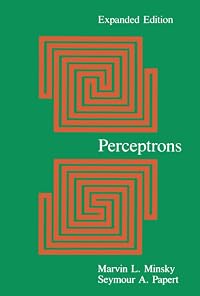
Perceptrons: An Introduction to Computational Geometry
by Marvin Minsky, Seymour Papert
On This Page
Description
The first systematic study of parallelism in computation by two pioneers in the field.Reissue of the 1988 Expanded Edition with a new foreword by Leon BottouIn 1969, ten years after the discovery of the perceptron--which showed that a machine could be taught to perform certain tasks using examples--Marvin Minsky and Seymour Papert published Perceptrons, their analysis of the computational capabilities of perceptrons for specific tasks. As Leon Bottou writes in his foreword to this edition, show more "Their rigorous work and brilliant technique does not make the perceptron look very good." Perhaps as a result, research turned away from the perceptron. Then the pendulum swung back, and machine learning became the fastest-growing field in computer science. Minsky and Papert's insistence on its theoretical foundations is newly relevant.Perceptrons--the first systematic study of parallelism in computation--marked a historic turn in artificial intelligence, returning to the idea that intelligence might emerge from the activity of networks of neuron-like entities. Minsky and Papert provided mathematical analysis that showed the limitations of a class of computing machines that could be considered as models of the brain. Minsky and Papert added a new chapter in 1987 in which they discuss the state of parallel computers, and note a central theoretical challenge: reaching a deeper understanding of how "objects" or "agents" with individuality can emerge in a network. Progress in this area would link connectionism with what the authors have called "society theories of mind." show lessTags
Recommendations


































Member Reviews
This extraordinary book was written at least ten years before its time. When it was written, there was not the computing power to support the ideas and concepts in it.
When I initially wrote this review, both Minsky and Papert were still alive. Now they're both gone. The world is a smaller, poorer place without them.
Connectionism (later on termed neural networks) began here.
When I initially wrote this review, both Minsky and Papert were still alive. Now they're both gone. The world is a smaller, poorer place without them.
Connectionism (later on termed neural networks) began here.
Ratings
Members
- Recently Added By
Author Information

21+ Works 3,233 Members
Marvin Minsky is Toshiba Professor of Media Arts and Sciences and Professor of Electrical Engineering and Computer Science at the Massachusetts Institute of Technology and cofounder of the M.I.T. Artificial Intelligence Laboratory

15+ Works 986 Members
Seymour Aubrey Papert was born in Pretoria, South Africa on February 29, 1928. He received doctorates from the University of the Witwatersrand in South Africa and the University of Cambridge in England. After his doctoral work, he spent four years at the University of Geneva exploring both mathematics and children's learning as a researcher for show more Jean Piaget. In 1964, he joined the Massachusetts Institute of Technology faculty and immediately delved into artificial intelligence research with Marvin Minsky. He was a co-director of the renowned Artificial Intelligence Laboratory at the Massachusetts Institute of Technology. Papert and Minsky published Perceptrons: An Introduction to Computational Geometry in 1969. Papert foresaw children using computers as instruments for learning and enhancing creativity well before the advent of the personal computer. In the late 1960's, he created a computer programming language, called Logo, to teach children how to use computers. He wrote several other books including Mindstorms: Children, Computers and Powerful Ideas and Constructionism written with Idit Harel. Papert retired from the faculty at M.I.T. in 1996, but continued to work there as a lecturer and consultant to doctoral students. He died from complications of a series of kidney and bladder infections on July 31, 2016 at the age of 88. (Bowker Author Biography) show less
Common Knowledge
- Canonical title
- Perceptrons: An Introduction to Computational Geometry
- Original publication date
- 1969
Classifications
Statistics
- Members
- 135
- Popularity
- 242,288
- Reviews
- 1
- Rating
- (3.67)
- Languages
- English
- Media
- Paper, Ebook
- ISBNs
- 5