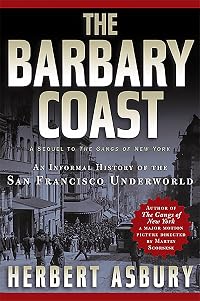
The Barbary Coast: An Informal History of the San Francisco Underworld
by Herbert Asbury
On This Page
Description
The history of the Barbary Coast properly begins with the gold rush to California in 1849. If the precious yellow metal hadn't been discovered ... the development of San Francisco's underworld in all likelihood would have been indistinguishable from that of any other large American city. Instead, owing almost entirely to the influx of gold-seekers and the horde of gamblers, thieves, harlots, politicians, and other felonious parasites who battened upon them, there arose a unique criminal show more district that for almost seventy years was the scene of more viciousness and depravity, but which at the same time possessed more glamour, than any other area of vice and iniquity on the American continent. The Barbary Coast is Herbert Asbury's classic chronicle of the birth of San Francisco--a violent explosion from which the infant city emerged full-grown and raging wild. From all over the world practitioners of every vice stampeded for the blood and money of the gold fields. Gambling dens ran all day including Sundays. From noon to noon houses of prostitution offered girls of every age and race. (In the 1850s, San Francisco was home to only one woman for every thirty men. It was not until 1910 that the sexes achieved anything close to parity in their populations.) This is the story of the banditry, opium bouts, tong wars, and corruption, from the eureka at Sutter's Mill until the last bagnio closed its doors seventy years later. show lessTags
Recommendations


















Member Reviews
Asbury, in episodic fashion, makes the case that from the time of the Gold Rush (1849) to 1917, San Francisco was the wickedest city on earth. And he backs it up with tales of crime, gambling, gangs, and prostitution that will make you wonder how honest citizens could be brave enough to leave their homes! Sometimes when they did leave their homes, it was to join large groups of vigilantes who, for a short time at least, were able to take the law into their own hands and mete out their harsh form of justice, although from Asbury's account, it probably was justice in most cases. In any case, Asbury has covered wickedness up one side and down the other--which would have cost you about 50 cents in one of San Francisco's numerous bagnios.
Early San Francisco was a profoundly strange city. The Gold Rush exploded a sleepy port into an expensive haven of vice and villainy, designed to separate miners and sailors from their cash with booze, prostitution, and blunt objects. The dense area of houses of ill-repute, named the Barbary Coast, was a real-life version of that Simpsons song about New Orleans. Asbury's book is from 1933, and takes pretty much every lurid newspaper article from the time at face value. There are some interesting anecdotes about such characters as Dirty Tom McAlear, who would eat or drink anything for a few cents and hadn't had a bath in fifteen years, to wars between proprietors of vice and the vigilant Vigilance Committee, or the various ruses used to show more shanghai sailors onto new ships, but overall this book is just long, early 20th century scandalizing about admittedly very bad vice, without much of an organizing framework. show less
I'm not sure how accurate this history of early San Francisco is but it was an interesting read. As much a product of it's own time (written in the 1930s) as a history, there is plenty of language that not what we would say today and some attitudes that are jarring but you do get a sense of what the Barbary Coast must have been like and perhaps a bit of why San Francisco is the city it is today. I particularly like the preacher who said that roller-rinks were the "road to perdition." If only my skating today was that interesting,
Originally written in the 1930s, this book is interesting for someone who wants to know about the origins of San Francisco and the seedier side of the city. There is a lot of language and description that would be considered outmoded now and overall Asbury presents a relatively judgement-free account of some pretty bad behavior. You can read between the lines and what he describes in a fairly light tone will come across as more horrifying. the discovery of gold launched the city and created a world of crime and corruption. It was interesting to me to learn that San Francisco has always been what it is now- a city of fortune-seekers and those who would take advantage of the less fortunate.
This book, which originally came out in 1933, is a companion to Asbury's famous books on New York City, as well as his surveys of the underworlds of New Orleans and Chicago. This one, as the title indicates, is on San Francisco's legendary den of vice and ill-repute, the Barbary Coast (the origin of the name being one of the things discussed in the book). As with Asbury's other books, while the sourcing can be a bit thin (other than the cited newspapers), the writing is top-notch, and is the fun of the book. It would be better with some good maps, though.
This is a history of the worst elements in the beginnings of the city of San Francisco. The author had access to people who had lived through these events, as well as many articles and other resources. He covers the political underpinnings of the vice, along with the culture and moment in time which enabled the Barbary Coast to have its beginning, triumph and fall.
The author writes in a very readable manner, using a bit of humor to lighten the load of history. Published in 1933, he seemed to think that the worst of the crime and vice were over for San Francisco. I wonder what he would think now?
The author writes in a very readable manner, using a bit of humor to lighten the load of history. Published in 1933, he seemed to think that the worst of the crime and vice were over for San Francisco. I wonder what he would think now?
(First Edition, Knopf) San Francisco began life as a quiet little mission in northern California. As soon as gold was discovered, a roaring, rough and tumble shanty town developed and from that a dangerous, violent city was born. First came the miners and then followed the criminal element set on fleecing them. Gangs, riots, vigilantes, conmen, prostitutes, corruption and all else flourished in San Francisco until the earthquake and fire destroyed much of the underworld. Amazing!
Members
- Recently Added By
Published Reviews
ThingScore 100
I knew San Francisco had a vice-filled past, but in Asbury's telling, that vice acquired an almost metaphysical status. Asbury provided San Francisco with a history so lurid and romantic it seemed to come from a different epoch -- a ruthless time, a time without prudence, when pleasure and fate were the only stars men steered by. Casting a strange, sulphurous light on streets and buildings, show more Asbury's history gave the whole town an uncanny second life. show less
added by Shortride
Lists

Books Read in 2017
4,249 works; 130 members
Author Information

17+ Works 2,917 Members
Herbert Asbury (1891-1963) was a prolific journalist and editor
Common Knowledge
- Original publication date
- 1933
- People/Characters
- Billy Abbott; Rheine Adams (sex worker, real name Polly Knight); Jack Addison; Ah Toy (sex worker); Charles F. Aked; Joseph Alexander (show all 391); Ned Allen (Bull Run Allen); William Alvord; Jefferson de Angelis; H. P. Ashe; E. D. Baker ( (); Lucky Baldwin; Hubert Howe Bancroft; Jerome Bassity (Jere McGlane); Jim Beckett; Thomas Berdue; Dick Berry; William J. Biggy; John M. Bigler; Tony Bleecker; Sam Blumenberg; Charles E. Bolton (Black Bart); Jeanne Bonnet (Little Frog Catcher); J. D. Borthwick; Samuel Brannan; Henry C. Breeden; James F. Brennan; Maggie Brewer; Bill Briggs; David C. Broderick; Mother Bronson; Horseshoe Brown; Shanghai Brown; Edwin Bryant; J. J. Bryant; Lord Bryce; James Buchanan; Christopher A. Buckley; J. W. Buel; William Burns; Donaldina Cameron; Terence Caraher; Bill Carr; James P. Casey; Tommy Chandler; Young Chevalier; Chin Fong; Chin Poy; Ching Ming Sek; Jerry Chorn; J. W. Coffroth; Henry D. Cogswell; Nellie Cole; William T. Coleman; George D. Collins; Jimmy Collins; Judge Conlan; Michael Connor; Carroll Cook; Jesse B. Cook; Willie Coombs; Belle Cora (Arabella Ryan); Charles Cora; James J. Corbett; Patsy Corrigan; John Coulter; Harry Courtaine; Hallelujah Cox; Lotta Crabtree; Dick Creighton; Pedro Cueta; Dago May; Dah Pa Tsin; Frank Daroux; A. L. Davis; Irish Annie Davis; Dear Wo; John Denny; Johnny Devine; F. J. Drake; Jerry Driscoll; Charles P. Duane; Little Josie Dupree; A. C. Durand; Theodore Durrant; Billy Dwyer; George L. Eaton; Kate Edington; Jack Edwards; Zoeth Skinner Eldredge; Eng Ying Gong; Eddie Englehart; Malachi Fallon; W. B. Farwell; A. Fayole; Johnny Fearem; James Fell; B. Ferner; Billy Finnegan; Harry P. Flannery; Wilson Flint; Fong Suey; Ned Foster; Victor J. Fourgead; R. C. Foute; Eddie Foy; George Frank; Bartlett Freel; Olaf Frisson; Abe Fromberg; Fung Jing Toy; Madame Gabrielle; Mart Gallagher; Mike Gallo; Jack Gamble; Reggie Gamble; Manuel Garcia; John W. Geary; John H. Gihon; Louis Gomez; Bruce Grant; Ulysses S. Grant; William M. Gwin; Jack Hallinan; Mrs. W. B. Hamilton; Asbury Harpending; Ned Harrigan; Billy Harrington; Happy Jack Harrington; Dooney Harris; Tony Hart; William Hartmeyer; Colonel Jack Hayes; James A. Hearne; William Randolph Hearst; Joseph Heatherington; J. C. B. Hebard; Paul Hendiara; Dora Herz; Izzy Herz; Arthur Hinrichs; Ho Ah Kow; S. Fred Hogue; Hong Ah Kay; Hoo Yee Hin; Crisis Hopkins; Policeman Hopkins; Sterling A. Hopkins; Auguste Houges; Volney E. Howard; Isaac Humphrey; Pauline Jacobson; J. C. Jansen; John Jenkins; J. Neely Johnson; Deacon Jones; Ellis W. Jones; Idwal Jones; John Jordan; Aunt Josie; Simone Jules; Bertha Kahn; Denis Kearney; Woolley Kearney; Emil Kehrlein; Valentine Kehrlein; Hugo Keil; George Keiley; Maggie Kelly; Shanghai Kelly; Spider Kelly; King of Pain; James King of William; Rudyard Kipling; Thomas W. Knox; Kum Ho; John E. Kunkler; Kwan Leung; Emperor Kwang Hsu; Madame Labrodet; Jimmy Laflin; Blanche Lamont; Thomas Langford; Thomas O. Larkin; Emilio Lastreto; M. S. Latham; Johnny Lawless; Madame Lazarene; T. M. Leavenworth; Amanda Lee; Marian Lee; William Lee; Lee Hem; Lee Tong Hay; Lem Duck; Lem Jok Lep; Lem Jung; Jim Le Strange; Solomon Levy; Ben Lewis; Bill Lewis; Li Hung Chang; Benjamin Estelle Lloyd; Loi Yan; Kate Lombard; Loo Chee; Justice Lorigan; Harry Love; Low Sing; Madame Lucy; Lum Hip; Jeremiah Lynch; Joe Mabbot; Walter Macauley; John MacDougal; Samuel MacKeever; Tom Magee; Tom Maguire; Billy Maitland; Buzzard Maloney; Reuben Maloney; Madame Marcelle; Pauline Markham; Patsy Marley; Big Louise Marshall\; James W. Marshall; P. Marsicano; Ellie Martell; John Masefield; William Maxwell; Dirty Tom McAlear; Soapy McAlpine; J. H. McCabe; P. H. McCarthy; Joseph McCorckle; Junie McCree; Jim McCullough; Robert McKenzie; George McMahon; Gavin McNab; Johnny McNear; Alcade Meade; Captain Meagher; Henry Meiggs; Joseph Michel; Louis Michel; Ming Long; James B. Mix; Mon Op; Captain Montgomery; Sheriff Moore; Ben Moors; John Morrissey; Pearl Morton; Ed Moses; Frank Mulkey; Billy Mulligan; Joaquin Murieta; Rosita Felix Murieta; William Murphy; Terry Mustain; Duncan Nichol; James Nisbet; Matthew Noonan; Joshua Abraham Norton; John Nugent; Johnny Nyland; Denny O'Brien; Fremont Older; J. H. O'Neill; One Year Tim; Ong Lin Foon; Oofty Goofty; Oofty Goofty Gus; Father Otis; Louis Parente; Black Tony Parmagin; Anna Pavlova; J. C. Peters; Madame Peterson; Louis Peterson; Walter J. Peterson; James D. Phelan; Gus Phillips; Pigeon-Toed Sal; Miss Piggott; Ed Pincus; Bob Pinner; Mme Pleasant; Jean Pon; E. B. Pon; Arthur Putnam; John Philip Quinn; William Quinn; Andrew Randall; John Randolph; George Reuben; W. A. Richardson; W. H. Richardson; Charles Ridgeway; James Riley (King of the Hoodlums); Thomas D. Riordan; Sam Roberts; James Rolph; Julius Rosenstirn; Rotary Rosie (sex worker); Josiah Royce; Abe Ruef; Jim Rynders; Mabel Santley; David S. Scannell; Eugene Schmitz; Herbert Schmitz; Barney Schow; Joanna Schriffin; Charley Schultze; Frank Scivio; Selina (courtesan); George Sellinger; Sep Sam; William Tecumseh Sherman; Terry Shiner; Bezer Simmons; Dr. Simpson; Sing Dock; Billy Skeantlebury; Charles F. Skelly; Billy Smith; Paul Jordan Smith; Persifer F. Smith; Solly; Frank Soulé; O. B. Spalding; Maude Spencer; C. Staderman; Leland Stanford; Steam-Schooner Ruby; Jonathan D. Stevenson; Charles Warren Stoddard; English Jim Stuart; Suey Hin; John L. Sullivan; Joseph Sullivan; Yankee Sullivan; John A. Sutter; Charles Sutton; Edward R. Taylor; William Taylor; David S. Terry; Samuel Tetlow; Sally Thayer; Jerry Thomas; H. D. Thompson; Mush Thornton; Richard H. Thornton; Tip Thornton; Curtis Tobey; John E. Townes; Prince Tsai Hsun; Kitty Turner; Samuel C. Upham; P. Vincent; George W. Virgin; Wah Lee; Big Queue Wai; Johnny Walker; William Walker; Tessie Wall; Flora Walsh; Abe Warner; Daniel Webster; Sam Wells; T. M. Wells; Johanna Werner; M. R. Werner; J. C. Westenberg; Steve Whipple; David A. White; Samuel Whittaker; Cod Wilcox; James H. Wilkins; Dow Williams; Minnie Williams; Wing Sing; George Wittman; Won Chung; Won Lung; Woo Sam; G. Woodhull; Yee Toy; John P. Young
- Important places
- San Francisco, California, USA
- Important events
- California Gold Rush; San Francisco Earthquake and Fire
- First words
- The history of the Barbary Coast properly begins with the gold rush to California in 1849.
- Last words
- (Click to show. Warning: May contain spoilers.)And that was the end of the Barbary Coast. Of its ancient glories nothing remains excepting a few battered façades, the tattered remains of signs, and the plaster nymphs and satyrs in the entrance lobby of the old Hippodrome, now befouled by dirt and penciled obscenities.
- Original language
- English
Classifications
- Genres
- History, Nonfiction, General Nonfiction
- DDC/MDS
- 306.0979461 — Society, government, & culture Social sciences, sociology & anthropology Social Behavior - Dating, Marriage, Divorce Social history North America West Coast U.S.
- LCC
- HN80 .S4 .A8 — Social sciences Social history and conditions. Social problems. Social reform Social history and conditions. Social problems. By region or country
- BISAC
Statistics
- Members
- 326
- Popularity
- 98,116
- Reviews
- 7
- Rating
- (3.87)
- Languages
- English
- Media
- Paper, Ebook
- ISBNs
- 6
- ASINs
- 12