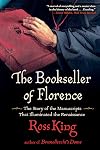
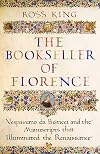
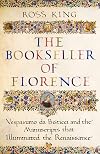
The Bookseller of Florence
by Ross King
On This Page
Description
"The Renaissance in Florence conjures images of beautiful frescoes and elegant buildings-the dazzling handiwork of the city's skilled artists and architects. But equally important for the centuries to follow were geniuses of a different sort: Florence's manuscript hunters, scribes, scholars, and booksellers, who blew the dust off a thousand years of history and, through the discovery and diffusion of ancient knowledge, imagined a new and enlightened world. At the heart of this activity, show more which bestselling author Ross King relates in his exhilarating new book, was a remarkable man: Vespasiano da Bisticci. Born in 1422, he became what a friend called "the king of the world's booksellers." At a time when all books were made by hand, over four decades Vespasiano produced and sold many hundreds of volumes from his bookshop, which also became a gathering spot for debate and discussion. Besides repositories of ancient wisdom by the likes of Plato, Aristotle, and Quintilian, his books were works of art in their own right, copied by talented scribes and illuminated by the finest miniaturists. His clients included a roll-call of popes, kings, and princes across Europe who wished to burnish their reputations by founding magnificent libraries. Vespasiano reached the summit of his powers as Europe's most prolific merchant of knowledge when a new invention appeared: the printed book. By 1480, the king of the world's booksellers was swept away by this epic technological disruption, whereby cheaply produced books reached readers who never could have afforded one of Vespasiano's elegant manuscripts. A chronicle of intellectual ferment set against the dramatic political and religious turmoil of the era, Ross King's The Bookseller of Florence is also an ode to books and bookmaking that charts the world-changing shift from script to print through the life of an extraordinary man long lost to history-one of the true titans of the Renaissance"-- show lessTags
Recommendations
















Member Reviews
Vespasian became a bookmaker in Florence, Italy at a tender age and grew up to become the greatest bookseller and bookmaker at just the moment scribes and illuminators were being replaced by the printing press, a technology Vespasian refused to accept. He could find just about any book that existed in the known world for a discriminating buyer, or he could hire the best scribes and illuminators to transcribe (& translate) if need be for kings & the wealthy across the western world. His work was superior. A marvelous book describing the history of writing on papyrus to parchment to paper made of linen, of making the ink and colors, of the printing press and typesetting, and the creation of fonts. We learn about the work of scribes & show more talented illuminators to typesetters & printers. Extraordinarily interesting on the one hand, and boring on the other as the book covers the rise and fall of the kings and rulers and the battles they fought—important because they were Vespasian’s customers. He often found himself supplying manuscripts to people on both sides of conflicts. Sadly, that part of the book was tedious. Overall, a brilliant read! show less
I'm torn about this book.
It's an interesting idea, tracing how certain books were influential in the Renaissance through the lens of a Florentine bookseller*, and how the coming of the printing press affected him.
The book is long, just over 400 pages, and it could and should have been shorter. The author (Ross King) did a tremendous amount of research, and it almost seems as though he could not bear to leave anything out. The book is full of digressions, as he wanders about the highways and byways of conspiracies, crusades, feuds, and Papal politics. He feels the need to give us the back story of everyone mentioned, however peripheral, and all the details of how things are made.
The book would have been better and more enjoyable if it show more had had a strong editorial hand.
* slightly inaccurate term, but we have today nothing equivalent to the person who not only sold books, but arranged for them to be made, hiring the scribes, binders, etc. show less
It's an interesting idea, tracing how certain books were influential in the Renaissance through the lens of a Florentine bookseller*, and how the coming of the printing press affected him.
The book is long, just over 400 pages, and it could and should have been shorter. The author (Ross King) did a tremendous amount of research, and it almost seems as though he could not bear to leave anything out. The book is full of digressions, as he wanders about the highways and byways of conspiracies, crusades, feuds, and Papal politics. He feels the need to give us the back story of everyone mentioned, however peripheral, and all the details of how things are made.
The book would have been better and more enjoyable if it show more had had a strong editorial hand.
* slightly inaccurate term, but we have today nothing equivalent to the person who not only sold books, but arranged for them to be made, hiring the scribes, binders, etc. show less
No, this isn't a review of an historical novel.
The Bookseller of Florence is a marvellous art history book about a hero of the Renaissance called Vespasiano da Bisticci (1421 – 1498) who was the preeminent book merchant of his era. He contributed to the store of knowledge from which we still benefit today by hunting out manuscripts from the ancient world that were decaying in dusty monasteries all over Europe, and then he hired the most talented of scribes to copy the manuscripts and had them illuminated by the finest miniaturists so that the books were glorious works of art. His clients were popes, kings and princes who proclaimed their status by founding magnificent libraries to outdo each other.
My favourite chapter explains the show more technicalities of making a book before the advent of the printed book. As King says, in the chapter called 'Antique Letters':
It began with finding the manuscript, the search for which is detailed in a previous chapter, where it is shown how important it was to get hold of a quality exemplar. In Chapter 6, King tells us that Petrarch complained that, so sloppy were the scribes of his day, and so full of errors were the manuscripts they produced, 'an author would not recognise his own work.' Vespasiano had a good eye for the best of texts, but he was also highly skilled in acquiring the best of materials. Occasionally he used paper, but the most beautiful and expensive material on which to write was calfskin, or vellum. Readers who are fond of animals are best advised not to read the details of the finest and whitest vellum available. Suffice to say that the supply of hides for parchment was always dependent on the dietary preferences of the local population, and in Italy the appetite was for goats, and that supply was impacted by Lent when people did not eat meat.
And why were the butchers of Florence required to move their operations into the shops on the Ponte Vecchio? So that they, like the tanners, fish sellers and beltmakers, for reasons of hygiene, could turf their blood and slops into the Arno instead of fouling the streets.
Clearly, from the description given of the processing (which I will spare you), parchment makers needed to have strong stomachs. But they also needed to have considerable finesse in scraping the skins to 0.1mm (1/250 of an inch), because if they were careless it would be uneven, or tear.
For Vespasiano, his work was a labour of love.
To read the rest of my review please visit https://anzlitlovers.com/2022/12/22/the-bookseller-of-florence-by-ross-king/ show less
The Bookseller of Florence is a marvellous art history book about a hero of the Renaissance called Vespasiano da Bisticci (1421 – 1498) who was the preeminent book merchant of his era. He contributed to the store of knowledge from which we still benefit today by hunting out manuscripts from the ancient world that were decaying in dusty monasteries all over Europe, and then he hired the most talented of scribes to copy the manuscripts and had them illuminated by the finest miniaturists so that the books were glorious works of art. His clients were popes, kings and princes who proclaimed their status by founding magnificent libraries to outdo each other.
My favourite chapter explains the show more technicalities of making a book before the advent of the printed book. As King says, in the chapter called 'Antique Letters':
The word 'manuscript' comes from the Latin manu scriptus, 'written by hand', but any manuscript was the product of much more work than simply the writing of a single hand. It was a months- or even years-long, multistep process calling for the expertise of a series of tradesmen and specialist craftsmen from parchment makers to scribes, miniaturists, goldbeaters, and even apothecaries, carpenters, and blacksmiths. (p.99)
It began with finding the manuscript, the search for which is detailed in a previous chapter, where it is shown how important it was to get hold of a quality exemplar. In Chapter 6, King tells us that Petrarch complained that, so sloppy were the scribes of his day, and so full of errors were the manuscripts they produced, 'an author would not recognise his own work.' Vespasiano had a good eye for the best of texts, but he was also highly skilled in acquiring the best of materials. Occasionally he used paper, but the most beautiful and expensive material on which to write was calfskin, or vellum. Readers who are fond of animals are best advised not to read the details of the finest and whitest vellum available. Suffice to say that the supply of hides for parchment was always dependent on the dietary preferences of the local population, and in Italy the appetite was for goats, and that supply was impacted by Lent when people did not eat meat.
For hundreds of years, the transmission of knowledge had depended on carnivorous appetites and good animal husbandry. Large volumes with hundreds of pages required the skins of many animals. One goat was often needed for each page of parchment in a large liturgical book such as an antiphonary, while a Bible might take the skins of more than two hundred animals — and entire herd of goats or flock of sheep. (p.100)
And why were the butchers of Florence required to move their operations into the shops on the Ponte Vecchio? So that they, like the tanners, fish sellers and beltmakers, for reasons of hygiene, could turf their blood and slops into the Arno instead of fouling the streets.
Clearly, from the description given of the processing (which I will spare you), parchment makers needed to have strong stomachs. But they also needed to have considerable finesse in scraping the skins to 0.1mm (1/250 of an inch), because if they were careless it would be uneven, or tear.
For Vespasiano, his work was a labour of love.
To read the rest of my review please visit https://anzlitlovers.com/2022/12/22/the-bookseller-of-florence-by-ross-king/ show less
It was an age when scholars studied the ancient Greek and Roman philosophers in search of answers to contemporary concerns. Book collectors scoured monasteries and abbeys across Italy and Europe seeking rare and neglected books.
Golden Age Florence was a a republic, a literate city that educated boys and girls, a place where both wealthy and tradesmen ordered volumes for their personal libraries.
It was also an age of cruel acts of vengeance, political intrigue and family wars, a time of plague, while the Ottoman empire threatened from the East. The church was in turmoil, powerless girls were married off or sent to an abbey, either way locked away from the world.
While some sought truth in Plato and Aristotle, others rejected anything show more but the Holy Bible and traditional Christian beliefs.
As one bookseller in Florence wrote,"All evil is born from ignorance, Yet writers have illuminated the world, chasing away the darkness." He was Vespasiano da Bisticci. He started life as an eleven-year-old assistant in a book shop, a stationer and bookbinder, doing manual work that required great strength. He went on to be renowned as the "king of the world's booksellers", a trusted friend to the wealthy and powerful and the scholar.
The Bookseller of Florence is the story of Vespasiano's career, set against the story of bookmaking during the shift from hand written and illuminated manuscripts bound in velvet and jewels to the mass production of the printing press. And it is the history of Florence and Italy during the early Renaissance.
Saving ancient manuscripts, copying them, and distributing them for scholarly study did not protect the texts. Without libraries to store and protected them, many sat neglected or where destroyed by fire and warfare, or carried off to disappear.
King covers a lot of territory! I was only vaguely familiar with Italian and Catholic history previously---and found it fascinating. I will read more! (Such as King's Brunelleschi’s Dome, on my Kindle TBR shelf.) I learned about every aspect of book making, the switch from papyrus to parchment to paper, the advances in writing fonts, how printing presses work.
Yes, the book is filled with a huge cast of historic people and events, but my interest never flagged. I was swept up in this epic history.
I received a free egalley from the publisher through NetGalley. My review is fair and unbiased. show less
Golden Age Florence was a a republic, a literate city that educated boys and girls, a place where both wealthy and tradesmen ordered volumes for their personal libraries.
It was also an age of cruel acts of vengeance, political intrigue and family wars, a time of plague, while the Ottoman empire threatened from the East. The church was in turmoil, powerless girls were married off or sent to an abbey, either way locked away from the world.
While some sought truth in Plato and Aristotle, others rejected anything show more but the Holy Bible and traditional Christian beliefs.
As one bookseller in Florence wrote,"All evil is born from ignorance, Yet writers have illuminated the world, chasing away the darkness." He was Vespasiano da Bisticci. He started life as an eleven-year-old assistant in a book shop, a stationer and bookbinder, doing manual work that required great strength. He went on to be renowned as the "king of the world's booksellers", a trusted friend to the wealthy and powerful and the scholar.
The Bookseller of Florence is the story of Vespasiano's career, set against the story of bookmaking during the shift from hand written and illuminated manuscripts bound in velvet and jewels to the mass production of the printing press. And it is the history of Florence and Italy during the early Renaissance.
Saving ancient manuscripts, copying them, and distributing them for scholarly study did not protect the texts. Without libraries to store and protected them, many sat neglected or where destroyed by fire and warfare, or carried off to disappear.
King covers a lot of territory! I was only vaguely familiar with Italian and Catholic history previously---and found it fascinating. I will read more! (Such as King's Brunelleschi’s Dome, on my Kindle TBR shelf.) I learned about every aspect of book making, the switch from papyrus to parchment to paper, the advances in writing fonts, how printing presses work.
Yes, the book is filled with a huge cast of historic people and events, but my interest never flagged. I was swept up in this epic history.
I received a free egalley from the publisher through NetGalley. My review is fair and unbiased. show less
I listened to the audiobook which was well done. The only problem with an audiobook is that I had no idea how to spell the name of the principal character. But that's why there is Google, right?
Vespasiano da Bisticci was born in 1422 in Florence. He was a bookseller when all books were hand produced so he had a workroom of scribes and illustrators to turn out books, mostly on request. The Medicis were one of his best customers and his bookshop was very close to their palace. His world changed when Johanes Gutenberg invented the movable-type printing press. It took a number of years before there were printing presses in Florence but when they did come they could produce books at a fraction of the cost of hand made manuscripts. This show more allowed more common people to buy books and expanded the knowledge of classic literature. At the time, most books were still reprints of Greek and Latin classics such as books by Ovid, Plato, Socrates. However, there was still a market of hand produced books so our bookseller continued to do well. Throughout his lifetime he witnessed such momentous events as the fall of Constantinople and the invasion of Italy by Charles VIII of France and the rise to power of the Dominican priest Savonarola. He also rubbed shoulders with Leonardo da Vinci. So this book is not just about the selling of books but is an exploration of the Renaissance period.Quite fascinating. show less
Vespasiano da Bisticci was born in 1422 in Florence. He was a bookseller when all books were hand produced so he had a workroom of scribes and illustrators to turn out books, mostly on request. The Medicis were one of his best customers and his bookshop was very close to their palace. His world changed when Johanes Gutenberg invented the movable-type printing press. It took a number of years before there were printing presses in Florence but when they did come they could produce books at a fraction of the cost of hand made manuscripts. This show more allowed more common people to buy books and expanded the knowledge of classic literature. At the time, most books were still reprints of Greek and Latin classics such as books by Ovid, Plato, Socrates. However, there was still a market of hand produced books so our bookseller continued to do well. Throughout his lifetime he witnessed such momentous events as the fall of Constantinople and the invasion of Italy by Charles VIII of France and the rise to power of the Dominican priest Savonarola. He also rubbed shoulders with Leonardo da Vinci. So this book is not just about the selling of books but is an exploration of the Renaissance period.Quite fascinating. show less
Ross King's book about Vespasiano da Bistricci, a bookseller who lived in Florence during the Renaissance is packed with information. His research is extensive and, I guess, this is why the book stretches to 400 pages. I was fascinated by the stories about handmaking book making and what was involved in the 15th century, the scholars and rich people Vespasiano rubbed shoulders with and the emergence of printing presses that eventually reached Florence. However, I was flagging by the end and probably skipped quickly through some fascinating sections. Ross King has moments when he conjures up the 15th century streets of Florence vividly and I loved these. I learnt plenty from the book.
A thorough biography of bookseller Vespaniano da Bisticci, which also contains much fascinating information about many of his clients and patrons, as well as a readable account of the biblio-culture of fifteenth-century Italy. Yes there is a lot of detail here, but it's quite readably done.
Members
- Recently Added By
Lists

On Books
70 works; 1 member
Author Information

16+ Works 11,122 Members
Ross King is the award-winning and bestselling author of Brunelleschi's Dome, Michelangelo and the Popes Ceiling, The Judgment of Paris, Mad Enchantment, Leonardo and the Last Supper, and Machiavelli: Philosopher of Power, among other books. He and his wife live in Woodstock, Great Britain.
Some Editions
Work Relationships
Has as a commentary on the text
Common Knowledge
- Canonical title
- The Bookseller of Florence
- Original title
- The Bookseller of Florence: Vespasiano da Bisticci and the Manuscripts that Illuminated the Renaissance; The Bookseller of Florence: The Story of the Manuscripts That Illuminated the Renaissance
- Alternate titles*
- De boekhandelaar van Florence : de renaissance, de boekdrukkunst en de veranderende kracht van ideeën
- Original publication date
- 2021 (Engels) (Engels); 2021; 2021 (Nederlands) (Nederlands)
- People/Characters
- Vespasiano da Bisticci
- Important places
- Florence, Tuscany, Italy
- Epigraph
- All evil is born from ignorance. Yet writers have illuminated the world, chasing away the darkness.
- Vespasiano da Bisticci - Dedication
- For Simonetta Brandolini d'Adda
I am profoundly thankful, as always, to my wife, Melanie, a fellow writer and book lover, for her enthusiasm, patience, and love. The book is dedicated to our dear friend, the ultimate 'Friend of Florence,' Simonetta Brandoli... (show all)ni d'Adda, in recognition of everything she does to preserve and protect the splendours of Florence, ensuring that it has not only a rich and storied past but also a vibrant future.
Acknowledgements. - First words
- The Street of Booksellers, Via dei Librai, ran through the heart of Florence, midway between the town hall to the south and the cathedral to the north.
Chapter 1. The Street of Booksellers. - Last words
- (Click to show. Warning: May contain spoilers.)It states that San Jacopo di Ripoli was where one of Europe's first printing presses was set up in 1476 by Bernardo Cennini.
(Click to show. Warning: May contain spoilers.)This darkness he and his friends hoped to dispel by casting on to their fractured and unhappy times the pure radiance of the past, one scribe and one manuscript at a time.
Epilogue. - Blurbers
- Schama, Simon; Carey, John; Williams, Rowan
- Original language
- English
*Some information comes from Common Knowledge in other languages. Click "Edit" for more information.
Classifications
Statistics
- Members
- 776
- Popularity
- 36,054
- Reviews
- 16
- Rating
- (4.08)
- Languages
- 5 — Dutch, English, Hungarian, Italian, Russian
- Media
- Paper, Audiobook, Ebook
- ISBNs
- 22
- ASINs
- 6