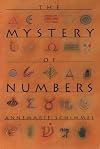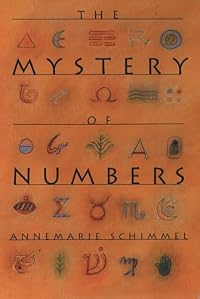
The Mystery of Numbers
by Annemarie Schimmel
On This Page
Description
"Why is the number seven lucky - even holy - in almost every culture? Why do cats have nine lives (except in Iran, where they have seven)? From literature to folklore to private superstitions, numbers play a conspicuous role in our daily lives. But in this fascinating book, Annemarie Schimmel shows that numbers have been filled with mystery and meaning since the earliest times, and across every society." "In The Mystery of Numbers Annemarie Schimmel conducts an illuminating tour of the show more mysteries attributed to numbers over the centuries. She begins with an informative and often surprising introduction to the origins of number systems: pre-Roman Europeans, for example, may have had one based on twenty, not ten (as suggested by the English word "score" and the French word for 80, quatrevingt - four times twenty), while the Mayans had a system more sophisticated than our own. Schimmel also reveals how our fascination with numbers has led to a rich cross-fertilization of knowledge: "Arabic" numerals, for instance, were picked up by Europe from the Arabs, who had earlier adopted them from Indian sources ("algorithm" and "algebra" are corruptions of the Arabic author and title names of a mathematical text prized in medieval Europe). But the heart of the book is an engrossing guide to the symbolism of numbers. Number symbolism, she shows, has deep roots in Western culture, from the philosophy of the Pythagoreans and Platonists, to the religious mysticism of the Cabala and the Islamic Brethren of Purity, to Kepler's belief that the laws of planetary motion should be mathematically elegant, to the unlucky thirteen. After exploring the sources of number symbolism, Schimmel examines individual numbers ranging from one to ten thousand, discussing the meanings they have had for Judaic, Christian, and Islamic traditions, with examples from Indian, Chinese, and Native American cultures as well. Two, for instance, has widely been seen as a number of contradiction and polarity. And six, according to ancient and neo-Platonic thinking, is the most perfect number because it is both the sum and the product of its parts (1+2+3=6 and 1x2x3=6). Using examples ranging from the Mayans to Shakespeare, she shows how numbers have been considered feminine and masculine, holy and evil, lucky and unlucky." "A highly respected scholar of Islamic culture, Annemarie Schimmel draws on her vast knowledge to paint a rich, cross-cultural portrait of the many meanings of numbers. Engaging and accessible, her account uncovers the roots of a phenomenon we all feel every Friday the thirteenth."--Jacket. show lessTags
Recommendations















Member Reviews
The Mystery of Numbers was developed by Annemarie Schimmel from an earlier text in German by Franz Carl Endres. Presumably, Schimmel's version (for publisher Ulf Diedrichs) was originally in German also. No translator is credited here, but Miriam Rosen was the editor, whether in English or German is unclear. Schimmel uses "components" (e.g. on page 14) to mean factors, which is a little confusing in US mathematical idiom, and possibly an artifact of translation from German. German folklore and poetry does loom a little large in a book that on the whole makes serious efforts to be a wide-ranging cross-cultural survey.
There are seven chapters of "Introduction" discussing the history of number systems and evolution of number symbolism. show more Generally, depth is sacrificed for breadth, in an effort to touch on systems throughout Western history, and also in Asia and pre-Columbian America. The historical essays are followed by "A Little Dictionary of Numbers," organized in numerical order starting at 1. The highest value to receive an entry is 10,000, but even below 50, many numbers significant to me are not represented with their own articles, such as 23, 31, 34, and 44.
On the whole, the book is a decent introduction to its topic, and it can be a useful supplement to other more specialized treatments. show less
There are seven chapters of "Introduction" discussing the history of number systems and evolution of number symbolism. show more Generally, depth is sacrificed for breadth, in an effort to touch on systems throughout Western history, and also in Asia and pre-Columbian America. The historical essays are followed by "A Little Dictionary of Numbers," organized in numerical order starting at 1. The highest value to receive an entry is 10,000, but even below 50, many numbers significant to me are not represented with their own articles, such as 23, 31, 34, and 44.
On the whole, the book is a decent introduction to its topic, and it can be a useful supplement to other more specialized treatments. show less
Annemarie Schimmel is Professor of Indo-Muslim Culture at Harvard University, and author of numerous books on Islamic literature, culture, and religion.
This work is a descriptive study of folklore, rather than mathematics. Numbers play a conspicuous role in our daily lives, since the beginning, and across every society. Examines individual numbers from "one" to ten thousand.
She notes that al-Ghazali, like medieval Christian scholars, "sought to arrange their writings in meaningful combinations of numbers". In Revivification of the Sciences of Religion, his number was 40, leading to the central figure of Mohammad in the 20th chapter, with acts of mystical love in the final meeting with the Lord at the moment of death. Augustine's City show more of God was 22, corresponding to 22 letters of the Hebrew alphabet. Dante's Divine Comedy exhibits elaborate number symbolism based on the 3 of the Trinity.
Curiously, the author mentions the number 19--long a sacred number in the Near East, drawn from the 19 dieties of the 19 limbs of the body in the Egyptian Book of the Dead, and the 19-year Metonic Cycle of the ancient Babylonian calendar.
"Recently someone in Pakistan has tried to prove that the Quran is based upon the number 19 (incidentally the number of guardians of hell) and its multiples. However, despite the clever use of computer technology for this study, its results have been challenged by most Muslims." [224]
"On the other hand", she goes on, "19 is uncontestably the sacred number of the Baha'is (again based on the numerical value of wahid), and they even divide the year into 19 months of 19 days each." [224] show less
This work is a descriptive study of folklore, rather than mathematics. Numbers play a conspicuous role in our daily lives, since the beginning, and across every society. Examines individual numbers from "one" to ten thousand.
She notes that al-Ghazali, like medieval Christian scholars, "sought to arrange their writings in meaningful combinations of numbers". In Revivification of the Sciences of Religion, his number was 40, leading to the central figure of Mohammad in the 20th chapter, with acts of mystical love in the final meeting with the Lord at the moment of death. Augustine's City show more of God was 22, corresponding to 22 letters of the Hebrew alphabet. Dante's Divine Comedy exhibits elaborate number symbolism based on the 3 of the Trinity.
Curiously, the author mentions the number 19--long a sacred number in the Near East, drawn from the 19 dieties of the 19 limbs of the body in the Egyptian Book of the Dead, and the 19-year Metonic Cycle of the ancient Babylonian calendar.
"Recently someone in Pakistan has tried to prove that the Quran is based upon the number 19 (incidentally the number of guardians of hell) and its multiples. However, despite the clever use of computer technology for this study, its results have been challenged by most Muslims." [224]
"On the other hand", she goes on, "19 is uncontestably the sacred number of the Baha'is (again based on the numerical value of wahid), and they even divide the year into 19 months of 19 days each." [224] show less
Ratings
Members
- Recently Added By
Lists

Essential Reading for Continuing Professional Development
11 works; 5 members
Author Information

109+ Works 1,646 Members
Annemarie Schimmel was born in Erfurt, Germany on April 7, 1922 and attended the University of Berlin and the University of Marburg. Schimmel has taught at the University of Ankara in Turkey, Harvard University, and Bonn University. Along with writing more than eighty books and essays, Schimmel has translated literature from the Arabic, Persian, show more Turkish and Sindhi languages into German and English. She was honored on her 75th birthday by having the Annemarie Schimmel Chair for Indo-Muslim Culture established at Bonn University. (Bowker Author Biography) show less
Series
Belongs to Publisher Series
Common Knowledge
- Canonical title
- The Mystery of Numbers
- Original title
- Das Mysterium der Zahl
- Original language
- German
Classifications
- Genres
- Nonfiction, Religion & Spirituality, General Nonfiction, History
- DDC/MDS
- 133.3 — Philosophy and Psychology Parapsychology & occultism Specific topics in parapsychology and occultism Divinatory arts
- LCC
- BF1623 .P9 .E55 — Philosophy, Psychology and Religion Psychology Occult sciences Magic. Hermetics. Necromancy
- BISAC
Statistics
- Members
- 218
- Popularity
- 149,161
- Reviews
- 2
- Rating
- (3.82)
- Languages
- English, German, Turkish
- Media
- Paper, Ebook
- ISBNs
- 11
- ASINs
- 2