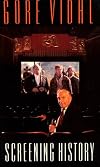
Screening History
by Gore Vidal
On This Page
Description
Gore Vidal saw his first talking picture in 1929 when he was four years old. At age ten, the film A Midsummer Night's Dream whetted his appetite for all of Shakespeare's plays, and Mickey Rooney's Puck inspired his early fantasy about becoming an actor. Yet it was movies about history, albeit history as brought to life on the silver screen, that he remembers most vividly from his youth. Movies such as Roman Scandals, The Prince and the Pauper, and Fire Over England, in his words, "opened for show more me that door to the past where I have spent so much of my life-long present." Author of Burr, Lincoln, and other best-selling novels chronicling our experience, Vidal shows how history and fiction blend in the private and public worlds of his generation. In Screening History, he intertwines fond recollections of films savored in the movie palaces of his Washington, D.C., boyhood with strands of autobiography and trenchant observations about American politics. Never before has Vidal--a scion of one of our oldest political families--revealed so much about his own life or written with such marvelous immediacy about the real and imagined forces that have shaped America in the twentieth century. We see Vidal witnessing history as his grandfather is sworn in for a fourth Senate term during the Depression; we see him making history as a young airman of ten flying a Hammond Y-1 under the watchful eye of his father, FDR's Director of Aviation; and we journey back with him to America in the 1930s and 1940s, to theaters with names like the Belasco and the Metropolitan where the history screened for the nation's moviegoers often turned reality into fantasy, or into downright propaganda. Screening History is rich with anecdotes about Vidal's eminent family and shrewd insights about prominent figures known and observed. It captures the hold that movies have had on the American imagination and the mark they left on the mind of a youngster who grew up to become one of our best-known and most controversial literary figures. At times poignant, often bitingly funny, this is Gore Vidal at his best, inscribing his views on the American political scene from FDR to George Bush and on issues from the writing of history to the inability of movies to set history straight. The rapier wit for which he is legend animates every page. show lessTags
Recommendations





















Member Recommendations

SnootyBaronet History as represented in film
Member Reviews
A hugely enjoyable memoir as Gore Vidal looks back at his getting of wisdom through the historical films of the 1930s.
A witty, perceptive, loving tribute to the power of Hollywood films on one's imagination.
A witty, perceptive, loving tribute to the power of Hollywood films on one's imagination.
Ratings
Members
- Recently Added By
Published Reviews
ThingScore 75
As an evocative reminiscence, it's most persuasive, even if Vidal's logic is not quite airtight. He rightly skewers Hollywood's long-standing infatuation with English pomp: "On our screens, in the thirties, it seemed as if the only country on earth was England," he writes. "I recall no popular films about Washington or Jefferson or Lincoln the president. . . . Our history was thought show more unsuitable for screening." But Vidal proposes that America's atavistic yearning for royalty, which has degenerated into the current tabloid obsession with Di and Fergie, goes far deeper than the amorphous conspiracy on the part of expatriate British filmmakers. For when he then goes on to dismiss the red-baiters who accused communists of similarly infiltrating Hollywood during the '30s and '40s, he has to admit that "you couldn't get anything of a political nature into any film." The movies of Hollywood's golden age may have offered up unconscious propaganda, but no programmatic plot was afoot. show less
added by SnootyBaronet
Author Information

168+ Works 31,203 Members
Gore Vidal was born Eugene Luther Gore Vidal Jr. on October 3, 1925 at the U.S. Military Academy at West Point, New York. He did not go to college but attended St. Albans School in Washington and graduated from Phillips Exeter Academy in New Hampshire in 1943. He enlisted in the Army, where he became first mate on a freight supply ship in the show more Aleutian Islands. His first novel, Williwaw, was published in 1946 when he was twenty-one years old and working as an associate editor at the publishing company E. P. Dutton. The City and the Pillar was about a handsome, athletic young Virginia man who gradually discovers that he is homosexual, which caused controversy in the publishing world. The New York Times refused to advertise the novel and gave a negative review of it and future novels. He had such trouble getting subsequent novels reviewed that he turned to writing mysteries under the pseudonym Edgar Box and then gave up novel-writing altogether for a time. Once he moved to Hollywood, he wrote television dramas, screenplays, and plays. His films included I Accuse, Suddenly Last Summer with Tennessee Williams, Is Paris Burning? with Francis Ford Coppola, and Ben-Hur. His most successful play was The Best Man, which he also adapted into a film. He started writing novels again in the 1960's including Julian, Washington, D.C., Myra Breckenridge, Burr, Myron, 1876, Lincoln, Hollywood, Live From Golgotha: The Gospel According to Gore Vidal, and The Golden Age. He also published two collections of essays entitled The Second American Revolution, which won the National Book Critics Circle Award for criticism in 1982 and United States: Essays 1952-1992. In 2009, he received the National Book Awards lifetime achievement award. He died from complications of pneumonia on July 31, 2012 at the age of 86. (Bowker Author Biography) show less
Series
Belongs to Publisher Series
Common Knowledge
- Original publication date
- 1992
Classifications
- Genres
- Nonfiction, History, Biography & Memoir, General Nonfiction, Philosophy
- DDC/MDS
- 791.43 — Arts & recreation Recreation, sports, and performing arts Movies, TV, Video Motion pictures, radio, television, podcasting Motion pictures
- LCC
- PN1995.9 .H5 .V54 — Language and Literature Literature (General) Literature (General) Drama Motion pictures
- BISAC
Statistics
- Members
- 142
- Popularity
- 228,723
- Reviews
- 1
- Rating
- (3.81)
- Languages
- English
- Media
- Paper
- ISBNs
- 4
- ASINs
- 2