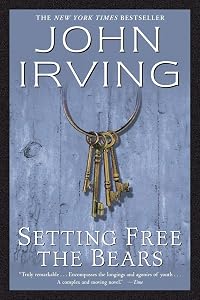
Setting Free the Bears
by John Irving
On This Page
Description
"It is 1967 and two Viennese university students want to liberate the Vienna Zoo, as was done after World War II. But their good intentions have both comic and gruesome consequences, in this first novel written by a twenty-five year old John Irving ..."--Page 4 of cover.Tags
Recommendations





Member Reviews
Beautifully observed with well-developed characters like all other Irving, but pages upon pages upon pages of talk about motorcycle parts. Plus, countless contrived dark slapstick situations I suspect John Irving thought were brilliant and hilarious built around intentional or unintentional animal abuse/ death as a recurring theme. “The Water Method Man”, published 4 years after this, is my very favorite- if this were my first John Irving novel, it would have been my last. I would consider bringing it with me on camping trips to use the pages as kindling.
I'm a huge John Irving fan, so I'm not sure how I missed this one until now. That said, it is my least favourite book by him. Don't get me wrong, it was good and shows the promise that I know Mr. Irving exceeded over time. I found it hard to identify with the characters and thought the pacing was a little slow. But the writing about the bears was vintage Irving.
I first read this book more than 25 years ago,so I decided to give it another read when I was clearing out my cupboard and found it buried at the bottom.This book has such a terrific youthful energy(I think it's Irving's first)and is like a time capsule ,firstly of the free spirited 60's and then of the foreboding 30's and war years in Austria.Siggy and Graff's high spirited youthful adventures on their motorbike seem so innocent compared to the happenings of Siggy's parents before and during the war.I enjoyed this book more than I thought I would,it's freerolling and a great history lesson as well.
Jag älskar John Irving, han är en av mina favorit författare. Släpp björnarna loss är hans första bok, och handlar om två unga killar som ger sig iväg på ett äventyr på sin motorcykel, målet är att inte ha något mål.
John Irving skriver på sitt lättsamma och med humör så man kan absolut känna igen honom i denna bok. Men det märks att han än inte har utvecklats fullt ut som författare, boken är lite för enkelt skriven.
Men den är läsvärd : Handling & Tema : 2/5
Karaktärerna: 1/5
Miljöbeskrivning: 1/5
Språk och berättarkonst 1/5
John Irving skriver på sitt lättsamma och med humör så man kan absolut känna igen honom i denna bok. Men det märks att han än inte har utvecklats fullt ut som författare, boken är lite för enkelt skriven.
Men den är läsvärd : Handling & Tema : 2/5
Karaktärerna: 1/5
Miljöbeskrivning: 1/5
Språk och berättarkonst 1/5
I'm a fan of John Irving and have read many of his books. I was aware that early in his career he was not immediately a bestselling author and had written three novels before his break thru The World According Garp. Setting Free the Bears was his first. My guess is he was writing it while he was in The University of Iowa's Writer's Workshop studying under Kurt Vonnegut. While there are no wrestlers there were several aspects which became expected parts of a Irving novel. There are central characters moving along the arc of a plot, sex, accidents, weirdness, tons of imagination, relatives, motorcycles, animals, violence, cursing, broken families, etc. Frotting becomes the f-word of choice used frequently. While Irving's later novels are show more often based in the U.S. and Canada he has also taken us to northern European countries. This one is a little different. It takes place in Austria with side trips mainly to Yugoslavia.
The arc starts off with a student at loose ends who quickly pairs up with a wild man who's obsessed with motorcycles. They begin an aimless journey, think Jack Kerouac, riding, fishing, living off the land, exiting before authorities appear. The wild man becomes obsessed with the possibility of freeing animals locked up in captivity, to his mind, through no fault of their own. Things get complex when they arrive at a village with a Gasthaus and a drunken milkman is whipping a fallen horse. The wild man goes berserk and beats up the drunk. It gets worse and it's time for him to exit quickly, with motorcycle of course. Our hero on the other hand is left holding the bag and becoming enamored with the young niece of the Gasthaus owner.
At this point everything shifts. We barely hear about our hero and his predicament. Instead it feels like the Writer's Workshop intervenes and we have two stories told through alternating passages. In one we get the wild man's back story in terms of his father's prewar and WWII experiences and how he comes to possess the legendary motorcycle our wild man is attached to. The story is told with the accuracy of a historical fiction writer laying out how WWII impacted real people, ruining lives right and left. I can only guess this is what John Irving studied in school down to a short bibliography of sources for these seemingly wild series of events. Alternating with this saga we see the wild man meticulously creating a way to bust out all the animals as he stalks the nightwatchmen who he believes must be torturing the animals as they scream out to warn each other. He silently talks with the animals and understands their pain. Acting against type, he puts together a detailed plan, which he is convinced will free the beasts once the tyrant has been subdued.
Time for the handoff. The wild man returns to the village to free our hero and recruit him to free the zoo animals from their oppressor. But this time the authorities are waiting for him and he goes out in a burst of glory upsetting the perilously stacked tower of bees who of course take it out on our hero who barely survives the zillions of stinging insects. He is nursed/bathed back to health in the Gasthaus only to have to escape with the young niece who seems to have aged quickly. And of course they ride off with the motorcycle. At first it's just the bliss of getting away. Then we await the inevitable as the two slowly become a couple. She wants to become worldly and suggests they go to Vienna, only to discover that's where the zoo is. Our hero sees the wild man's notebook contains a carefully crafted plan to bust out the animals. They fight over his desire to free the animals as she clearly sees this as the madness she thought they both recognized and rejected. She goes along with the plan only if he revised it to only release small animals who won't kill each other. It starts out that way but the animals have a mind of their own and get into it, releasing bigger and bigger beasts. It's pandemonium with the larger predators exercising their natural instincts to hunt the slower beasts. Our lovers escape the zoo only to find the neighbors have risen to the challenge with pitchforks and other implements at hand. Killing is everywhere. Once they've cleared the area they stop. She is fed up with him, demands the money she was paid to have her long hair cut to be made into wigs. She wants to go back to Vienna without of course the defeated hero who heads out of town hoping she might change her mind.
How does this end? As he gets further out of town he stops only to see a pair of bears slowly getting closer to the mountains ahead. In some sense it was worth it after all.
Irving had to start somewhere. show less
The arc starts off with a student at loose ends who quickly pairs up with a wild man who's obsessed with motorcycles. They begin an aimless journey, think Jack Kerouac, riding, fishing, living off the land, exiting before authorities appear. The wild man becomes obsessed with the possibility of freeing animals locked up in captivity, to his mind, through no fault of their own. Things get complex when they arrive at a village with a Gasthaus and a drunken milkman is whipping a fallen horse. The wild man goes berserk and beats up the drunk. It gets worse and it's time for him to exit quickly, with motorcycle of course. Our hero on the other hand is left holding the bag and becoming enamored with the young niece of the Gasthaus owner.
At this point everything shifts. We barely hear about our hero and his predicament. Instead it feels like the Writer's Workshop intervenes and we have two stories told through alternating passages. In one we get the wild man's back story in terms of his father's prewar and WWII experiences and how he comes to possess the legendary motorcycle our wild man is attached to. The story is told with the accuracy of a historical fiction writer laying out how WWII impacted real people, ruining lives right and left. I can only guess this is what John Irving studied in school down to a short bibliography of sources for these seemingly wild series of events. Alternating with this saga we see the wild man meticulously creating a way to bust out all the animals as he stalks the nightwatchmen who he believes must be torturing the animals as they scream out to warn each other. He silently talks with the animals and understands their pain. Acting against type, he puts together a detailed plan, which he is convinced will free the beasts once the tyrant has been subdued.
Time for the handoff. The wild man returns to the village to free our hero and recruit him to free the zoo animals from their oppressor. But this time the authorities are waiting for him and he goes out in a burst of glory upsetting the perilously stacked tower of bees who of course take it out on our hero who barely survives the zillions of stinging insects. He is nursed/bathed back to health in the Gasthaus only to have to escape with the young niece who seems to have aged quickly. And of course they ride off with the motorcycle. At first it's just the bliss of getting away. Then we await the inevitable as the two slowly become a couple. She wants to become worldly and suggests they go to Vienna, only to discover that's where the zoo is. Our hero sees the wild man's notebook contains a carefully crafted plan to bust out the animals. They fight over his desire to free the animals as she clearly sees this as the madness she thought they both recognized and rejected. She goes along with the plan only if he revised it to only release small animals who won't kill each other. It starts out that way but the animals have a mind of their own and get into it, releasing bigger and bigger beasts. It's pandemonium with the larger predators exercising their natural instincts to hunt the slower beasts. Our lovers escape the zoo only to find the neighbors have risen to the challenge with pitchforks and other implements at hand. Killing is everywhere. Once they've cleared the area they stop. She is fed up with him, demands the money she was paid to have her long hair cut to be made into wigs. She wants to go back to Vienna without of course the defeated hero who heads out of town hoping she might change her mind.
How does this end? As he gets further out of town he stops only to see a pair of bears slowly getting closer to the mountains ahead. In some sense it was worth it after all.
Irving had to start somewhere. show less
Was tun, wenn zwei Wiener Eulenspiegel beschlossen haben, durch ihre Universitätsexamen zu fallen, auf einem geliehenen Motorrad in die Welt zu fahren und die Bären zu befreien? Unterwegs gilt es, dicke und dünne Mädchen zu erobern, wachsame Tanten, Parkwächter und wütende Bienen zu überlisten. Vor dem Hintergrund des Zweiten Weltkrieges in Österreich bekommt diese Reise eine tragisch-skurrile Vorgeschichte.
If you are a fan of John Irving's work, it may be worthwhile to read this book, his first novel. It contains some of the themes which will return a lot in his later books, but I actually like that they are a bit less prominent here. Because of this, Setting Free the Bears is not a typical Irving book and therefore a nice diversion from his later books.
Members
- Recently Added By
Lists

Lucy's Long List
69 works; 1 member

Best Sellers / Popular 1968
237 works; 5 members
Author Information

61+ Works 96,585 Members
John Irving published his first novel at the age of twenty-six. He has received awards from the Rockefeller Foundation, the National Endowment for the Arts, and the Guggenheim Foundation; he has won an O. Henry Award, a National Book Award, and an Academy Award. (Publisher Provided) John Irving was born John Wallace Blunt, Jr. on March 2, 1942 in show more Exeter, New Hampshire. His named was changed to John Winslow Irving when his stepfather adopted him at the age of six. He was a dyslexic child and it took him five years to get through Exeter Academy, which is where his adoptive father taught Russian history. He received a B.A. (cum laude) from the University of New Hampshire in 1965 and an M.F.A. from the Iowa Writers' Workshop, in 1967, where he studied with Kurt Vonnegut Jr. His first novel was Setting Free the Bears (1969) but it wasn't until The World According to Garp was published in 1978, that he became a literary star. The novel spent six months on the bestseller list and won the American Book Award in 1980. It was also made into a movie in 1982 starring Robin Williams and costarring Glenn Close and John Lithgow. In 1981, he received an O. Henry Award for the short story Interior Space. Some of his other novels were also made into movies including The Hotel New Hampshire starring Jodie Foster and Rob Lowe; A Prayer for Owen Meany, which was titled Simon Birch starring Jim Carrey; and The Cider House Rules starring Michael Caine. He won the Oscar for Best Adapted Screenplay for The Cider House Rules in 2000. Irving also wrote two memoirs; one detailing his wrestling adventures entitled The Imaginary Girlfriend, and another concerning his novels made into Hollywood films entitled My Movie Business: A Memoir. (Bowker Author Biography) show less
Some Editions
Series
Belongs to Publisher Series
Work Relationships
Is contained in
Common Knowledge
- Canonical title*
- Liberté pour les ours !
- Original title
- Setting Free the Bears
- Original publication date
- 1968
- People/Characters*
- Hannes Graff; Siegfried Javotnik (Siggy); Hilke Marter; Zahn Glanz; Vratno Javotnik; Ernst Watzek-Trummer (show all 8); Gottlob Wut; Gallen von Sankt Leonhard
- Important places
- Vienna, Austria
- Dedication
- Dieses Buch ist für Violette und Co zum Andenken an George
- First words*
- Je savais le trouver tous les midis, assis sur un banc dans le parc de l'Hôtel de Ville, un petit sachet bourré de radis de serre sur les genoux et une bouteille de bière à la main.
- Last words*
- (Click to show. Warning: May contain spoilers.)Et j'espère entendre parler des exploits des Ours à lunettes. Sûr !
*Some information comes from Common Knowledge in other languages. Click "Edit" for more information.
Classifications
Statistics
- Members
- 2,032
- Popularity
- 10,350
- Reviews
- 18
- Rating
- (3.20)
- Languages
- 14 — Czech, Danish, Dutch, English, Finnish, French, German, Italian, Japanese, Lithuanian, Norwegian, Polish, Spanish, Swedish
- Media
- Paper, Audiobook, Ebook
- ISBNs
- 50
- ASINs
- 23