
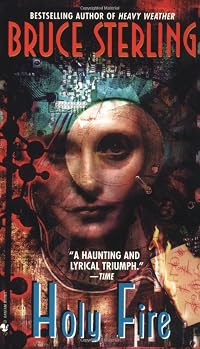
Holy Fire
by Bruce Sterling
On This Page
Description
The 21st century is coming to a close, and the medical industrial complex dominates the world economy. It is a world of synthetic memory drugs, benevolent government surveillance, underground anarchists, and talking canine companions. Power is in the hands of conservative senior citizens who have watched their health and capital investments with equal care, gaining access to the latest advancements in life-extension technology. Meanwhile, the young live on the fringes of society, ekeing out show more a meagre survival on free, government-issued rations and a black market in stolen technological gadgetry from an earlier, less sophisticated age. Mia Ziemann is a 94-year-old medical economist who enjoys all the benefits of her position. But a deathbed visit with a long-ago ex-lover and a chance meeting with a young bohemian dress-designer brings Mia to an awful revelation. She has lived her life with such caution that it has been totally bereft of pleasure and adventure. She has one chance to do it all over. But first she must submit herself to a radical--and painful--experimental procedure which promises to make her young again. The procedure is not without risk and her second chance at life will not come without a price. But first she will have to escape her team of medical keepers. Hitching a ride on a plane to Europe, Mia sets out on a wild intercontinental quest in search of spiritual gratification, erotic revelation, and the thing she missed most of all: the holy fire of the creative experience. She joins a group of outlaw anarchists whose leader may be the man of her dreams...or her undoing. Worst of all, Mia will have to undergo one last radical procedure that could cost her a second life. In Holy Fire, Bruce Sterling once again creates a unique and provocative future that deals with such timeless topics of the human condition as love, memory, science, politics, and the meaning of death. Poginant, lyrical, humorous, and often shocking, Holy Fire offers a hard unsparing look into a world that could become our own. From the Paperback edition. show lessTags
Recommendations









Member Reviews
Mia Ziemann is 93, but looks thirty thanks to advances in medical technology and living life very carefully. The world has survived a prolonged bout of plague and disease, and a significant portion of the global economy is devoted to keeping people alive and healthy for as long as possible, an interval that is growing all the time. After a radical new treatment gives her the appearance of a twenty year old, Mia experiences side effects which appear to give her the mind of a twenty year old, too, and in a sort of fugue state, she ditches the paraphernalia that is carefully monitoring her every move and takes off for Europe. There she encounters a typically Sterlingian cast of drop-outs, thieves, artists, intellectuals, bohemians and show more radicals. These are the young in a world dominated by the old and the rich. Stifled and coddled by a society made utterly safe but with no way to compete with or replace the dominant gerontocracy, the young foment and plan and strive to make their own stamp on the world.
This is a thoughtful, mature, ultimately moving novel about creating art and rebellion in a society where everything seems wrapped in cotton wool, where the only thing to rebel against is the indifference of those in power and where the people may not be human anymore, and therefore no longer capable of creating art. It's stuffed with big ideas and, unlike a lot of the books that came out of the cyberpunk movement, seems as relevant today as when it was first published. show less
This is a thoughtful, mature, ultimately moving novel about creating art and rebellion in a society where everything seems wrapped in cotton wool, where the only thing to rebel against is the indifference of those in power and where the people may not be human anymore, and therefore no longer capable of creating art. It's stuffed with big ideas and, unlike a lot of the books that came out of the cyberpunk movement, seems as relevant today as when it was first published. show less
In the year 2095, 94-year-old Mia undergoes an experimental youth-restoring treatment. She emerges from the procedure a very different person and quickly ditches her medical monitoring and runs off to Europe.
Life-prolongation techniques and their possible consequences to society are venerable old SF subjects, but Sterling somehow manages to make them feel surprisingly fresh. His world-building is top-notch: detailed, well-thought-out, imaginative and original. And he touches on a great many weighty topics -- age, youth, creativity, identity, technology, rebellion -- in ways that may not be extremely cohesive, but are nevertheless fascinating. There's not really all that much the story itself, and some of the most significant plot show more points seem to happen off-screen, so to speak, and are only lightly sketched in. Plus most of the characters are hip, pretentious, arty types, which is something that normally puts me off. So I think it really says something about Sterling's writing that I found this extremely absorbing, anyway. show less
Life-prolongation techniques and their possible consequences to society are venerable old SF subjects, but Sterling somehow manages to make them feel surprisingly fresh. His world-building is top-notch: detailed, well-thought-out, imaginative and original. And he touches on a great many weighty topics -- age, youth, creativity, identity, technology, rebellion -- in ways that may not be extremely cohesive, but are nevertheless fascinating. There's not really all that much the story itself, and some of the most significant plot show more points seem to happen off-screen, so to speak, and are only lightly sketched in. Plus most of the characters are hip, pretentious, arty types, which is something that normally puts me off. So I think it really says something about Sterling's writing that I found this extremely absorbing, anyway. show less
This book is a masterpiece. Sterling takes a single seed of an idea, radical life extension, and grows it into a mighty tree of a setting, with eminently realistic politics, economics, and design centered around the status quo of a world controlled by very responsible, very kind, and very old women. It a world that has gone through a great Crisis, and come out in some ways a utopia, but in other ways a perfectly padded prison that eats its own young like Saturn. And around the setting, Sterling builds an entire ecosystem of thought on youth, age, ambition, art, aesthetics, and what it means to be a human being.
Books like Holy Fire are why I read science-fiction.
*** UPDATE ***
On a reread 11 years later, some of the book's flaws become show more more apparent. The theory on art, artifice, and artificiality comes off as clunky and very obsolete. I'm not entirely sure that Sterling can write women well enough to make them a viewpoint character, though Maya is definitive not a woman, rather some kind of post-womanly being going through another puberty.
The setting still absolutely slams. Their gerontocracy of responsible old ladies trying to live forever in a polity where a near majority of people have retreated into artificial realities of VR and drugs is a lot better than our gerontocracy of lurching and erratic billionaires and the propagandized post-factual social networking. The questions of what it means to be human, to become more than human, and to be possessed of the Holy Fire necessary to create authentic art are as vital as ever. show less
Books like Holy Fire are why I read science-fiction.
*** UPDATE ***
On a reread 11 years later, some of the book's flaws become show more more apparent. The theory on art, artifice, and artificiality comes off as clunky and very obsolete. I'm not entirely sure that Sterling can write women well enough to make them a viewpoint character, though Maya is definitive not a woman, rather some kind of post-womanly being going through another puberty.
The setting still absolutely slams. Their gerontocracy of responsible old ladies trying to live forever in a polity where a near majority of people have retreated into artificial realities of VR and drugs is a lot better than our gerontocracy of lurching and erratic billionaires and the propagandized post-factual social networking. The questions of what it means to be human, to become more than human, and to be possessed of the Holy Fire necessary to create authentic art are as vital as ever. show less
Extraordinary and creative, full of ideas in a future world where little by little the old have extended their lifespan and control wealth and public policy. Our protagonist is one of these people, most of whom are women, and she takes a radical rejuvenation procedure. This makes her physically very young again as well as losing a lot of her personality and she falls in with young radicals bucking against the system ruled by the gerontocracy. Absolutely gorgeous at times, but also pretentious but overall highly recommended.
Holy Fire is a fascinating story about the social changes caused by readily available rejuvenation technology. By the end of the 21st century it is possible to be active and working well into your second century and rejuvenation techniques are getting better every year, but although bodies can be rejuvenated attitudes can not and the rejuvenated old, known as posthumans, are very different from the truly young. The world is a gerontocracy, with all money and power in the hands of the old, while the disenfranchised young are treated dismissively and patronisingly by the old, almost as if they are pets. The young have all the imagination and inspiration but live in a cash economy, unable to get hold of 'real money' (i.e. investable show more currency) or make progress in their chosen careers, since the old no longer make room for them by retiring.
Mia found herself in an architect's office. There was a big desk in simulated woodgrain, and painfully gleaming brass lamps, and algorithmic swirls of simulated marble. The chairs were puffy, overstuffed, and swaddingly comfortable. Old people's chairs. They were the kind of chairs that top-flight furniture designers had begun making back in the 2070s, when furniture designers suddenly realized that very old people possessed all the money in the world, and that from now on very old people were going to have all the money until the end of time.
The posthumans are set in their ways and exceedingly cautious with their health, since medical records are available for all to see, and the best upgrades are only available to those who have taken good care of themselves. This is the story of what happens when one of them, 93-year-old Californian medical economist Mia Ziemann undergoes a radical new upgrade technique which seems to make her truly young again. Escaping from medical supervision during her convalescence, she rejects her old life and name, running away to Europe to hide as an illegal within the vivid subcultures of the young.
When Maya saw the raw shots on Novak's notebook screen, she was elated and appalled. Elated because he had made her so lovely. Appalled because Novak's fantasy was so revelatory. He'd made her a bewitching atavism, a subterranean queen of illicit chic for a mob of half-monstrous children. Novak's glamour was a lie that told a truth.
I liked the postcanines, talking dogs with artificially augmented intelligence that can work as anything from bouncers to chat-show hosts, and for some reason the idea of having bean-bag seats on trains and aeroplanes really appealed to me. show less
Mia found herself in an architect's office. There was a big desk in simulated woodgrain, and painfully gleaming brass lamps, and algorithmic swirls of simulated marble. The chairs were puffy, overstuffed, and swaddingly comfortable. Old people's chairs. They were the kind of chairs that top-flight furniture designers had begun making back in the 2070s, when furniture designers suddenly realized that very old people possessed all the money in the world, and that from now on very old people were going to have all the money until the end of time.
The posthumans are set in their ways and exceedingly cautious with their health, since medical records are available for all to see, and the best upgrades are only available to those who have taken good care of themselves. This is the story of what happens when one of them, 93-year-old Californian medical economist Mia Ziemann undergoes a radical new upgrade technique which seems to make her truly young again. Escaping from medical supervision during her convalescence, she rejects her old life and name, running away to Europe to hide as an illegal within the vivid subcultures of the young.
When Maya saw the raw shots on Novak's notebook screen, she was elated and appalled. Elated because he had made her so lovely. Appalled because Novak's fantasy was so revelatory. He'd made her a bewitching atavism, a subterranean queen of illicit chic for a mob of half-monstrous children. Novak's glamour was a lie that told a truth.
I liked the postcanines, talking dogs with artificially augmented intelligence that can work as anything from bouncers to chat-show hosts, and for some reason the idea of having bean-bag seats on trains and aeroplanes really appealed to me. show less
I've kinda always regarded Bruce Sterling as something of a wanna-be William Gibson, and I *do* like Gibson's stuff better - but this is a pretty good cyberpunk book.
Mia Ziemann, a careful, cautious and rather stuffy old woman in a future mainly controlled by the old, signs up for an experimental rejuvenation treatment which not only gives her the appearance of a gorgeous 20-year-old, but causes a radical personality shift as well... soon she's running away from her medical staff, and making her way through a kaleidoscope of radical friends and lovers - the disillusioned, the disenfranchised, artists and hoodlums, anarchists and junkies....
The book manages to both incorporate a host of hilarious details, and meditate seriously on issues show more of youth vs. age, power vs. the lack thereof, and the nature of true artistic inspiration.... show less
Mia Ziemann, a careful, cautious and rather stuffy old woman in a future mainly controlled by the old, signs up for an experimental rejuvenation treatment which not only gives her the appearance of a gorgeous 20-year-old, but causes a radical personality shift as well... soon she's running away from her medical staff, and making her way through a kaleidoscope of radical friends and lovers - the disillusioned, the disenfranchised, artists and hoodlums, anarchists and junkies....
The book manages to both incorporate a host of hilarious details, and meditate seriously on issues show more of youth vs. age, power vs. the lack thereof, and the nature of true artistic inspiration.... show less
In 2095, the world has been through some rough pandemics and wound up run by a gerontocracy facilitated by advanced medical technology. Mia Ziemann has been careful enough to make it to age 94 before finally deciding to try a full rejuvenation treatment, and decides to try the new cutting-edge technology— which, in addition to restoring physical youth, also adds a lot of fresh new brain cells to replace the ones lost over the decades. And with a head full of fresh neurons and a body coursing with youthful hormones, the rejuvenated Mia finds that she has an all-new set of priorities that don’t match the life she led before. This carries her off on an escapade into Europe and a world of disaffected young artists who aren’t so show more thrilled to be in a society run by and for the aged.
The future society is very believable, and Sterling put a lot of good thought into an artistic world a century from the time the book was written. The story itself has world-sized problems without world-sized solutions; it’s a good cautionary tale that warns of what can go wrong, but only provides a basis for speculation about how to do things right. show less
The future society is very believable, and Sterling put a lot of good thought into an artistic world a century from the time the book was written. The story itself has world-sized problems without world-sized solutions; it’s a good cautionary tale that warns of what can go wrong, but only provides a basis for speculation about how to do things right. show less
Members
- Recently Added By
Lists

Best Science Fiction Novels
816 works; 430 members

Exploration of alternative economical systems
40 works; 3 members

Character-driven SF
59 works; 1 member

Future Politics Political Science 300
18 works; 1 member

Broderick and Di Filippo's Science Fiction: The 101 Best Novels 1985-2010
103 works; 7 members

Books You Couldn't Finish
202 works; 29 members
Author Information

131+ Works 20,963 Members
Bruce Sterling is a recent winner of the Nebula Award and the author of the nonfiction book "The Hacker Crackdown" as well as novels and short story collections. He co-authored, with William Gibson, the critically acclaimed novel "The Difference Engine." He lives in Austin, Texas, with his wife and daughter. (Publisher Provided)
Some Editions
Awards and Honors
Series
Belongs to Publisher Series
Work Relationships
Is contained in
Has as a commentary on the text
Common Knowledge
- Canonical title
- Holy Fire
- Original publication date
- 1996-06
- People/Characters
- Mia Ziemann
- First words
- Mia Ziemann needed to know what to wear at a deathbed.
- Quotations
- A marriage always seems such a good idea when you're about to commit one.
- Last words
- (Click to show. Warning: May contain spoilers.)The camera clicked.
Classifications
Statistics
- Members
- 1,164
- Popularity
- 21,554
- Reviews
- 21
- Rating
- (3.46)
- Languages
- 9 — Danish, English, French, German, Italian, Japanese, Polish, Russian, Spanish
- Media
- Paper, Audiobook, Ebook
- ISBNs
- 19
- ASINs
- 9