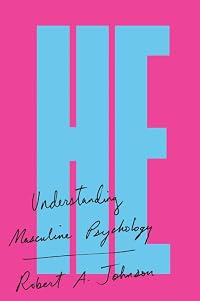
He: Understanding Masculine Psychology
by Robert A. Johnson, C. G. Jung
On This Page
Description
Robert A. Johnson's classic work exploring the differences between man and woman, female and male-newly reissued. What does it really mean to be a man? What are some of the landmarks along the road to mature masculinity? And what of the feminine components of a man's personality? Women have developed, over the centuries, considerable expertise in the technique of adapting to men, and for good reason, but that is not the same as truly understanding them. The transition from male childhood to show more real manhood is a complicated struggle, and explored in this book. As timely today as when it was first published, He provides a fascinating look into male identity and how female dynamics influence men. show lessTags
Recommendations








Member Reviews
The advice is good. I don't like it when the silly Jungians and Fruedians start using jargon but this book was a surprisingly good intro to Jungian thinking, a great example of analyses of the collective (un)consciousness as well as a reminder; happiness is like love. If you only chase it mono-directionally you'll scare away the person and they'll pepper spray you. If you are sated/whole without it then it'll enter into your life itself.
By the trident, bless the internet for being able to learn such wisdom early!
By the trident, bless the internet for being able to learn such wisdom early!
Myths and legends form powerful expressions of our humanity. It would seem that the most enduring of them are likely so powerful because they tap into some elemental truth of our humanness. If so, a deep reading of the story should illuminate ourselves.
This is what Robert Johnson achieves in He: Understanding Masculine Psychology, a deconstruction and interpretation of the Grail story. Johnson, a psychologist with Jungian training interprets the tale of Parsifal’s departure from his mother, arrival at Arthur’s court, and search for the Grail.
The Arthurian legends comprise a body of stories with multiple variations. The tales focus variously upon Arthur, the naïve knight, Parsifal (Percival), other knights, mentors, the ailing show more Fisher King, Queen Guenevere, other damsels and loathsome ladies. Johnson uses the French version, penned as an epic poem by Chrétien de Troyes, in the 12th century because it is the oldest. Being the oldest version, it is simpler, more direct, and closer to the subconscious.
As we follow Parsival through his adventures Johnson interprets them as life transitions for men. In the process we discover antecedents to Lord of the Rings, the Star Wars trilogy, and Harry Potter. At the end we understand that chasing happiness is ephemeral and true meaning and wholeness can only be attained through service to others.
To get us there, I have a worry about the fidelity of Johnson’s retelling of the story, the origins of which are lost in the mists of time. show less
This is what Robert Johnson achieves in He: Understanding Masculine Psychology, a deconstruction and interpretation of the Grail story. Johnson, a psychologist with Jungian training interprets the tale of Parsifal’s departure from his mother, arrival at Arthur’s court, and search for the Grail.
The Arthurian legends comprise a body of stories with multiple variations. The tales focus variously upon Arthur, the naïve knight, Parsifal (Percival), other knights, mentors, the ailing show more Fisher King, Queen Guenevere, other damsels and loathsome ladies. Johnson uses the French version, penned as an epic poem by Chrétien de Troyes, in the 12th century because it is the oldest. Being the oldest version, it is simpler, more direct, and closer to the subconscious.
As we follow Parsival through his adventures Johnson interprets them as life transitions for men. In the process we discover antecedents to Lord of the Rings, the Star Wars trilogy, and Harry Potter. At the end we understand that chasing happiness is ephemeral and true meaning and wholeness can only be attained through service to others.
To get us there, I have a worry about the fidelity of Johnson’s retelling of the story, the origins of which are lost in the mists of time. show less
This book was read as part of an effort to establish "Why do men think like that?" Unfortunately, the woman who was also reading the book viewed it as an exploration of what had to be changed to make men think like women, not to understand the duality in couples relationships. So, it requires an investment in objectivity on the part of the reader. I don't think it was a bad book about how men think.
Why, if the book was published in 1989, did I finish it on October 20th, 1986?
Why, if the book was published in 1989, did I finish it on October 20th, 1986?
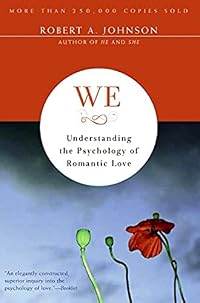
This book takes the myth of Parsifal and attempts to explain some basic aspects of masculine psychology. I did not enjoy this book quite as much as We, or She. The main reason is because, although it describes what men need to do during their journey of life, it doesn't really explain or give many real world examples.The basic premise is that men have a latent or suppressed feminine side of their personality (anima) that needs to be dealt with and accepted instead of ignored.
If anyone could help me get anything other than a rare insight into what the author was saying and how he came to his many conclusions, I'd be grateful.
Do you need some background in Jung or some other preparation for reading this book?
Do you need some background in Jung or some other preparation for reading this book?
One of the two books (with Tillich's The Courage to Be) that helped get me through a Dark Night of the Soul.
Ratings
Members
- Recently Added By
Lists

Men's healing resources
728 works; 1 member
Author Information

25+ Works 5,171 Members
Robert A. Johnson is a noted lecturer and Jungian analyst in private practice in San Diego, California

881+ Works 42,532 Members
Carl Gustav Jung was born in Switzerland on July 26, 1875. He originally set out to study archaeology, but switched to medicine and began practicing psychiatry in Basel after receiving his degree from the University of Basel in 1902. He became one of the most famous of modern psychologists and psychiatrists. Jung first met Sigmund Freud in 1907 show more when he became his foremost associate and disciple. The break came with the publication of Jung's Psychology of the Unconscious (1912), which did not follow Freud's theories of the libido and the unconscious. Jung eventually rejected Freud's system of psychoanalysis for his own "analytic psychology." This emphasizes present conflicts rather than those from childhood; it also takes into account the conflict arising from what Jung called the "collective unconscious"---evolutionary and cultural factors determining individual development. Jung invented the association word test and contributed the word complex to psychology, and first described the "introvert" and "extrovert" types. His interest in the human psyche, past and present, led him to study mythology, alchemy, oriental religions and philosophies, and traditional peoples. Later he became interested in parapsychology and the occult. He thought that unidentified flying objects (UFOs) might be a psychological projection of modern people's anxieties. He wrote several books including Studies in Word Association, Flying Saucers: A Modern Myth of Things Seen in the Skies, and Psychology and Alchemy. He died on June 6, 1961 after a short illness. (Bowker Author Biography) show less
Some Editions
Common Knowledge
- Canonical title
- He: Understanding Masculine Psychology
- Original title
- He! A contribution to understanding masculine psychology, based on the legend of Parsifal and his search for the Grail, and using Jungian psychological concepts.
- Original publication date
- 1974
- People/Characters
- Parsifal
- First words
- Often, when a new era begins in history, a myth for that era springs up simultaneously.
- Last words
- (Click to show. Warning: May contain spoilers.)If we can hear this old tale of an innocent fool blundering into the Grail castle for the first time and earning his way there a second time, we can find some sage advice for our own modern way.
Classifications
- Genres
- Nonfiction, General Nonfiction, Sexuality and Gender Studies
- DDC/MDS
- 155.332 — Philosophy and Psychology Psychology Differential and developmental psychology Sexuality and Gender Masculinity, Femininity, and Other Gender Orientations Masculinity
- LCC
- BF692.5 .J63 — Philosophy, Psychology and Religion Psychology Psychology Psychology of sex. Sexual behavior
- BISAC
Statistics
- Members
- 772
- Popularity
- 36,076
- Reviews
- 7
- Rating
- (3.66)
- Languages
- 5 — Dutch, English, Korean, Portuguese (Portugal), Spanish
- Media
- Paper, Audiobook, Ebook
- ISBNs
- 14
- ASINs
- 4