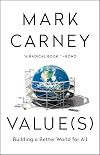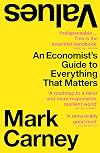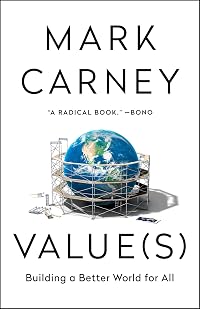
Values: Building a Better World for All
by Mark Carney
On This Page
Description
Our world is full of fault lines - growing inequality in income and opportunity; systemic racism; health and economic crises from a global pandemic; mistrust of experts; the existential threat of climate change; deep threats to employment in a digital economy with robotics on the rise. These fundamental problems and others like them, argues Mark Carney, stem from a common crisis in values. Drawing on the turmoil of the past decade, Mark Carney shows how 'market economies' have evolved into show more 'market societies' where price determines the value of everything. In this profoundly important new book, Carney argues that radical, foundational change is required if we are to build an economy and society based not on market values but on human values. A society that can work better for all. When we think about what we, as individuals, value most highly, we might list fairness, health, the protection of our rights, economic security from poverty, the preservation of natural diversity, resources and beauty. The tragedy is, these things that we hold dearest are too often the casualties of our twenty-first century world, where they ought to be our bedrock. In Value(s), Mark Carney offers a vision of a more humane society and a practical manifesto for getting there. How we reform our infrastructure to make things better and fairer is at the heart of every chapter, with outlines of wholly new ideas that can restructure society and enshrine our human values at the core of all that we build for our children and grandchildren. show lessTags
Recommendations














Member Reviews
Mark Carney is no longer the Governor of the Bank of England or of the Bank of Canada. So a fat book by him should be expected to explain his real thoughts, not the stilted public statements of officialese, and his real reactions to people and events, not the politically shackled statements designed to reveal nothing. His book Value(s) makes it seem as if he was still in office as a central banker.
The basic principle is that value, ie. a dollar, pound or euro amount, is being confused and confounded with values, which are societal, and not monetary. He summarizes it this way: “In recent decades, subtly but relentlessly, we have been moving from a market economy to a market society. Increasingly, to be valued, an asset or activity has show more to be in a market; the price of everything is becoming the value of everything.”
He keeps to that theme pretty much throughout, but it becomes endlessly repetitive once you understand how he thinks. He thinks like a bureaucrat.
Carney loves citing the wisdom of others, and many of the numerous quotes throughout the book are worth highlighting. He does a much better job than most in picking relevant and eloquent citations. But his own wisdom seems to be limited to breaking down every topic to its smallest units, then measuring, recording and reporting them up the chain, so that they might provide value to those who might actually have a plan of action.
His thirst for knowledge is also impressive. Central bankers (thankfully) want a handle on everything in the economy. And the economy includes pretty much everything. Heading up a central bank means you get all the original research from anywhere you want, the actual unvarnished truth of the matter. So Carney can tell you that a study by Statistics Norway during the COVI19 pandemic estimated that school closures cost $173 per child per day in lost future earnings and lost parental productivity.
There are two chapters on COVID19 as well the financial crisis, and two on climate change as well as the gold standard. Carney likes to think (or perhaps hopes) he has not lost the common touch, talking to shop owners and students as well as heads of state and other central bankers. The book ends with a chapter on humility. He says “A sense of self must be accompanied by s sense of solidarity.”
Early on, he sets out the three lies of markets: This time is different, markets are always right/clear, and markets are moral. These lies play out in several chapters on different topics. Central bankers have not figured out the universal law to success or even stability. They are constantly reacting to events. They are constantly surprised by events. And although he doesn’t go there, they are constantly fighting today’s battles with yesterday’s new tools, designed for the last crisis, which was completely different. But through it all, the three lies continue to come back to bite the economies of countries again and again. Every ten years or so. It’s astonishing, even to Carney. Bankers never learn, and as soon as things settle down and the economy picks up, bankers start taking forbidden chances again. They succeed for a while, he says, and the economy appears to benefit, so regulators and politicians back off. Until it all blows up again. And it always boils down to these same three lies the whole finance world knows so well.
Readers might think Carney is therefore not sold on market economies, but he totally is. Despite their unending attempts to monetize values, their continual skirting of regulations to produce the next banking crisis, and the endless greed they routinely qualify as virtue, Carney understands their power to build, innovate, and of course, fund. This, like everything in the book, is not in the least controversial.
Despite knowing and working with the who’s who of finance, Carney is not about to criticize anyone else. Even for Alan Greenspan, whose hands-off administration led The Great Moderation of supposedly endless stability to the great financial crisis of 2008 (which for some has still not ended), Carney has no critique. The farthest he goes is to quote Greenspan himself at a congressional hearing where he admitted to being “partially wrong” after seeing the incredible greed of Wall Street in action. Otherwise, everything’s good.
Carney is forgiving of pretty much everything. Banking, finance and economics are continually evolving. What was true when we were on the gold standard is not true today. Rules made yesterday will need revising tomorrow. All the errors are forgivable.
Except one.
By far the most negative and critical chapter in the book is about cryptocurrencies. These are apparently evil incarnate. Carney basically has nothing good to say about them. They are not authorized, not regulated, not bound by nations, central banks or governments. They offer no guarantees, no oversight and no submission to rules other than their own. They don’t scale and aren’t universally available. They will never replace currencies, which do offer all of the above, and anyway, today’s currencies are more and more global and digital every day, so cryptocurrencies offer little or nothing over central bank-issued real money. A crypto coin from a central bank offers nothing for Mark Carney. In his own words:
“It must improve fairness by increasing financial inclusion and promoting solidarity. New forms of money and payments must make good on their potential to democratise financial services by opening access to all. That means dramatically lowering the costs of payments, banking and cross-border transactions including remittances. And it means promoting competition for customer services. All network externalities in new forms of money should accrue to the benefit of the public…New payment systems must be scalable. After all, money is a social convention, a network. The more people that use it, the more useful it is. To be effective, the forms of money must be at least as efficient at large scale as they are at smaller ones. At present, this is a marked deficiency of most crypto-substitutes.
“Once they are brought into the regulatory net – as all forms of money eventually are – their attractiveness to many of their core users will cease.“
This is as dramatic as the book gets, and it is all focused on digital coins. He does not apply anything like this passion or criticism to anything else. Bizarrely, he does not accord to crypto the forgiveness he offers on every disaster in economic history. Unlike everything else, they will apparently never evolve from where they are today. Unlike, say, the pound, which was under his control and which he says, has suffered inflation of 2200% just in our lifetime. The chapter on cryptocurrencies seems condescending, inadequate, and demonstrates not so much analysis as contempt for the whole movement.
Back on terra firma, Carney offers five lessons from the financial crisis of 2008:
-The market can be wrong longer than you can stay solvent
-Hope is not a strategy and to quote Tim Geithner’s refrain plan beats no plan. And a plan that is actually executed is the best one of all. Searching endlessly for the best is the enemy of the good.
-Communicate clearly, frequently and honestly
-There are no libertarians in financial crises.
-Overwhelming force is the best way to restore confidence.
This brings up the unbelievable number of lists in the book. There seems to be one on every other page. They get to Carney’s modus operandi of breaking things down and listing the component parts. Everything can be reduced to three, four or five points, with a couple of sevens in there along the way. He applies this to everything. It can be instructive, but after a hundred of them, it becomes routine and wearying. And most of them are not nearly as insightful as the financial crisis points above.
Value(s) has two chapters on climate change, but neither one contains any thoughts on how to tame it. Instead, they are about bureaucratic process and ESG, the new rating system for companies to rate themselves on environmental, social and governance issues like diversity.
What are central banks doing? “Network for Greening the Financial System (NGFS), a coalition of seventy central banks, representing countries that generate almost three-quarters of the world’s emissions, have developed representative scenarios to show how climate risks might evolve and affect the real and financial economies.” They’re modeling.
What does Carney recommend for lawmakers? “Credible policy frameworks reduce the risk that businesses form wrong expectations about future policies and continue to invest in obsolete technologies. By setting out clear strategies, politicians can provide forward guidance on the policies they plan to put in place. Such predictability of climate policy helps companies start adjusting to the reality of a net-zero world today, and ensures that this adjustment is orderly.” More modeling.
His most memorable thoughts on climate are two small anecdotes. Carney says he received Greta Thunberg one day at the Bank of England. He took her downstairs to show her the hundreds of millions of pounds worth of gold stored there. That she was unimpressed would be a good British understatement. Carney simply says Thunberg has a way of keeping you focused on her issue.
Then in the USA, Carney cites the head of Morgan Stanley, James Gorman, answering a question in congressional testimony about “whether climate change really was a risk to financial stability: ‘It’s hard to have a financial system if you don’t have a planet.’”
That’s better than everything else in both chapters combined.
But Carney is not deterred. In his love of lists and process, he says: “There are a variety of ways to calculate the warming impact across equities, corporate bonds and sovereign bonds and then to combine them into a single ‘portfolio’ score. They have three steps in common:
1) allocating carbon budgets and translating them into benchmarks;
2) assessing company-level alignment relative to these benchmarks; and
3) aggregating the results to a portfolio level to assess portfolio alignment.”
James Gorman was better.
The book seems to be built on three verbs: need, should, and must. Carney is all about bankers and governments needing to do this and that. But the verbs are not followed by solutions. Carney’s needs and musts are about putting structure in place to analyze the effects of solutions should anyone come up with them. He himself has none. Here’s an example of what readers will encounter again and again, which they eventually realize are not so much profound as meaningless:
“Advancing patriotism by reinstilling common purpose, ideals and values in global affairs is integral to country strategies that build opportunities for all. We need a new form of international integration, one that is focused on outcomes, that maintains values and preserves sovereignty in its truest sense. That is the highest example of institutions adapting to achieve their purpose.”
Central bankers live in a closed world that can be fascinating. Carney tells of his time in the UK, where choosing who to put on pound notes and coins, the colors used on the notes, the polymer paper – all finely figure into the requirement to make the bank appear substantial, stable and reliable. Banking, now that there is no gold backing money, is a confidence game. As long as everyone believes there will always be a Bank of England, and that it is run by enormously careful and skilled technocrats, the pound, and the economy, are safe. Any thought to the contrary must be avoided, denied or expunged.
Along the same lines: “We have learned that talking about ‘prices and jobs’ is far more effective than the economic jargon of inflation and employment.” Central bankers recognize their audience. It just means banks will continue to be bailed out, currencies will continue to be manipulated, and debt will continue to rise. Because that’s how they build confidence in money.
This is the kind of insight I wanted to read more of, but what I have referenced here is pretty much all there is in the book.
I was rather hoping Value(s) would be a seat at the central bankers’ table. It is everything but. And flat to boot.
David Wineberg show less
The basic principle is that value, ie. a dollar, pound or euro amount, is being confused and confounded with values, which are societal, and not monetary. He summarizes it this way: “In recent decades, subtly but relentlessly, we have been moving from a market economy to a market society. Increasingly, to be valued, an asset or activity has show more to be in a market; the price of everything is becoming the value of everything.”
He keeps to that theme pretty much throughout, but it becomes endlessly repetitive once you understand how he thinks. He thinks like a bureaucrat.
Carney loves citing the wisdom of others, and many of the numerous quotes throughout the book are worth highlighting. He does a much better job than most in picking relevant and eloquent citations. But his own wisdom seems to be limited to breaking down every topic to its smallest units, then measuring, recording and reporting them up the chain, so that they might provide value to those who might actually have a plan of action.
His thirst for knowledge is also impressive. Central bankers (thankfully) want a handle on everything in the economy. And the economy includes pretty much everything. Heading up a central bank means you get all the original research from anywhere you want, the actual unvarnished truth of the matter. So Carney can tell you that a study by Statistics Norway during the COVI19 pandemic estimated that school closures cost $173 per child per day in lost future earnings and lost parental productivity.
There are two chapters on COVID19 as well the financial crisis, and two on climate change as well as the gold standard. Carney likes to think (or perhaps hopes) he has not lost the common touch, talking to shop owners and students as well as heads of state and other central bankers. The book ends with a chapter on humility. He says “A sense of self must be accompanied by s sense of solidarity.”
Early on, he sets out the three lies of markets: This time is different, markets are always right/clear, and markets are moral. These lies play out in several chapters on different topics. Central bankers have not figured out the universal law to success or even stability. They are constantly reacting to events. They are constantly surprised by events. And although he doesn’t go there, they are constantly fighting today’s battles with yesterday’s new tools, designed for the last crisis, which was completely different. But through it all, the three lies continue to come back to bite the economies of countries again and again. Every ten years or so. It’s astonishing, even to Carney. Bankers never learn, and as soon as things settle down and the economy picks up, bankers start taking forbidden chances again. They succeed for a while, he says, and the economy appears to benefit, so regulators and politicians back off. Until it all blows up again. And it always boils down to these same three lies the whole finance world knows so well.
Readers might think Carney is therefore not sold on market economies, but he totally is. Despite their unending attempts to monetize values, their continual skirting of regulations to produce the next banking crisis, and the endless greed they routinely qualify as virtue, Carney understands their power to build, innovate, and of course, fund. This, like everything in the book, is not in the least controversial.
Despite knowing and working with the who’s who of finance, Carney is not about to criticize anyone else. Even for Alan Greenspan, whose hands-off administration led The Great Moderation of supposedly endless stability to the great financial crisis of 2008 (which for some has still not ended), Carney has no critique. The farthest he goes is to quote Greenspan himself at a congressional hearing where he admitted to being “partially wrong” after seeing the incredible greed of Wall Street in action. Otherwise, everything’s good.
Carney is forgiving of pretty much everything. Banking, finance and economics are continually evolving. What was true when we were on the gold standard is not true today. Rules made yesterday will need revising tomorrow. All the errors are forgivable.
Except one.
By far the most negative and critical chapter in the book is about cryptocurrencies. These are apparently evil incarnate. Carney basically has nothing good to say about them. They are not authorized, not regulated, not bound by nations, central banks or governments. They offer no guarantees, no oversight and no submission to rules other than their own. They don’t scale and aren’t universally available. They will never replace currencies, which do offer all of the above, and anyway, today’s currencies are more and more global and digital every day, so cryptocurrencies offer little or nothing over central bank-issued real money. A crypto coin from a central bank offers nothing for Mark Carney. In his own words:
“It must improve fairness by increasing financial inclusion and promoting solidarity. New forms of money and payments must make good on their potential to democratise financial services by opening access to all. That means dramatically lowering the costs of payments, banking and cross-border transactions including remittances. And it means promoting competition for customer services. All network externalities in new forms of money should accrue to the benefit of the public…New payment systems must be scalable. After all, money is a social convention, a network. The more people that use it, the more useful it is. To be effective, the forms of money must be at least as efficient at large scale as they are at smaller ones. At present, this is a marked deficiency of most crypto-substitutes.
“Once they are brought into the regulatory net – as all forms of money eventually are – their attractiveness to many of their core users will cease.“
This is as dramatic as the book gets, and it is all focused on digital coins. He does not apply anything like this passion or criticism to anything else. Bizarrely, he does not accord to crypto the forgiveness he offers on every disaster in economic history. Unlike everything else, they will apparently never evolve from where they are today. Unlike, say, the pound, which was under his control and which he says, has suffered inflation of 2200% just in our lifetime. The chapter on cryptocurrencies seems condescending, inadequate, and demonstrates not so much analysis as contempt for the whole movement.
Back on terra firma, Carney offers five lessons from the financial crisis of 2008:
-The market can be wrong longer than you can stay solvent
-Hope is not a strategy and to quote Tim Geithner’s refrain plan beats no plan. And a plan that is actually executed is the best one of all. Searching endlessly for the best is the enemy of the good.
-Communicate clearly, frequently and honestly
-There are no libertarians in financial crises.
-Overwhelming force is the best way to restore confidence.
This brings up the unbelievable number of lists in the book. There seems to be one on every other page. They get to Carney’s modus operandi of breaking things down and listing the component parts. Everything can be reduced to three, four or five points, with a couple of sevens in there along the way. He applies this to everything. It can be instructive, but after a hundred of them, it becomes routine and wearying. And most of them are not nearly as insightful as the financial crisis points above.
Value(s) has two chapters on climate change, but neither one contains any thoughts on how to tame it. Instead, they are about bureaucratic process and ESG, the new rating system for companies to rate themselves on environmental, social and governance issues like diversity.
What are central banks doing? “Network for Greening the Financial System (NGFS), a coalition of seventy central banks, representing countries that generate almost three-quarters of the world’s emissions, have developed representative scenarios to show how climate risks might evolve and affect the real and financial economies.” They’re modeling.
What does Carney recommend for lawmakers? “Credible policy frameworks reduce the risk that businesses form wrong expectations about future policies and continue to invest in obsolete technologies. By setting out clear strategies, politicians can provide forward guidance on the policies they plan to put in place. Such predictability of climate policy helps companies start adjusting to the reality of a net-zero world today, and ensures that this adjustment is orderly.” More modeling.
His most memorable thoughts on climate are two small anecdotes. Carney says he received Greta Thunberg one day at the Bank of England. He took her downstairs to show her the hundreds of millions of pounds worth of gold stored there. That she was unimpressed would be a good British understatement. Carney simply says Thunberg has a way of keeping you focused on her issue.
Then in the USA, Carney cites the head of Morgan Stanley, James Gorman, answering a question in congressional testimony about “whether climate change really was a risk to financial stability: ‘It’s hard to have a financial system if you don’t have a planet.’”
That’s better than everything else in both chapters combined.
But Carney is not deterred. In his love of lists and process, he says: “There are a variety of ways to calculate the warming impact across equities, corporate bonds and sovereign bonds and then to combine them into a single ‘portfolio’ score. They have three steps in common:
1) allocating carbon budgets and translating them into benchmarks;
2) assessing company-level alignment relative to these benchmarks; and
3) aggregating the results to a portfolio level to assess portfolio alignment.”
James Gorman was better.
The book seems to be built on three verbs: need, should, and must. Carney is all about bankers and governments needing to do this and that. But the verbs are not followed by solutions. Carney’s needs and musts are about putting structure in place to analyze the effects of solutions should anyone come up with them. He himself has none. Here’s an example of what readers will encounter again and again, which they eventually realize are not so much profound as meaningless:
“Advancing patriotism by reinstilling common purpose, ideals and values in global affairs is integral to country strategies that build opportunities for all. We need a new form of international integration, one that is focused on outcomes, that maintains values and preserves sovereignty in its truest sense. That is the highest example of institutions adapting to achieve their purpose.”
Central bankers live in a closed world that can be fascinating. Carney tells of his time in the UK, where choosing who to put on pound notes and coins, the colors used on the notes, the polymer paper – all finely figure into the requirement to make the bank appear substantial, stable and reliable. Banking, now that there is no gold backing money, is a confidence game. As long as everyone believes there will always be a Bank of England, and that it is run by enormously careful and skilled technocrats, the pound, and the economy, are safe. Any thought to the contrary must be avoided, denied or expunged.
Along the same lines: “We have learned that talking about ‘prices and jobs’ is far more effective than the economic jargon of inflation and employment.” Central bankers recognize their audience. It just means banks will continue to be bailed out, currencies will continue to be manipulated, and debt will continue to rise. Because that’s how they build confidence in money.
This is the kind of insight I wanted to read more of, but what I have referenced here is pretty much all there is in the book.
I was rather hoping Value(s) would be a seat at the central bankers’ table. It is everything but. And flat to boot.
David Wineberg show less
It is refreshing to have a literate prime minister after ten years ... actually it has been very much longer than that (I want say that there has been imbecility, but that would be rude). It gives me hope that someone in high places has the intellect to understand and the compassion to appreciate Oscar Wilde's quip about those who know the price of everything and the value of nothing, and has given thought to the values necessary in our communal life. But the erudition in this tome is perhaps a bit excessive at times.
An Amazon review from Australia that evidently got attached to the wrong product turned out to be hysterically apt.
5.0 out of 5 stars: "A very solid addition to the kitchen"
Reviewed in Australia on April 18, 2021
This is a show more robust piece of kit and is easy to grip onto. It does the job very well.
Solid and robust are good adjectives for this 600-page volume, and it does do the job well, but some of the ideas might not be as easy to grasp ("grip onto") as one might hope. show less
An Amazon review from Australia that evidently got attached to the wrong product turned out to be hysterically apt.
5.0 out of 5 stars: "A very solid addition to the kitchen"
Reviewed in Australia on April 18, 2021
This is a show more robust piece of kit and is easy to grip onto. It does the job very well.
Solid and robust are good adjectives for this 600-page volume, and it does do the job well, but some of the ideas might not be as easy to grasp ("grip onto") as one might hope. show less
Canadian Mark Carney’s “Value(s): Building a Better World for All” could have benefitted by a little more editing.
Well, maybe a lot more editing.
He’s a little windy and preachy. There are a lot of “we musts” in the text, a lot of forgettable acronyms, and countless lists, almost as if the author took the “Best of” framing for his discussion.
I guess that comes from his experience in the international realm where gaining cooperation was paramount.
It’s as if he couldn’t decide what was worth keeping and what worth throwing out, so he kept it all.
It usually stems from an author who is unsure of his audience or who is a megalomaniac and believes everybody should read his book.
I initially found Carney’s book on a show more facebook posting by my public library and I was intrigued. I knew Carney had been a Goldman, Sachs flunkie, a Deputy Minister of Finance for the Canadian Government, and later Governor of the Bank of Canada, and more recently — and improbably — Governor of the Bank of England.
So that meant he was a big wheel.
Why was he publishing a book now? Was he contemplating a political run? (A journalist friend tells me that yes, indeed, Carney plans a run for the Liberals.)
Well, if his public speaking is anything like his prose, this man was not intended for politics.
The book feels like a blueprint for capitalism on a dying planet.
It’s less a work of history or public policy than a prescription for reorienting big business and finance and government from a doomsday scenario to an adaptive, planet friendly future.
Carney is one of the few guys who knows enough about how all these things work that when he gets into the weeds on corporate governance and social responsibility, on how to get there from here, you really have to listen.
His main beef is with the Milton Friedman economic tradition of the primacy of the shareholder over the rest of us in how banks and business are run.
He doesn’t believe that kind of thinking has helped us navigate financial catastrophes, or pandemics, and is a prescription for disaster on climate.
But he does very heartily believe that it is the dynamism of capitalism, corporate restraint, and big time international cooperation are our hope of managing the challenge that climate change presents.
I resisted rating this book because — who knows — Carney could wind up being somebody really important and I wouldn’t want a guy with the power to order an audit of my tax return as an enemy.
If you can grind through the leaden prose, you can learn stuff about international finance, standards setting, government cooperation that’s actually pretty important.
But for the main point I really recommend Kate Raworth’s “Donut Economics: Seven Ways to Think Like a 21st Century Economist.”
I couldn’t leave this book, however, without a sinking feeling that Carney is apologizing for a system of free enterprise that no longer really exists. Our economy is buffered by gigantic oligopolies.
Is there real competition anymore? Does anyone really compete with amazon, Alphabet, Unilever, Bayer?
On one level I find it completely understandable why young people shy away from starting new businesses here in Canada. Making a profit whether you invest $500 or $5,000,000 is really hard.
The alternative is clearly not communism, but capitalism is dreadfully inefficient and as JP Morgan once is believed to have said, “Competition is terrible for business.” show less
Well, maybe a lot more editing.
He’s a little windy and preachy. There are a lot of “we musts” in the text, a lot of forgettable acronyms, and countless lists, almost as if the author took the “Best of” framing for his discussion.
I guess that comes from his experience in the international realm where gaining cooperation was paramount.
It’s as if he couldn’t decide what was worth keeping and what worth throwing out, so he kept it all.
It usually stems from an author who is unsure of his audience or who is a megalomaniac and believes everybody should read his book.
I initially found Carney’s book on a show more facebook posting by my public library and I was intrigued. I knew Carney had been a Goldman, Sachs flunkie, a Deputy Minister of Finance for the Canadian Government, and later Governor of the Bank of Canada, and more recently — and improbably — Governor of the Bank of England.
So that meant he was a big wheel.
Why was he publishing a book now? Was he contemplating a political run? (A journalist friend tells me that yes, indeed, Carney plans a run for the Liberals.)
Well, if his public speaking is anything like his prose, this man was not intended for politics.
The book feels like a blueprint for capitalism on a dying planet.
It’s less a work of history or public policy than a prescription for reorienting big business and finance and government from a doomsday scenario to an adaptive, planet friendly future.
Carney is one of the few guys who knows enough about how all these things work that when he gets into the weeds on corporate governance and social responsibility, on how to get there from here, you really have to listen.
His main beef is with the Milton Friedman economic tradition of the primacy of the shareholder over the rest of us in how banks and business are run.
He doesn’t believe that kind of thinking has helped us navigate financial catastrophes, or pandemics, and is a prescription for disaster on climate.
But he does very heartily believe that it is the dynamism of capitalism, corporate restraint, and big time international cooperation are our hope of managing the challenge that climate change presents.
I resisted rating this book because — who knows — Carney could wind up being somebody really important and I wouldn’t want a guy with the power to order an audit of my tax return as an enemy.
If you can grind through the leaden prose, you can learn stuff about international finance, standards setting, government cooperation that’s actually pretty important.
But for the main point I really recommend Kate Raworth’s “Donut Economics: Seven Ways to Think Like a 21st Century Economist.”
I couldn’t leave this book, however, without a sinking feeling that Carney is apologizing for a system of free enterprise that no longer really exists. Our economy is buffered by gigantic oligopolies.
Is there real competition anymore? Does anyone really compete with amazon, Alphabet, Unilever, Bayer?
On one level I find it completely understandable why young people shy away from starting new businesses here in Canada. Making a profit whether you invest $500 or $5,000,000 is really hard.
The alternative is clearly not communism, but capitalism is dreadfully inefficient and as JP Morgan once is believed to have said, “Competition is terrible for business.” show less
Mr. Carney has written a book about three major crises affecting the world today: credit, COVID, and climate. He says these are crises of values and would like to better align our values with what we/markets value. He has a breadth and depth of these and other issues that is truly impressive.
He often used acronyms without first spelling them out. Luckily, I read with Google nearby. To be honest, I found the first 130 pages a bit of a slog as he reviewed economic history. That's on me; he did a fine job. But my interest was really grabbed when he started speaking about how to better reflect our values in our economic decision making. The book is more of an ideas based discussion rather than a prescription of solutions. His ideas, I show more think, are the way of the future as younger people, having grown up with the internet, are better positioned to know about the social, environmental and governance policies of companies they wish to patronize and invest in.
I do wonder, though, how many people will read this book. It's long and could have been shorter with better editing. If the ideas don't get "out there", little will come of them. show less
He often used acronyms without first spelling them out. Luckily, I read with Google nearby. To be honest, I found the first 130 pages a bit of a slog as he reviewed economic history. That's on me; he did a fine job. But my interest was really grabbed when he started speaking about how to better reflect our values in our economic decision making. The book is more of an ideas based discussion rather than a prescription of solutions. His ideas, I show more think, are the way of the future as younger people, having grown up with the internet, are better positioned to know about the social, environmental and governance policies of companies they wish to patronize and invest in.
I do wonder, though, how many people will read this book. It's long and could have been shorter with better editing. If the ideas don't get "out there", little will come of them. show less
Arguably a very important book, but too long and although Carney can write well, it's anything but compelling. It felt like it was rushed to publication. I would only recommend it to policy wonks. I gave up half way through.
Ratings
Members
- Recently Added By
Lists

Globe and Mail | Canadian Non-Fiction: January 25, 2025
10 works; 1 member

Globe and Mail | Canadian Non-Fiction: January 10, 2026
10 works; 1 member

Globe and Mail | Canadian Non-Fiction: August 23, 2025
10 works; 1 member

Globe and Mail | Canadian Non-Fiction: August 30, 2025
10 works; 1 member

Globe and Mail | Canadian Non-Fiction: September 6, 2025
10 works; 1 member
Globe and Mail | Canadian Non-Fiction: September 13, 2025
10 works; 1 member
Globe and Mail | Canadian Non-Fiction: September 20, 2025
10 works; 1 member

Globe and Mail | Canadian Non-Fiction: September 27, 2025
10 works; 1 member

Globe and Mail | Canadian Non-Fiction: October 4, 2025
10 works; 1 member

Globe and Mail | Canadian Non-Fiction: October 25, 2025
10 works; 1 member
Globe and Mail | Canadian Non-Fiction: December 20, 2025
10 works; 1 member
Globe and Mail | Canadian Non-Fiction: December 27, 2025
10 works; 1 member
Globe and Mail | Canadian Non-Fiction: Year End, 2025
10 works; 1 member
Globe and Mail | Canadian Non-Fiction: January 31, 2026
10 works; 1 member

Globe and Mail | Canadian Non-Fiction: August 9, 2025
10 works; 1 member
Globe and Mail | Canadian Non-Fiction: February 7, 2026
10 works; 1 member
Globe and Mail | Canadian Non-Fiction: February 14, 2026
10 works; 1 member
Globe and Mail | Canadian Non-Fiction: February 21, 2026
10 works; 1 member
Globe and Mail | Canadian Non-Fiction: February 28, 2026
10 works; 1 member
Globe and Mail | Canadian Non-Fiction: March 7, 2026
10 works; 1 member
Globe and Mail | Canadian Non-Fiction: March 14, 2026
10 works; 1 member
Globe and Mail | Canadian Non-Fiction: March 21, 2026
10 works; 1 member

Globe and Mail | Canadian Non-Fiction: March 28, 2026
10 works; 1 member
Globe and Mail | Canadian Non-Fiction: April 4, 2026
10 works; 1 member

Globe and Mail | Canadian Non-Fiction: April 11, 2026
10 works; 1 member

Globe and Mail | Canadian Non-Fiction: April 25, 2026
10 works; 1 member
Globe and Mail | Canadian Non-Fiction: August 16, 2025
10 works; 1 member
Globe and Mail | Canadian Non-Fiction: August 2, 2025
10 works; 1 member

Globe and Mail | Canadian Non-Fiction: February 1, 2025
10 works; 1 member
Globe and Mail | Canadian Non-Fiction: April 26, 2025
10 works; 1 member
Globe and Mail | Canadian Non-Fiction: February 8, 2025
10 works; 1 member

Globe and Mail | Canadian Non-Fiction: February 15, 2025
10 works; 1 member
Globe and Mail | Canadian Non-Fiction: February 22, 2025
10 works; 1 member

Globe and Mail | Canadian Non-Fiction: March 1, 2025
10 works; 1 member

Globe and Mail | Canadian Non-Fiction: March 8, 2025
10 works; 1 member
Globe and Mail | Canadian Non-Fiction: March 15, 2025
10 works; 1 member
Globe and Mail | Canadian Non-Fiction: March 22, 2025
10 works; 1 member
Globe and Mail | Canadian Non-Fiction: March 29, 2025
10 works; 1 member
Globe and Mail | Canadian Non-Fiction: April 5, 2025
10 works; 1 member
Globe and Mail | Canadian Non-Fiction: April 12, 2025
10 works; 1 member
Globe and Mail | Canadian Non-Fiction: April 19, 2025
10 works; 1 member
Globe and Mail | Canadian Non-Fiction: May 3, 2025
10 works; 1 member

Globe and Mail | Canadian Non-Fiction: July 26, 2025
10 works; 1 member
Globe and Mail | Canadian Non-Fiction: May 10, 2025
10 works; 1 member
Globe and Mail | Canadian Non-Fiction: May 17, 2025
10 works; 1 member
Globe and Mail | Canadian Non-Fiction: May 24, 2025
10 works; 1 member
Globe and Mail | Canadian Non-Fiction: May 31, 2025
10 works; 1 member
Globe and Mail | Canadian Non-Fiction: June 7, 2025
10 works; 1 member

Globe and Mail | Canadian Non-Fiction: June 14, 2025
10 works; 1 member
Globe and Mail | Canadian Non-Fiction: June 21, 2025
10 works; 1 member
Globe and Mail | Canadian Non-Fiction: June 28, 2025
10 works; 1 member
Globe and Mail | Canadian Non-Fiction: July 5, 2025
10 works; 1 member
Globe and Mail | Canadian Non-Fiction: July 12, 2025
10 works; 1 member
Globe and Mail | Canadian Non-Fiction: July 19, 2025
10 works; 1 member

Globe and Mail | Canadian Non-Fiction: May 2, 2026
10 works; 1 member
Author Information
1 Work 241 Members
Awards and Honors
Distinctions
Observer Book of the Week (2021-03-21)
Common Knowledge
- Canonical title*
- Il valore e i valori. Un manifesto per ripensare il nostro presente
- Original title
- Value(s): Building a Better World for All (s)
*Some information comes from Common Knowledge in other languages. Click "Edit" for more information.
Classifications
- Genres
- Economics, Nonfiction, General Nonfiction, Business, Politics and Government
- DDC/MDS
- 303.372 — Society, government, & culture Social sciences, sociology & anthropology Social processes Coordination and control Social norms Belief systems and customs
- LCC
- HM681 .C366 — Social sciences Sociology (General) Sociology Social control
- BISAC
Statistics
- Members
- 242
- Popularity
- 134,671
- Reviews
- 5
- Rating
- (3.31)
- Languages
- English, Italian
- Media
- Paper, Audiobook, Ebook
- ISBNs
- 16
- ASINs
- 7