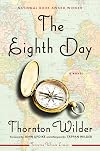
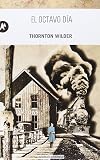
The Eighth Day
by Thornton Wilder
On This Page
Description
At the turn of the century, an Illinois man is sentenced to death for the murder of a close friend, but escapes to South America to build a new world for himself and his family.Tags
Recommendations














Member Reviews
I read one scrap of information that led me to seek out this book: I knew it was a story of families reckoning with events that closed out the 19th century leading into the 20th century. On this information, I thought this would be a book that captured and reflected on the excitement and dread that I remember feeling at the threshold of the 20th century leading to the 21st (... not Y2K related). In some ways, the book is about this kind of transition, but maybe also about the way that we place boundaries around periods of time and assign them significance, coherence, and maybe some retrospective inevitability that we carry forward as an expectation that the moment we live in is part of some inevitability outcome, a story, that we have show more yet to discover.
There is a scene toward the end of the book when a major character is shown a rug with a design on the top. The rug is then flipped over to show the knotwork holding the threads in place. In a way, the rug is a metaphor for the book which focuses on the knotted threads represented by each of the characters, none of who see the pattern that they contribute to or how their lives carry the imprint of those who have accompanied them in life. They cannot have this perspective because that is the realm of art. Our individual experience is always grounded in the eighth day.
I have not completely wrapped my head around the message of this novel, and I may take a different interpretation than others, but I interpret the eighth day as the everlasting moment that we all live in -- the day that you make do with what you have. The grand narrative of the previous seven days (i.e., of Creation) was just the end of the beginning. show less
There is a scene toward the end of the book when a major character is shown a rug with a design on the top. The rug is then flipped over to show the knotwork holding the threads in place. In a way, the rug is a metaphor for the book which focuses on the knotted threads represented by each of the characters, none of who see the pattern that they contribute to or how their lives carry the imprint of those who have accompanied them in life. They cannot have this perspective because that is the realm of art. Our individual experience is always grounded in the eighth day.
I have not completely wrapped my head around the message of this novel, and I may take a different interpretation than others, but I interpret the eighth day as the everlasting moment that we all live in -- the day that you make do with what you have. The grand narrative of the previous seven days (i.e., of Creation) was just the end of the beginning. show less
In the foreword to this volume, John Updike says about the book "Reviews were mixed, from Edmund Wilson's calling it 'the best thing he ever wrote' to...Stanley Kaufmann's [judgment] that 'we have – from a man who has always meant well – a book that means nothing.'" And, in a certain way, that divergence of opinion (a divergence that is evident in the many reviews of the book) is a nutshell of the reading experience. At times it was one of the finest books I ever read; at others I felt myself tempted to skim past descriptions or dissertations and even wonder why a certain section was included.
But, somewhere in between "greatest book" and "book that means nothing" is the crux of it. This is a very good book that sometimes stumbles on show more itself, but only because it is attempting to grasp and attempt quite a bit.
Harlan Ellison begins "'Repent, Harlequin!' Said the Ticktockman" with the line "Now begin in the middle, and later learn the beginning; the end will take care of itself." And that is as good a description of the plot line for this novel as I have seen – we start with a murder and trial, but then jump between the histories occurring before the event and the developments long afterwards.
The very beginning of the Prologue starts with John Barrington Ashley being tried for the murder of Breckenridge Lansing. They were friends, and everyone knows Ashley was not the murderer. However, that is not the outcome of the trial and Ashley is convicted. On the train ride to prison Ashely is freed; no one has any idea who freed him – not even Ashley.
That story, along with the subsequent explorations of how Lansing actually died and who freed Ashley, would take up the average, everyday novel. However, this is the least of what Wilder is trying to do. Again, this is the middle of the story.
What follows is an exploration of certain Ashely and Langston family members, as well as residents of Coaltown, Illinois. We see how people survived after the trial, we see the past that brought these two families to the Illinois coal town, and, most importantly, we see how these events shaped the people they have become and the people they will become.
While we learn who the people really are, this does not serve to drive forward a plot of "what happened?" (Part of the reason the book is dismissed as meaning nothing). Instead, it serves Wilder's bigger purpose of showing the way lives evolve and how we are all evolving into something new and different. (Is it for the better? That is a decision he leaves up to the reader.)
Some of the discussions of theories and religious concepts can (as one early reviewer noted) sound like essays embedded in a novel. And yet they serve well the purpose of showing that particular individual's development. And, by digging deeply into multiple characters, different points of view are brought forward with equal authority.
By the end, the answers to the mysteries are provided. But those have become nothing more than a necessary interference to the bigger questions that are raised throughout the novel. Those bigger questions do not have nicely-tied answers, as evidenced by Wilder's last paragraph. But, even without answers, we learn.
The book is a pleasant voyage. While the characters are not necessarily brilliantly dynamic (something we seem to expect in books that we don't expect of real people in real life) they have a reality that helps us accept them on their own terms. And, even with the essay-like discussions, the book continues to drive forward. I found myself caught up in the people and in those discussions. What more do we really want from a novel? show less
But, somewhere in between "greatest book" and "book that means nothing" is the crux of it. This is a very good book that sometimes stumbles on show more itself, but only because it is attempting to grasp and attempt quite a bit.
Harlan Ellison begins "'Repent, Harlequin!' Said the Ticktockman" with the line "Now begin in the middle, and later learn the beginning; the end will take care of itself." And that is as good a description of the plot line for this novel as I have seen – we start with a murder and trial, but then jump between the histories occurring before the event and the developments long afterwards.
The very beginning of the Prologue starts with John Barrington Ashley being tried for the murder of Breckenridge Lansing. They were friends, and everyone knows Ashley was not the murderer. However, that is not the outcome of the trial and Ashley is convicted. On the train ride to prison Ashely is freed; no one has any idea who freed him – not even Ashley.
That story, along with the subsequent explorations of how Lansing actually died and who freed Ashley, would take up the average, everyday novel. However, this is the least of what Wilder is trying to do. Again, this is the middle of the story.
What follows is an exploration of certain Ashely and Langston family members, as well as residents of Coaltown, Illinois. We see how people survived after the trial, we see the past that brought these two families to the Illinois coal town, and, most importantly, we see how these events shaped the people they have become and the people they will become.
While we learn who the people really are, this does not serve to drive forward a plot of "what happened?" (Part of the reason the book is dismissed as meaning nothing). Instead, it serves Wilder's bigger purpose of showing the way lives evolve and how we are all evolving into something new and different. (Is it for the better? That is a decision he leaves up to the reader.)
Some of the discussions of theories and religious concepts can (as one early reviewer noted) sound like essays embedded in a novel. And yet they serve well the purpose of showing that particular individual's development. And, by digging deeply into multiple characters, different points of view are brought forward with equal authority.
By the end, the answers to the mysteries are provided. But those have become nothing more than a necessary interference to the bigger questions that are raised throughout the novel. Those bigger questions do not have nicely-tied answers, as evidenced by Wilder's last paragraph. But, even without answers, we learn.
The book is a pleasant voyage. While the characters are not necessarily brilliantly dynamic (something we seem to expect in books that we don't expect of real people in real life) they have a reality that helps us accept them on their own terms. And, even with the essay-like discussions, the book continues to drive forward. I found myself caught up in the people and in those discussions. What more do we really want from a novel? show less
I read the hardcover published in 1967. This was not easy to read nor understand, but a very worthwhile book. There are so many metaphors presented so well I'm sure I missed many. There are also too many characters to keep track of. However, Wilder makes many comments on human behavior and the lack of humanity that I found this as relevant today as it was in the past. Most of the booki takes place in the 1880's until the 1920's, but Wilder also discusses both earlier and later times. He tells us mainly about 2 families who are brought together by a misattributed tragedy.
I liked this book and its odd narrative structure: the plot was intriguing and the prose was distinctive. So, why do I dock it a star? I thought the characters were unbelievable and the things that happened to them implausible. I wished for a bit more showing and a bit less telling.
There's something very Midwestern about the book. It captures the puritanical mindset that still exists out here in a non-condescending manner, and that is a very difficult thing. Hard work is rewarded, acts of charity are done silently. Bad things happen to good people, but the good never suffer. To me the novel is unsettling, but it embodies a distinctively American philosophy that I see around me but can never know nor understand.
There's something very Midwestern about the book. It captures the puritanical mindset that still exists out here in a non-condescending manner, and that is a very difficult thing. Hard work is rewarded, acts of charity are done silently. Bad things happen to good people, but the good never suffer. To me the novel is unsettling, but it embodies a distinctively American philosophy that I see around me but can never know nor understand.
A really good book with great writing. The plot however is a little unsettling, moving backwards and forwards through time, never really going where you expect it too.
A wonderful existentialist novel about a man convicted of a murder he did not committ, the threads of his life leading up to the event and the threads of his entire family's lives leading from the event. I had read this when a teenager and wanted to see whether it was a good as I had remembered. it was better!
In the beginning John Ashley came from New York, hired as a maintenance engineer to repair and fortify the mines of Coaltown, Illinois. Breckenridge Lansing was the managing director of the mines. This is how their paths would cross, innocently enough. Their paths would uncross when John shoots Breckenridge in the back of the head. Simple enough. After John is convicted and is on his way to be executed for the crime he somehow escapes. For the first part of the book we follow John's trek to Chile where he resumes his mine work. The rest of the book follows the lives of the people he left behind: his wife and children, Breck's widow and children. While the story meanders through philosophy and religion, the storyline is clear. There is show more something definitely amiss about this murder. John claims he is innocent and yet he was the only one with a gun. show less
Members
- Recently Added By
Published Reviews
ThingScore 100
In the end, like all good novels, this one is about how every story is part of a grand tradition of stories in the world, from the Bible to histories to journalism, as if, on the eighth day, God created a story about the first seven.
added by Shortride
Lists

Publisher's Weekly Bestsellers - Part II - 1940 - 1979
355 works; 6 members

National Book Award - Fiction
78 works; 10 members

Writers In Public Domain 2026
90 works; 1 member
Author Information

One of the most honored and versatile of modern writers, Thornton Wilder combined a career as a successful novelist with work for the theater that made him one of this century's outstanding dramatists. It was an early short novel, however, that first brought him fame. The Bridge of San Luis Rey (1927), a bestseller that won the Pulitzer Prize in show more 1927, is the story of a group of assorted people who happen to be on a bridge in Peru when it collapses. Ingeniously constructed and rich in its philosophical implications about fate and synchronicity, Wilder's book would seem to be the first well-known example of a formula that has become a cliche in popular literature. His attraction to classical themes is manifested in The Woman of Andros (1930), a tragedy about young love in pre-Christian Greece, and The Ides of March (1948), set in the time of Julius Caesar and told in letters and documents covering a long span of years. Heaven's My Destination (1934), is a seriocomic and picaresque story about a young book salesman traveling through the Midwest during the early years of the Great Depression.Theophilus North (1973), Wilder's last novel, disappointed many reviewers, but it provided its author with opportunities to offer some wry observations on the life of the idle rich in Newport during the summer of 1926 and to ponder in the story of his alter ego what might have happened if Wilder had stayed home, so to speak, instead of becoming Thornton Wilder. As a serious writer of fiction, Wilder's main claim rests on The Eighth Day (1967), an intellectual thriller, which the N.Y. Times called "the most substantial fiction of his career." It won the National Book Award for fiction in 1968. (Bowker Author Biography) show less
Awards and Honors
Series
Belongs to Publisher Series
Fischer Taschenbuch (1444)
Work Relationships
Is contained in
Common Knowledge
- Canonical title
- The Eighth Day
- Original publication date
- 1967
- Dedication
- For Isabel Wilder
- First words
- In the early summer of 1902 John Barrington Ashley of Coaltown, a small mining center in southern Illinois, was tried for the murder of Breckenridge Lansing, also of Coaltown.
- Last words
- (Click to show. Warning: May contain spoilers.)Some find strength in the conviction that there is nothing to see. Some.
- Canonical DDC/MDS
- 813.5; 813.52
- Canonical LCC
- PS3545.I345
Classifications
Statistics
- Members
- 770
- Popularity
- 36,515
- Reviews
- 14
- Rating
- (3.80)
- Languages
- 5 — English, German, Hungarian, Italian, Spanish
- Media
- Paper, Audiobook, Ebook
- ISBNs
- 26
- UPCs
- 1
- ASINs
- 35