
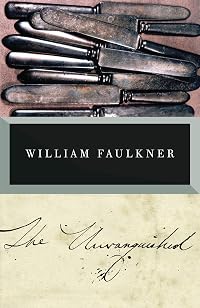
The Unvanquished
by William Faulkner
On This Page
Description
Bayard Sartoris returns from the battlefields of the Civil War and tries to build his family and his fortune.Tags
Recommendations













Member Reviews
The Unvanquished by William Faulkner
This is the story of the Sartoris family, during and shortly after the Civil War, as told by Bayard Sartoris. As the story begins, Bayard's father John is off leading Confederate troops in battle. John's mother-in-law, known to all as Granny, is managing the homeplace. Vicksburg has fallen to Grant's beseiging army, and at least one of the family's slaves is envisioning the fall of the entire Confederacy.
While Col. John is resisting the Union with fire and sword, Granny, Bayard, and his black friend Ringo resist with a nifty grift. Who would believe this whisp of a woman could harbor such gile? But Granny attempts to do business with a small band of rebel deserters who are pilaging and terrorising show more the region, and she's murdered. Bayard and Ringo relentlessly track the gang until the murderer is released to them. They have their revenge.
When the war ends, the colonel returns home to rebuild. He thwarts northern schemers who endeavor to install former slaves in the local government. With a business partner, he develops a railroad. The partnership sours, and Bayard leaves college to avenge his father.
The theme, to my mind, is resistence to suppression. These southerners refuse to be vanquished, by the Union army, by thieves and marauders, by corrupt politicans, by death, even by tradition and convention. Being unvanquished isn't necessarily being triumphant, or even surviving. It is being resolute, strong, clever, persistent, courageous, proud, often perverse.
Faulkner is a challenging writer. Sure he tells the story in those endless sentences, the ones so low-key that you misjudge their power. The narrative is a torrent, an unstoppable rush. I luv it. show less
This is the story of the Sartoris family, during and shortly after the Civil War, as told by Bayard Sartoris. As the story begins, Bayard's father John is off leading Confederate troops in battle. John's mother-in-law, known to all as Granny, is managing the homeplace. Vicksburg has fallen to Grant's beseiging army, and at least one of the family's slaves is envisioning the fall of the entire Confederacy.
While Col. John is resisting the Union with fire and sword, Granny, Bayard, and his black friend Ringo resist with a nifty grift. Who would believe this whisp of a woman could harbor such gile? But Granny attempts to do business with a small band of rebel deserters who are pilaging and terrorising show more the region, and she's murdered. Bayard and Ringo relentlessly track the gang until the murderer is released to them. They have their revenge.
When the war ends, the colonel returns home to rebuild. He thwarts northern schemers who endeavor to install former slaves in the local government. With a business partner, he develops a railroad. The partnership sours, and Bayard leaves college to avenge his father.
The theme, to my mind, is resistence to suppression. These southerners refuse to be vanquished, by the Union army, by thieves and marauders, by corrupt politicans, by death, even by tradition and convention. Being unvanquished isn't necessarily being triumphant, or even surviving. It is being resolute, strong, clever, persistent, courageous, proud, often perverse.
Faulkner is a challenging writer. Sure he tells the story in those endless sentences, the ones so low-key that you misjudge their power. The narrative is a torrent, an unstoppable rush. I luv it. show less
84. The Unvanquished by William Faulkner
OPD: 1938
format: 260-page paperback
acquired: March (from Faulkner House in New Orleans) read: Dec 17-23 time reading: 8:40, 2.0 mpp
rating: 4
genre/style: Classic short stories theme: Faulkner
locations: Yoknapatawpha, county, Mississippi
about the author: 1897-1962. American Noble Laureate who was born in New Albany, MS, and lived most of his life in Oxford, MS.
My 13th book by Faulkner, and by far the easiest to read. It’s kind of like a break. It’s more a boy’s story, and it has a touch of a Huck Finn quality, with a black and white bond boy bond. The race aspect has serious issues but also has a warmth and intimacy within a not very warm environment.
Within Faulkner's Yoknapatawpha books, show more this is the story of the first Bayard Sartoris, who came of age during the American Civil War. Too young to fight, he stays home with his grandmother and their house slaves, while his father goes off to fight. But when the book opens, the Union troops are into Mississippi. During the first story Bayard and his black childhood friend Ringo, a slave, work together to shoot down a Union scout. They kill only a horse, and the Union soldiers are gentle about it. But so begins this complicated view of the war from the losing home front.
The prose is simple, always in Bayard's own voice, but stories are nicely worked out, wandering and paced, and they address a lot of interesting aspects of the war - the Union burning of towns and fine houses, the freed slaves wandering en masse towards who knows where, the sense of loyalty in some slaves, like Ringo, and the sense of injustice in others. Also Women confederate soldiers, and a sense of the outlaw violence as the war ends. Biographers say it's hard to know Faulkner's sources or accuracy of this era that he happens to bring to life. It's not clear how much is imagined or might have come from local lore. But it's an interesting picture regardless.
These are also nicely plotted stories, with the penultimate story capitalizing on everything before and ramping up the tension and sustaining it. This book is, perhaps, a good introduction to Faulkner.
2024
https://www.librarything.com/topic/365030#8705265 show less
OPD: 1938
format: 260-page paperback
acquired: March (from Faulkner House in New Orleans) read: Dec 17-23 time reading: 8:40, 2.0 mpp
rating: 4
genre/style: Classic short stories theme: Faulkner
locations: Yoknapatawpha, county, Mississippi
about the author: 1897-1962. American Noble Laureate who was born in New Albany, MS, and lived most of his life in Oxford, MS.
My 13th book by Faulkner, and by far the easiest to read. It’s kind of like a break. It’s more a boy’s story, and it has a touch of a Huck Finn quality, with a black and white bond boy bond. The race aspect has serious issues but also has a warmth and intimacy within a not very warm environment.
Within Faulkner's Yoknapatawpha books, show more this is the story of the first Bayard Sartoris, who came of age during the American Civil War. Too young to fight, he stays home with his grandmother and their house slaves, while his father goes off to fight. But when the book opens, the Union troops are into Mississippi. During the first story Bayard and his black childhood friend Ringo, a slave, work together to shoot down a Union scout. They kill only a horse, and the Union soldiers are gentle about it. But so begins this complicated view of the war from the losing home front.
The prose is simple, always in Bayard's own voice, but stories are nicely worked out, wandering and paced, and they address a lot of interesting aspects of the war - the Union burning of towns and fine houses, the freed slaves wandering en masse towards who knows where, the sense of loyalty in some slaves, like Ringo, and the sense of injustice in others. Also Women confederate soldiers, and a sense of the outlaw violence as the war ends. Biographers say it's hard to know Faulkner's sources or accuracy of this era that he happens to bring to life. It's not clear how much is imagined or might have come from local lore. But it's an interesting picture regardless.
These are also nicely plotted stories, with the penultimate story capitalizing on everything before and ramping up the tension and sustaining it. This book is, perhaps, a good introduction to Faulkner.
2024
https://www.librarything.com/topic/365030#8705265 show less
One of the more accessible of Faulkner's novels I've read, but still requiring a good deal of retracing passages and allowing the narrative to teach you how to read it. Which is some of the most fun of reading Faulkner, I often think. My favorite part about The Unvanquished was the way Faulkner puts the setting and the time period on the page. I felt very immersed in the rural Civil War south while reading and in the end thought maybe I understood something a little that I wouldn't have before.
Read this book in order to understand the culture of the South during and shortly after the Civil War--Faulkner's view of it, anyway. It's a collection of related short stories in chronological order, and the last story, "An Odor of Verbena," is key. "An Odor of Verbena," which concerns dueling, the demand for violent revenge to satisfy family honor, and the human cost of such a culture, was required reading in the Southern American culture course I took.
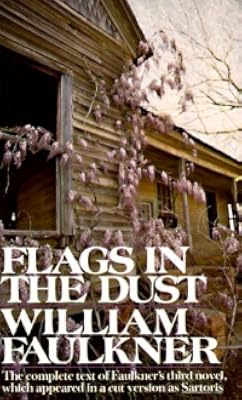
Flags in the Dust, Faulkner's other book (a novel proper) about the Sartoris family, was written first but is set 40-50 years later; Bayard Sartoris, the young protagonist of The Unvanquished, is an old man in Flags in the Dust. So read The Unvanquished first for an introduction to the show more Sartoris family. (I mistakenly did the opposite.) show less
Flags in the Dust, Faulkner's other book (a novel proper) about the Sartoris family, was written first but is set 40-50 years later; Bayard Sartoris, the young protagonist of The Unvanquished, is an old man in Flags in the Dust. So read The Unvanquished first for an introduction to the show more Sartoris family. (I mistakenly did the opposite.) show less
A glimpse of Civil War history through the eyes of a child living through it, along with his best friend, the slave boy who is probably his brother. As the Yankees start winning and burn the mansions and steal the meager treasures holed up by families, the slave boy is only confused and frightened by his "freedom". Grandma finds a way to provide for those around her by claiming the return of her fortuitous-named Yankee-appropriated mule "Old One Hundred".
Great collection of short stories that are exciting and fun to read. Bayard grows up as the stories proceed, and so the stories become slightly more critical of the South, but it is mostly the difference between what the characters do and how the reader reacts that reveals the critique. Also, this novel features Drusilla Hawk, one of my new favorite women of modernist lit.
Great collection of short stories that are exciting and fun to read. Bayard grows up as the stories proceed, and so the stories become slightly more critical of the South, but it is mostly the difference between what the characters do and how the reader reacts that reveals the critique. Also, this novel features Drusilla Hawk, one of my new favorite women of modernist lit.
Members
- Recently Added By
Lists

20th Century Literature
1,161 works; 55 members

1930s
262 works; 5 members

history
12 works; 1 member

Llibres que he llegit el 2025
81 works; 2 members
Author Information

462+ Works 99,040 Members
Born in an old Mississippi family, William Faulkner made his home in Oxford, seat of the University of Mississippi. After the fifth grade he went to school only off and on-lived, read, and wrote much as he pleased. In 1918, refusing to enlist with the "Yankees," he joined the Canadian Air Force, and was transferred to the British Royal Air Force. show more After the war he studied a little at the University, did house painting, worked as a night superintendent at a power plant, went to New Orleans and became a friend of Sherwood Anderson, then to Europe and back home to Oxford. By this time he had written two novels. The Sound and the Fury followed in 1929. Financial success came with Sanctuary in 1931, which he assisted in filming. Faulkner 's novels are intense in their character portrayals of disintegrating Southern aristocrats, poor whites, and African Americans. A complex stream-of-consciousness rhetoric often involves Faulkner in lengthy sentences of anguished power. Most of his tales are set in the mythical Yoknapatawpha County, Mississippi, and are characterized by the use of many recurring characters from families of different social levels spanning more than a century. His best subjects are the old, dying South and the newer materialistic South. As I Lay Dying (1930), is a grotesquely tragicomic story about a family of poor southern whites. With Absalom, Absalom! (1936); the difficult parts of his famous short novel "The Bear" (published in Go Down, Moses, 1942); and the allegorical A Fable (1954), a non-Yoknapatawpha novel set in France during World War I; Faulkner returned to an innovative and difficult style that most readers have trouble with. Yet, interspersed among such works are collections of easily read stories originally published in popular magazines. There seems to be a growing sentiment among critics that the Snopes trilogy-The Hamlet (1940), The Town (1957), and The Mansion (1959)-for the most part an example of Faulkner's "moderate" style, could well be among his most important works. Faulkner was awarded the 1949 Nobel Prize for literature "for his powerful and artistically independent contribution to the new American novel," but it would appear now that he also deserved to win that honor for his contribution to world literature. When reporting his death, the Boston Globe quoted Faulkner's having once told an interviewer: "Since man is mortal, the only immortality for him is to leave something behind him that is immortal since it will always move. That is the artist's way of scribbling "Kilroy was here" on the wall of the final and irrevocable oblivion through which he must some day pass." In addition to the Nobel Prize, Faulkner received the Howells Medal of the American Academy of Arts and Letters in 1950, and in 1951 he was given the National Book Award for his Collected Stories Collected Stories. For his novel A Fable he received the National Book Award for the second time, as well as the Pulitzer Prize in 1955. The Reivers (1962) was awarded the Pulitzer Prize in 1963. In 1957 and 1958, he was the University of Virginia's first writer-in-residence, and in January 1959 he accepted an appointment as consultant on contemporary literature to the Alderman Library of that university. Although Faulkner was not without honors in his lifetime and has received world recognition since then, it is surprising to learn that, when Malcolm Cowley edited The Portable Faulkner in 1946, he found that almost all of Faulkner's books were out of print. By arranging selections from the works to form a continuous chronicle, Cowley deserves much of the credit for making readers aware of the way in which Faulkner was creating a fictive world on a scale grander than that of any novelist since Balzac. William Faulkner died in Oxford, Mississippi, in 1962. (Bowker Author Biography) show less
Some Editions
Awards and Honors
Notable Lists
Series
Belongs to Publisher Series
Grote Beren (15)
De twintigste eeuw (37)
Work Relationships
Is contained in
Has as a concordance
Has as a student's study guide
Common Knowledge
- Canonical title
- The Unvanquished
- Original title
- The Unvanquished
- Alternate titles*
- Onoverwinnelijk
- Original publication date
- 1938
- People/Characters
- Bayard Sartoris; John Sartoris (Colonel); Ringo; Rosa Millard; Drusilla; Louvinia
- Important places
- Yoknapatawpha County, Mississippi, USA; Mississippi, USA
- Important events
- American Civil War (1861 | 1865)
- First words
- Behind the smokehouse that summer, Ringo and I had a living map.
- Last words
- (Click to show. Warning: May contain spoilers.)I thought that until I had crossed the room and looked down at the pillow on which it lay—the single sprig of it (without looking she would pinch off a half dozen of them and they would be all of a size, almost all of a shape, as if a machine had stamped them out) filling the room, the dusk, the evening with that odor which she said you could smell alone above the smell of horses.
- Original language
- English
*Some information comes from Common Knowledge in other languages. Click "Edit" for more information.
Classifications
Statistics
- Members
- 2,203
- Popularity
- 9,153
- Reviews
- 17
- Rating
- (3.66)
- Languages
- 14 — Catalan, Danish, Dutch, English, Finnish, French, German, Greek, Italian, Norwegian (Bokmål), Polish, Spanish, Swedish, Portuguese (Portugal)
- Media
- Paper, Audiobook, Ebook
- ISBNs
- 36
- UPCs
- 1
- ASINs
- 49