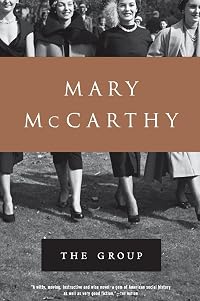
The Group
by Mary McCarthy
On This Page
Description
This smash bestseller about privileged Vassar classmates shocked America in the sixties and remains "juicy . . . witty . . . brilliant" (Cosmopolitan). At Vassar, they were known as "the group"--eight young women of privilege, the closest of friends, an eclectic mix of vibrant personalities. A week after graduation in 1933, they all gather for the wedding of Kay Strong, one of their own, before going their separate ways in the world. In the years that follow, they will each know show more accomplishment and loss in equal measure, pursuing careers and marriage, experiencing the joys and traumas of sexual awakening and motherhood, all while suffering through betrayals, infidelities, and sometimes madness. Some of them will drift apart. Some will play important roles in the personal dramas of others. But it is tragedy that will ultimately unite the group once again. A novel that stunned the world when it was first published in 1963, Mary McCarthy's The Group found acclaim, controversy, and a place atop the New York Times bestseller list for nearly two years for its frank and controversial exploration of women's issues, social concerns, and sexuality. A blistering satire of the mores of an emergent generation of women, The Group is McCarthy's enduring masterpiece, still as relevant, powerful, and wonderfully entertaining fifty years on. This ebook features an illustrated biography of Mary McCarthy including rare images from the author's estate. show lessTags
Recommendations



















Member Recommendations

JuliaMaria Die Erinnerungen beziehen sich auf den Zeitraum ihres Literaturstudiums am Vassar-College. "Die Clique" hat hier ihren Ursprung.


Member Reviews
Read this for my Zoom book club. Rather, it was a reread—I think I first read it when I was in my early 20s, but so much of what makes it a really meaty novel just went right over my head. Which makes me marvel at how truly oblivious I must have been at that age, despite having been raised in a reasonably aware liberal household and living in NYC. I just wasn't a political animal, I guess, because the big themes she shifts around with her eight or so main characters—class and sexism, mainly, with a little anti-Semitism and racism thrown in—did not weigh in my mind at the time, as I remember.
This time around I found it all fascinating and horrifying, as well as an entertaining read, a slow burn of amusing, annoying, satirical, and show more then appalling—kind of a rear-view-mirror dystopia, published the year I was born and all the more unsettling for that intersection into my own time line. Especially given the recent Supreme Court rollback of Roe... it's not as far back in the rear-view mirror as I'd like it to be, these days.
Anyway, too much going on in the book (Vassar grads in the 1930s moving through young adulthood, trials both of the time and timeless, and some really awful men) to describe, but it's worth a read for sure. And it made for a very good book club discussion. show less
This time around I found it all fascinating and horrifying, as well as an entertaining read, a slow burn of amusing, annoying, satirical, and show more then appalling—kind of a rear-view-mirror dystopia, published the year I was born and all the more unsettling for that intersection into my own time line. Especially given the recent Supreme Court rollback of Roe... it's not as far back in the rear-view mirror as I'd like it to be, these days.
Anyway, too much going on in the book (Vassar grads in the 1930s moving through young adulthood, trials both of the time and timeless, and some really awful men) to describe, but it's worth a read for sure. And it made for a very good book club discussion. show less
The premise of The Group isn't very promising, on the face of it: an account of a bunch of overprivileged American young women (Vassar Class of '33) making the transition from student life to adulthood in New York City. It's the plot of every romantic comedy, and Virago have made sure you don't miss the point by commissioning the author of Sex and the city to write the introduction.
Except that - of course - whilst McCarthy draws heavily on the imagery, set-piece scenes and language of romantic comedy as well as its plot conventions (even to the extent of having a chapter written from the POV of an English Butler in an obvious Wodehouse-pastiche), there is no way that anyone could possibly mistake this for a conventional romantic show more comedy. A few pages into the book we are dropped into a detailed and decidedly unerotic description of a young woman's first experience of sexual intercourse, making it abundantly clear to the reader that we are as far away from Lady Chatterley as we are from Jill the reckless. And in case we might still have any delusions about that, we then get a whole chapter on the diaphragm. Later on in the book, McCarthy takes on other sensitive topics, including domestic violence, breast-feeding, rival theories of baby-care, the abuses of psychiatric medicine, Lesbianism (still determinedly large-L in McCarthy's day), and burial practices. This was all written at a time when battles over literary censorship were still raging in most English-speaking countries, and publishers were far from sure that you could get away with talking about such things in print (but they were always willing to try, knowing that controversial books sell like hot cakes...).
There's clearly a roman à clef aspect as well, since she draws quite heavily on her own life for subject-matter (even to the extent of giving one of the most unsympathetic characters the name and occupation of her own first husband...). And McCarthy makes no attempt to hide her left-wing political views, although she does poke a bit of fun at her former Trotskyist affiliation.
The fact that a book broke taboos in 1963 doesn't necessarily make it worth reading now. So what else does McCarthy have to offer? I got a lot of pleasure from her very precise, ironic use of language. She is constantly subverting the idiom of romance by slipping in some ostensibly harmless expression that actually turns the sense of the whole passage on its head. There are hundreds of examples in the text: one that particularly struck me is the scene where the horrible Harald has committed his perfectly sane wife to a mental hospital and spends the day wandering aimlessly around the city thinking about the enormity of what he's just done. Amongst other things, he visits the zoo and looks at "his ancestors, the apes". In context, you hardly notice it going past, but when you've read that you know exactly what to think of Harald and you're not in the least surprised that his conscience does not win out over his desire to get his wife out of the way. Maybe that sort of thing is more a columnist's trick than a building block for a big literary structure, but it does make sure you keep on reading attentively.
The other reason for reading the book today, and probably the important one, is for what it tells us about the way the dominant ideology defines roles for women. The characters in the book have been brought up to see themselves as the crème de la crème (to borrow a phrase from another fifties book about women in the thirties) of the coming generation in America. They have completed an education that should qualify them to go anywhere and do anything, and most of them have the kind of dynastic support and financial resources that ought to mean no door is closed to them. Some of them are the daughters of women who were prominent in the struggle for women's education and the vote. Most have left college with the idea of changing the world (as we all do...), yet by the end of the book, none of them seems to have retained enough belief in herself to achieve anything professionally: sooner or later they all end up measuring success or failure in terms of husbands, babies, furniture and designer clothes. The corollary of this should presumably be "if they can't manage it, what hope is there for working-class women?" - but it isn't really very evident from the book that any of the characters, or even the author, is really aware that working-class women exist (except for faintly comic black maidservants, and they seem to become invisible when off duty too). So I suspect that we might just be reading that into it. show less
Except that - of course - whilst McCarthy draws heavily on the imagery, set-piece scenes and language of romantic comedy as well as its plot conventions (even to the extent of having a chapter written from the POV of an English Butler in an obvious Wodehouse-pastiche), there is no way that anyone could possibly mistake this for a conventional romantic show more comedy. A few pages into the book we are dropped into a detailed and decidedly unerotic description of a young woman's first experience of sexual intercourse, making it abundantly clear to the reader that we are as far away from Lady Chatterley as we are from Jill the reckless. And in case we might still have any delusions about that, we then get a whole chapter on the diaphragm. Later on in the book, McCarthy takes on other sensitive topics, including domestic violence, breast-feeding, rival theories of baby-care, the abuses of psychiatric medicine, Lesbianism (still determinedly large-L in McCarthy's day), and burial practices. This was all written at a time when battles over literary censorship were still raging in most English-speaking countries, and publishers were far from sure that you could get away with talking about such things in print (but they were always willing to try, knowing that controversial books sell like hot cakes...).
There's clearly a roman à clef aspect as well, since she draws quite heavily on her own life for subject-matter (even to the extent of giving one of the most unsympathetic characters the name and occupation of her own first husband...). And McCarthy makes no attempt to hide her left-wing political views, although she does poke a bit of fun at her former Trotskyist affiliation.
The fact that a book broke taboos in 1963 doesn't necessarily make it worth reading now. So what else does McCarthy have to offer? I got a lot of pleasure from her very precise, ironic use of language. She is constantly subverting the idiom of romance by slipping in some ostensibly harmless expression that actually turns the sense of the whole passage on its head. There are hundreds of examples in the text: one that particularly struck me is the scene where the horrible Harald has committed his perfectly sane wife to a mental hospital and spends the day wandering aimlessly around the city thinking about the enormity of what he's just done. Amongst other things, he visits the zoo and looks at "his ancestors, the apes". In context, you hardly notice it going past, but when you've read that you know exactly what to think of Harald and you're not in the least surprised that his conscience does not win out over his desire to get his wife out of the way. Maybe that sort of thing is more a columnist's trick than a building block for a big literary structure, but it does make sure you keep on reading attentively.
The other reason for reading the book today, and probably the important one, is for what it tells us about the way the dominant ideology defines roles for women. The characters in the book have been brought up to see themselves as the crème de la crème (to borrow a phrase from another fifties book about women in the thirties) of the coming generation in America. They have completed an education that should qualify them to go anywhere and do anything, and most of them have the kind of dynastic support and financial resources that ought to mean no door is closed to them. Some of them are the daughters of women who were prominent in the struggle for women's education and the vote. Most have left college with the idea of changing the world (as we all do...), yet by the end of the book, none of them seems to have retained enough belief in herself to achieve anything professionally: sooner or later they all end up measuring success or failure in terms of husbands, babies, furniture and designer clothes. The corollary of this should presumably be "if they can't manage it, what hope is there for working-class women?" - but it isn't really very evident from the book that any of the characters, or even the author, is really aware that working-class women exist (except for faintly comic black maidservants, and they seem to become invisible when off duty too). So I suspect that we might just be reading that into it. show less
A political, economic and social snapshot of particular people in particular times, the novel is a window into the lives of at least eight Vassar-graduate women during 30s America - that unusual period of flux in (American) history anchored on either side by the Depression and WWII.
The story is thoughtful in the analyses of its characters: their privileges, their vanities, their rebellion towards the rigidity of their parents' era and their burgeoning ideas of feminism, their encounters and reactions to patriarchal hierarchies, their own newly developed intellectual pretensions battling with their ingrained social pretensions. The novel puts their hypocrisy and denial on full display, not to condemn them, but to acknowledge and show more contextualise their flaws without excusing their actions.
It tackles some incredibly prevalent issues, such as birth control, sexuality, domestic abuse and in/dependence within a marriage. It is disheartening to be reminded again of the paradoxical expectations placed on women, especially these educated women who are applauded for their independence, yet who are still expected to fulfil all the "traditional" aspects of being a nurturing homebound subservient mother.
With Life as the only overarching plot here, the book is still nevertheless thoroughly engaging, with just the right amount of depth of characterisation for the breadth of characters it had. show less
The story is thoughtful in the analyses of its characters: their privileges, their vanities, their rebellion towards the rigidity of their parents' era and their burgeoning ideas of feminism, their encounters and reactions to patriarchal hierarchies, their own newly developed intellectual pretensions battling with their ingrained social pretensions. The novel puts their hypocrisy and denial on full display, not to condemn them, but to acknowledge and show more contextualise their flaws without excusing their actions.
It tackles some incredibly prevalent issues, such as birth control, sexuality, domestic abuse and in/dependence within a marriage. It is disheartening to be reminded again of the paradoxical expectations placed on women, especially these educated women who are applauded for their independence, yet who are still expected to fulfil all the "traditional" aspects of being a nurturing homebound subservient mother.
With Life as the only overarching plot here, the book is still nevertheless thoroughly engaging, with just the right amount of depth of characterisation for the breadth of characters it had. show less
Ouch! This one has not aged well at all. McCarthy follows a group of eight Vassar friends through their early adulthood. I can see why this book might have been something of a sensation in its day: the characters discuss sex, relationships and birth control forthrightly, and it's obvious that McCarthy wants to tell her curious readers all about the life that awaits modern working women after graduation. Still, her attempt at social realism is badly undercut by, among other things, the large amount of soap opera schmaltz that she throws into the mix. She has a bad habit of describing her characters by telling and not showing; some of her descriptions wouldn't be out of place in the captions to a Vogue fashion spread. McCarthy seems to do show more better when she gives her characters a bit more room to develop. A couple of her characters, such as Polly Andrews, a nurse, or Libby MacAusland, who wants to work in publishing, evolve into well-rounded protagonists, but, in this case, eight is probably too much. I suspect that "The Group" might have worked better if its membership had been cut in half. Also, while one hears a lot about "male" and "female" writing these days, McCarthy's prose strikes me as "female" in a particularly uncomplimentary way. Gossipy, prim, and condescending in more or less equal measure, McCarthy succeeds in making her college gals sound shallower and less intelligent than she probably intended.
There are other problems here, too. While the blood at the Seven Sisters probably ran a bit bluer in the thirties than it does today, every member of the titular group seems to be wealthy, fashionable, and pretty. It's a pleasant-enough fantasy, sure, but it makes it difficult for this reader to take these characters, and the author who created them, very seriously. "The Group" suffers from an early version of what we might call the "Sex in the City" problem: McCarthy can't seem to decide whether she's critiquing her characters' privileged upbringings and social presumption or celebrating them. Too often, I feel it's the latter; the book is riddled with brand names, upper-class signifiers and loving descriptions of luxury goods. At the same time, she seems to vaguely resent her characters' presumably insincere dabbling in leftist politics, proving, perhaps, that some social grudges seem to seem to endure down through the generations. Heck, add a few tattoos, vegan tacos, and fixie bikes and "The Group" could tell the story of contemporary Brooklyn hipsters. I hope I haven't just given some aspiring writer an idea; I doubt very much that a Williamsburg version of "The Group" would be any better than McCarthy's original. Readers who don't go all soft when handsome young doctors propose marriage to their put-upon nurses are encouraged to skip this particular product of its time. show less
There are other problems here, too. While the blood at the Seven Sisters probably ran a bit bluer in the thirties than it does today, every member of the titular group seems to be wealthy, fashionable, and pretty. It's a pleasant-enough fantasy, sure, but it makes it difficult for this reader to take these characters, and the author who created them, very seriously. "The Group" suffers from an early version of what we might call the "Sex in the City" problem: McCarthy can't seem to decide whether she's critiquing her characters' privileged upbringings and social presumption or celebrating them. Too often, I feel it's the latter; the book is riddled with brand names, upper-class signifiers and loving descriptions of luxury goods. At the same time, she seems to vaguely resent her characters' presumably insincere dabbling in leftist politics, proving, perhaps, that some social grudges seem to seem to endure down through the generations. Heck, add a few tattoos, vegan tacos, and fixie bikes and "The Group" could tell the story of contemporary Brooklyn hipsters. I hope I haven't just given some aspiring writer an idea; I doubt very much that a Williamsburg version of "The Group" would be any better than McCarthy's original. Readers who don't go all soft when handsome young doctors propose marriage to their put-upon nurses are encouraged to skip this particular product of its time. show less
This brilliant social document (to paraphrase the quote on the book cover) tells the stories of several savvy Vassar grads with varying and dynamic personalities, careers, political persuasions, and personal affairs--who all interact in and around New York City. It's filled with satire and historical imagery and taught me tons about the political atmosphere in the 1930s (it was written around 1960). McCarthy is wonderful--she was a frequent New Yorker contributor and wrote these full-bodied characters astutely and intelligently and lovingly.
It's unfortunate that time has not already proven this novel a classic. Besides when I saw Betty Draper read it on Mad Men (Weiner loves those time stamps, y'all) and when an older man saw my copy show more and said he "hadn't seen anyone reading that in over 35 years," I've never encountered another person who's heard of it. It was the #1 best seller in 1964 and apparently every woman had her nose in it that year. Wish more men would read this. But, with a cast full of ladies, it's been pegged as a woman's novel ever since publication. show less
It's unfortunate that time has not already proven this novel a classic. Besides when I saw Betty Draper read it on Mad Men (Weiner loves those time stamps, y'all) and when an older man saw my copy show more and said he "hadn't seen anyone reading that in over 35 years," I've never encountered another person who's heard of it. It was the #1 best seller in 1964 and apparently every woman had her nose in it that year. Wish more men would read this. But, with a cast full of ladies, it's been pegged as a woman's novel ever since publication. show less
After tearing through Mary McCarthy's The Group, I'm kinda shocked that it hasn't been inducted into the canon yet. The book is a stunning, scary look at gender relations in the 1930s, yet so searing that it's a shock to see it was written in the 1950s. Even Mad Men, written from the perspective of today's improvements, isn't as damning as McCarthy can be about the oppression of the time.
McCarthy gets quite a bit out of the tension between characters being comedically wrong and worryingly wrong. And that's putting it lightly; some of the dialogue can be absolutely chilling, especially the prisoners who have learned to love their prison. Each of the characters seems promising and aware of their times, until they incidentally slip into show more some pattern of behavior that perpetuates the oppression of women at the time.
As far as those patterns of behavior, McCarthy has wonderful treatments of internal dialogues and how women at the time sort of reasoned their way through the world. More than their actions, it shows the assumptions and prejudices they worked under, and the rationalizations that justified horrible results for themselves. There's also a tremendous insecurity from the expectations of the day, primarily marriage.
So many of the dialogues would start with the character considering something and, like pulling on a sweater's thread, slowly unraveling what they thought they knew. Sometimes it's accurate, but most of the time you get the sense that they're just running around in circles missing some central lacuna. And so many of the dialogues pulled from the pop-psychology of the day, primarily Freud's. It's hard to imagine today how large his impact was, but at the time it rivaled Darwin's (and possibly exceeded).
Sometimes McCarthy steps back and looks at things from an incidental character's point of view, showing how these young women are perceived—and in that perception, constrained—by men and older women. There are yet other episodes that show the fruitless of their analysis and pop-psychology by upturning one character's inferences using the experience of another. in one memorable case, she has one character remember a party that was already described matter-of-factly, except this character's rememberance is overtaken by a single, surprising urge.
I was surprised by how much the novel was also focused on class: how it in some senses liberated the women of the novel to worry less about material needs, but at the same time gave them more to lose if they worked against the social order. It's hard to say whether class lended itself to more or less equitable relations—I'd guess more because these women had access to education, but it's hard to tell given the shared social background of most characters. It would certainly vary dramatically by region though, with women in East Texas not yet receiving electricity and expected to perform any number of back-breaking duties in a day.
That's not to say that our monied characters don't have terrifying experiences of their own. The mental ward chapter was especially scary, having gone through a similar experience myself. Kay's admission is still very similar to how it's done today, and is enough to drive one to madness if they weren't already there. Public mental health care in the US is like maintaining a fire department without fire codes, and it hasn't markedly improved in the last 80 years. One's husband cannot trap you in the ward merely on his say-so, but the criteria for release are still frustratingly vague.
This is in many ways a tremendously important novel to read today, even though things have certainly improved for the better. Most people today understand that it was bad for women in the past, but it's hard to imagine the ways that such oppression sustained itself. For so many historical studies of sexism and racism, it's a tempting answer to just say they were dumber back in the day; while this is somewhat true when you consider lead-poisoning and alcohol consumption of the day, it's a dangerously incomplete answer. Grappling with the particulars of how we demeaned women is gruesome but necessary so we understand that oppression doesn't come in flashing neon. It slips into your very ways of thinking, masquerading as a web of supporting assumptions that can't be eliminated until the entire system has been unmasked and hacked away. show less
McCarthy gets quite a bit out of the tension between characters being comedically wrong and worryingly wrong. And that's putting it lightly; some of the dialogue can be absolutely chilling, especially the prisoners who have learned to love their prison. Each of the characters seems promising and aware of their times, until they incidentally slip into show more some pattern of behavior that perpetuates the oppression of women at the time.
As far as those patterns of behavior, McCarthy has wonderful treatments of internal dialogues and how women at the time sort of reasoned their way through the world. More than their actions, it shows the assumptions and prejudices they worked under, and the rationalizations that justified horrible results for themselves. There's also a tremendous insecurity from the expectations of the day, primarily marriage.
So many of the dialogues would start with the character considering something and, like pulling on a sweater's thread, slowly unraveling what they thought they knew. Sometimes it's accurate, but most of the time you get the sense that they're just running around in circles missing some central lacuna. And so many of the dialogues pulled from the pop-psychology of the day, primarily Freud's. It's hard to imagine today how large his impact was, but at the time it rivaled Darwin's (and possibly exceeded).
Sometimes McCarthy steps back and looks at things from an incidental character's point of view, showing how these young women are perceived—and in that perception, constrained—by men and older women. There are yet other episodes that show the fruitless of their analysis and pop-psychology by upturning one character's inferences using the experience of another. in one memorable case, she has one character remember a party that was already described matter-of-factly, except this character's rememberance is overtaken by a single, surprising urge.
I was surprised by how much the novel was also focused on class: how it in some senses liberated the women of the novel to worry less about material needs, but at the same time gave them more to lose if they worked against the social order. It's hard to say whether class lended itself to more or less equitable relations—I'd guess more because these women had access to education, but it's hard to tell given the shared social background of most characters. It would certainly vary dramatically by region though, with women in East Texas not yet receiving electricity and expected to perform any number of back-breaking duties in a day.
That's not to say that our monied characters don't have terrifying experiences of their own. The mental ward chapter was especially scary, having gone through a similar experience myself. Kay's admission is still very similar to how it's done today, and is enough to drive one to madness if they weren't already there. Public mental health care in the US is like maintaining a fire department without fire codes, and it hasn't markedly improved in the last 80 years. One's husband cannot trap you in the ward merely on his say-so, but the criteria for release are still frustratingly vague.
This is in many ways a tremendously important novel to read today, even though things have certainly improved for the better. Most people today understand that it was bad for women in the past, but it's hard to imagine the ways that such oppression sustained itself. For so many historical studies of sexism and racism, it's a tempting answer to just say they were dumber back in the day; while this is somewhat true when you consider lead-poisoning and alcohol consumption of the day, it's a dangerously incomplete answer. Grappling with the particulars of how we demeaned women is gruesome but necessary so we understand that oppression doesn't come in flashing neon. It slips into your very ways of thinking, masquerading as a web of supporting assumptions that can't be eliminated until the entire system has been unmasked and hacked away. show less
Reading this book is like drinking a very dry gin martini (shaken, not stirred). Closely observed, carefully described, always acerbic - this was a real pleasure.
I remember skimming through this at my Seattle grandmother's house when I was in high school. At that point I was mostly shocked that someone had written so frankly about sex during the 1930's ("They had SEX in the 1930's? Really?") - teenagers are always a bit surprised to discover a whole world out there that is outside of their own experience. I tucked the book away in the back of my mind as something I should read at some point. I am currently reading books that were published in my birth year and this was the first. If it is any evidence of the quality of writing in 1963 show more then it was a great year for more than just me! I was completely floored by how wonderful this book was.
Written almost more as a series of short stories about the women in the group, the stories are tied together by Vassar, a wedding (at the beginning), and a funeral (at the end). In between are stories I will never forget. A Particular standout for me is Chapter 2, wherein Dottie loses her virginity. Ms. McCarthy truly captures the universal awkwardness of this event along with its own attendant pleasant surprises and does so in effortless intelligent prose. I loved one of the minor characters, Noreen Schmittlapp - utterly contemptible in some ways and yet so admirable in her ability to flaunt convention - she's a gorgeous counterpoint to some of the other more downtrodden and conventional characters.
This book makes me grateful that I was born during the era of Our Bodies, Ourselves instead of relying on Kraft-Ebbing for my education on human sexuality. I am glad that I have more choices than these women did (What the hell did they get such great educations for, anyway, if all that was on offer was to keep house? Better cocktail party conversation?). I am glad that I can't be institutionalized for objecting to a spouse's affairs and physical abuse (at least not easily).
I was just as struck, however, by the way some things endure - watch any one of the dozens of bridal shows on television right now and boggle along with me at the notion that this is a woman's only day, the most important dress she'll ever spend too much money on, the ne plus ultra of life - the more things change, the more they stay same (factoring in inflation, of course). show less
I remember skimming through this at my Seattle grandmother's house when I was in high school. At that point I was mostly shocked that someone had written so frankly about sex during the 1930's ("They had SEX in the 1930's? Really?") - teenagers are always a bit surprised to discover a whole world out there that is outside of their own experience. I tucked the book away in the back of my mind as something I should read at some point. I am currently reading books that were published in my birth year and this was the first. If it is any evidence of the quality of writing in 1963 show more then it was a great year for more than just me! I was completely floored by how wonderful this book was.
Written almost more as a series of short stories about the women in the group, the stories are tied together by Vassar, a wedding (at the beginning), and a funeral (at the end). In between are stories I will never forget. A Particular standout for me is Chapter 2, wherein Dottie loses her virginity. Ms. McCarthy truly captures the universal awkwardness of this event along with its own attendant pleasant surprises and does so in effortless intelligent prose. I loved one of the minor characters, Noreen Schmittlapp - utterly contemptible in some ways and yet so admirable in her ability to flaunt convention - she's a gorgeous counterpoint to some of the other more downtrodden and conventional characters.
This book makes me grateful that I was born during the era of Our Bodies, Ourselves instead of relying on Kraft-Ebbing for my education on human sexuality. I am glad that I have more choices than these women did (What the hell did they get such great educations for, anyway, if all that was on offer was to keep house? Better cocktail party conversation?). I am glad that I can't be institutionalized for objecting to a spouse's affairs and physical abuse (at least not easily).
I was just as struck, however, by the way some things endure - watch any one of the dozens of bridal shows on television right now and boggle along with me at the notion that this is a woman's only day, the most important dress she'll ever spend too much money on, the ne plus ultra of life - the more things change, the more they stay same (factoring in inflation, of course). show less
Members
- Recently Added By
Lists

The Guardian's 1000 Novels Everyone Must Read
1,005 works; 552 members

Best Historical Fiction
620 works; 262 members

501 Must-Read Books
529 works; 72 members

Female Author
1,234 works; 65 members

Top Five Books of 2013
1,562 works; 721 members

Read the book and saw the movie
1,170 works; 195 members

Recommend the 20 best books you've read in the last five years
2,168 works; 609 members
Books That Changed Me
158 works; 46 members

In or About the 1930s
198 works; 27 members

Books I've Read More Than Once
602 works; 49 members

500 Great Books by Women
507 works; 60 members

1950s
340 works; 22 members

50 Books by Women Authors
50 works; 10 members
Literature About Women and Girls
426 works; 41 members
TML 200 Best Books 1950-1999
202 works; 10 members

Summer Reads 2014
207 works; 70 members

A Novel Cure
742 works; 23 members

Publisher's Weekly Bestsellers - Part II - 1940 - 1979
355 works; 6 members

Mad Men Reading List
25 works; 5 members
discontinued
24 works; 4 members

Books Read in 2016
4,666 works; 199 members
The Complete Rory Gilmore Reading List
506 works; 5 members
My Mad Men Reading List
47 works; 1 member

Books Featured on Gilmore Girls
307 works; 21 members
National Book Award Finalists - Fiction
377 works; 12 members

The Atlantic's The Great American Novel
136 works; 12 members
Read These Too
458 works; 9 members

The Modern Library (The Two Hundred Best Novels....
202 works; 1 member
Talk Discussions
Past Discussions
The Group by Mary McCarthy: Spoilers allowed in Girlybooks (May 2014)
Author Information

43+ Works 7,587 Members
Some Editions
Awards and Honors
Series
Belongs to Publisher Series
Work Relationships
Common Knowledge
- Canonical title*
- Il gruppo
- Original title
- The Group
- Original publication date
- 1963
- People/Characters
- Elinor "Lakey" Eastlake; Pokey Prothero; Libby MacAusland; Kay Leiland Petersen-Strong; Harald Petersen; Dottie Renfrew (show all 10); Polly Andrews; Norine Schmittlapp; Priss Hartshorn; Helena Davison
- Important places
- Vassar College, Poughkeepsie, New York, USA; New York, New York, USA
- Related movies
- The Group (1966 | IMDb)
- First words
- It was June, 1933, one week after Commencement, when Kay Leiland Strong, Vassar '33, the first of her class to run around the table at the Class Day dinner, was married to Harald Petersen, Reed '27, in the chapel of St. Georg... (show all)e's Church, P.E., Karl F. Reiland, Rector.
My mother introduced me to The Group when I was a teenager. (Introduction) - Quotations
- Libby took special pains with her reports ... typing them triple-spaced on a kind of sky-blue typing paper that was still manufactured in one of the mills in Pittsfield and stapling them in stiff blue covers.
One of the big features of living alone was that you could talk to yourself all you wanted and address imaginary audiences, running the gamut of emotions. - Last words
- (Click to show. Warning: May contain spoilers.)She drove on following the cortege, watching him in the rear-view mirror as he crossed the road and stood, thumbing a ride, while cars full of returning mourners glided past him, back to New York.
(Click to show. Warning: May contain spoilers.)I'm also quite sure I'll never be able to pull off a book like The Group, but McCarthy will always inspire me. (Introduction) - Blurbers
- Mantel, Hilary; Keyes, Marian; Knight, India; Waters, Sarah
- Original language
- English
- Canonical DDC/MDS
- 813.54
- Canonical LCC
- PS3525.A1435
*Some information comes from Common Knowledge in other languages. Click "Edit" for more information.
Classifications
Statistics
- Members
- 2,566
- Popularity
- 7,467
- Reviews
- 55
- Rating
- (3.73)
- Languages
- 12 — Danish, Dutch, English, Finnish, French, German, Hungarian, Italian, Polish, Portuguese, Spanish, Swedish
- Media
- Paper, Audiobook, Ebook
- ISBNs
- 67
- UPCs
- 1
- ASINs
- 49