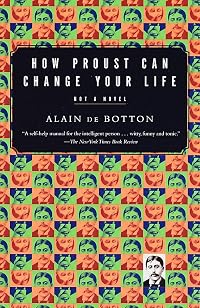
How Proust Can Change Your Life
by Alain de Botton
On This Page
Description
The starting point of How Proust can change your Life is that a great novel can be nothing less than life-transforming. This is an unusual claim: our education system, while stressing that novels are highly worthwhile, rarely investigates why this is so. How Proust can change your Life takes Marcel Proust's In Search of Lost Time as the basis for a sustained investigation into the power and significance of literature. Proust's novel, almost a byword for obscurity and irrelevance, emerges as show more an invaluable source of insight into the workings of love, society, art and the meaning of existence. The book reveals Proust's thoughts on how to revive a relationship, choose a good doctor, enjoy a holiday, make friends and respond to insult. A vivid portrait of the eccentric yet deeply sympathetic author is built up out of extracts from his letters, essays and fiction and is combined with a commentary on the power of literature to change our lives. A self-help book like few others. show lessTags
Recommendations
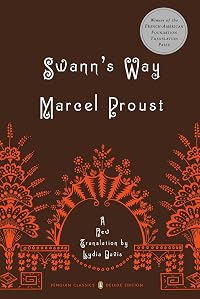
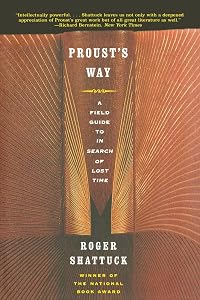
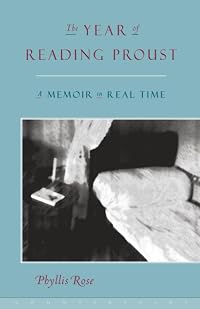
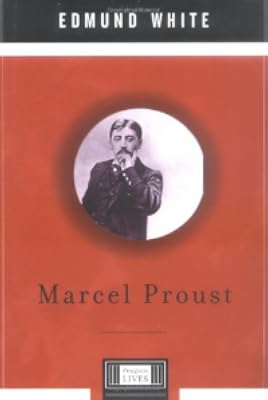




Member Reviews
Not a book about Proust, in the same vein as how Wheatstacks (End of Summer) is not about wheatstacks.
An engaging, fun book that gently reminds us to never confuse the message with the messenger and that, ultimately, we are responsible for continuing down a road after an author or artist has simply alerted us that the road exists. Re true seeing versus artistic idolatry, de Botton writes “[i]t should not be Illiers-Combray that we visit: a genuine homage to Proust would be to look at *our *world through *his* eyes, not to look at *his* world through *our* eyes.” By exploring the disconnects and vagaries of Proust’s interactions with those around him compared to his writing, we recognize the duality (oh no! People are . . show more complicated??) and general weirdness of ourselves and everyone else.
While much of the ‘self-help’ aspect, no matter how tongue-in-cheek, couldn’t be said to be revelatory, the comments about suffering, sadness and the like do offer something more insightful, a needed twist on most of the blathering balm that spills out of every psychobabble bulletin — “Though philosophers had traditionally been concerned with the pursuit of happiness, far greater wisdom would seem to lie in pursuing ways to be properly and productively unhappy. The stubborn recurrence of misery means that the development of a workable approach to it must surely outstrip the value of any utopian quest for happiness.”
A wonderful essay on the reading life, on appreciating detail and finding beauty in one’s own life, and that no matter how much one loves any book (not just ISOLT) there comes a time to put the book down and think one’s own thoughts. People who get uncomfortable with books and authors not actually being one and the same or who prefer their philosophies to be able to fit on a bumper sticker may not be motivated to read ISOLT; those who have enjoyed ISOLTwill like the book even more after reading de Botton’s book about what ISOLT made him think about, what ideas then generated in his own mind, to get Proustified. show less
An engaging, fun book that gently reminds us to never confuse the message with the messenger and that, ultimately, we are responsible for continuing down a road after an author or artist has simply alerted us that the road exists. Re true seeing versus artistic idolatry, de Botton writes “[i]t should not be Illiers-Combray that we visit: a genuine homage to Proust would be to look at *our *world through *his* eyes, not to look at *his* world through *our* eyes.” By exploring the disconnects and vagaries of Proust’s interactions with those around him compared to his writing, we recognize the duality (oh no! People are . . show more complicated??) and general weirdness of ourselves and everyone else.
While much of the ‘self-help’ aspect, no matter how tongue-in-cheek, couldn’t be said to be revelatory, the comments about suffering, sadness and the like do offer something more insightful, a needed twist on most of the blathering balm that spills out of every psychobabble bulletin — “Though philosophers had traditionally been concerned with the pursuit of happiness, far greater wisdom would seem to lie in pursuing ways to be properly and productively unhappy. The stubborn recurrence of misery means that the development of a workable approach to it must surely outstrip the value of any utopian quest for happiness.”
A wonderful essay on the reading life, on appreciating detail and finding beauty in one’s own life, and that no matter how much one loves any book (not just ISOLT) there comes a time to put the book down and think one’s own thoughts. People who get uncomfortable with books and authors not actually being one and the same or who prefer their philosophies to be able to fit on a bumper sticker may not be motivated to read ISOLT; those who have enjoyed ISOLTwill like the book even more after reading de Botton’s book about what ISOLT made him think about, what ideas then generated in his own mind, to get Proustified. show less
http://nhw.livejournal.com/1086397.html
De Botton does a brilliant job of juxtaposing Proust's many oddities as a person (there is a truly hilarious account of his one disastrous meeting with James Joyce) with the achievement of his writing. In particular, he points out, the point of Proust's work is not so much to bring us into the imagined world of Combray, Balbec and Paris, but to equip us readers to experience our own world, our relationships, our reading, all the more vividly. The chapters have titles like "How to Be a Good Friend", "How to Be Happy in Love" and "How to Suffer Successfully", all with evidence from In Search of Lost Time backed up with stories from Proust's own life of how he did (or quite often did not) live up to show more these ideas himself. Excellent stuff, and actually a great book for people who have not yet read Proust but might be thinking about doing so. show less
De Botton does a brilliant job of juxtaposing Proust's many oddities as a person (there is a truly hilarious account of his one disastrous meeting with James Joyce) with the achievement of his writing. In particular, he points out, the point of Proust's work is not so much to bring us into the imagined world of Combray, Balbec and Paris, but to equip us readers to experience our own world, our relationships, our reading, all the more vividly. The chapters have titles like "How to Be a Good Friend", "How to Be Happy in Love" and "How to Suffer Successfully", all with evidence from In Search of Lost Time backed up with stories from Proust's own life of how he did (or quite often did not) live up to show more these ideas himself. Excellent stuff, and actually a great book for people who have not yet read Proust but might be thinking about doing so. show less
This is a very slim volume about a very thick book. In fact, the longest novel so far written apparently. I worked my way through "Remembrance of things Past" when I was about 40 and it took me several years. Was it worth it? Hmm....boasting rights I guess for having read it......being profoundly bored through Sodom and Gomorrah but then a flash of recognition...a connection with a character from one of the early parts..."Swan's Way"? It certainly left an impression on me ...as it has on most others, I guess, who have made the pilgrimage. And what has Alain Boton done here but tossed off a few thoughts about Proust which he (Boton) suggests can change our lives.
Initially, I was not impressed. I thought it was superficial. Boton doesn't show more even mention the idea that Albertine's model in real life was the chauffeur Alfredo Agostinelli.....but as I got deeper into the book....I became much more engrossed and impressed. Boton has managed to tease out some of the real essence there. A dangerous move because he suggests that there are certain limitations to reading that Proust highlights: "What can it matter to you what Ruskin feels: feel it for yourself"........."Reading is on the threshold of the spiritual life; it can introduce us to it: it does not constitute it". So we have Boton ...with his own book ....trying to skirt around these sentiments. In fact he warns us aginst a range of symptoms (such as the following) identified in the over-reverent, over-reliant reader:
1. That we mistake writers for oracles....Proust was asked for advice on all sorts of topics which he was totally unqualified to speak about: "Why would an ability to write "In Search of Lost time" in any way indicate an aptitude for advising recently dismissed white-collar workers on their career?"
2. That we will be unable to write after reading a good book: Proust might have expressed many things well, but independent thought and the history of the novel had not come to a halt with him. His book did not have to be followed by silence"....and of course, it was not. (Though Virginia Woolf had trouble overcoming her writer's block after reading Proust....it was too good too compete. Still, she did write again. and wrote well).
3. That we become artistic idolaters. .......combining a literal reverence for object depicted in art with a neglect of the spirit of the art. Becoming attached to a part of the countryside depicted by a great painter, and mistake this for an appreciation of the painter.
4. That we will be tempted to invest in a copy of La Cuisine Retrouve......and think by eating the food described by Proust ...we have discovered the spirit in which the food was considered. (It's like point 3, above).
5. That we will be tempted to visit Illiers-Combray. In fact the village of Illiers has cashed in on Proust by adding Combray to their name. Yes, Proust did stay there for a few years and clearly modelled Combray on this village. but ....same point as in 3, above....if you concentrate on Villiers-Combray....you lose Proust's manner of treating it. Combray could be any one of many villages. The beauty which Proust revealed there could be present, latent. in almost any town , if only we made the effort to consider it in a Proustian way". A genuine homage to Proust would be to look at OUR world through HIS eyes, not to look at HIS world through OUR eyes.."
And what is this Proustian way?......"It's devoting attention to noticing the faint yet vital tremors" in people...in life..."with an ability to describe these far better than we would have been able .....to put a finger on perceptions that we recognise as our own , yet could not have formatted on our own." Putting it more bluntly it's noticing the details.
And it is to: "respond to the unexpected and hurtful behaviour of others ..with something more than a wipe of the glasses, to see it as a chance to expand our understanding".
Proust contends the good writing cuts new channels: ..they begin to write well only on condition that they are original, that they create their own language."
Boton can't help himself: he reflects on the philosophical conundrum elaborated by Bertram Russell in his theory of descriptions: "the the morning star is the evening star" or, more apposite: "Scott is the author of Waverly" ..when he talks about using one word for the author of "In search of lost time" (Proust) and the author of "the Strong Virgins" (Prevost)......the public frequently confused the two writers but it seems to really be a sly reference to the theory of descriptions. (It doesn't quite work because, I guess, the one word he is referring to is "author".
With impressionist painting Proust argues that in every successful work of art there is an ability to restore to our sight a distorted or neglected aspect of reality.
Apparently Proust had many good friends ....friends who wrote powerful tributes to him after his death yet there was clearly an ability in Proust to see through friendships to the insincerity apparent in every friendship. "Though it had the power to make him both a better more loyal, more charming friend, AND a more honest, profound and unsentimental thinker".
And on opening one's eyes...we should not deny the bread on the sideboard a place in our conception of beauty and we should restrain our expectations when introduced to great aristocrats.
And Proust on love. He seems to think that the supreme feeling of love is when the loved one is just out of reach...unattainable. And once attained, the desire recedes or is eliminated. I'm not sure that Marcel was really the best person to write about love. Sure he had lots of intense feelings ...and most of Sodom and Gommorah is consumed with these feelings (mainly jealousy) but he never really sustained a loving relationship. Yet others seem to have been able to do this. Are they all wrong/misguided? Or is Marcel missing something from his experience of life? I think the latter.
I liked a few of the illustrations...the reproduction...winding around and around of a single sentence from Proust which would run for 4 meters in standard text...reproduced here in micro text...snaking around and around. And that delightful reproduction of a printers proof overwhelmed by marcel's corrections and amendments to the text....as Boton says..."it might have enraged the publisher but it served to make a better book".
Overall, quite a fascinating book and well worth re-reading. I give it 4.5 stars. show less
Initially, I was not impressed. I thought it was superficial. Boton doesn't show more even mention the idea that Albertine's model in real life was the chauffeur Alfredo Agostinelli.....but as I got deeper into the book....I became much more engrossed and impressed. Boton has managed to tease out some of the real essence there. A dangerous move because he suggests that there are certain limitations to reading that Proust highlights: "What can it matter to you what Ruskin feels: feel it for yourself"........."Reading is on the threshold of the spiritual life; it can introduce us to it: it does not constitute it". So we have Boton ...with his own book ....trying to skirt around these sentiments. In fact he warns us aginst a range of symptoms (such as the following) identified in the over-reverent, over-reliant reader:
1. That we mistake writers for oracles....Proust was asked for advice on all sorts of topics which he was totally unqualified to speak about: "Why would an ability to write "In Search of Lost time" in any way indicate an aptitude for advising recently dismissed white-collar workers on their career?"
2. That we will be unable to write after reading a good book: Proust might have expressed many things well, but independent thought and the history of the novel had not come to a halt with him. His book did not have to be followed by silence"....and of course, it was not. (Though Virginia Woolf had trouble overcoming her writer's block after reading Proust....it was too good too compete. Still, she did write again. and wrote well).
3. That we become artistic idolaters. .......combining a literal reverence for object depicted in art with a neglect of the spirit of the art. Becoming attached to a part of the countryside depicted by a great painter, and mistake this for an appreciation of the painter.
4. That we will be tempted to invest in a copy of La Cuisine Retrouve......and think by eating the food described by Proust ...we have discovered the spirit in which the food was considered. (It's like point 3, above).
5. That we will be tempted to visit Illiers-Combray. In fact the village of Illiers has cashed in on Proust by adding Combray to their name. Yes, Proust did stay there for a few years and clearly modelled Combray on this village. but ....same point as in 3, above....if you concentrate on Villiers-Combray....you lose Proust's manner of treating it. Combray could be any one of many villages. The beauty which Proust revealed there could be present, latent. in almost any town , if only we made the effort to consider it in a Proustian way". A genuine homage to Proust would be to look at OUR world through HIS eyes, not to look at HIS world through OUR eyes.."
And what is this Proustian way?......"It's devoting attention to noticing the faint yet vital tremors" in people...in life..."with an ability to describe these far better than we would have been able .....to put a finger on perceptions that we recognise as our own , yet could not have formatted on our own." Putting it more bluntly it's noticing the details.
And it is to: "respond to the unexpected and hurtful behaviour of others ..with something more than a wipe of the glasses, to see it as a chance to expand our understanding".
Proust contends the good writing cuts new channels: ..they begin to write well only on condition that they are original, that they create their own language."
Boton can't help himself: he reflects on the philosophical conundrum elaborated by Bertram Russell in his theory of descriptions: "the the morning star is the evening star" or, more apposite: "Scott is the author of Waverly" ..when he talks about using one word for the author of "In search of lost time" (Proust) and the author of "the Strong Virgins" (Prevost)......the public frequently confused the two writers but it seems to really be a sly reference to the theory of descriptions. (It doesn't quite work because, I guess, the one word he is referring to is "author".
With impressionist painting Proust argues that in every successful work of art there is an ability to restore to our sight a distorted or neglected aspect of reality.
Apparently Proust had many good friends ....friends who wrote powerful tributes to him after his death yet there was clearly an ability in Proust to see through friendships to the insincerity apparent in every friendship. "Though it had the power to make him both a better more loyal, more charming friend, AND a more honest, profound and unsentimental thinker".
And on opening one's eyes...we should not deny the bread on the sideboard a place in our conception of beauty and we should restrain our expectations when introduced to great aristocrats.
And Proust on love. He seems to think that the supreme feeling of love is when the loved one is just out of reach...unattainable. And once attained, the desire recedes or is eliminated. I'm not sure that Marcel was really the best person to write about love. Sure he had lots of intense feelings ...and most of Sodom and Gommorah is consumed with these feelings (mainly jealousy) but he never really sustained a loving relationship. Yet others seem to have been able to do this. Are they all wrong/misguided? Or is Marcel missing something from his experience of life? I think the latter.
I liked a few of the illustrations...the reproduction...winding around and around of a single sentence from Proust which would run for 4 meters in standard text...reproduced here in micro text...snaking around and around. And that delightful reproduction of a printers proof overwhelmed by marcel's corrections and amendments to the text....as Boton says..."it might have enraged the publisher but it served to make a better book".
Overall, quite a fascinating book and well worth re-reading. I give it 4.5 stars. show less
I recently finished reading my first Proust novel and found it so unlike any other novel that I had read that I was keen to understand more about what Proust was hoping to achieve.
This book is quite short but it shines a light on how Proust thought, his views on literature and his attempts to shake people out of their complacency. M. de Botton draws not just upon In Search of Lost Time but also letters, diaries and recollections by people who knew Proust.
One of the abiding themes of Proust's writing is how familiarity deadens our powers of observation, that constant association reduces our ability to see things as they truly are.
After reading this book I have a new found appreciation of Proust and will almost certainly read the show more remainder of his great work in a different light. show less
This book is quite short but it shines a light on how Proust thought, his views on literature and his attempts to shake people out of their complacency. M. de Botton draws not just upon In Search of Lost Time but also letters, diaries and recollections by people who knew Proust.
One of the abiding themes of Proust's writing is how familiarity deadens our powers of observation, that constant association reduces our ability to see things as they truly are.
After reading this book I have a new found appreciation of Proust and will almost certainly read the show more remainder of his great work in a different light. show less
The best introduction to Proust I can imagine and, yes, distils some useful advice from his vast corpus too. De Botton's lucid and slightly coy style works wonderfully when applied to Proust's labrynthine and elaborate writings.
Many thanks to my reading trio friend Elaine Elinson for introducing me to this book as a good companion to Proust's Swann's Way. I found Botton's book to be funny, illuminating, thoughtful and a page turner. Reading this has definitely added a new dimension to my thoughts on "Swann's Way" and what Proust was trying to do, as well as giving me lots to think about in general regarding how we engage with the world and artistic representations of it. The biggest take-away for me is the message--Proust's message and Botton's--that our lives are enormously enriched if we take the time to actually see what is around us and not gloss over what seem to be details or substitute someone else' view/vision as an unconscious time saver to do look show more carefully ourselves. show less
Okay, so it's not a novel. It admits that right there in the subtitle. So if it's not a novel, what is it? I can't decide whether Botton has written a book of literary criticism or self-help. Maybe both...or neither. Rambling bits and pieces of Marcel Proust's philosophy are presented in nine "How to..." chapters. But why should anyone expect to learn how to change their life from a man who stayed in bed for 14 years writing a long-winded book?
Personally, I read How Proust Can Change Your Life because I was interested in Proust, not because I want to change my life. I had hoped to find something in it that would make me want to read the seven volumes of In Search of Lost Time. Instead I found a lot of Proustian quotes from his show more voluminous book that were refuted by the way he lived his life. How ironic that the theme of Lost Time could be summed up as "how to stop wasting time and appreciate life" when one considers the huge amount of time spent by Proust in writing the book and the equally inordinate amount of time it would take to read it.
Botton addresses this issue in the final chapter when he uses Proust's words against him: "...for all its qualities, his work must eventually also prove silly, maniacal, constraining, false and ridiculous to those who spend too long on it." Hmmmm... After reading Botton's book, the only change I'm planning is to read no more parodies of self-help books. However, I'm seriously contemplating reading Proust someday to form my own opinion of his work, so perhaps Botton's book does succeed in the end. show less
Personally, I read How Proust Can Change Your Life because I was interested in Proust, not because I want to change my life. I had hoped to find something in it that would make me want to read the seven volumes of In Search of Lost Time. Instead I found a lot of Proustian quotes from his show more voluminous book that were refuted by the way he lived his life. How ironic that the theme of Lost Time could be summed up as "how to stop wasting time and appreciate life" when one considers the huge amount of time spent by Proust in writing the book and the equally inordinate amount of time it would take to read it.
Botton addresses this issue in the final chapter when he uses Proust's words against him: "...for all its qualities, his work must eventually also prove silly, maniacal, constraining, false and ridiculous to those who spend too long on it." Hmmmm... After reading Botton's book, the only change I'm planning is to read no more parodies of self-help books. However, I'm seriously contemplating reading Proust someday to form my own opinion of his work, so perhaps Botton's book does succeed in the end. show less
Members
- Recently Added By
Published Reviews
ThingScore 75
One doesn't usually think of Marcel Proust as the author of a great self-help book. Unless of course what you admire most about ''Remembrance of Things Past'' is its usefulness for killing huge amounts of time.
Alain de Botton, a novelist, doesn't take quite such a crassly utilitarian view in his delightfully original work of literary criticism, ''How Proust Can Change Your Life: Not a Novel.'' show more But he does come close in places. For instance, in Chapter 3, called ''How to Take Your Time,'' he points out that one reaction to the great length of Proust's famous novel was the ''All-England Summarize Proust Competition,'' once presented by the Monty Python troupe in the belief, as Mr. de Botton puts it, that ''what had originally taken seven volumes to express could reasonably be condensed into 15 seconds or less, without too great a loss of integrity or meaning, if only an appropriate candidate could be found.'' . . . show less
Alain de Botton, a novelist, doesn't take quite such a crassly utilitarian view in his delightfully original work of literary criticism, ''How Proust Can Change Your Life: Not a Novel.'' show more But he does come close in places. For instance, in Chapter 3, called ''How to Take Your Time,'' he points out that one reaction to the great length of Proust's famous novel was the ''All-England Summarize Proust Competition,'' once presented by the Monty Python troupe in the belief, as Mr. de Botton puts it, that ''what had originally taken seven volumes to express could reasonably be condensed into 15 seconds or less, without too great a loss of integrity or meaning, if only an appropriate candidate could be found.'' . . . show less
added by PLReader
Lists

Best Self Help Books
87 works; 18 members

Mustich's 1000 Books to Read Before You Die: A Life Changing List
1,001 works; 19 members

On Books
70 works; 1 member
Author Information

53+ Works 26,035 Members
Born in Zurich, Switzerland on December 20, 1969, Alain de Botton was educated at Cambridge University, England, and now divides his time between London and Washington, D.C. With the publication of his first novel, Essays in Love, de Botton quickly became one of the most talked about British novelists of the 1990s. Although the basic plot of show more Essays in Love (published in the U.S. as On Love) is a rather typical love story, de Botton presents it in a unique and humorous way. De Botton's other novels include The Romantic Movement: Sex, Shopping and the Novel, which is written in a similar style to Essays on Love, and Kiss and Tell, which follows a would-be biographer as he attempts to write the life story of the first person he encounters. The Course of Love is his latest novel and is on the bestsellers list. Alain de Botton is also the author of How Proust Can Change Your Life: Not a Novel. (Bowker Author Biography) show less
All Editions
Some Editions
Awards and Honors
Awards
Series
Belongs to Publisher Series
Work Relationships
Is abridged in
Is a study of
Has as a student's study guide
Common Knowledge
- Canonical title*
- Hoe Proust je leven kan veranderen
- Original title
- How Proust Can Change Your Life
- Original publication date
- 1997
- People/Characters
- Marcel Proust
- Important places
- Paris, France; France
- Important events
- Fin de siècle
- Related movies
- How Proust Can Change Your Life (2000 | IMDb)
- First words
- There are few things humans are more dedicated to than unhappiness.
- Quotations
- In 1971 the small town of Illiers chose to let even the least cultured motorist know of its connection to its most famous son, or rather visitor. For it was here that Proust spent his summers from the age of six until nine an... (show all)d once again at the age of fifteen, in the house of his father's sister, Elisabeth Amiot - and here that he drew inspiration for the creation of his fictional Combray.
- Last words
- (Click to show. Warning: May contain spoilers.)Even the finest books deserve to be thrown aside.
- Blurbers
- Proust, Marcel
*Some information comes from Common Knowledge in other languages. Click "Edit" for more information.
Classifications
- Genres
- Literature Studies and Criticism, Nonfiction
- DDC/MDS
- 843.912 — Literature & rhetoric French Literature French fiction 1900- 20th Century 1900-1945
- LCC
- PQ2631 .R63 .Z54917 — Language and Literature French, Italian, Spanish and Portuguese literatures French literature Modern literature 1900-1960
- BISAC
Statistics
- Members
- 3,657
- Popularity
- 4,429
- Reviews
- 60
- Rating
- (3.69)
- Languages
- 15 — Arabic, Danish, Dutch, English, Finnish, French, German, Greek, Italian, Korean, Norwegian (Bokmål), Polish, Portuguese, Spanish, Swedish
- Media
- Paper, Audiobook, Ebook
- ISBNs
- 66
- ASINs
- 15