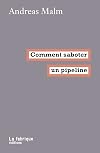
How to Blow Up a Pipeline
by Andreas Malm
On This Page
Description
Property will cost us the earthThe science on climate change has been clear for a very long time now. Yet despite decades of appeals, mass street protests, petition campaigns, and peaceful demonstrations, we are still facing a booming fossil fuel industry, rising seas, rising emission levels, and a rising temperature. With the stakes so high, why haven't we moved beyond peaceful protest?
In this lyrical manifesto, noted climate scholar (and saboteur of SUV tires and coal mines) Andreas Malm show more makes an impassioned call for the climate movement to escalate its tactics in the face of ecological collapse. We need, he argues, to force fossil fuel extraction to stop—with our actions, with our bodies, and by defusing and destroying its tools. We need, in short, to start blowing up some oil pipelines.
Offering a counter-history of how mass popular change has occurred, from the democratic revolutions overthrowing dictators to the movement against apartheid and for women's suffrage, Malm argues that the strategic acceptance of property destruction and violence has been the only route for revolutionary change. In a braided narrative that moves from the forests of Germany and the streets of London to the deserts of Iraq, Malm offers us an incisive discussion of the politics and ethics of pacifism and violence, democracy and social change, strategy and tactics, and a movement compelled by both the heart and the mind. Here is how we fight in a world on fire. show less
Tags
Recommendations



























Member Reviews
This book isn't about how to blow up a pipeline. Obviously, that would lead to [REDACTED], but more about why to blow up a pipeline. Malm poses an interesting question: If we take the climate science seriously, and that we are heading towards a dark Here Be Dragons future of 600+ ppm, mass extinctions, heavy weather, refugee crises, and desperate struggles over the last scraps, why has the environmental movement been so notably ineffective in enforcing policy to keep carbon in the ground? Isn't it time to do more? Isn't it time to quit talking, and start [REDACTING]?
Of course, an energy transition is complex and expensive. Cheap fossil energy has its tendrils everywhere. We all benefit from it. As an ecomodernist, I'm all in favor of show more cheap, clean and accessible energy. And even though we've seen major progress in solar, wind, storage, and electric vehicles, it simply isn't enough. The clean energy future is smaller than the dirty energy present of new pipelines, new coal plants, new SUVs, let alone the dead fossil weight of history.
The climate movement is notably both because of its abstraction and idealism, and how it has been neutered by an ideological and tactical commitment to absolute non-violence. In thrall to Chenoweth's thesis that non-violent movements are more likely to succeed, and terrified an alienating any part of a democratic coalition, protests are symbolic, mostly delaying rather destroying. A complete deconstruction of the non-violence thesis is a project for another book, but her sample is obviously flawed and incomplete, categorizing movements which did involve violence as non-violence, and somehow ignoring major successes, like the violent movement which toppled governments in Russia, China, and Germany in the 20th century. Seeing that Chenowith is affiliated with Harvard Kennedy School makes me deeply suspicious that the non-violence fetish is literally a CIA op to make dissent easier to manage. Successful movements such as the suffragettes included deliberate violence against property at a scale between vandalism and arson. While deliberate violence often fails, the impromptu mass of a crowd deciding that this will not stand has toppled dictators.
As Malm points out, actual sabotage from the level of letting the air out of SUV tires, to burning down gas stations, to striking vulnerable fixed installations, has rarely been tried, and when it does, it provokes a response all out of proportion to the seeming irritation. If not killing people remains a key moral principle, attacks on Middle Eastern oil infrastructure by violent terrorist groups, political rather than ecological strikes, have very low casualties. Jessica Reznicek and Ruby Montoya carried out multiple attacks against the Dakota Access Pipeline, causing millions of dollars in damage and earning multiple years in prison.
If I may indulge in a moment of conspiracy, the media is silent about Malm's thesis because it would work. Actual, capital-P Power, the people the rule the world, know how much of their strength is tied up with masses sated on cheap energy, and they believe they can ride this out in the New Zealand Apocalypse Bunkers. Fossil fuel infrastructure is omnipresent, impossible to secure, and so very very flammable. At this moment, with gasoline hitting $8 a gallon in the US and Europe's painful lesson about Russian natural gas dependency being to switch from pipelines to LNG terminals so that they're still dependent on fossil fuels, but no Russia, it seems like, well, maybe this is a chance for a few brave people to [REDACTED]. show less
Of course, an energy transition is complex and expensive. Cheap fossil energy has its tendrils everywhere. We all benefit from it. As an ecomodernist, I'm all in favor of show more cheap, clean and accessible energy. And even though we've seen major progress in solar, wind, storage, and electric vehicles, it simply isn't enough. The clean energy future is smaller than the dirty energy present of new pipelines, new coal plants, new SUVs, let alone the dead fossil weight of history.
The climate movement is notably both because of its abstraction and idealism, and how it has been neutered by an ideological and tactical commitment to absolute non-violence. In thrall to Chenoweth's thesis that non-violent movements are more likely to succeed, and terrified an alienating any part of a democratic coalition, protests are symbolic, mostly delaying rather destroying. A complete deconstruction of the non-violence thesis is a project for another book, but her sample is obviously flawed and incomplete, categorizing movements which did involve violence as non-violence, and somehow ignoring major successes, like the violent movement which toppled governments in Russia, China, and Germany in the 20th century. Seeing that Chenowith is affiliated with Harvard Kennedy School makes me deeply suspicious that the non-violence fetish is literally a CIA op to make dissent easier to manage. Successful movements such as the suffragettes included deliberate violence against property at a scale between vandalism and arson. While deliberate violence often fails, the impromptu mass of a crowd deciding that this will not stand has toppled dictators.
As Malm points out, actual sabotage from the level of letting the air out of SUV tires, to burning down gas stations, to striking vulnerable fixed installations, has rarely been tried, and when it does, it provokes a response all out of proportion to the seeming irritation. If not killing people remains a key moral principle, attacks on Middle Eastern oil infrastructure by violent terrorist groups, political rather than ecological strikes, have very low casualties. Jessica Reznicek and Ruby Montoya carried out multiple attacks against the Dakota Access Pipeline, causing millions of dollars in damage and earning multiple years in prison.
If I may indulge in a moment of conspiracy, the media is silent about Malm's thesis because it would work. Actual, capital-P Power, the people the rule the world, know how much of their strength is tied up with masses sated on cheap energy, and they believe they can ride this out in the New Zealand Apocalypse Bunkers. Fossil fuel infrastructure is omnipresent, impossible to secure, and so very very flammable. At this moment, with gasoline hitting $8 a gallon in the US and Europe's painful lesson about Russian natural gas dependency being to switch from pipelines to LNG terminals so that they're still dependent on fossil fuels, but no Russia, it seems like, well, maybe this is a chance for a few brave people to [REDACTED]. show less
This book was an interesting collection of musings and arguments that should perhaps be entitled “Why to Blow up Pipeline”. In it, the author a Swedish activist, author and professor, examines several key questions. Among them, why has there been such a glaring lack of any sustained sabotage or property damage in the climate activism sphere? Does such property damage constitute a viable and worthwhile form of protest and activism in the face of ever increasing climate change? And if so, what would sabotage and vandalism of this kind look like on a large scale? What would the goals of such an enterprise be? What would be its limits?
From the title of this book you can guess the author’s answers to some of these questions. While I show more wasn’t wholly convinced, I do think the arguments in this short work offer and excellent framework for considering the future of resistance to the expanding fossil fuel industry. This quick read is as good a starting place as any for considering the nature of current climate activism, it’s strengths and weaknesses, and how effective heretofore unutilized methods, up to and including infrastructure sabotage, might be used in the fight to keep earth’s climate habitable for humanity. show less
From the title of this book you can guess the author’s answers to some of these questions. While I show more wasn’t wholly convinced, I do think the arguments in this short work offer and excellent framework for considering the future of resistance to the expanding fossil fuel industry. This quick read is as good a starting place as any for considering the nature of current climate activism, it’s strengths and weaknesses, and how effective heretofore unutilized methods, up to and including infrastructure sabotage, might be used in the fight to keep earth’s climate habitable for humanity. show less
This chap knows his stuff. He is wise enough not to give definitive solutions but rather, to lay out a smorgasbord of signposts to possible actions.
Where he is definite, is in the certainty that the climate is in a precarious position and that "business as usual" is not an option. He also waves aside the idea that if we all do a little, it will all be alright. IT WON'T!!
Where he is definite, is in the certainty that the climate is in a precarious position and that "business as usual" is not an option. He also waves aside the idea that if we all do a little, it will all be alright. IT WON'T!!
Not very good. The agenda is quickly revealed to be more anti-capitalist than anti-climate change. But he doesn't really explain any of that, instead he spends at least half the book attacking the ideas of a handful of his intellectual adversaries. Not being familiar with them, I could care less about the alleged flaws in their reasoning; I am reading this book to hear the author's own ideas, not his grudge-based opinions about what others think. It felt like a political campaign with no coherent platform of its own, comprised solely of attack ads.
The other half of the book is devoted to one main idea. That violence (if done properly and appropriately) can be an effective tool to bring about change. Which might be a radical idea in the show more author's Sweden, but in the US (founded on violent protest) this isn't a concept that needs much explaining. The sticking point is determining what "properly" and "appropriate" mean, and how to effectively organize to do it right. He ruthlessly mocks previous attempts by radical environmental groups to do exactly what he seems to be suggesting, but doesn't really offer any concrete advise on how to it better.
Along the way, he celebrates the effectiveness of various murderous terrorist groups. Although he claims to be opposed to harming or killing people, the groups he cites are guilty of horrific bloody attacks, and he seems to be suggesting that in extreme cases (such as the climate crisis) the ends justify the needs. These views seem contradictory, and he needs to do a better job reconciling them.
Ultimately, the best he's able to muster is dressing up as "Indians" to non-destructively let the air out of SUV tires and spray-painting graffiti on the wall of a coal-fired power plant: "it was violence of the sweetest kind. I was high for weeks afterwards." Again, the tenuous link between such performative self-indulgent acts of virtue signaling and any sort of actual policy change (let along a hint of a strategy to wean off of fossil fuels besides sinking 300 mega-yachts and slashing SUV tires) is almost entirely absent. He condemns climate fatalists for meekly accepting their fate, yet seems equally content to conduct a few symbolic acts of resistance so he can sleep well at night, even though the outcome is the same either way. show less
The other half of the book is devoted to one main idea. That violence (if done properly and appropriately) can be an effective tool to bring about change. Which might be a radical idea in the show more author's Sweden, but in the US (founded on violent protest) this isn't a concept that needs much explaining. The sticking point is determining what "properly" and "appropriate" mean, and how to effectively organize to do it right. He ruthlessly mocks previous attempts by radical environmental groups to do exactly what he seems to be suggesting, but doesn't really offer any concrete advise on how to it better.
Along the way, he celebrates the effectiveness of various murderous terrorist groups. Although he claims to be opposed to harming or killing people, the groups he cites are guilty of horrific bloody attacks, and he seems to be suggesting that in extreme cases (such as the climate crisis) the ends justify the needs. These views seem contradictory, and he needs to do a better job reconciling them.
Ultimately, the best he's able to muster is dressing up as "Indians" to non-destructively let the air out of SUV tires and spray-painting graffiti on the wall of a coal-fired power plant: "it was violence of the sweetest kind. I was high for weeks afterwards." Again, the tenuous link between such performative self-indulgent acts of virtue signaling and any sort of actual policy change (let along a hint of a strategy to wean off of fossil fuels besides sinking 300 mega-yachts and slashing SUV tires) is almost entirely absent. He condemns climate fatalists for meekly accepting their fate, yet seems equally content to conduct a few symbolic acts of resistance so he can sleep well at night, even though the outcome is the same either way. show less
Best for:
I’m really not sure, and I’ll get to that in the review.
In a nutshell:
Author (and climate activist) Malm attempts to argue in favor of stronger action by the public where it comes to climate change and fossil fuel.
Worth quoting:
“We face an ostensible paradox here, in that the US is a vastly more violent society — as measured by the diffusion of guns, the incidence of mass shootings, the civilians killed by police, the veneration of armed heroes in popular culture, the belligerence of the state and any other yardstick — than France, and yet the intolerance for violence committed by social movements as at its highest in the former.”
Why I chose it:
While the title is provocative, I was hoping to learn more about the show more discussion of what to do with the fact that governments are just not acting with enough urgency.
What it left me feeling:
Frustrated
Review:
I’m trying to be more constructive in my reviews, because I’m trying to remind myself that there is a person who spent a lot of time and energy on the book I’m reviewing. I might disagree with their arguments (or even disagree that an argument has been made at all), but unless they are making harmful claims (e.g. expressing bigotry), there’s no point is being unnecessarily critical.
So of course one of the first books I am reviewing with this new approach is one that is going to test it mightily.
The world is on fire. In some places, quite literally. And the leaders are failing us all. As Greta Thunberg pointed out in her speech to the UN: "People are suffering. People are dying. Entire ecosystems are collapsing. We are in the beginning of a mass extinction, and all you can talk about is money and fairy tales of eternal economic growth. How dare you!”
It is very clear that politicians in the nations responsible for the most CO2 emissions, the most burning of fossil fuels, are doing the absolute least in addressing these issues. They sign onto agreements that only require changes many years in the future. They repeatedly move the goalposts. And while that happens, California and Australia burn, islands in the Caribbean are mowed down by increased tropical storms. England reaches 107 degrees F. And private jets are still a thing, and yachts are still a thing, and billionaires are somehow still a thing.
So, what do we do? Malm sort of has a suggestion - more action targeted at the polluters, in the form not just of sit-ins or marches, but in the form of vandalism. Take out pipelines (he doesn’t literally explain how to or directly advocate for that). Deflate tires of SUVs in rich areas (he has done that). Do whatever it takes to be heard.
I don’t know if I agree or disagree with Malm because I found his book challenging to follow, and not because it’s too academic, or beyond my understanding. As previous reviews show, I am generally fine with sharing when I think I just don’t understand a book. This one, I found, is just not well argued. Part of that is its length - it’s not short, but it only has three chapters, and I don’t think the argument was well-organized enough to fit into just three chapters. I think it would be much stronger with more logical and specific delineations.
But it isn’t just that for me - I also am not sure of what the specific argument Malm is putting forth. Obviously I agree with him that climate change is of critical importance and that a different approach is needed, but I’m not sure if I know what the different approach is that he supports. Most of the book seems to be Malm arguing against other people who have made arguments that he disagrees with. And that can definitely work, but I don’t think it does here because those other arguments aren’t well positioned against anything the author himself is offering.
He spends a lot of time looking at historical protests that others suggest were successful due to their non-violent nature, and refutes a lot of that. And while the way he does that isn’t how I would choose to do it, he does do it. He also calls out how some modern-day climate actions are ineffective (specifically Extinction Rebellion) as well as hypocritical in their complete non-violence stance (again, Extinction Rebellion). He also spends time suggesting that violence doesn’t need to mean physically harming people - and I think perhaps even argues that we need a different term, because violence is loaded, and damaging a pipeline shouldn’t be considered violent. Especially when the impact of that pipeline is actual violence, causing actual harm to real people. I can see his point, I think, but I needed more from him here.
The strongest part of the book for me is when he talks about luxury vs subsistence emissions. Like, it’s absurd to suggest that people who burn wood so they can heat their homes and cook food and survive need to be making changes before someone who owns a yacht or an SUV or flies a private jet.
In the end, for me, books like this need to have a specific audience to be successful, and after reading it I am not clear on who the audience is. Is he trying to convince average folks to take up the cause to fight climate change? Is he trying to convince existing activists to step up their games and be more pro-active in their targeting of those causing the most harm to the climate? Is he trying to convince the big movements to stop calling for non-violence? The book cannot be all things to all audiences, and it feels to me that it is trying to be just that, and so ultimately it does not work. The subtitle is ‘Learning to Fight in a World on Fire,’ but I do not feel like the book is teaching how to fight.
The book also suffers (for me) from something I see so often in activism books: the sort of ‘who knows’ of it all. The author, just four pages from the end, says this “How could that happen? This cannot be known beforehand. It can be found out only through immersion in practice.” Which strikes me as disingenuous. 157 pages of arguing about needing to take a new approach to climate activism, but ultimately he isn’t willing to write out specifically what that should look like and how it can work.
If the target audience is people who aren’t yet active in the climate change arena (me), it doesn’t work. I’d be interested to learn if those who are active in that area find the book useful.
Recommend to a Friend / Keep / Donate it / Toss it:
Toss it show less
I’m really not sure, and I’ll get to that in the review.
In a nutshell:
Author (and climate activist) Malm attempts to argue in favor of stronger action by the public where it comes to climate change and fossil fuel.
Worth quoting:
“We face an ostensible paradox here, in that the US is a vastly more violent society — as measured by the diffusion of guns, the incidence of mass shootings, the civilians killed by police, the veneration of armed heroes in popular culture, the belligerence of the state and any other yardstick — than France, and yet the intolerance for violence committed by social movements as at its highest in the former.”
Why I chose it:
While the title is provocative, I was hoping to learn more about the show more discussion of what to do with the fact that governments are just not acting with enough urgency.
What it left me feeling:
Frustrated
Review:
I’m trying to be more constructive in my reviews, because I’m trying to remind myself that there is a person who spent a lot of time and energy on the book I’m reviewing. I might disagree with their arguments (or even disagree that an argument has been made at all), but unless they are making harmful claims (e.g. expressing bigotry), there’s no point is being unnecessarily critical.
So of course one of the first books I am reviewing with this new approach is one that is going to test it mightily.
The world is on fire. In some places, quite literally. And the leaders are failing us all. As Greta Thunberg pointed out in her speech to the UN: "People are suffering. People are dying. Entire ecosystems are collapsing. We are in the beginning of a mass extinction, and all you can talk about is money and fairy tales of eternal economic growth. How dare you!”
It is very clear that politicians in the nations responsible for the most CO2 emissions, the most burning of fossil fuels, are doing the absolute least in addressing these issues. They sign onto agreements that only require changes many years in the future. They repeatedly move the goalposts. And while that happens, California and Australia burn, islands in the Caribbean are mowed down by increased tropical storms. England reaches 107 degrees F. And private jets are still a thing, and yachts are still a thing, and billionaires are somehow still a thing.
So, what do we do? Malm sort of has a suggestion - more action targeted at the polluters, in the form not just of sit-ins or marches, but in the form of vandalism. Take out pipelines (he doesn’t literally explain how to or directly advocate for that). Deflate tires of SUVs in rich areas (he has done that). Do whatever it takes to be heard.
I don’t know if I agree or disagree with Malm because I found his book challenging to follow, and not because it’s too academic, or beyond my understanding. As previous reviews show, I am generally fine with sharing when I think I just don’t understand a book. This one, I found, is just not well argued. Part of that is its length - it’s not short, but it only has three chapters, and I don’t think the argument was well-organized enough to fit into just three chapters. I think it would be much stronger with more logical and specific delineations.
But it isn’t just that for me - I also am not sure of what the specific argument Malm is putting forth. Obviously I agree with him that climate change is of critical importance and that a different approach is needed, but I’m not sure if I know what the different approach is that he supports. Most of the book seems to be Malm arguing against other people who have made arguments that he disagrees with. And that can definitely work, but I don’t think it does here because those other arguments aren’t well positioned against anything the author himself is offering.
He spends a lot of time looking at historical protests that others suggest were successful due to their non-violent nature, and refutes a lot of that. And while the way he does that isn’t how I would choose to do it, he does do it. He also calls out how some modern-day climate actions are ineffective (specifically Extinction Rebellion) as well as hypocritical in their complete non-violence stance (again, Extinction Rebellion). He also spends time suggesting that violence doesn’t need to mean physically harming people - and I think perhaps even argues that we need a different term, because violence is loaded, and damaging a pipeline shouldn’t be considered violent. Especially when the impact of that pipeline is actual violence, causing actual harm to real people. I can see his point, I think, but I needed more from him here.
The strongest part of the book for me is when he talks about luxury vs subsistence emissions. Like, it’s absurd to suggest that people who burn wood so they can heat their homes and cook food and survive need to be making changes before someone who owns a yacht or an SUV or flies a private jet.
In the end, for me, books like this need to have a specific audience to be successful, and after reading it I am not clear on who the audience is. Is he trying to convince average folks to take up the cause to fight climate change? Is he trying to convince existing activists to step up their games and be more pro-active in their targeting of those causing the most harm to the climate? Is he trying to convince the big movements to stop calling for non-violence? The book cannot be all things to all audiences, and it feels to me that it is trying to be just that, and so ultimately it does not work. The subtitle is ‘Learning to Fight in a World on Fire,’ but I do not feel like the book is teaching how to fight.
The book also suffers (for me) from something I see so often in activism books: the sort of ‘who knows’ of it all. The author, just four pages from the end, says this “How could that happen? This cannot be known beforehand. It can be found out only through immersion in practice.” Which strikes me as disingenuous. 157 pages of arguing about needing to take a new approach to climate activism, but ultimately he isn’t willing to write out specifically what that should look like and how it can work.
If the target audience is people who aren’t yet active in the climate change arena (me), it doesn’t work. I’d be interested to learn if those who are active in that area find the book useful.
Recommend to a Friend / Keep / Donate it / Toss it:
Toss it show less
Interesting deconstruction of environmental pacifism, more thought experiment than manifesto.
Despite the title, this book is merely a philosophical treatise on the need to engage in violent measures to exact wide-spread societal change. From an historical standpoint, this is not an outlandish proposition but the writing is tediously academic and is unlikely to sway anyone who doesn't already agree.
Members
- Recently Added By
Lists

Books Read in 2023
5,638 works; 147 members
Author Information

25+ Works 1,593 Members
Andreas Malm is a scholar of Human Ecology and author of among other books, Fossil Capital and The Progress of this Storm. The Zetkin Collective is a group of scholars, activists and students researching the political ecology of the far right.
Some Editions
Awards and Honors
Awards
Series
Belongs to Publisher Series
Work Relationships
Common Knowledge
- Canonical title*
- Miten öljyputki räjäytetään: Oppia taistelemaan palavassa maailmassa
- Original title
- How to blow up a pipeline : learning to fight in a world on fire
- Original publication date
- 2020
- Important events
- activism (climate); sabotage; pacifism; climate crisis
- First words
- On the last day of negotiations, we geared up for our most daring action yet.
- Last words
- (Click to show. Warning: May contain spoilers.)The breaking of fences may one day be seen as a very minor misdemeanour indeed.
- Blurbers
- Klein, Naomi; Wallace-Wells, David
*Some information comes from Common Knowledge in other languages. Click "Edit" for more information.
Classifications
- Genres
- Science & Nature, General Nonfiction, Nonfiction, Politics and Government, Philosophy
- DDC/MDS
- 363.325933379 — Society, government, & culture Social problems and social services Public Safety - Police, Crime Investigation Terrorism, Disasters, Civil Defense Social conflict Terrorism
- LCC
- TD170 .M34 — Technology Environmental technology. Sanitary engineering Environmental technology. Sanitary engineering Environmental protection
- BISAC
Statistics
- Members
- 600
- Popularity
- 49,010
- Reviews
- 11
- Rating
- (3.74)
- Languages
- 7 — Danish, English, Finnish, French, German, Italian, Spanish
- Media
- Paper, Audiobook, Ebook
- ISBNs
- 12
- ASINs
- 5