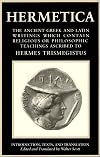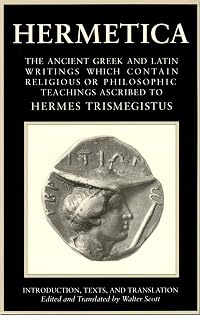
Hermetica: Volume I: Introduction, Texts, and Translation
by Hermes Trismegistus (Author), Walter Scott (Editor)
Hermetica (1)
On This Page
Description
"First published in 1924, this classic four-volume work contains various Greek and Latin writings of religious or philosophic teachings ascribed to Hermes Trismegistus, with Walter Scott's extensive notes, commentary, and addenda. It is said that these teachings are records of private, intimate talks between a teacher and one or two of his disciples. The setting was in Egypt under the Roman Empire, among men who had received some instruction in Greek philosophy, and especially the Platonism show more of the period, but were not content with merely accepting and repeating the cut-and-dried dogmas of the orthodox philosophic schools and sought to build up, on a basis of Platonic doctrine, a philosophic religion that would better satisfy their needs. Included here are the libelliof the Corpus Hermeticum, the Asclepius, the Hermetic excerpts in the Anthologiumof Stobaeus, and other fragments. The entire text is produced in the original Greek or Latin, with an English translation on facing pages. Volumes II, III, and IV of Hermetica, which contain Scott's notes on the work, his commentary, and testimonia, extensive addenda, an show lessTags
Recommendations





Member Reviews
HERMETICA, PART 1: THE ANCIENT GREEK AND LATÍN WRITINA WHICH CONTAIN RELIGIOUS OR PHOLOSOPHIC TEACHING ASCRIBED TO HERMES
INTRODUCTION
THE Hermetica dealt with in this book may be described as
'those Greek and Latin writings which contain religious or
philosophic teachings ascribed to Hermes Trismegistus'. It does not
much matter whether we say 'religious' or philosophic';' the
writers in question taught philosophic doctrines, but valued those
doctrines only as means or aids to religiorn.
There is, besides these, another class of documents, the contents
of which are also ascribed to Hermes Trismegistus ; namely, writings
concerning astrology, magic, alchemy, and kindred forms of
pseudoscience. But in the character of their contents these latter show more differ
fundamentally from the former. The two classes of writers agreed
in ascribing what they wrote to Hermes, but in nothing else. They
had little or nothing to do with one another; they were of very
different mental calibre; and it is in most cases easy to decide at
a glance whether a given document is to be assigned to the one
class or to the other. We are therefore justified in treating the
'religious' or philosophic' Hermetica as a class apart, and, for our
present purpose, ignoring the masses of rubbish which fall under
the other head.
By what sort of people, and in what circumstances, were our
Hermetica written? That question may be answered as follows.
There were in Egypt under the Roman Empire men who had
received some instruction in Greek philosophy, and especially in
the Platonism of the period, but were not content with merely
accepting and repeating the cut-and-dried dogmas of the orthodox
philosophic schools, and sought to build up, on a basis of Platonic...
1 Theological', if taken in the etymological sense of the word, would perhaps
be better; for the Hermetica are talks about God', or ' discussions concerning
God'. But the word theology, as now commonly used, has associations that
would be misleading
. J These thiags might be grouped together under the vague but convenient termn
occult arts and sciences show less
INTRODUCTION
THE Hermetica dealt with in this book may be described as
'those Greek and Latin writings which contain religious or
philosophic teachings ascribed to Hermes Trismegistus'. It does not
much matter whether we say 'religious' or philosophic';' the
writers in question taught philosophic doctrines, but valued those
doctrines only as means or aids to religiorn.
There is, besides these, another class of documents, the contents
of which are also ascribed to Hermes Trismegistus ; namely, writings
concerning astrology, magic, alchemy, and kindred forms of
pseudoscience. But in the character of their contents these latter show more differ
fundamentally from the former. The two classes of writers agreed
in ascribing what they wrote to Hermes, but in nothing else. They
had little or nothing to do with one another; they were of very
different mental calibre; and it is in most cases easy to decide at
a glance whether a given document is to be assigned to the one
class or to the other. We are therefore justified in treating the
'religious' or philosophic' Hermetica as a class apart, and, for our
present purpose, ignoring the masses of rubbish which fall under
the other head.
By what sort of people, and in what circumstances, were our
Hermetica written? That question may be answered as follows.
There were in Egypt under the Roman Empire men who had
received some instruction in Greek philosophy, and especially in
the Platonism of the period, but were not content with merely
accepting and repeating the cut-and-dried dogmas of the orthodox
philosophic schools, and sought to build up, on a basis of Platonic...
1 Theological', if taken in the etymological sense of the word, would perhaps
be better; for the Hermetica are talks about God', or ' discussions concerning
God'. But the word theology, as now commonly used, has associations that
would be misleading
. J These thiags might be grouped together under the vague but convenient termn
occult arts and sciences show less
Apr 9, 2018Spanish
Ratings
Members
- Recently Added By
Author Information

Series

Common Knowledge
- Canonical title
- Hermetica: Volume I: Introduction, Texts, and Translation
Classifications
- Genres
- Religion & Spirituality, Nonfiction, Philosophy, General Nonfiction
- DDC/MDS
- 299.93 — Religion Other religions Shintoism/Taoism/Other Mythologies Religions of other origin Religions of eclectic and syncretistic origin
- LCC
- BF1600 .H474 — Philosophy, Psychology and Religion Psychology Occult sciences Magic. Hermetics. Necromancy
- BISAC
Statistics
- Members
- 110
- Popularity
- 295,468
- Reviews
- 1
- Rating
- (3.50)
- Languages
- English
- Media
- Paper
- ISBNs
- 3